


-
September 1, 2026
-
BySteffy A
Section 202 of the Income Tax Act, 2025: Tax Slabs and Rules
Introduction
Section 202 of the Income Tax Act 2025 contains the provisions governing the new tax regime for individuals, Hindu Undivided Families, Associations of Persons, Bodies of Individuals, and certain artificial juridical persons. It prescribes the applicable tax slabs and explains how total income must be calculated. It also covers restricted deductions, treatment of losses and depreciation, the rebate available to resident individuals, and the procedure for opting out of the new tax regime.
The Income Tax Act, 2025, came into force on 1 April 2026. Accordingly, Section 202 applies from Tax Year 2026–27 onwards. Earlier tax years continue to be governed by the relevant provisions of the Income Tax Act, 1961, including Section 115BAC.
What Is Section 202 of the Income Tax Act?
Section 202 of the Income Tax Act provides the tax framework for the default new tax regime. Unless an eligible person exercises the prescribed option under Section 202(4), income tax is calculated according to the slab rates given under Section 202(1).
The section applies irrespective of other provisions of the Act, except Chapter XVII-B, and is subject to Parts A, B, E and the relevant Part of the Chapter.
In simple terms, eligible taxpayers are automatically covered by the new tax regime. They may opt out of it only by following the manner and timeline prescribed under Section 202(4).
Section 202 vs Section 115BAC of Income Tax Act
|
Basis |
Section 202 of the Income Tax Act 2025 |
Section 115BAC of the Income Tax Act, 1961 |
|
Purpose |
Governs the new tax regime under the Income Tax Act, 2025 | Governed the new tax regime under the Income Tax Act, 1961 |
| Applicable period | Applies from Tax Year 2026–27 onwards |
Applies to the relevant periods governed by the 1961 Act |
|
Nature |
Default regime unless the taxpayer exercises the prescribed option | Became the default regime after the Finance Act, 2023 amendments |
| Covered taxpayers | Individual, HUF, AOP, BOI and certain artificial juridical persons |
Similar categories of taxpayers |
|
Tax rates |
Slab rates ranging from nil to 30% | Slab rates prescribed under Section 115BAC |
| Deductions | Restricts specified exemptions, deductions, and loss adjustments |
Contains similar restrictions under the 1961 Act |
|
Opting out |
Governed by Section 202(4) | Governed by Section 115BAC and the applicable rules |
| Business income | Option continues for later years, subject to withdrawal restrictions |
Similar continuity and withdrawal restrictions applied |
|
Main difference |
Corresponding provision under the new Act with updated references and amendments |
Provision under the repealed Income Tax Act, 1961 |
Section 202 of the Income Tax Act, 2025 should be described as the corresponding provision to Section 115BAC rather than merely its renumbered equivalent because certain references and deduction-related provisions have been updated.
Persons Covered Under Section 202 of the Income Tax Act
Section 202 of the Income Tax Act applies to:
- An individual
- A Hindu Undivided Family
- An Association of Persons, other than a co-operative society
- A Body of Individuals, whether incorporated or not
- An artificial juridical person referred to in Section 2(77)(g)
These taxpayers are covered by the new tax regime unless they exercise the option to move out of it under Section 202(4).
Tax Slabs Under Section 202 of the Income Tax Act, 2025
The following tax slabs apply under Section 202 of the Income Tax Act, 2025:
|
Total Income |
Rate of Tax |
|
Up to ₹4,00,000 |
Nil |
| ₹4,00,001 to ₹8,00,000 |
5% |
|
₹8,00,001 to ₹12,00,000 |
10% |
| ₹12,00,001 to ₹16,00,000 |
15% |
|
₹16,00,001 to ₹20,00,000 |
20% |
| ₹20,00,001 to ₹24,00,000 |
25% |
|
Above ₹24,00,000 |
30% |
These rates apply progressively. Therefore, the entire income is not taxed at one rate. Each portion of income is taxed according to the slab within which it falls.
Rebate Available Under Section 156
A resident individual whose total income is taxable under Section 202 of the Income Tax Act may claim a rebate under Section 156.
Where the total income does not exceed ₹12 lakh, the rebate is equal to:
- 100% of the income tax payable; or
- ₹60,000,
whichever is lower.
Marginal relief is also available where total income slightly exceeds ₹12 lakh and the tax payable exceeds the amount by which total income exceeds ₹12 lakh.
Under Section 156(3), the rebate cannot exceed the income tax payable at the slab rates prescribed under Section 202(1). Therefore, the rebate does not reduce tax payable on income taxable at special rates.
For eligible salaried taxpayers, the ₹75,000 standard deduction may result in nil tax where gross salary is up to ₹12.75 lakh, provided the applicable conditions are satisfied and there is no income taxable at special rates.
Exemptions and Deductions Restricted Under Section 202
Under Section 202(2), total income must be calculated without allowing specified exemptions and deductions.
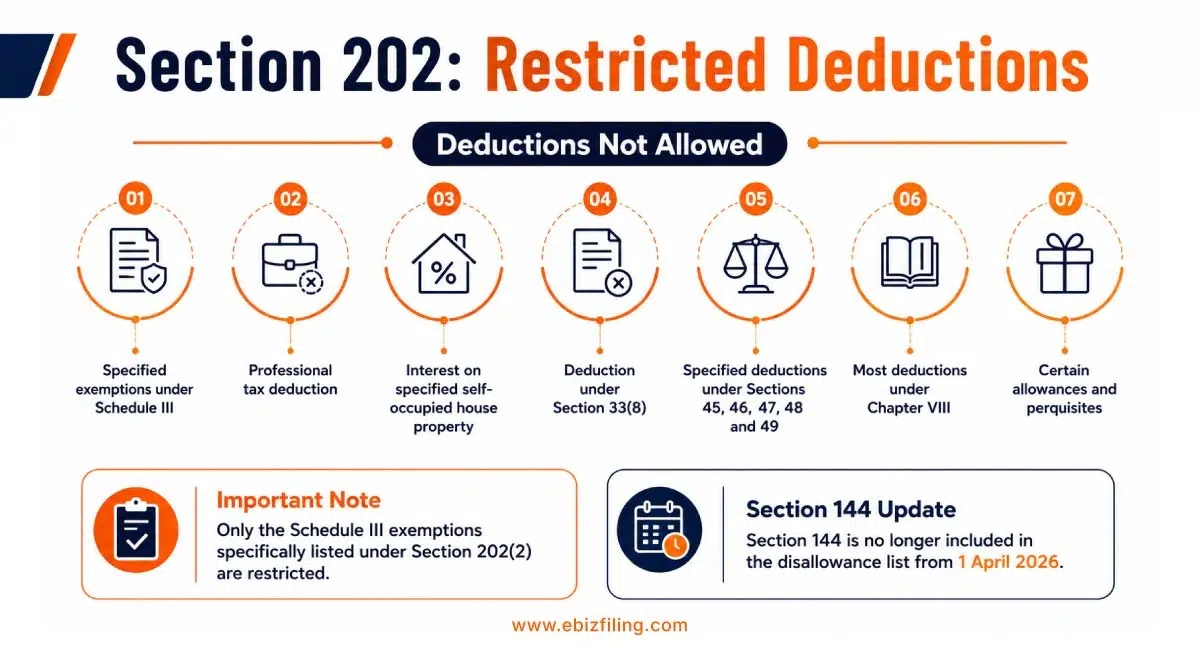
The restrictions include:
- Specified exemptions listed under Schedule III
- Professional tax deduction under Section 19(1), Table Sl. No. 1
- Interest deduction under Section 22(1)(b) for a self-occupied house property referred to in Section 21(6)
- Deduction under Section 33(8)
- Specified deductions under Section 45(3)(a), (b) and (c), Section 46, Section 47(1)(a), Section 48 and Section 49
- Most deductions under Chapter VIII
- Exemptions or deductions for allowances or perquisites provided under another law
Section 202 of the Income Tax Act does not restrict every exemption under Schedule III. Only the entries specifically mentioned under Section 202(2) are disallowed.
Section 144 is also no longer included in the disallowance list. It was omitted from Section 202(2) by the Finance Act, 2026 with effect from 1 April 2026. A deduction under Section 144 may therefore be considered subject to the conditions prescribed under that section.
Deductions Available Under Section 202
Although the new tax regime restricts several deductions, the following important benefits continue to be available, subject to their respective conditions.
1. Standard Deduction
An eligible salaried taxpayer may claim a standard deduction of ₹75,000 or the amount of salary, whichever is lower.
The restriction under Section 202 applies only to professional tax under Section 19(1), Table Sl. No. 1. It does not remove the standard deduction provided under Table Sl. No. 2.
Salaried individuals should also identify the correct return applicable to their income sources. Read more about ITR-1 Form Filing and its eligibility conditions.
2. Employer’s Contribution to NPS
A deduction is available under Section 124(1), read with Section 124(2), for an eligible contribution made by an employer to the employee’s account under a pension scheme notified by the Central Government. Where income is taxed under Section 202, the deduction may be claimed up to 14% of salary, subject to the applicable conditions.
3. Central Government Contribution to Agniveer Corpus Fund
A deduction remains available under Section 125(2) for the amount contributed by the Central Government to the eligible taxpayer’s Agniveer Corpus Fund account.
The Agniveer’s own contribution under Section 125(1) is not included in the deductions specifically permitted under Section 202.
4. Deduction for Additional Employee Cost
An eligible business taxpayer may claim a deduction under Section 146 for additional employee cost, subject to the conditions prescribed under that section.
The deduction is generally calculated at 30% of the eligible additional employee cost and may be allowed for three consecutive tax years.
5. Deduction for an Eligible IFSC Unit
A person having an eligible Unit in an International Financial Services Centre may claim a deduction under Section 147 while being taxed under Section 202, subject to the conditions contained in Section 147.
Restriction on Set-off Losses
A taxpayer covered by Section 202 cannot set off:
- Carried-forward losses or depreciation attributable to deductions restricted under Section 202(2)(a)
- A loss under the head “Income from house property” against income under another head
Therefore, a house property loss cannot be adjusted against salary income, business income, capital gains or income from other sources under the new tax regime.
The treatment of losses must also be reported in the correct return. Taxpayers with business or professional income may refer to the ITR-3 Form Filing Guide for reporting requirements.
Treatment of Losses and Depreciation
The losses and depreciation covered by Section 202(2)(b) are treated as having been given full effect.
Consequently, the taxpayer cannot carry forward and claim the same loss or depreciation in a subsequent tax year. Taxpayers with substantial carried-forward losses or unabsorbed depreciation should carefully review this impact before continuing under the new tax regime.
How Ebizfiling Supports Your Tax Regime Selection
Selecting a suitable tax regime requires a comparison of taxable income, salary deductions, business income, house property loss, carried-forward depreciation, special-rate income, and available rebates.
Ebizfiling can assist with:
- New and old tax regime comparison
- Income Tax Return filing
- Tax liability calculation
- Deduction and exemption review
- Income tax notice assistance
Use Ebizfiling’s Online CA consultation Service to calculate your tax liability and file your return accurately.to compare tax regimes, review available deductions and understand your tax liability. You can also use Ebizfiling’s Income Tax Return Filing Service to file your return accurately.
Conclusion
Section 202 of the Income Tax Act 2025 provides the framework for the default new tax regime from Tax Year 2026–27 onwards. It prescribes progressive tax rates ranging from nil to 30% and applies to individuals, HUFs, AOPs, BOIs and certain artificial juridical persons. The regime provides lower slab rates and a rebate for eligible resident individuals but restricts several exemptions, deductions, and loss set-off benefits. The ₹75,000 standard deduction, eligible employer NPS contribution, Central Government contribution to the Agniveer Corpus Fund and certain other deductions continue to be available.
Suggested Reads:
Section 134 of the Income Tax Act
Section 80G deduction limits for individual
Section 137 of the Income Tax Act
Income Tax Rates Slab FY 2013-14
Section 80D of the Income Tax Act
Health Insurance Deduction Under Section 126
Frequently Asked Questions
1. Does Section 202 apply automatically to eligible taxpayers?
Yes. Section 202 of the Income Tax Act makes the new tax regime the default regime for eligible taxpayers. A taxpayer must exercise the prescribed option under Section 202(4) to move out of it.
2. Is the standard deduction available under Section 202?
Yes. An eligible salaried taxpayer or pensioner may claim a standard deduction of ₹75,000 or the amount of salary, whichever is lower.
3. Can a resident individual receive a rebate under Section 202?
A resident individual whose total income taxable under Section 202 of the Income Tax Act does not exceed ₹12 lakh may claim a rebate of up to ₹60,000 under Section 156, subject to the prescribed conditions.
4. How does Section 202 of the Income Tax Act affect rental income?
Rental income remains taxable under the head “Income from house property.” However, a house property loss cannot be set off against income under another head under Section 202.
5. Can carried-forward depreciation be claimed under Section 202?
Depreciation attributable to deductions restricted under Section 202 cannot be set off. The covered amount is treated as having been given full effect and cannot be claimed in a subsequent tax year.
6. Can business taxpayers change their tax regime every year?
No. Once a person having business or professional income opts out of the new tax regime, the option continues for subsequent tax years and may generally be withdrawn only once. Business taxpayers should also identify the applicable return and reporting requirements before selecting a regime. Read more about Business Income Tax Return filing.
7. Can salaried taxpayers select a different regime every year?
A taxpayer without business or professional income may exercise the option along with the return for the relevant tax year. Such taxpayers can compare the available regimes each year, subject to the applicable filing requirements.
8. Does the 30% rate apply to the taxpayer’s entire income?
No. Section 202 uses progressive slab rates. Only the portion of income exceeding ₹24 lakh is taxed at 30%.
9. Is professional tax deductible under Section 202?
The professional tax deduction under Section 19(1), Table Sl. No. 1 is not available under Section 202 of the Income Tax Act. However, eligible salaried taxpayers and pensioners may continue to claim the standard deduction under Table Sl. No. 2. Ebizfiling can help taxpayers review the deductions available under the new tax regime.
10. Can an IFSC Unit claim a deduction under Section 202?
An eligible Unit in an International Financial Services Centre may claim a deduction under Section 147, subject to the prescribed conditions. Ebizfiling can assist eligible IFSC Units with tax computation, return filing, and compliance under the Income Tax Act, 2025.




Expert Tax Consultancy Services
Get expert tax consultancy for tax planning, regime selection, and seamless income tax compliance.
About Ebizfiling -



September 22, 2026 By Srishti M
Maharashtra Professional Tax Notice: Filing & Compliance Guide Introduction Receiving a Maharashtra Professional Tax Notice can create confusion for businesses, especially when the notice mentions pending PTRC returns, delayed filings, professional tax dues, late fees, or interest implications. Businesses often […]
September 21, 2026 By Srishti M
Raw Sugar Import Under TRQ: DGFT Eases Processing & Sale Deadline Introduction India has introduced an important change to the raw sugar import framework under the Tariff Rate Quota (TRQ) scheme. On 20 August 2026, the Directorate General of Foreign […]
September 21, 2026 By Srishti M
UPI MDR Charges 2026: 0.4% MDR on Payments Above ₹2,000 Introduction UPI MDR Charges 2026 introduce an important change for selected merchant payments made through the Unified Payments Interface. From 15 October 2026, a Merchant Discount Rate (MDR) of 0.4% […]