


-
September 26, 2026
-
BySiddhi R
PF and ESIC: Difference, Eligibility and Contribution Rates
Introduction
PF and ESIC are two important social security mechanisms for employees in India, but they serve different purposes. Provident Fund mainly supports long-term retirement savings, while the ESI scheme administered by ESIC provides medical and cash benefits to eligible employees.
With key provisions of the Code on Social Security, 2020 coming into force from 21 November 2025, employers should understand the current applicability, wage ceilings, and contribution requirements. This blog explains the difference between PF and ESIC, their eligibility, benefits and compliance requirements.
Summary
- PF mainly supports retirement savings, while ESIC provides medical and social security benefits.
- The PF chapter generally applies to establishments employing 20 or more employees.
- The ESI provisions generally apply to establishments employing 10 or more persons, subject to applicable coverage provisions.
- The notified PF wage ceiling is ₹15,000 per month, while the current ESI wage ceiling is ₹21,000 per month.
- Both PF and ESIC may apply to the same employee where the respective eligibility conditions are satisfied.
What is Provident Fund or PF?
Provident Fund, commonly known as PF or EPF, is a social security mechanism administered by the Employees’ Provident Fund Organisation (EPFO). It helps eligible employees build savings that can be used at retirement or withdrawn in permitted circumstances.
Under the Code on Social Security, 2020, the Employees’ Provident Fund provisions generally apply to establishments employing 20 or more employees. The Central Government has notified ₹15,000 per month as the wage ceiling for Chapter III relating to Employees’ Provident Fund.
The standard PF contribution is generally:
- Employee contribution: 12% of applicable wages
- Employer contribution: 12% of applicable wages, subject to allocation under the applicable provident fund, pension, and insurance provisions
Employees earning above the notified wage ceiling are not automatically outside PF in every situation. Existing membership and contribution on higher wages can be governed by the applicable scheme provisions. Therefore, it is incorrect to say that PF is mandatory simply because an employee earns more than ₹15,000.
Employers covered under PF are also required to file the monthly Electronic Challan-cum-Return (ECR) and deposit applicable contributions. Employers who are newly covered under PF can also get assistance with EPF registration before starting monthly contribution and return filing.
What is Employees’ State Insurance or ESIC?
Employees’ State Insurance, commonly known as ESI, is a social security scheme administered by the Employees’ State Insurance Corporation (ESIC). It provides eligible employees and their dependents with medical and specified cash benefits.
The benefits may include:
- Medical treatment
- Sickness benefit
- Maternity benefit
- Disablement benefit
- Dependents’ benefit
- Other benefits available under the applicable ESI provisions
The ESI provisions generally cover establishments employing 10 or more persons, subject to the applicable coverage and notified requirements. Employees earning wages up to ₹21,000 per month are generally eligible for coverage. For persons with disabilities, the wage ceiling is ₹25,000 per month.
The standard contribution rates applicable under ESI are generally:
- Employee contribution: 0.75% of wages
- Employer contribution: 3.25% of wages
Therefore, ESIC is not an employer-only contribution. Both the employee and employer contribute to the scheme.
What are the Eligibility Conditions for PF and ESIC?
The applicability of PF and ESIC should first be checked at the establishment level and then at the employee level.
For PF:
- Chapter III generally applies to establishments with 20 or more employees.
- ₹15,000 per month is the notified wage ceiling for the EPF provisions.
- Higher-wage employees may be covered depending on existing membership and applicable scheme provisions.
For ESIC:
- Chapter IV generally applies to establishments with 10 or more persons.
- The normal employee wage ceiling is ₹21,000 per month.
- The wage ceiling is ₹25,000 per month for persons with disabilities.
- Actual coverage is also subject to applicable ESI provisions and notified implementation.
For newly incorporated businesses, understanding PF and ESIC compliance for newly incorporated companies can help determine when registration and contribution requirements may begin.
What is the Difference Between PF and ESIC?
The main difference between PF and ESIC is their purpose. PF is primarily a long-term savings and retirement benefit mechanism, whereas ESIC provides insurance-based medical and cash benefits.
|
Basis |
Provident Fund (PF) |
ESIC |
|
Main purpose |
Retirement and long-term savings | Medical and social security benefits |
| Administered by | EPFO |
ESIC |
|
Establishment threshold |
Generally, 20 or more employees | Generally, 10 or more persons |
| Wage ceiling | ₹15,000 per month notified for EPF provisions |
₹21,000 per month |
|
PwD wage ceiling |
Applicable PF rules | ₹25,000 per month |
| Employee contribution | Generally 12% |
0.75% |
|
Employer contribution |
Generally, 12%, subject to applicable allocation | 3.25% |
| Nature of benefit | Accumulated fund, pension and related benefits |
Medical and specified cash benefits |
|
Interest |
PF balance earns the notified rate of interest | No individual interest-bearing fund |
| Withdrawal | Permitted as per applicable PF rules |
No withdrawal of an accumulated ESIC balance |
|
Compliance |
Monthly contribution and ECR |
Monthly employee-wise contribution |
ESIC should not be compared with PF on the basis of an “interest rate”. ESIC is an insurance-based social security system and does not create an individual savings balance on which employees earn interest.
Can an Employee Be Covered Under Both PF and ESIC?
Yes. PF and ESIC serve different purposes, so an employee may be covered under both schemes when the establishment and employee satisfy the respective conditions.
For example, an employee working in a covered establishment and earning ₹20,000 per month may fall within the ESI wage ceiling. PF coverage would separately depend on the employee’s PF membership status and the applicable provident fund provisions.
New companies that are unsure about ESI filing obligations can read our guide on ESIC nil return for new companies.
How are PF and ESIC Contributions Calculated?
Consider a simple hypothetical example.
For employees contributing on actual wages or higher wages as permitted under applicable provisions, the calculation may differ:
- Employee PF contribution at 12% = ₹1,800
- Employer contribution at 12% = ₹1,800, subject to the prescribed allocation under the applicable scheme
If ESI wages are ₹20,000 per month:
- Employee ESIC contribution at 0.75% = ₹150
- Employer ESIC contribution at 3.25% = ₹650
- Total ESI contribution = ₹800
The actual contribution should always be calculated using the applicable statutory definition of wages and relevant scheme provisions.
What are the PF and ESIC Compliance Requirements?
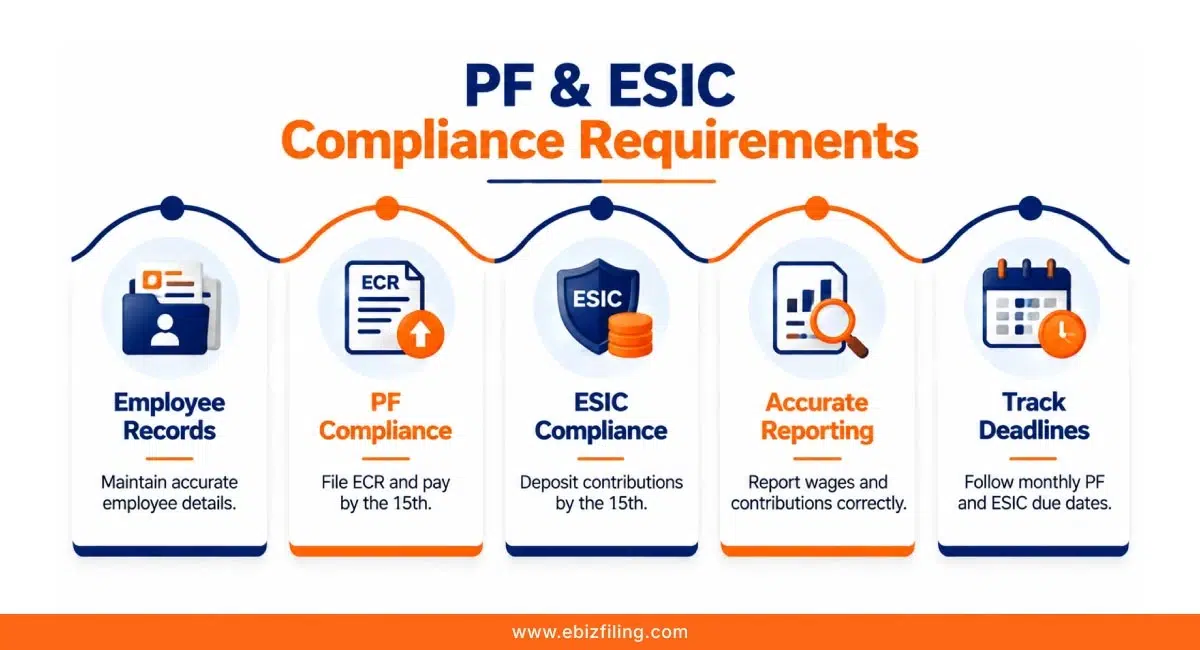
For PF, employers generally file a monthly ECR and deposit the contribution by the 15th of the following month. EPFO’s employer guidance specifies monthly ECR filing and contribution payment by the 15th.
ESI contributions are also deposited monthly, generally by the 15th day after the end of the relevant month. Employers should ensure that employee wage details and contributions are correctly reported through the ESIC system.
Employers should also track monthly due dates through a PF and ESI compliance calendar to avoid delays in contribution payment and return filing.
Ebizfiling Assistance for PF and ESIC Requirements
Ebizfiling can assist businesses with employee social security compliance, including:
- Understanding PF and ESIC applicability
- Assistance with PF Return filing
- Assistance with ESIC Registration
- Guidance on employee and employer contribution requirements
- Support with applicable PF and ESIC compliance documentation
For PF and ESIC registration or compliance assistance, connect with EbizFiling to understand the applicable requirements and complete the process as per the rules of the concerned authority.
Conclusion
Understanding PF and ESIC helps employers calculate employee contributions correctly and follow applicable social security requirements. PF mainly focuses on long-term retirement benefits, while ESIC provides medical and other insured benefits. Employers should check both establishment coverage and employee eligibility instead of relying only on the employee’s monthly salary.
Frequently Asked Questions
1. Can PF and ESIC apply to the same employee?
Yes. An employee can be covered under both PF and ESIC when the eligibility conditions of both schemes are satisfied. The two schemes provide different types of social security benefits.
2. Is PF mandatory for every employee earning more than ₹15,000?
No. This is a common misconception. ₹15,000 is the notified PF wage ceiling, and PF coverage also depends on establishment coverage, existing membership and the applicable scheme provisions.
3. What is the current ESIC salary limit?
The current ESI wage ceiling is ₹21,000 per month. For persons with disabilities, the applicable ceiling is ₹25,000 per month.
4. Does an employee contribute towards ESIC?
Yes. The employee contribution is currently 0.75% of wages, while the employer contributes 3.25%.
5. Is ESIC an investment or savings account like PF?
No. PF accumulates contributions as a long-term social security fund. ESIC is an insurance-based scheme that provides medical and specified cash benefits rather than an individual interest-bearing balance.
6. What is the standard employee PF contribution rate?
The standard employee PF contribution is generally 12% of applicable wages. The employer also makes the prescribed contribution, subject to the allocation required under the applicable provident fund provisions.
7. When should PF contributions be deposited?
Employers generally deposit monthly PF contributions and file the ECR by the 15th of the following month.
8. Does PF applicability depend only on an employee's salary?
No. Establishment coverage is an important factor. The PF chapter generally applies to establishments employing 20 or more employees, while employee-level membership is governed by the applicable PF provisions.
9. Can employees earning above ₹15,000 contribute to PF?
Yes, depending on their existing PF membership and applicable provisions. Higher-wage contribution arrangements may also require compliance with the prescribed conditions.
10. Can Ebizfiling assist with PF and ESIC compliance?
Yes. Ebizfiling can assist employers with PF return filing, ESIC registration, applicability review and related compliance documentation. Final registration and statutory acceptance remain with the respective government authorities.





Apply ESI Registration
Extend medical benefits to your employees. Register for ESIC.
About Ebizfiling -



Reviews
arti ittannavr
18 Apr 2022Took trademark registration from Ebizfiling india private limited service was excellent thank you 😊
HARIHARAN JEYARAMAN
17 Aug 2017Begining day one the focus was on how to help the customer i.e me. Be it the way the process is explained or timely updates on the process or how to be on time in ensuring the documentation is done, the team was very professional. I would definitely recommend this team and definitely use their service again and again.
Hemanshu Mahajan
01 Apr 2018I registered my LLP company, from eBizfilling. Great team and very competitive pricing. Will definitely use their services again.Thanks for work well done.
October 26, 2026 By Srishti M
October 21, 2026 By Srishti M
Tax Planning for NRI Returning to India Before Becoming ROR Introduction Tax planning for NRI returning to India should start before the person becomes Resident and Ordinarily Resident, also known as ROR. Under the Income-tax Act, 2025, residential status decides […]
October 19, 2026 By Srishti M