


-
July 25, 2026
-
BySteffy A
Section 393(2) of the Income Tax Act 2025: Complete TDS Guide
Introduction
Section 393(2) of the Income Tax Act 2025 provides the rules for deducting tax at source from specified income and sums paid or credited to non-residents, foreign companies and other specified non-resident payees. The applicable TDS rate depends on the nature of income, category of payee and person responsible for making the payment.
The provision covers specified interest income, business trust distributions, investment fund income, securitisation trust income, mutual fund income, offshore fund income, securities income and payments to non-resident sportspersons, entertainers and sports associations.
What is Section 393(2) of the Income Tax Act 2025?
Section 393(2) of the Income Tax Act 2025 requires the person responsible for paying specified income or sums to a non-resident to deduct income tax at source.
The provision applies where:
- The payment falls within the nature of income listed in the table;
- The recipient is a non-resident, foreign company, offshore fund, foreign institutional investor, specified fund, or another prescribed non-resident payee;
- The payment is made by the person specified in the relevant entry; and
- The tax is deducted at the rate prescribed for that payment.
A payment does not become subject to TDS merely because it is made or credited to a non-resident. The payment must fall within one of the specified entries under Section 393(2). In particular, serial number 17 applies only to other interest or any other sum, excluding salary, that is chargeable to tax in India. Therefore, where a payment is not chargeable to tax in India, TDS is not required under serial number 17.
When is TDS Deducted under Section 393(2)?
Tax must generally be deducted at the earlier of the following:
- At the time the income or sum is credited to the account of the payee; or
- At the time, the payment is made through cash, cheque, draft, or any other mode.
Therefore, the payer cannot postpone the TDS deduction until the amount is actually transferred if the income has already been credited to the non-resident’s account.
An exception applies to certain interest payments covered under serial number 17. Where the interest is payable by the Government, a public sector bank, or a specified public financial institution, TDS is deducted only at the time of actual payment.
Payments and TDS Rates under Section 393(2)
The following payments to non-residents are covered under Section 393(2) of the Income Tax Act 2025:
TDS on Payments to Non-Resident Sportspersons and Entertainers
Under Section 393(2) of the Income Tax Act 2025, income referred to in Section 211 and paid to a non-resident sportsperson, athlete, or entertainer who is not an Indian citizen is subject to TDS at 20%.
The same rate also applies where the payment is made to a non-resident sports association or institution.
The obligation to deduct tax is placed on any person making the covered payment.
TDS on Interest from Foreign Borrowings and Bonds
Section 393(2) of the Income Tax Act 2025 prescribes concessional TDS rates for certain interest payments made to non-residents and foreign companies.
A 5% TDS rate applies to interest on specified foreign currency borrowings, long-term infrastructure bonds, long-term bonds, and rupee-denominated bonds issued within the prescribed periods.
For certain bonds listed only on a recognised stock exchange located in an International Financial Services Centre, the applicable rates are:
- 4% where the bonds were issued on or after 1 April 2020 but before 1 July 2023
- 9% where the bonds were issued on or after 1 July 2023
These rates apply subject to the conditions specified in the relevant entries and Note 1.
Interest Paid by an Infrastructure Debt Fund
Interest paid by an eligible infrastructure debt fund to a non-resident or foreign company is subject to TDS at 5% under Section 393(2) of the Income Tax Act 2025.
The infrastructure debt fund must be covered under Schedule VII, Table serial number 46.
Income Distributed by a Business Trust
A business trust distributing specified income under Section 223 to a non-resident unit holder or foreign company must deduct TDS.
Depending on the nature of distributed income under Schedule V, the applicable rate may be:
- 5%
- 10%
- Rates in force
The payer must identify the nature of the distribution before applying the TDS rate.
Income from Investment Funds and Securitisation Trusts
An investment fund specified under Section 224 must deduct TDS on taxable income paid to a non-resident unit holder or foreign company.
The proportion of income exempt under Schedule V is excluded. TDS on the remaining income is deducted at the rates in force.
Similarly, a securitisation trust specified under Section 221 must deduct tax at the rates in force when paying income to a non-resident investor or foreign company.
TDS on Mutual Fund Income
Income from specified mutual fund units or units of a specified company paid to a non-resident or foreign company is covered under Section 393(2) of the Income Tax Act 2025.
According to Note 2, TDS must generally be deducted at 20%. However, a lower rate under an applicable tax treaty referred to in Section 159(1) or Section 159(2) may apply where the treaty provides a more beneficial rate.
To claim the lower treaty rate, the non-resident should furnish a valid Tax Residency Certificate and the prescribed information through Form 41, where applicable. The payer should verify these documents before applying the treaty rate.
TDS on Offshore Fund Income
Payments made to an offshore fund in respect of units referred to in Section 208 are subject to TDS at 10%.
Where the offshore fund earns long-term capital gains from the transfer of those units, TDS is deducted at 12.5%.
The payer must distinguish between regular income from the units and long-term capital gains from their transfer.
The tax treatment may also depend on whether the receipt is regular investment income or a capital gain. Read more about capital gains taxation for non-residents.
TDS on Bonds and Global Depository Receipts
Interest or dividend income paid to a non-resident in respect of bonds or Global Depository Receipts referred to in Section 209 is subject to TDS at 10%.
Long-term capital gains arising from the transfer of such bonds or Global Depository Receipts are subject to TDS at 12.5%.
TDS on Securities Income of FIIs and Specified Funds
Income from securities referred to in Section 210(1) and paid to a Foreign Institutional Investor is generally subject to TDS at 20%.
However, a lower treaty rate may apply where the applicable agreement under Section 159 provides a more beneficial rate and the payee furnishes a valid Tax Residency Certificate and the prescribed information and documents, including Form 41, where applicable.
Where the recipient is a specified fund referred to in Schedule VI, the applicable TDS rate is 10%.
To reference the complete table of payments and TDS rates under Section 393(2), please refer the PDF.
Important Notes under Section 393(2)
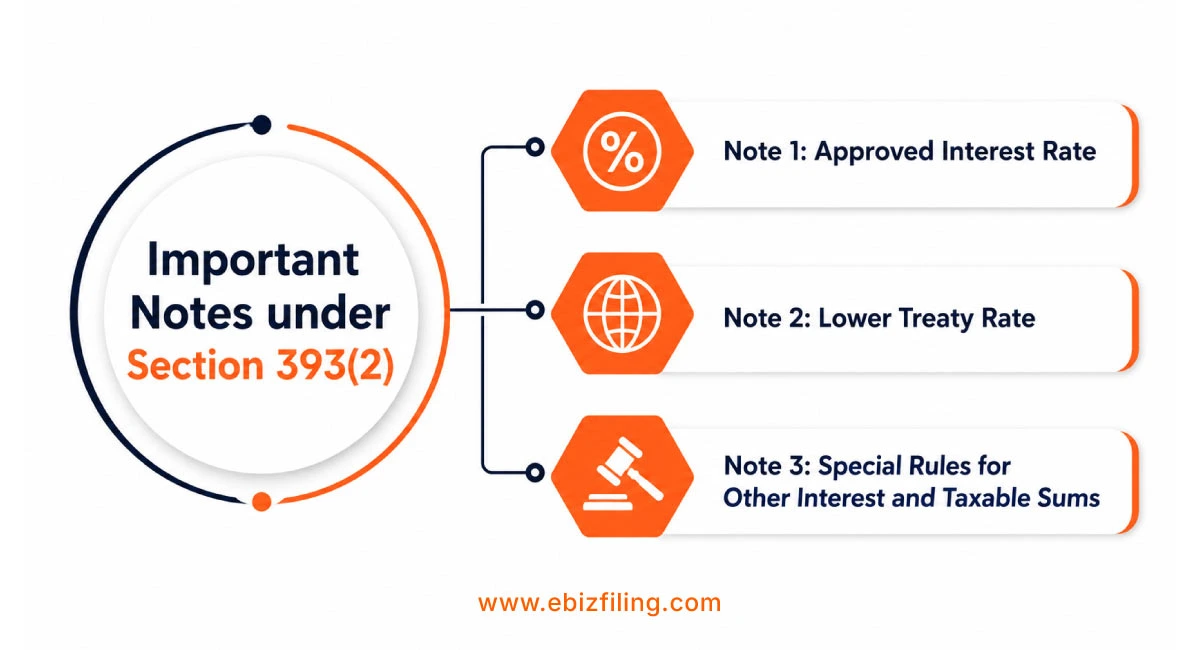
Note 1: Approved Interest Rate
For payments covered under serial numbers 2, 3, and 4, the concessional treatment applies only to the extent the interest does not exceed the amount calculated at the rate approved by the Central Government.
The approval may consider the terms of the loan or bond and its repayment conditions.
Note 2: Lower Treaty Rate
For mutual fund income under serial number 10 and FII securities income under serial number 15, the applicable TDS rate is 20%.
However, a lower treaty rate may apply where the relevant agreement under Section 159 provides a more beneficial rate and the payee furnishes a valid Tax Residency Certificate and the prescribed information and documents, including Form 41 where applicable.
Note 3: Special Rules for Other Interest and Taxable Sums
Where interest under serial number 17 is payable by the Government, a public sector bank, or a specified public financial institution, tax is deducted only when the payment is actually made.
The TDS obligation under this entry applies to both resident and non-resident payers, regardless of whether the non-resident has any physical or business presence in India.
Lower or Nil Deduction under Section 395
Where eligible, the payee may apply to the Assessing Officer for a certificate authorising deduction at a lower rate or without deduction under Section 395(1). In cases involving a payment covered by serial number 17, the payer may also apply under the applicable provisions of Section 395 for determination of the appropriate proportion of the sum chargeable to tax in India. The payer should apply a reduced or nil rate only after receiving and verifying a valid certificate or order and should follow its conditions, rate and validity period.
TDS Return Filing with Ebizfiling
Section 393(2) creates the TDS deduction obligation for specified payments. Form 144 is the prescribed quarterly statement for reporting non-salary payments to non-residents or foreign companies. It should include payment, rate, tax, challan, and payee details.
Ebizfiling Can Assist With:
- Identifying the applicable TDS rate
- Reviewing the nature and taxability of the payment
- Verifying challan and payment details
- Preparing and filing Form 144
- Correcting the TDS statement, where required
Get professional assistance with TDS return filing for payments made to non-residents and foreign companies through Ebizfiling.
Deductors should also monitor the applicable TDS return due dates for each quarter.
Conclusion
Section 393(2) of the Income Tax Act 2025 creates a detailed TDS framework for payments made to non-residents and foreign companies. The applicable rate depends on the nature of income, the category of the payee, the payer, and any applicable treaty benefit. Before making a payment, the payer should identify the correct entry, determine whether tax is deductible at a fixed rate or at the rates in force, and verify whether a lower treaty rate is available. Correct classification and timely deduction can help the payer comply with the non-resident TDS provisions.
Frequently Asked Questions
1. When must tax be deducted under Section 393(2) of the Income Tax Act 2025?
Under Section 393(2) of the Income Tax Act 2025, tax must generally be deducted when the income is credited to the non-resident’s account or when payment is made through cash, cheque, draft, or another mode, whichever occurs earlier. TDS cannot be postponed merely because the payment has not yet been transferred.
2. What are the Section 393(2) TDS rates for IFSC-listed bonds?
Section 393(2) of the Income Tax Act 2025 prescribes TDS at 4% on eligible long-term or rupee-denominated bonds issued from 1 April 2020 to 30 June 2023. For eligible bonds issued on or after 1 July 2023, the applicable TDS rate is 9%, subject to the prescribed conditions.
3. Is the 5% TDS rate available for every foreign borrowing?
No. The 5% rate under Section 393(2) of the Income Tax Act 2025 applies only to specified foreign currency borrowings, infrastructure bonds, long-term bonds, rupee-denominated bonds, and eligible infrastructure debt fund payments covered by the relevant entries. Other interest payments may be taxable at the rates in force.
4. How is TDS calculated on income distributed by a business trust to a non-resident?
A business trust may deduct TDS at 5%, 10%, or the rates in force, depending on the nature of income distributed under Section 223 and the relevant entry in Schedule V. The business trust must classify the income correctly before applying the TDS rate.
5. Is the exempt portion of investment fund income subject to TDS?
No. For income from units of an investment fund specified under Section 224, the portion exempt under Schedule V is excluded. TDS under Section 393(2) of the Income Tax Act 2025 applies only to the remaining taxable income paid to the non-resident unit holder.
6. Can a lower treaty rate apply to mutual fund income received by a non-resident?
Yes. The normal TDS rate for specified mutual fund income is 20%. However, a lower rate under an applicable tax treaty may apply where the treaty provides a more beneficial rate and the non-resident furnishes a valid Tax Residency Certificate and prescribed information and documents, including Form 41 where applicable.
7. What is the TDS rate on offshore fund income and long-term capital gains?
Under Section 393(2) of the Income Tax Act 2025, income received by an offshore fund from units referred to in Section 208 is subject to TDS at 10%. Long-term capital gains arising from the transfer of such units are subject to TDS at 12.5%.
8. Does Section 393(2) apply to a non-resident payer having no presence in India?
Yes. For payments covered by Table Serial Number 17, Section 393(2) of the Income Tax Act 2025 may apply to both resident and non-resident payers. The obligation can apply even where the non-resident payer has no residence, place of business, business connection, or other presence in India.
9. How can Ebizfiling assist with TDS on payments to non-residents?
Ebizfiling can assist with identifying the applicable rate under Section 393(2) of the Income Tax Act 2025, reviewing the nature of payment, verifying challan details, preparing Form 144, and correcting TDS filing errors where required.
10. Can Ebizfiling help file the TDS return for foreign company payments?
Yes. Ebizfiling can assist businesses with TDS return filing for payments made to non-residents and foreign companies. The service may include document review, payment classification, TDS rate verification, return preparation, filing, and acknowledgement support.





Expert Tax Consultancy Services
Get expert tax consultancy for TCS compliance, reporting, and seamless tax management for your business.
About Ebizfiling -



October 15, 2026 By Srishti M
TDS and TCS Compliance Calendar November 2026: Compliance Guide Introduction The TDS and TCS Compliance Calendar November 2026 covers important tax deduction, collection, payment, certificate and reporting requirements applicable during the month. It helps businesses, government offices and other responsible […]
October 14, 2026 By Srishti M
GST Compliance Calendar November 2026: Key Due Dates & Filings Introduction The GST Compliance Calendar November 2026 highlights the major GST return filing, tax payment, invoice reporting and year-end adjustment deadlines applicable during the month. It covers regular taxpayers, QRMP […]
October 13, 2026 By Srishti M