


-
October 14, 2026
GST Compliance Calendar November 2026: Key Due Dates & Filings
Introduction
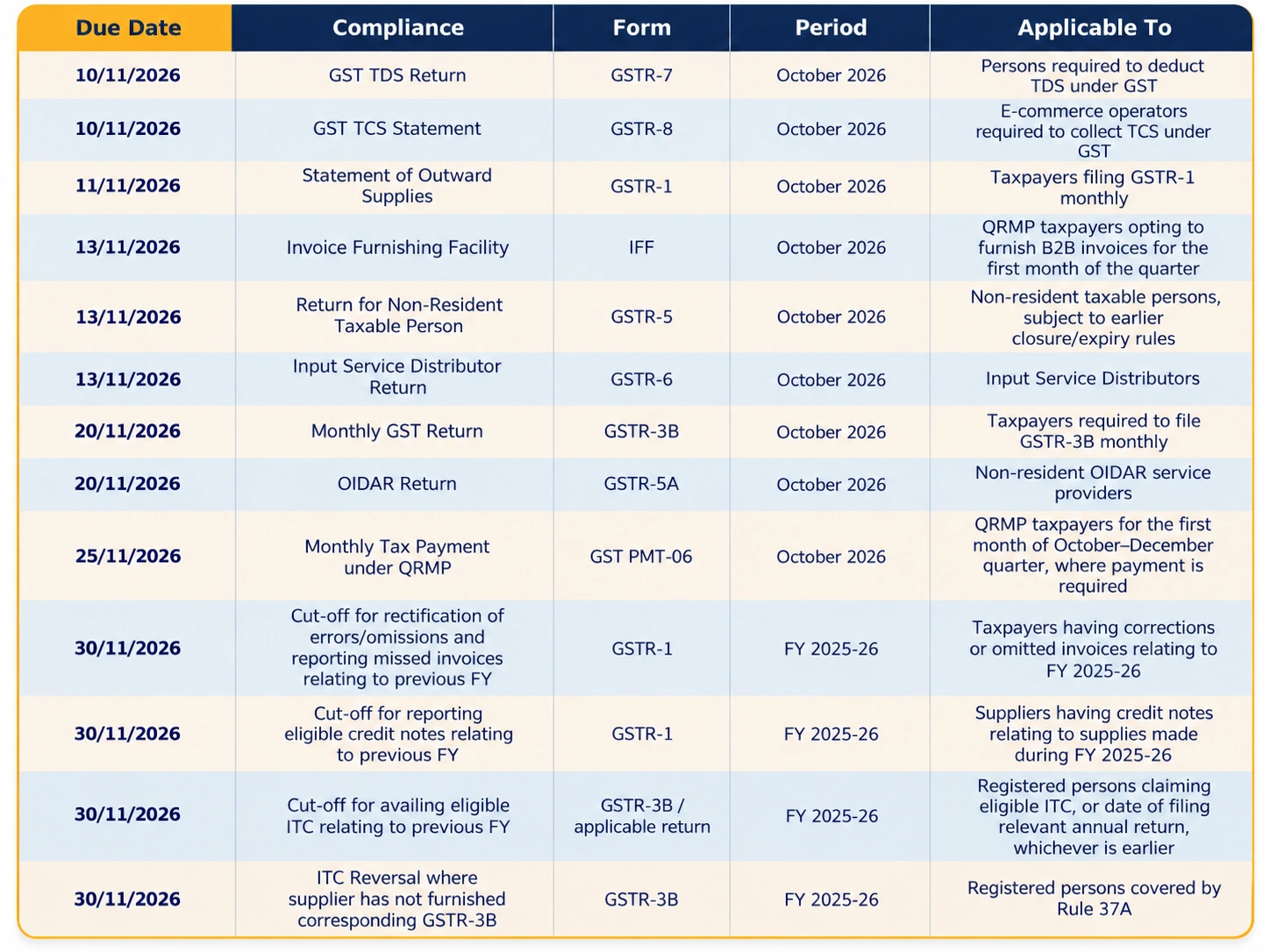
The GST Compliance Calendar November 2026 highlights the major GST return filing, tax payment, invoice reporting and year-end adjustment deadlines applicable during the month. It covers regular taxpayers, QRMP taxpayers, e-commerce operators, Input Service Distributors, non-resident taxable persons, OIDAR service providers and notified GST TDS/TCS entities.
November is also important for businesses reviewing previous-year GST records, since certain ITC claims, invoice corrections and credit note-related actions may need to be completed within the prescribed statutory timeline. Tracking the GST Compliance Calendar November 2026 in advance can help reduce filing errors, interest, late fees and avoidable reconciliation issues.
Quick Insights
- GSTR-7 and GSTR-8 cover separate GST TDS and TCS reporting requirements for the previous month.
- Monthly taxpayers need to track GSTR-1 and GSTR-3B separately, while QRMP taxpayers may use IFF for eligible B2B invoices.
- GSTR-5, GSTR-6 and IFF apply to different taxpayer categories even though they follow a similar mid-month filing cycle.
- QRMP taxpayers should separately monitor monthly tax payment through GST PMT-06 in addition to their quarterly return obligations.
- November also brings important previous-financial-year GST cut-offs relating to ITC, invoice corrections, credit notes and Rule 37A reversal requirements.
Important Due Dates in GST Compliance Calendar November 2026
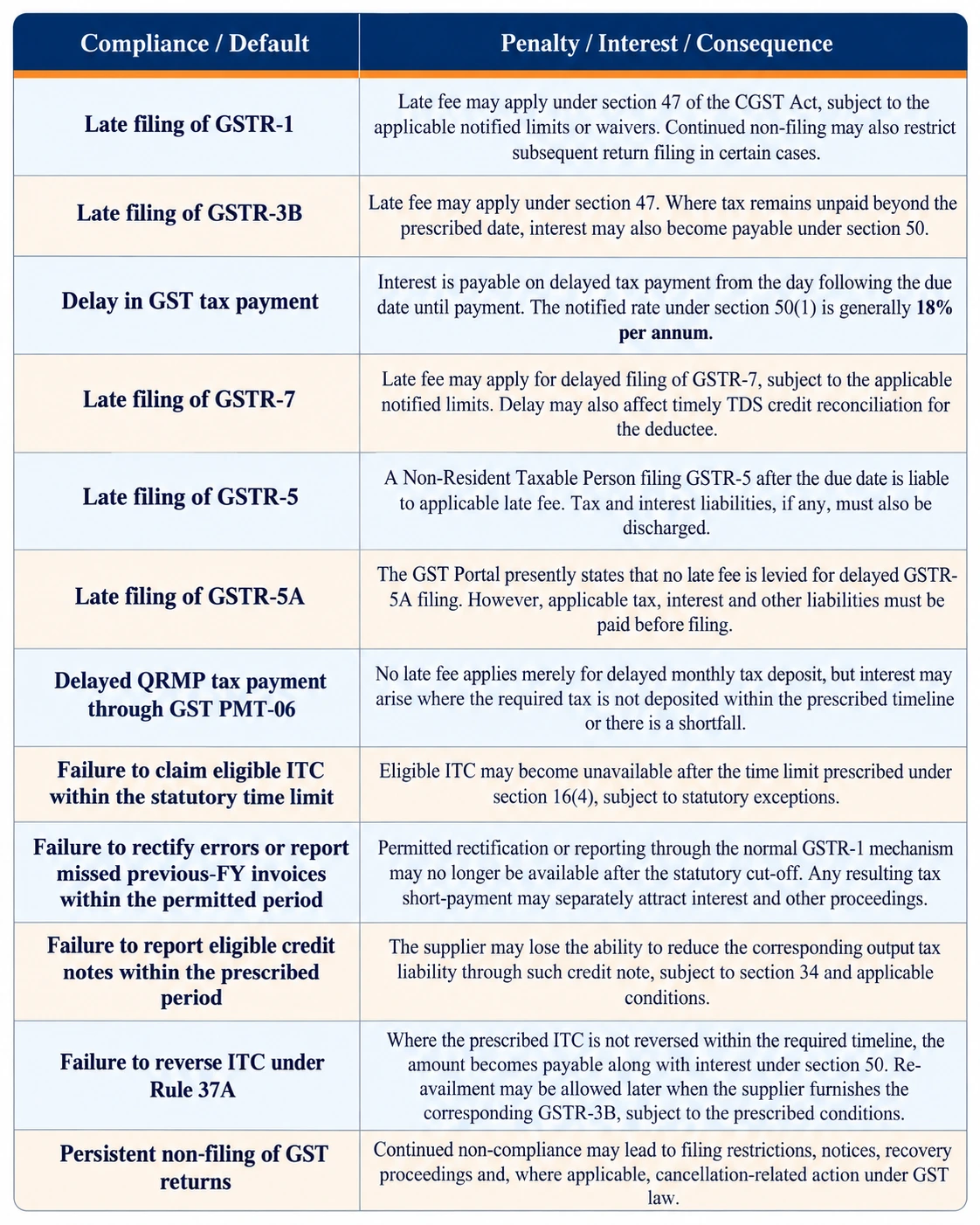
Penalty, Interest and Consequences of Non-compliance
Stay Ahead of Your November GST Compliance with Ebizfiling
November GST compliance brings together regular return filing, tax payment, invoice reporting, ITC review and year-end correction requirements. Since different taxpayers may follow monthly, QRMP, TDS/TCS, ISD or non-resident filing cycles, one missed requirement can create reconciliation issues or delay the availability of tax credits.
Ebizfiling supports businesses with GST Return Filing, GST Registration, GST Refund Assistance, LUT Filing, GST Modification, GST Reconciliation and GST Advisory. Our team helps review the applicable return cycle, reconcile transaction data and manage the required GST filings based on the taxpayer’s registration and compliance profile.
Use the GST Compliance Calendar November 2026 to organise your filings and complete applicable GST requirements with professional support from Ebizfiling.
Conclusion
The GST Compliance Calendar November 2026 covers regular monthly returns as well as important GST requirements relating to QRMP payments, non-resident taxpayers, ISDs, e-commerce operators, GST TDS/TCS and previous-year ITC or invoice corrections.
Businesses should reconcile outward supplies, purchase records, GSTR-2B, tax liability and earlier-period reporting before completing the applicable filings. A proper review can help identify missing invoices, ITC mismatches, reporting errors and other issues before they lead to avoidable interest, late fees or loss of eligible credit.
For a complete view of statutory obligations during the month, refer to our Compliance Calendar November 2026, covering GST, Income Tax, TDS and TCS, PF and ESI, LLP, OPC and Company compliance.
Suggested Reads:
Compliance Calendar FY 2026-27
TDS and TCS Compliance Calendar November 2026
Frequently Asked Questions
1. What should a business do if purchase invoices are missing from GSTR-2B?
A business should reconcile its purchase register with GSTR-2B and identify suppliers whose invoices are missing or incorrectly reported. ITC should be claimed only after checking invoice details, supplier reporting status and the eligibility conditions prescribed under GST law.
2. Can ITC be claimed if the supplier has uploaded the invoice but has not filed the corresponding GSTR-3B?
The appearance of an invoice in GSTR-2B does not independently establish final ITC eligibility. The recipient must satisfy the applicable conditions under Section 16. Under Rule 37A, where the supplier fails to furnish the corresponding GSTR-3B by 30 September following the financial year in which ITC was availed, the recipient must reverse the applicable ITC by 30 November. Re-availment is permitted when the supplier subsequently furnishes the corresponding return, subject to the prescribed conditions.
3. What should a taxpayer do if sales in the books do not match GSTR-1?
The taxpayer should perform an invoice-level reconciliation between the sales register and GSTR-1. Missing invoices, incorrect GSTINs, wrong taxable values, debit notes, credit notes and amendments should be identified and corrected through the permitted GST return mechanism within the applicable statutory time limit.
4. Can an invoice be corrected after GSTR-1 has already been filed?
Yes. Eligible invoice details can be corrected or added through GSTR-1A after filing GSTR-1 but before filing GSTR-3B for the same tax period. Corrections relating to earlier tax periods may be reported through a subsequent GSTR-1, subject to applicable statutory time limits and conditions.
5. What should be done if GSTR-1 shows higher tax liability than GSTR-3B?
The taxpayer should reconcile the difference immediately. If GSTR-1 correctly reflects the taxable supplies but GSTR-3B shows lower liability, the unpaid tax may need to be discharged along with applicable interest. Any genuine reporting error should be corrected through the appropriate GST mechanism.
6. What happens if ITC is claimed but the supplier later issues a credit note or amends the invoice?
The recipient should reassess the ITC based on the revised invoice or credit note. If the amendment reduces the eligible credit, the corresponding ITC may need to be reversed in GSTR-3B. The books, GSTR-2B and supplier-reported data should be reconciled before making the adjustment.
7. Is IFF mandatory for taxpayers under the QRMP scheme?
No. The Invoice Furnishing Facility is optional for QRMP taxpayers. It can be used to report eligible B2B invoices for the first two months of a quarter so that the invoices can reflect earlier for recipients instead of waiting for the quarterly GSTR-1.
8. How should a business respond to a GST notice caused by return mismatches?
The business should first identify the exact mismatch, reconcile GSTR-1, GSTR-3B, GSTR-2B and accounting records, and collect supporting invoices, challans and payment records. The reply should address each discrepancy specifically and be submitted within the prescribed response period.
9. Can Ebizfiling help resolve GSTR-1, GSTR-3B and GSTR-2B mismatches?
Yes. Ebizfiling can assist with GST reconciliation, identify invoice and tax differences, review ITC eligibility, check return-level mismatches and support the corrective action required for GSTR-1, GSTR-3B and GSTR-2B discrepancies.
10. How can Ebizfiling help businesses manage ongoing GST compliance?
Ebizfiling can support businesses with GST return filing, tax payment coordination, ITC review, invoice reconciliation, amendments, LUT filing, GST modification and responses to GST notices. The support can be aligned with the taxpayer’s registration type, filing frequency and applicable compliance requirements.





Simplify Your GST Return Filing
Get expert assistance with GST Return Filing to meet November 2026 due dates, submit accurate returns, and manage your business’s ongoing GST compliance requirements.
About Ebizfiling -



October 13, 2026 By Srishti M
October 12, 2026 By Srishti M
October 12, 2026 By Srishti M
Company Compliance Calendar November 2026: Key Due Dates & Filings Introduction The Company Compliance Calendar November 2026 highlights important annual return, dematerialisation and income tax compliances that companies may need to complete during the month. November 2026 is particularly […]