

Steps to respond to a non-filer compliance notice for cryptocurrency

Non-Filer Compliance Notice for Cryptocurrency: How to Respond

Overview

Receiving a Non-Filer Compliance Notice for Cryptocurrency can be concerning, especially when the transaction value reported by the Income Tax Department is much higher than the actual income earned. Cryptocurrency and other Virtual Digital Asset transactions may appear in tax information records even when the taxpayer believes there was little or no profit.


However, a high transaction value does not automatically mean that the entire amount is taxable income. The taxpayer must identify the relevant year, verify the reported transactions, calculate taxable VDA income correctly and determine whether an Income Tax Return or compliance response is required.


Summary

  • A Non-Filer Compliance Notice for Cryptocurrency may arise when reported financial activity does not match the taxpayer’s return-filing status.
  • Gross cryptocurrency transaction value is not automatically the same as taxable VDA income.
  • Income from transfer of Virtual Digital Assets is generally taxable at 30%, subject to the applicable law and permitted cost of acquisition.
  • Loss from one VDA transaction cannot generally be adjusted against positive income from another VDA transaction or carried forward.
  • Taxpayers should reconcile AIS, TDS, exchange statements, wallet records and bank transactions before filing a response or return.


What Is a Non-Filer Compliance Notice for Cryptocurrency?

A Non-Filer Compliance Notice for Cryptocurrency generally refers to a compliance communication where information available with the Income Tax Department shows financial activity connected with a taxpayer who has not filed an Income Tax Return for the relevant period or whose filing status requires clarification.


The term should not be treated as the name of one specific statutory notice issued under a single section. The exact nature of the communication may differ depending on the taxpayer’s case, the relevant year and the information available with the Department.


Crypto-related information may reach the Department through tax deduction records, financial reporting systems, crypto-asset reporting requirements and other information linked with the taxpayer’s PAN.


Taxpayers should therefore review their Annual Information Statement and compare the information with their own financial records.


A Non-Filer Compliance Notice for Cryptocurrency is not, by itself, proof that the entire reported transaction amount is taxable. It is important to understand what the reported amount represents before calculating tax or submitting a response.


Why can cryptocurrency transactions attract compliance attention?

Crypto trading often involves frequent purchases, sales and exchanges. A taxpayer may repeatedly use the same pool of capital to complete several transactions during a year.


For example, assume a person initially invests ₹5 lakh and subsequently buys and sells different crypto assets several times. The total value of all sale transactions during the year may reach ₹30 lakh or ₹40 lakh even though the taxpayer never had that amount invested at one time.


This means the following figures can be very different:


Particular

What it represents

Amount invested

Capital initially used for purchasing VDAs

Gross transaction value

Total value of purchases or sales during the period
Bank credits

Amounts received in the taxpayer’s bank account

Sale consideration

Amount received on transfer of a particular VDA
Taxable VDA income

Income calculated under the applicable VDA tax provisions


A Non-Filer Compliance Notice for Cryptocurrency should therefore not be answered merely by comparing total bank credits with the taxpayer’s salary or other income.

Received an Income Tax Communication
About Cryptocurrency?

Get professional assistance reviewing your notice, AIS details, and supporting crypto transaction records before responding.

Get Tax Notice Review →

Does receiving the communication mean tax is definitely payable?

Not necessarily.


The existence of a compliance communication and the final tax liability are separate issues. Tax liability depends on the nature of the transactions, acquisition cost, consideration received, applicable tax year and relevant provisions of the Income-tax law.


For example, some entries may represent:

  • Purchase of cryptocurrency
  • Sale of cryptocurrency
  • Transfer between the taxpayer’s own wallets
  • Transfer from an exchange wallet to a private wallet
  • Deposit or withdrawal of funds
  • Duplicate information
  • TDS information
  • Actual taxable transfer of a VDA

A taxpayer should classify each transaction correctly before reaching a conclusion about taxable income.


Which Law Applies to Cryptocurrency Transactions?

This issue has become particularly important because India moved from the Income-tax Act, 1961 to the Income-tax Act, 2025.


The Income-tax Act, 2025 came into force from 1 April 2026 and applies from Tax Year 2026-27 onward. Earlier assessment years continue to be governed by the Income-tax Act, 1961 under the applicable transition and savings provisions.


Therefore, a Non-Filer Compliance Notice for Cryptocurrency relating to an older period cannot automatically be analysed only under the new Act.


For example:


Period concerned

Broad legal framework

FY 2022-23

Income-tax Act, 1961
FY 2023-24

Income-tax Act, 1961

FY 2024-25

Income-tax Act, 1961
FY 2025-26

Income-tax Act, 1961

Tax Year 2026-27 onward

Income-tax Act, 2025


This distinction affects the section numbers, forms, return-filing rules and terminology used in the compliance process.


How are Virtual Digital Assets taxed under the Income-tax Act, 2025?

Under Section 194 of the Income-tax Act, 2025, income from transfer of a Virtual Digital Asset is taxable at 30%.


The law permits deduction of the cost of acquisition, if any, while computing such income. Other expenditure or allowances are not generally deductible for this special VDA computation.


The applicable tax may also be subject to surcharge and health and education cess according to the taxpayer’s circumstances.


The important point for a Non-Filer Compliance Notice for Cryptocurrency is that the tax is not calculated simply on:

Total cryptocurrency sales

or

Total bank credits from a crypto exchange


Instead, the taxable amount has to be calculated according to the special VDA computation provisions.


Why is transaction-wise calculation important?

The Income Tax Department’s Schedule VDA requires detailed transaction-wise information for transfers of Virtual Digital Assets.


For each relevant transaction, taxpayers may need to identify information such as:

  • Date of acquisition
  • Date of transfer
  • Cost of acquisition
  • Sale consideration
  • Resulting income
  • Applicable head of income

If the transfer results in positive income, that amount becomes relevant for VDA taxation.


If an individual transaction results in a loss, the special VDA rules restrict how that loss can be used.


Can one crypto loss be adjusted against another crypto profit?


Generally, no.


This is one of the most important tax rules to understand when dealing with a Non-Filer Compliance Notice for Cryptocurrency. A loss from transfer of a VDA cannot be freely set off against income computed under other provisions. The law also does not allow such VDA loss to be carried forward to succeeding tax years.


The transaction-wise reporting framework further means that positive VDA income cannot simply be reduced by loss from another VDA transaction.


Hypothetical example

Assume the taxpayer completes the following transactions:


Transaction Cost Sale value Result
Crypto A ₹5,00,000 ₹4,40,000 ₹60,000 loss
Crypto B ₹2,00,000 ₹2,90,000 ₹90,000 positive income


The ₹60,000 loss on Crypto A cannot simply be deducted from the ₹90,000 positive income from Crypto B to report only ₹30,000 as VDA income.


For the applicable VDA computation, the positive income must be considered according to the special statutory rules.


This is why a statement such as “I did not make an overall profit from crypto trading” may not, by itself, resolve a Non-Filer Compliance Notice for Cryptocurrency.


Can exchange fees, brokerage or other expenses be deducted?

The VDA tax regime is restrictive. Apart from the permitted cost of acquisition, other expenditure or allowances are not generally deductible while computing income from transfer of a VDA under the special provision. Therefore, taxpayers should not automatically deduct:

  • Trading fees
  • Platform charges
  • Internet expenses
  • Advisory expenses
  • General administrative costs
  • Other incidental expenditure

The treatment should always be checked against the law applicable to the relevant year.


How Does 1% TDS on VDA Transactions Work?

Under the Income-tax Act, 2025, TDS on consideration for transfer of a VDA is dealt with under Section 393. The general TDS rate applicable to qualifying VDA transfers is 1% of the consideration, subject to the statutory conditions and thresholds. The applicable thresholds are broadly:


Category

Threshold

Specified individual or HUF satisfying the statutory conditions

₹50,000

Other covered persons

₹10,000


The ₹50,000 threshold does not automatically apply to every individual.


Whether a person falls within the specified category depends on the conditions stated in the applicable provision.


Does 1% TDS mean 1% is the final crypto tax?

No. TDS and final income tax liability serve different purposes. TDS is deducted from the transaction consideration. Final tax liability is calculated on taxable VDA income under the applicable provisions. For example, a crypto transfer may involve substantial consideration and therefore generate TDS information even though the actual taxable income after considering the permitted cost of acquisition is relatively small.


This TDS information can also be one of the reasons a Non-Filer Compliance Notice for Cryptocurrency attracts attention when no return has been filed.
Taxpayers should review their tax-credit information and may refer to the Ebizfiling guide on Form 26AS and tax credit information.

Is Your Crypto Turnover, TDS, and
Taxable Income Mismatched?

Reconcile cryptocurrency transactions, TDS details, and taxable income with Ebizfiling's expert assistance.

Get Expert Support →

What Should You Check Before Responding to the Notice?

Responding immediately without reconciling the underlying data can lead to incorrect reporting. Before preparing a response to a Non-Filer Compliance Notice for Cryptocurrency, taxpayers should collect and compare all relevant records.


Crypto exchange statements

Download transaction reports from every exchange used during the relevant year.


These reports should ideally show:

  • Purchases
  • Sales
  • Deposits
  • Withdrawals
  • Trading pairs
  • Dates
  • Quantities
  • Transaction value
  • Charges

If multiple exchanges were used, records from all exchanges should be consolidated.


Wallet transaction history

Crypto may be transferred between:

  • Exchange wallets
  • Private wallets
  • Hardware wallets
  • Other platforms

A transfer between wallets owned by the same taxpayer should not automatically be classified as a taxable sale merely because crypto moved from one address to another.


However, the taxpayer should maintain evidence showing ownership of the relevant wallets.


Bank statements

Bank records should be reconciled with:

  • Fiat deposits into crypto exchanges
  • Withdrawals from exchanges
  • Payments made for crypto purchases
  • Amounts received after sales

The total bank inflow should not automatically be treated as taxable VDA income.


AIS and tax-credit information

The taxpayer should compare the Department’s information with actual transaction records.


A Non-Filer Compliance Notice for Cryptocurrency may involve:

  • Correct information
  • Duplicate information
  • Incorrect amount
  • Transactions belonging to another year
  • Transactions that require clarification

Where AIS information is incorrect, the taxpayer may use the feedback mechanism available on the portal. However, giving AIS feedback does not automatically replace a separate ITR filing obligation or a response required under a notice.


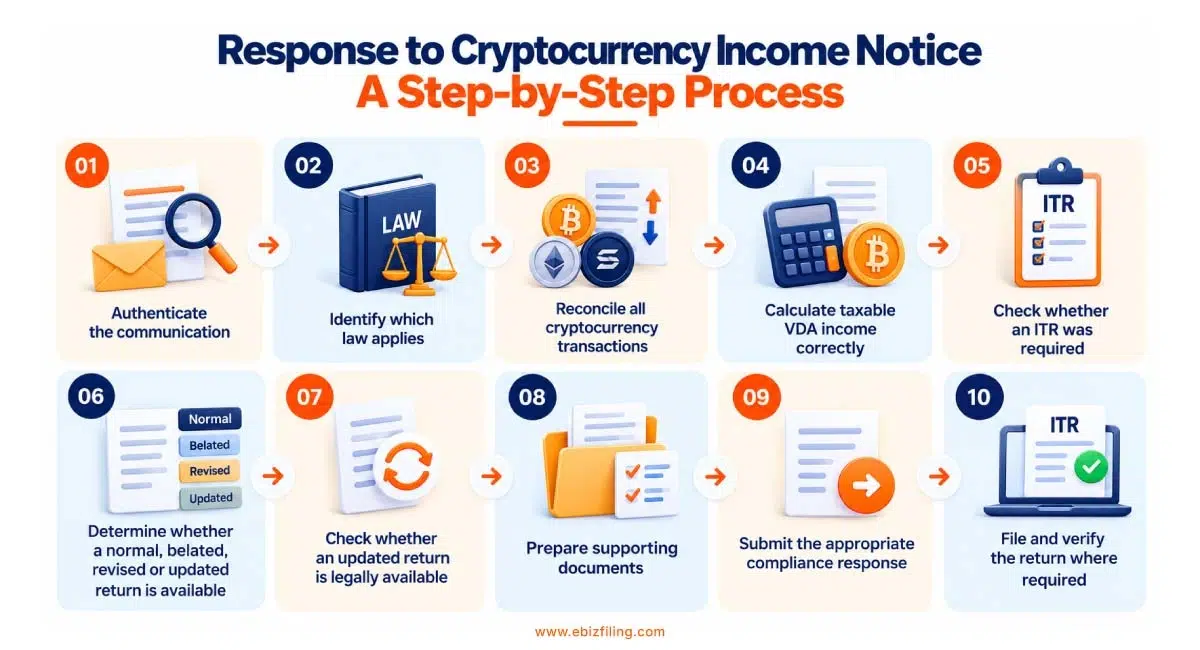
How Should You Respond to a Non-Filer Compliance Notice for Cryptocurrency?

The response should depend on the actual communication received rather than a generic template.


How to authenticate a cryptocurrency-related income tax notice


Step 1: Authenticate the communication

Verify the communication through the official Income Tax portal.


Check:

  • PAN
  • Name of taxpayer
  • Relevant financial year, assessment year or tax year
  • Communication or reference number
  • Document Identification Number, where applicable
  • Reported transaction amount
  • Nature of compliance issue
  • Response deadline

Do not rely only on the text of an email or SMS.


Step 2: Identify which law applies

Determine whether the matter relates to a year governed by:

  • Income-tax Act, 1961, or
  • Income-tax Act, 2025

This avoids using the wrong section numbers, filing procedures or return terminology.


Step 3: Reconcile all cryptocurrency transactions

Prepare a year-wise transaction reconciliation covering every exchange and wallet.


Separate:

  • Purchases
  • Sales
  • Wallet transfers
  • Deposits
  • Withdrawals
  • Income-generating transfers
  • Loss-making transfers

This step is particularly important where the Non-Filer Compliance Notice for Cryptocurrency refers to a large amount that appears inconsistent with the taxpayer’s actual income.


Step 4: Calculate taxable VDA income correctly

Taxable VDA income should be calculated transaction-wise.


Do not assume: ₹40 lakh crypto turnover = ₹40 lakh taxable income


Similarly, do not assume: Overall portfolio loss = no taxable VDA income


Both conclusions can be incorrect.


Step 5: Check whether an ITR was required

The taxpayer should determine whether a return was required for the relevant year based on:

  • Total income
  • Nature of income
  • Applicable return-filing provisions
  • VDA income
  • Other filing conditions

The suitable return form depends on the taxpayer’s status and income profile.


Ebizfiling’s ITR Forms guide explains the general form-selection framework.


Step 6: Determine whether a normal, belated, revised or updated return is available

For Tax Year 2026-27 onward, Section 263 of the Income-tax Act, 2025 governs return filing.


Depending on the circumstances and statutory timelines, the taxpayer may need to consider:

  • Original return
  • Belated return
  • Revised return
  • Updated return

For earlier assessment years, corresponding provisions under the Income-tax Act, 1961 continue to apply.


Taxpayers can also refer to Ebizfiling’s Income Tax Return filing service for professional filing assistance.

Need to File Your ITR and Respond
to a Crypto Tax Notice?

Get help reviewing VDA records and identifying the appropriate tax filing and compliance response requirements.

Get ITR Assistance →

Step 7: Check whether an updated return is legally available

An updated return is not a universal solution for every non-filing case.


Under Section 263(6) of the Income-tax Act, 2025, an updated return can generally be filed within the prescribed 48-month framework, subject to statutory restrictions.


Depending on when it is filed, additional income-tax may apply at specified rates.


An updated return is also subject to restrictions. It cannot ordinarily be used merely to:

  • Increase a refund
  • Reduce total tax liability
  • Create or enhance a loss

For older assessment years, the corresponding updated-return framework arises under Section 139(8A) of the Income-tax Act, 1961.


The Ebizfiling guide on Section 139(8A) and ITR-U provides further background on the earlier framework.


Step 8: Prepare supporting documents

Keep supporting evidence ready for the response.


Relevant documents may include:

  • AIS
  • Tax-credit statement
  • Crypto exchange ledger
  • Trade history
  • Bank statements
  • Wallet transaction records
  • Cost-of-acquisition records
  • TDS details
  • Earlier ITR, if filed
  • Tax computation
  • Relevant notice or communication

Ebizfiling’s guide on documents required for replying to an Income Tax notice provides additional context.


Step 9: Submit the appropriate compliance response

Do not assume that every taxpayer must select a particular portal option such as “ITR not filed – Will file.”


Portal options can differ depending on:

  • Compliance campaign
  • Tax year
  • Nature of communication
  • Return status
  • Information available with the Department

The taxpayer should select the response that accurately reflects the facts.


Step 10: File and verify the return where required

If an ITR must be filed, submitting the return alone is not enough. It must also be verified according to the applicable procedure.


Taxpayers may refer to Ebizfiling’s guide on e-filing an Income Tax Return for the general filing process.


What If AIS Shows ₹64 Lakh of Crypto Transactions but You Made No Overall Profit?

This is a common type of situation behind a Non-Filer Compliance Notice for Cryptocurrency. Suppose AIS or another information source shows cryptocurrency transactions worth ₹64 lakh.


This figure does not automatically establish that the taxpayer earned ₹64 lakh.


The amount may represent cumulative transaction consideration generated through repeated trades.


For instance:

  • ₹5 lakh may have been invested initially.
  • The same capital may have been used repeatedly.
  • Multiple sale transactions may collectively reach ₹64 lakh.
  • Some transactions may result in gains.
  • Some transactions may result in losses.

The taxpayer must reconstruct the individual transactions.


Why “I made no profit” may still be insufficient

Assume the taxpayer had:

  • Positive income from some VDA transfers of ₹3 lakh
  • Losses from other VDA transfers of ₹3.5 lakh

Economically, the taxpayer may feel that the overall result is a ₹50,000 loss.


However, under the special VDA tax rules, the loss-making transactions cannot automatically be used to wipe out the positive taxable VDA income.Therefore, the taxpayer may still have taxable VDA income despite having an overall economic loss across all crypto transactions. This distinction is important when answering a Non-Filer Compliance Notice for Cryptocurrency.

Received a Cryptocurrency Tax Notice?

Understand your notice and prepare an appropriate response with Ebizfiling's Income Tax Notice Reply service.

Get Notice Reply Assistance →

What If the Crypto Information in AIS Is Incorrect?

The taxpayer should not report an incorrect figure merely because it appears in AIS.


First compare the information with:

  • Exchange statements
  • Wallet records
  • Bank statements
  • TDS records

If an AIS entry is incorrect, duplicate or does not belong to the taxpayer, appropriate feedback can be submitted through the available AIS mechanism.


However, the taxpayer should retain evidence supporting the correction.


For example, if the same transaction appears twice, retain the exchange report and transaction reference showing that only one transfer actually occurred.


What About Transfers Between Your Own Crypto Wallets?

A movement of crypto between two wallets belonging to the same taxpayer should not automatically be assumed to be a sale merely because a blockchain transfer occurred.


The tax analysis depends on whether there has actually been a transfer giving rise to taxable income under the applicable provisions.


Good documentation is particularly important in this situation.


The taxpayer should maintain:

  • Wallet addresses
  • Exchange withdrawal records
  • Deposit records
  • Transaction hashes
  • Evidence that both wallets belong to the taxpayer

This can help distinguish an internal transfer from a sale or transfer to another person.


What Records Should Crypto Taxpayers Preserve?

Crypto taxation is transaction-driven, so maintaining records is important even where no compliance communication has been received.


Useful records include:

  • Purchase invoices or exchange statements
  • Sale statements
  • Wallet addresses
  • Blockchain transaction IDs
  • Date of acquisition
  • Date of transfer
  • Quantity of VDA
  • Cost of acquisition
  • Sale consideration
  • Bank statements
  • TDS information
  • AIS data
  • Tax computation

Accurate records make it easier to explain discrepancies if a Non-Filer Compliance Notice for Cryptocurrency is issued later.


What Mistakes Should You Avoid?

Taxpayers should avoid the following mistakes:

  • Ignoring the communication.
  • Missing the response deadline mentioned in the communication.
  • Treating gross transaction value as taxable income.
  • Treating overall portfolio loss as proof that no VDA tax applies.
  • Adjusting VDA losses against positive VDA income incorrectly.
  • Carrying forward VDA losses where the law prohibits it.
  • Deducting unsupported trading expenses.
  • Ignoring TDS appearing in tax records.
  • Using the Income-tax Act, 2025 for a year governed by the Income-tax Act, 1961.
  • Filing an ITR under the wrong year.
  • Filing an updated return without checking eligibility.
  • Responding without reconciling bank, exchange and wallet records.
  • Assuming that merely submitting a portal response automatically closes the issue.

A compliance response may be accepted, reviewed further or followed by another communication depending on the Department’s examination and the applicable law.

Received an Income Tax Notice
About Cryptocurrency?

Get professional assistance reviewing your notice, crypto transaction records, and applicable tax obligations.

Get Expert Help →

How Ebizfiling Can Simplify Your Crypto Tax Notice Response

A Non-Filer Compliance Notice for Cryptocurrency can involve more than just filing a reply. The taxpayer may need to identify the correct tax year, check whether the Income-tax Act, 1961 or Income-tax Act, 2025 applies, reconcile AIS with exchange and bank records, and calculate taxable VDA income correctly.


Ebizfiling can assist with reviewing the communication, examining cryptocurrency transaction records, checking the applicable ITR filing route, and preparing the required tax return or compliance response based on the facts of the case. This can help ensure that the response is supported by proper records and follows the applicable tax provisions.


The final decision on any return, explanation or response remains with the Income Tax Department.


Conclusion

A Non-Filer Compliance Notice for Cryptocurrency should not be ignored or answered only on the basis that the taxpayer made no overall profit. The correct approach is to identify the applicable year, reconcile AIS and cryptocurrency records and calculate each relevant VDA transfer according to the applicable tax law.


Gross transaction value is not automatically taxable income, but VDA losses are subject to strict set-off restrictions. Proper reconciliation of exchange statements, wallet records, TDS information and ITR requirements can help the taxpayer submit an accurate and supported response.


Frequently Asked Questions


1. Can gross cryptocurrency turnover shown in AIS be treated as taxable VDA income?

No. Gross transaction value and taxable VDA income are different. Taxable income is computed for each relevant VDA transfer using the consideration received and the permitted cost of acquisition. Therefore, a large transaction value appearing in AIS does not automatically become the taxpayer’s taxable income.


2. How should a taxpayer report a VDA transaction that results in a loss?

Schedule VDA requires transaction-wise reporting. Where a transaction results in a loss, the loss is reported as nil for aggregation purposes, while positive amounts from other VDA transfers are carried forward for tax computation. This prevents a loss from one VDA transaction from reducing positive income from another.


3. Can exchange fees, brokerage or gas fees be deducted while calculating taxable VDA income?

The special VDA tax provision generally permits deduction only of the cost of acquisition. Other expenditure or allowances are not deductible while computing income from transfer of a VDA. Therefore, exchange charges, brokerage or similar expenses should not automatically be deducted from taxable VDA income.


4. What should a taxpayer do if the cryptocurrency transaction reported in AIS is incorrect or duplicated?

The taxpayer should first reconcile the AIS entry with exchange statements, wallet records and bank transactions. If the information is incorrect or duplicated, feedback can be submitted through the AIS facility. The Income Tax Department allows taxpayers to provide feedback and shows both the reported and modified values after feedback is submitted.


5. Is a transfer of cryptocurrency between two wallets owned by the same taxpayer automatically taxable?

Not merely because a blockchain transfer has occurred. The tax treatment depends on whether the transaction legally amounts to a transfer giving rise to income. A taxpayer moving assets between self-owned wallets should retain wallet addresses, transaction hashes and exchange records to establish continuity of ownership.


6. How is 1% TDS on cryptocurrency different from the 30% tax on VDA income?

The 1% TDS applies to qualifying consideration paid for transfer of a VDA, subject to statutory conditions and thresholds. The 30% rate applies to taxable income arising from the VDA transfer. TDS is therefore a withholding mechanism and should not be confused with the taxpayer’s final VDA tax liability. Under the Income-tax Act, 2025, the TDS framework is contained in Section 393.


7. Does Section 509 of the Income-tax Act, 2025 require every crypto investor to file a separate crypto statement?

No. Section 509 applies to prescribed reporting entities that are required to furnish information about crypto-asset transactions. It is not a separate return-filing obligation imposed on every individual crypto investor. Individual taxpayers must continue to report taxable VDA income through the applicable Income Tax Return.


8. Can correcting AIS information automatically resolve a Non-Filer Compliance Notice for Cryptocurrency?

No. AIS feedback and return filing are separate compliance actions. Correcting an AIS entry does not replace an ITR where the taxpayer is legally required to file one, nor does it automatically close a compliance communication. The taxpayer must separately evaluate the filing requirement and respond to the communication received.


9. Can Ebizfiling help reconcile crypto exchange statements with AIS before responding to a notice?

Yes. Ebizfiling can assist with comparing AIS data, exchange statements, bank records, TDS information and available wallet records to identify mismatches before preparing the applicable return or compliance response. The final tax position depends on the taxpayer’s records and the provisions applicable to the relevant year.


10. Can Ebizfiling assist when a crypto notice relates to an earlier assessment year?

Yes. Ebizfiling can assist in identifying the year involved, reviewing the applicable statutory framework and determining the appropriate return or response route. This is relevant where the transaction relates to a period governed by the Income-tax Act, 1961 rather than the Income-tax Act, 2025.

About Ebizfiling -

EbizFiling is a concept that emerged with the progressive and intellectual mindset of like-minded people. It aims at delivering the end-to-end corporate legal services 0f incorporation, compliance, advisory, and management consultancy services to clients in India and abroad in all the best possible ways.
 
To know more about our services and for a free consultation, get in touch with our team on  info@ebizfiling.com or call 9643203209.
 
Ebizfiling

Author: srishti

Srishti Mukherjee is an Advocate, Legal Researcher, and Legal Content Writer at Ebizfiling, with practical courtroom experience in civil, criminal, and revenue matters before Trial Courts and High Courts. She holds an LL.M. in Constitutional Law and Criminal Law, combining her academic background with hands-on litigation experience, legal drafting, and statutory interpretation. At Ebizfiling, Srishti researches and writes on corporate law, Income Tax, GST, Intellectual Property Rights (IPR), business registration, and regulatory compliance. Her professional interests extend to company law, taxation, and emerging legal developments, where she applies her legal research skills to understand statutory provisions, compliance procedures, and their practical implications for businesses and individuals. Her writing reflects a research-oriented approach supported by practical legal experience. She focuses on simplifying complex legislation, regulatory requirements, filing procedures, and legal documentation into clear, structured, and accessible content. Through her articles, she aims to help startups, businesses, professionals, and taxpayers better understand legal obligations and make informed compliance decisions.

Follow Author

Leave a Reply

Your email address will not be published. Required fields are marked *

  • Rating

Hi, Welcome to EbizFiling!

Hello there!!! Let us know if you have any Questions.

Thank you for your message.

☎
whatsapp