
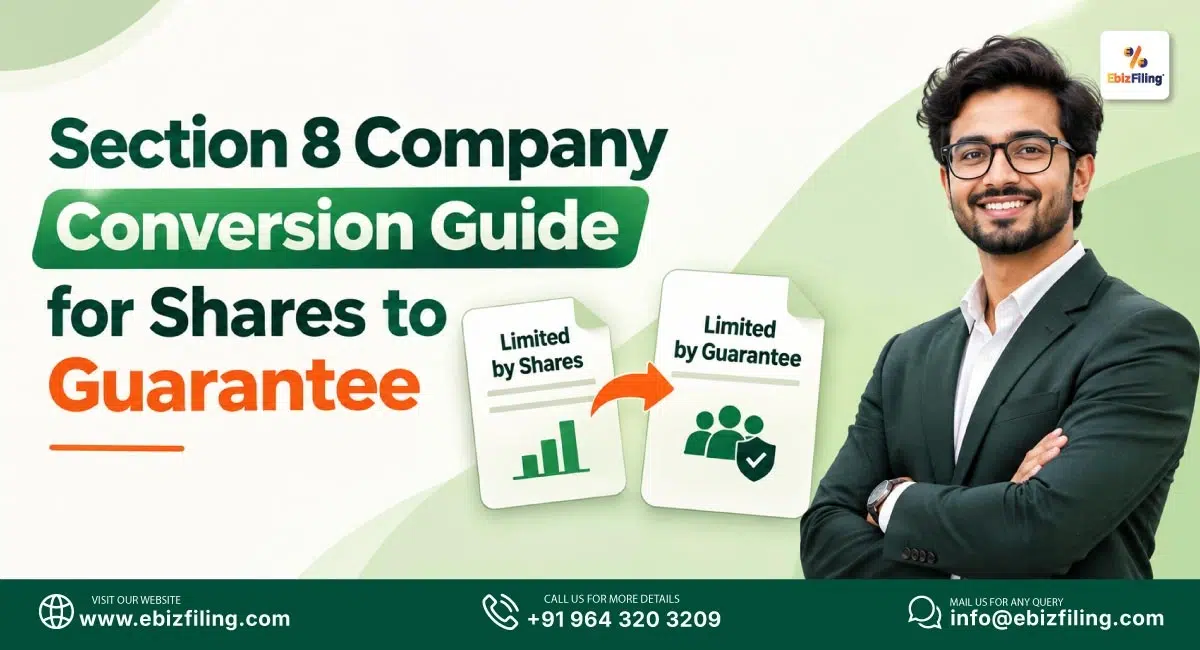
Section 8 Company Conversion: From Limited by Shares to Limited by Guarantee
Introduction
A Section 8 company can be incorporated either as a company limited by shares or as a company limited by guarantee. While both structures are suitable for non-profit objectives, the way members’ liability is defined differs significantly. Over time, changes in the organisation’s membership model, governance structure, funding pattern or long-term objectives may make the original share-based structure less practical.
In such cases, a Section 8 Company Conversion from limited by shares to limited by guarantee may be considered. This conversion changes the basis of members’ liability from unpaid share capital to a predetermined guarantee amount that members agree to contribute in the event of winding up. Since this change affects the company’s constitutional and capital structure, it requires careful review of the existing Memorandum of Association (MOA), Articles of Association (AOA), share capital, member rights and the approvals applicable under the Companies Act, 2013.
The process should therefore be approached as a legal restructuring rather than a simple MCA form filing. Proper planning is required to ensure that the revised structure continues to comply with Section 8 conditions and accurately reflects the organisation’s intended governance and liability framework.
Summary
- A Section 8 Company Conversion changes members’ liability from share-based liability to a guaranteed contribution.
- Section 18 provides the statutory basis for converting a company from one class to another through alteration of its MOA and AOA.
- Section 8 companies are subject to additional restrictions on altering their constitutional documents.
- Existing share capital must be properly assessed before adopting a guarantee-based structure.
- INC-18 should not automatically be used when the company intends to retain its Section 8 status.
What Does Section 8 Company Conversion Mean?
Section 3 of the Companies Act, 2013 recognises a company limited by shares, a company limited by guarantee and an unlimited company. Section 4 requires the memorandum to specify the nature and extent of members’ liability.
In a company limited by shares, members are generally liable only to the extent of the amount unpaid on their shares. In a company limited by guarantee, members undertake to contribute a specified amount to the assets of the company in the event of winding up.
A Section 8 Company Conversion therefore changes the company’s liability and membership framework and requires the constitutional documents to reflect the revised structure.
For a broader understanding of the entity, read Ebizfiling’s guide on Section 8 Company Registration.
How Is a Company Limited by Shares Different from a Company Limited by Guarantee?
|
Basis |
Limited by Shares |
Limited by Guarantee |
|
Member liability |
Limited to unpaid amount on shares | Limited to the amount undertaken as guarantee |
| Membership basis | Shareholding |
Membership and guarantee |
|
Share capital |
Generally present | May exist or may be absent |
| Winding-up contribution | Unpaid amount on shares |
Guaranteed contribution |
|
Constitutional focus |
Share and capital clauses |
Membership and guarantee clauses |
A Section 8 Company Conversion must therefore address the actual liability structure rather than simply changing the description of the company.






November 14, 2026 By Srishti M
The compliance calendar December 2026 covers important statutory obligations under GST, Income Tax, TDS/TCS, Company Law, LLP regulations, EPF and ESI. It helps businesses identify the filings, tax payments and regulatory requirements applicable during the month. Companies, LLPs, OPCs, employers and registered taxpayers should review the compliance calendar December 2026 based on their entity type, registration status, filing frequency and transaction profile. Timely compliance planning can help avoid late fees, interest, penalties and filing delays.
November 12, 2026 By Srishti M
November 7, 2026 By Srishti M