
Auditor removal under Section 140(1), including process and ROC compliance

Removal of Auditor: Process for Replacement and ROC Compliance

Introduction

When a statutory auditor becomes unresponsive, companies can quickly find themselves stuck with pending audits, unsigned financial statements and delayed ROC filings. The situation may appear straightforward, but the law does not allow a company to simply appoint a new auditor or assume that prolonged silence amounts to resignation.


Under the Companies Act, 2013, Removal of Auditor, resignation and a casual vacancy of auditor are treated as separate legal situations, each with its own procedure, approvals and filing requirements. Choosing the wrong route can create further compliance issues and affect the validity of the auditor replacement process.


For companies already facing delayed annual filings or multiple years of pending compliance, it is important to first regularise the auditor’s position and then proceed with the required audit and ROC filings. This article explains the correct legal process, the role of Forms ADT-2 and ADT-3, the appointment of new auditor, and the steps required to restore ROC compliance.


Summary

  • Removal of an auditor before the expiry of tenure is governed by Section 140(1) of the Companies Act, 2013.
  • An auditor’s failure to respond does not automatically amount to resignation.
  • Form ADT-2 is used to seek approval for the removal of an auditor before the expiry of the auditor’s term.
  • Formal resignation can create a casual vacancy of auditor under Section 139(8).
  • Valid appointment of a new auditor should precede pending audits and restoration of ROC compliance.


What Should a Company Do When Its Auditor Becomes Unresponsive?

The first step is to determine the legal status of the existing auditor. Failure to respond to calls, emails, or document requests does not by itself terminate the auditor’s statutory appointment. The company should preserve emails, letters, notices and other communication attempts. These records may support the Board’s decision-making, but they do not convert silence into resignation.


If the auditor remains validly appointed and the company wants to end the appointment before expiry, the statutory Removal of Auditor procedure must be followed.


For a detailed explanation of the separate resignation route, see Ebizfiling’s guide on auditor resignation and appointment under the Companies Act, 2013.


Which legal route applies?


Situation

Applicable legal route

Auditor remains in office but company wants removal before expiry

Removal of Auditor under Section 140(1)

Auditor formally resigns

Casual vacancy of auditor under Section 139(8)

Auditor incurs a disqualification under Section 141(3)

Vacancy treated as a casual vacancy under Section 141(4)
Auditor’s term expires normally

Appointment or reappointment under Section 139


Section 141(4) provides that where an auditor incurs a disqualification specified in Section 141(3) after appointment, the auditor must vacate office and the resulting vacancy is treated as a casual vacancy.

Planning to Remove Your
Company's Auditor?

Get professional assistance with auditor removal procedures, statutory approvals, and ROC filings.

Get Auditor Removal Support

Section 140(1) of the Companies Act, 2013

Section 140(1) governs Removal of Auditor before expiry of the auditor’s term. An auditor appointed under Section 139 may be removed before expiry only through a special resolution after obtaining the previous approval of the Central Government.


The auditor must also be given a reasonable opportunity of being heard before action is taken.


Section 140(1) of the Companies Act, 2013 on auditor removal


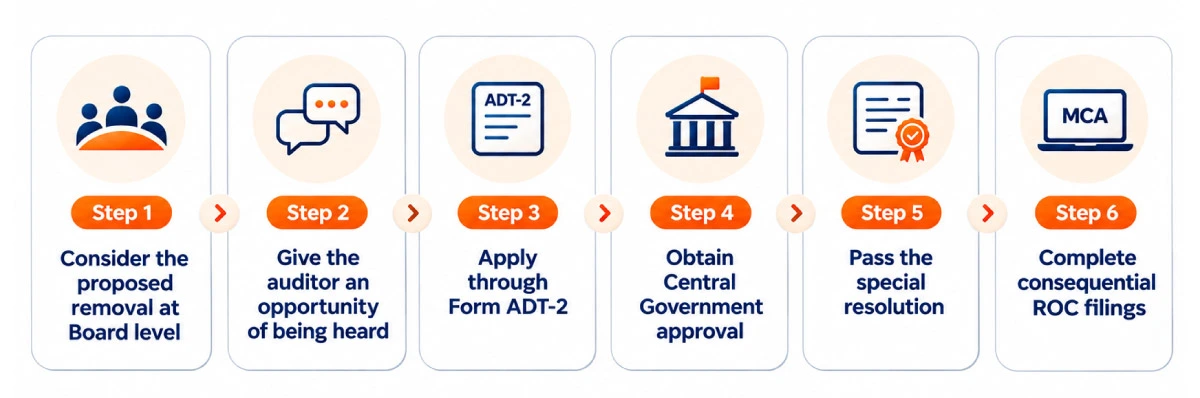
Step 1: Consider the proposed removal at Board level

The Board should formally consider the grounds for the proposed auditor replacement and authorise the statutory process.


Where the company is required to constitute an Audit Committee under Section 177, the applicable recommendations of the committee should also be considered in accordance with the Companies Act.


Step 2: Give the auditor an opportunity of being heard

The existing auditor must receive a reasonable opportunity of being heard before the Removal of Auditor is completed.


The company should document the notice, communication and opportunity provided to the auditor.


Step 3: Apply through Form ADT-2

Rule 7 of the Companies (Audit and Auditors) Rules, 2014 requires the application for Removal of Auditor to be made to the Central Government in Form ADT-2 with the prescribed fee.


The application in Form ADT-2 must be made within 30 days of the Board resolution proposing the removal.


The grounds for removal and supporting corporate records should be prepared carefully because Form ADT-2 forms part of a statutory approval process.


Step 4: Obtain Central Government approval

The company must obtain previous approval of the Central Government before completing the removal through a special resolution.


A Board decision or shareholder resolution by itself does not satisfy Section 140(1).


Step 5: Pass the special resolution

Rule 7 requires the company to hold the general meeting within 60 days from receipt of Central Government approval.


The members must then pass the required special resolution for Removal of Auditor.


Step 6: Complete consequential ROC filings

The company should complete the applicable resolution and auditor-related filings after the statutory removal and auditor replacement process.


A special resolution is generally filed with the Registrar in Form MGT-14 within the applicable statutory period.


For broader annual filing requirements, refer to Ebizfiling’s guide on ROC compliance for a private limited company.


What Happens When the Auditor Formally Resigns?

Resignation follows a different legal route from Removal of Auditor.


Under Section 140(2), an auditor who resigns must file the prescribed statement within 30 days from the date of resignation with the company and the Registrar, stating the reasons and other relevant facts.


For companies covered by Section 139(5), the statement must also be filed with the Comptroller and Auditor-General of India.


Who files Form ADT-3?

Rule 8 prescribes Form ADT-3 for reporting an auditor’s resignation.


The responsibility to file Form ADT-3 lies with the resigning auditor. The company should therefore not file Form ADT-3 merely because an auditor has stopped responding.


A genuine resignation must first exist.


How is a casual vacancy after resignation filled?

For a company other than one whose auditor is appointed by the CAG, Section 139(8) requires the Board to fill a casual vacancy of auditor within 30 days.


Where the casual vacancy of auditor arises due to resignation, the appointment must also be approved by members at a general meeting convened within three months of the Board’s recommendation.


The replacement auditor holds office until the conclusion of the next Annual General Meeting.


For companies whose auditors are appointed by the CAG, Section 139(8)(ii) provides a separate mechanism. The CAG gets the first 30-day period to fill the vacancy, followed by the Board where the CAG does not do so.


Therefore, the casual vacancy of auditor process should not be mixed with the Form ADT-2 removal process.


What Should Be Checked Before Appointment of New Auditor?

Before the appointment of new auditor, the company should verify the proposed auditor’s eligibility and disqualification position under Section 141 of the Companies Act, 2013.


The proposed auditor should provide the prescribed consent and eligibility confirmation.


Is communication with the previous auditor required?

Yes, professional requirements also apply to the incoming Chartered Accountant.


Under ICAI ethical requirements, a Chartered Accountant in practice should communicate in writing with the previous auditor before accepting an audit previously held by another Chartered Accountant.


A formal NOC should not be confused with this professional communication requirement.


The auditor replacement must therefore satisfy both company-law requirements and applicable professional requirements.

Need Help with Auditor Appointment
and ADT-1 Filing?

Simplify auditor appointment documentation and ROC compliance with Ebizfiling's professional assistance.

Get Expert Help

Which ROC forms are relevant?


Form

Purpose

Responsibility

Main timeline

ADT-1

Notice of auditor appointment Company

As applicable to the relevant appointment under the Act and Rules

Form ADT-2

Application for removal before expiry Company

Within 30 days of Board resolution

Form ADT-3

Statement relating to resignation Resigning auditor

Within 30 days of resignation

MGT-14

Filing of special resolution Company

Within the applicable statutory period


For additional context on annual company forms, see Ebizfiling’s guide on filing Form MGT-7 and AOC-4 online.


Can the New Auditor Complete Audits for Pending Financial Years?

The answer depends on the legal status of the auditor appointment for each pending period.


Where financial statements remain unaudited, the incoming auditor must first have a legally valid appointment covering the audit work being undertaken. The auditor must then perform appropriate audit procedures and independently form an audit opinion.


The appointment of new auditor does not allow the incoming auditor to simply adopt unfinished audit work or re-sign financial statements already audited, adopted or filed by another auditor.


The incoming auditor may require access to:

  • Books of account;
  • Bank statements;
  • Ledgers and vouchers;
  • GST and TDS records;
  • Earlier financial statements;
  • Previous audit reports;
  • Board and general meeting minutes;
  • Statutory registers; and
  • Earlier ROC filings.

Where older financial statements have already been audited, adopted or filed, the company should separately assess what corrective or statutory process, if any, is legally available.

Worried About ROC Compliance
During Auditor Removal?

Get assistance with regulatory documentation, resolutions, and applicable MCA filings.

Get ROC Filing Assistance

How Can Pending ROC Compliance Be Restored?

Once the Removal of Auditor or the applicable casual vacancy of auditor process has been completed, the company should review each pending financial year separately.


The compliance sequence may involve completion of audits, Board approval of financial statements, AGM-related requirements, filing of financial statements and filing of annual returns.


Filing pending financial statements and annual returns

Depending on company type and applicability, pending ROC compliance may include:

  • AOC-4 or the applicable AOC-4 form;
  • MGT-7;
  • MGT-7A for eligible OPCs and small companies; and
  • Other event-based or annual forms applicable to the company.

Ebizfiling’s detailed guide on Form MGT-7 and its annual filing requirements explains the annual return process.


For companies deciding between MGT-7 and MGT-7A, see the comparison of Form MGT-7 and Form MGT-7A applicability.


What if ROC filings have remained pending for several years?

Long-standing non-filing should be reviewed year by year because the consequences may extend beyond additional filing fees.


For example, Section 164(2) can become relevant where a company has failed to file financial statements or annual returns for the prescribed consecutive period.


Ebizfiling’s guide on disqualification of directors under Section 164(2) explains this risk in detail.


A structured ROC compliance review should therefore cover the auditor position, financial statements, annual returns, director status and other outstanding MCA filings together.


How Can Ebizfiling Assist With Auditor Replacement and ROC Compliance?

Ebizfiling can support companies in structuring the auditor replacement and ROC compliance process based on the existing auditor status and pending statutory filings.


Assistance may include reviewing the applicable auditor-change route, preparing corporate documentation, supporting Form ADT-2 and auditor appointment formalities, assessing the Form ADT-3 position where an actual resignation has occurred, and reviewing pending annual ROC filings.


For companies with multiple years of outstanding filings, Ebizfiling can also help map the compliance sequence so that the appointment of new auditor, pending audits and annual filings are addressed in an organised manner.

Looking for Complete Support with
Your Company's Annual Compliance?

Stay on top of recurring statutory filings and corporate obligations with Ebizfiling's compliance services.

Explore Company Compliance Services

Conclusion

The Removal of Auditor should be handled through the exact legal route that applies to the company’s situation. An auditor’s continued non-response does not by itself amount to resignation, and removal before expiry of tenure must remain distinct from resignation and the resulting casual vacancy of auditor.


Once the company regularises the auditor’s position and completes the appointment of new auditor in accordance with the Companies Act, 2013, it can move forward with pending audits, financial statements and annual ROC filings. A properly documented auditor replacement also helps maintain continuity in statutory records and supports smoother restoration of ROC compliance for pending financial years.


For companies dealing with multiple years of delayed filings, resolving the auditor position first creates a clear compliance path for completing the audit, approving financial statements and filing the applicable ROC forms in the correct sequence.


Frequently Asked Questions


1. Can a company treat an unresponsive auditor as having resigned?

No. Mere silence, non-cooperation or failure to respond does not amount to resignation under the Companies Act, 2013. If the auditor has not formally resigned, the company must follow the applicable statutory route, including Section 140(1) where removal before expiry is proposed.


2. Is Central Government approval required before removing an auditor?

Yes. Under Section 140(1), an auditor can be removed before expiry of the term only after obtaining previous approval of the Central Government and then passing a special resolution. The auditor must also be given a reasonable opportunity of being heard.


3. What is the filing timeline for Form ADT-2?

Form ADT-2 is used to seek approval for removal of an auditor before expiry of the term. It must be filed within 30 days of the Board resolution proposing the removal.


4. Who files Form ADT-3 when an auditor resigns?

Form ADT-3 is filed by the resigning auditor, not by the company. It must be filed within 30 days from the date of resignation and should state the reasons and other relevant facts.


5. How is a casual vacancy caused by auditor resignation filled?

For a non-CAG company, the Board must fill the casual vacancy within 30 days. If the vacancy arises due to resignation, the appointment must also be approved by members at a general meeting within three months of the Board’s recommendation.


6. What happens if an auditor becomes disqualified after appointment?

If an auditor incurs a disqualification under Section 141(3) after appointment, the auditor must vacate office. Section 141(4) treats the resulting vacancy as a casual vacancy.


7. Can a new auditor accept the audit without contacting the previous auditor?

No. ICAI’s professional requirements require the incoming Chartered Accountant to communicate in writing with the previous auditor before accepting the audit. Failure to do so can amount to professional misconduct.


8. Can a newly appointed auditor audit financial statements for earlier pending years?

Yes, where the appointment legally covers the audit work and the financial statements remain pending for audit. The incoming auditor must independently perform the required audit procedures and cannot simply adopt or re-sign work completed by the previous auditor.


9. How can Ebizfiling help with removal and replacement of an auditor?

Ebizfiling can assist with identifying the applicable legal route, preparing Board and shareholder documentation, supporting Form ADT-2 and auditor-appointment filings, and structuring the compliance steps required for a valid auditor replacement.


10. Can Ebizfiling help restore pending ROC compliance after auditor replacement?

Yes. Ebizfiling can help identify pending financial years, map the applicable audit and filing sequence, and assist with forms such as AOC-4, MGT-7 or MGT-7A after the auditor position is legally regularised.

About Ebizfiling -

EbizFiling is a concept that emerged with the progressive and intellectual mindset of like-minded people. It aims at delivering the end-to-end corporate legal services 0f incorporation, compliance, advisory, and management consultancy services to clients in India and abroad in all the best possible ways.
 
To know more about our services and for a free consultation, get in touch with our team on  info@ebizfiling.com or call 9643203209.
 
Ebizfiling

Author: srishti

Srishti Mukherjee is an Advocate, Legal Researcher, and Legal Content Writer at Ebizfiling, with practical courtroom experience in civil, criminal, and revenue matters before Trial Courts and High Courts. She holds an LL.M. in Constitutional Law and Criminal Law, combining her academic background with hands-on litigation experience, legal drafting, and statutory interpretation. At Ebizfiling, Srishti researches and writes on corporate law, Income Tax, GST, Intellectual Property Rights (IPR), business registration, and regulatory compliance. Her professional interests extend to company law, taxation, and emerging legal developments, where she applies her legal research skills to understand statutory provisions, compliance procedures, and their practical implications for businesses and individuals. Her writing reflects a research-oriented approach supported by practical legal experience. She focuses on simplifying complex legislation, regulatory requirements, filing procedures, and legal documentation into clear, structured, and accessible content. Through her articles, she aims to help startups, businesses, professionals, and taxpayers better understand legal obligations and make informed compliance decisions.

Follow Author

Leave a Reply

Your email address will not be published. Required fields are marked *

  • Rating

Hi, Welcome to EbizFiling!

Hello there!!! Let us know if you have any Questions.

Thank you for your message.

☎
whatsapp