


-
July 29, 2026
-
BySteffy A
Section 46 of the Income Tax Act, 2025: Specified Business Deduction
Introduction
Certain businesses require major investment in buildings, machinery, infrastructure, and operational facilities. Hospitals, hotels, warehouses, pipelines, and infrastructure projects are common examples. Section 46 of the Income Tax Act, 2025 allows eligible assessees carrying on specified businesses to claim the whole qualifying capital expenditure incurred wholly and exclusively for the business. However, this deduction is subject to prescribed eligibility, payment, and asset-use conditions.
This blog explains the meaning of Section 46, eligible specified businesses, conditions for claiming the deduction, excluded expenditures, the eight-year asset-use rule, and the difference between Section 35AD and Section 46.
What Is Section 46 of the Income Tax Act, 2025?
Section 46 of the Income Tax Act, 2025 allows an assessee to claim a deduction for the whole capital expenditure incurred wholly and exclusively for carrying on a specified business.
The deduction is generally allowed in the tax year in which the capital expenditure is incurred. Therefore, the assessee does not need to spread the qualifying expenditure over several years.
The claim is optional. An assessee may evaluate the applicable conditions and decide whether to claim the benefit under Section 46.
Where eligible capital expenditure is incurred before the business starts operations, the expenditure may be claimed in the tax year in which the business commences. However, such expenditure must be capitalised in the books of account on the date of commencement of operations.
Section 35AD vs Section 46
Section 35AD provided the specified business deduction under the Income tax Act, 1961. Under the Income Tax Act, 2025, the corresponding provision is contained in Section 46 of the Income Tax Act, 2025.
|
Basis |
Earlier Provision |
New Provision |
|
Governing law |
Income tax Act, 1961 | Income Tax Act, 2025 |
| Section number | Section 35AD |
Section 46 |
|
Nature of benefit |
Capital expenditure deduction | Capital expenditure deduction |
| Eligible activity | Specified business |
Specified business |
|
Deduction amount |
Whole qualifying capital expenditure | Whole qualifying capital expenditure |
| Relevant period | Previous year |
Tax year |
|
Pre-commencement expense |
Allowed when capitalised | Allowed when capitalised |
| Asset-use requirement | Eight years |
Eight years |
|
Used machinery limit |
Up to 20% subject to conditions | Up to 20% subject to conditions |
| Excluded expenses | Land, goodwill, and financial instruments |
Land, goodwill and financial instruments |
|
Double deduction |
Not permitted | Not permitted |
| New depreciation reference | Section 32 |
Section 33 |
The main change is the section number and references under the new law. The basic purpose remains to provide an investment-linked deduction for capital expenditure incurred for eligible specified businesses.
Under the Income Tax Act 2025 Key Changes vs the Old Income Tax Law, the corresponding provision is contained in Section 46 of the Income Tax Act, 2025.
Eligibility Conditions Under Section 46
A business must satisfy the prescribed conditions before claiming the deduction.
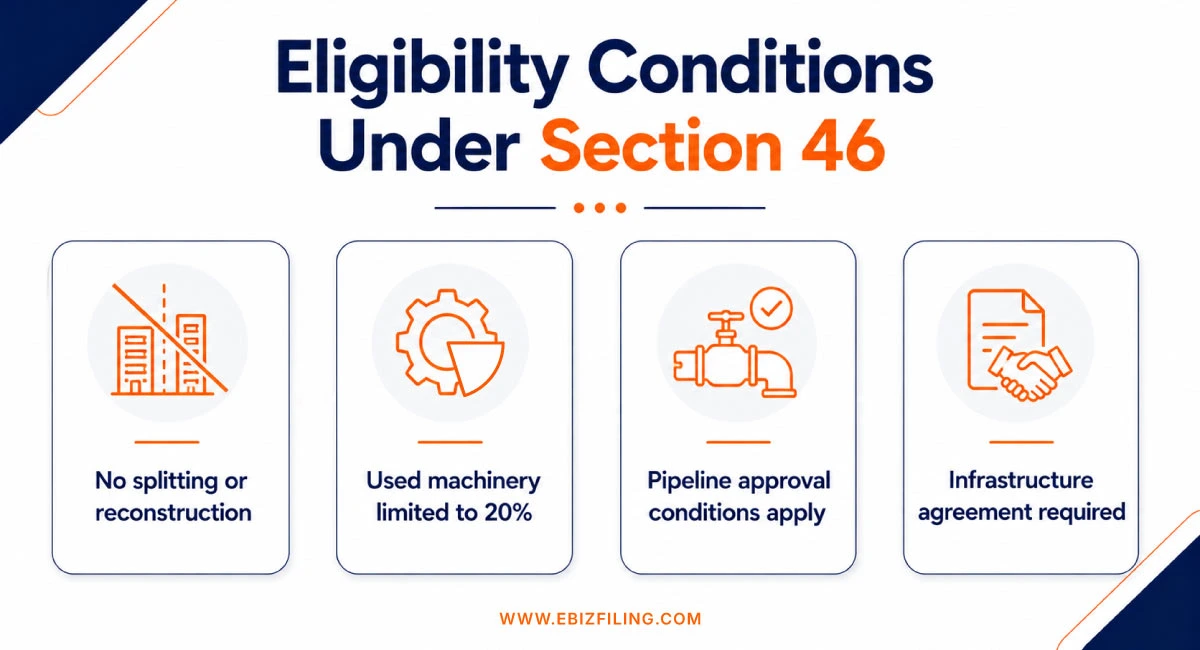
1. No splitting or reconstruction
The specified business must not be formed by splitting up or reconstructing an already existing business.
This condition prevents an existing business from restructuring its operations only to claim the deduction.
2. Restriction on used machinery
The specified business must not generally be established by transferring machinery or plant that was previously used for another purpose.
However, the condition is treated as satisfied where the value of previously used machinery or plant does not exceed 20% of the total value of machinery or plant used in the specified business.
3. Conditions for pipeline businesses
A cross-country natural gas, crude oil or petroleum pipeline business must satisfy additional conditions relating to ownership, regulatory approval and common-carrier capacity.
4. Conditions for infrastructure businesses
A new infrastructure facility must be owned by an eligible company, consortium, authority, board, corporation, or other permitted body.
The eligible entity must also enter into an agreement with the Central Government, State Government, local authority, or another statutory body for developing, operating, or maintaining the infrastructure facility.
Specified Businesses Eligible Under Section 46
The deduction is available only to businesses covered within the definition of a specified business.
Eligible businesses include:
- Setting up and operating a cold-chain facility
- Warehousing facilities for agricultural produce
- Cross-country natural gas, crude oil or petroleum pipeline networks
- Hotels classified as two-star or above
- Hospitals having at least 100 beds
- Notified slum redevelopment or rehabilitation projects
- Notified affordable housing projects
- Production of fertiliser in India
- Inland container depots
- Container freight stations
- Bee-keeping and production of honey and beeswax
- Warehousing facilities for storing sugar
- Slurry pipelines for transporting iron ore
- Notified semiconductor wafer fabrication units
- Developing, operating, or maintaining a new infrastructure facility
The law also defines an infrastructure facility to include roads, toll roads, bridges, rail systems, highway projects, water supply projects, irrigation projects, sanitation systems, sewerage systems, ports, airports, and inland waterways.
Capital Expenditure Eligible for Deduction
The expenditure must be capital in nature and must be incurred wholly and exclusively for the specified business.
Depending on the type of business, qualifying expenditures may include:
- Plant and machinery
- Operational equipment
- Building and construction expenditure
- Storage and warehousing infrastructure
- Medical equipment for eligible hospitals
- Pipeline and transportation infrastructure
- Equipment required for manufacturing operations
The connection between the expenditure and the specified business must be clearly established.
Pre-commencement capital expenditure may also qualify where it is properly capitalised in the books on the date the business starts operations.
Expenditure Not Eligible for Deduction
Section 46 excludes certain expenses from the meaning of capital expenditure.
The deduction is not available for expenditure incurred on:
- Acquisition of land
- Acquisition of goodwill
- Acquisition of financial instruments
- Personal or unrelated business expenses
- Routine revenue expenditure
- Certain payments made through non-specified modes
Where payment or the total payments made to one person in a day exceed ₹10,000, the expenditure may not qualify if payment is not made through the specified banking or online mode.
Businesses should therefore make qualifying payments through permitted banking channels and maintain supporting payment records.
Eight-Year Asset-Use Requirement
An asset for which the Section 46 deduction has been claimed must generally be used only for the specified business for eight years, beginning with the tax year in which it is acquired or constructed. If the asset is used for another purpose during this period and the amount is not otherwise chargeable under Section 26(2)(k), the deduction claimed earlier, reduced by the depreciation that would have been allowable under Section 33, is treated as business income in the year of such other use.
How Ebizfiling Supports Your Section 46 Compliance
Claiming a deduction under Section 46 of the Income Tax Act, 2025 requires proper classification of expenses and careful review of the eligibility conditions.
Ebizfiling can assist businesses with:
- Reviewing whether the business qualifies as a specified business
- Identifying eligible and ineligible capital expenditures
- Checking the applicable payment conditions
- Maintaining accounting and asset records
Businesses can use Ebizfiling’s CA services for income tax return filing to review eligible deductions, verify supporting documents, and reduce the risk of incorrect or duplicate claims.
Conclusion
Section 46 of the Income Tax Act, 2025 provides a valuable deduction for qualifying capital expenditure incurred by eligible specified businesses. However, the benefit is available only when the prescribed business, payment, and asset-use conditions are satisfied. Businesses should classify expenses correctly, maintain proper records, and review the applicable requirements before claiming the deduction.
Frequently Asked Questions
1. What deduction is available under Section 46 of the Income Tax Act?
Section 46 of the Income Tax Act allows an eligible assessee to claim the whole qualifying capital expenditure incurred wholly and exclusively for a specified business. The deduction is generally allowed in the tax year in which the expenditure is incurred.
2. Is the Section 46 specified business deduction compulsory?
No. The Section 46 of the Income Tax Act, 2025 specified business deduction is optional. An assessee may review the tax position, eligibility conditions and nature of expenditure before deciding whether to claim the deduction.
3. Can capital expenditure incurred before starting operations be claimed?
Yes. Capital expenditure incurred before the commencement of operations may qualify if it is capitalised in the books of account on the date the specified business begins operations. The deduction is then allowed in the relevant tax year.
4. Which businesses are eligible for deduction under Section 46?
Eligible businesses under Section 46 include cold-chain facilities, agricultural warehouses, two-star or higher hotels, hospitals with at least 100 beds, pipelines, fertiliser production, inland container depots and notified infrastructure projects.
5. Can a business formed by reconstructing an existing business claim the deduction?
Generally, no. A specified business under Section 46 of the Income Tax Act, 2025 must not be formed by splitting up or reconstructing an existing business. This condition prevents businesses from restructuring existing operations only to obtain the deduction.
6. Is previously used machinery permitted under Section 46 of the Income Tax Act, 2025?
Previously used machinery is generally restricted. However, the condition may be satisfied where the value of such machinery does not exceed 20% of the total value of the machinery or plant used in the specified business.
7. Which expenses are excluded under the Section 46 capital expenditure rules?
The Section 46 capital expenditure rules exclude expenditure on land, goodwill and financial instruments. Certain payments exceeding ₹10,000 may also be disallowed when they are not made through the specified banking or online modes.
8. What happens if an asset is used for another business within eight years?
The asset must generally be used only for the specified business for eight years. If it is used for another purpose during this period, the earlier deduction may be treated as business income after adjusting the depreciation that would otherwise have been available.
9. How can Ebizfiling help identify eligible capital expenditure?
Unless the amount is chargeable under Section 26(2)(k) or the specified statutory exception applies, the earlier deduction, after reducing the depreciation that would have been allowable under Section 33, is deemed to be business income in the tax year in which the asset is used for another purpose.
10. What is the main difference between Section 35AD and Section 46?
In the comparison of Section 35AD and Section 46, Section 35AD belonged to the Income tax Act, 1961, while Section 46 of the Income Tax Act, 2025 is the corresponding provision under the Income Tax Act, 2025. Ebizfiling can help businesses understand the revised section references and apply the correct provision for the relevant tax year.





About Ebizfiling -



October 6, 2026 By Srishti M
October 7, 2026 By Srishti M
October 3, 2026 By Srishti M
Revised ITR Under Old Tax Regime: Change Rules Explained Overview A salaried taxpayer may file an Income Tax Return under the new tax regime and later realise that the old tax regime could be more suitable because of eligible deductions […]