


-
August 18, 2026
-
BySteffy A
Independent Director in India: Eligibility and Registration Process
Overview
Becoming an independent director in India is increasingly recognized as a professional opportunity in corporate governance. Experienced professionals can use their knowledge to contribute to Board-level discussions, business strategy, risk management, and regulatory compliance.
The increasing focus on transparency and good corporate governance has strengthened the importance of independent directors in companies. The position may provide Board-level exposure and remuneration in the form permitted under the Companies Act, 2013, depending on the company and the responsibilities involved.
Definition of an Independent Director Under Section 149(6)
According to Section 149(6) of the Companies Act, 2013, an independent director in India is a director other than a managing director, whole-time director or nominee director. The person must, in the opinion of the Board, possess integrity, relevant expertise, and experience.
An independent director must not be a promoter of the company or its holding, subsidiary, or associate company. The person must also satisfy the prescribed conditions relating to relationships with the company, its promoters, directors, and management. These requirements help ensure that financial, professional, or personal interests do not affect the director’s independent judgment.
You can also understand the different types of directors under company law before evaluating the specific role of an independent director.
Independent Director Meaning in Simple Words
An independent director in India is a non-executive Board member who provides objective and unbiased opinions on company matters. The person is not involved in the company’s day-to-day management and must not have relationships or interests that could compromise their independence.
Independent directors play an important role in improving transparency, accountability, and unbiased decision-making. They also review management performance, assess risks, and help protect the interests of shareholders and other stakeholders.
Who Must Appoint Independent Directors?
Every listed public company must have at least one-third of its total number of directors as independent directors. If the calculation results in a fraction, it must be rounded off to the next whole number.
An unlisted public company is generally required to appoint at least two independent directors if it meets any of the following conditions:
- Paid-up share capital of ₹10 crore or more;
- Turnover of ₹100 crore or more; or
- Aggregate outstanding loans, debentures and deposits exceeding ₹50 crore.
However, the above requirement does not apply to a joint venture, a wholly owned subsidiary, or a dormant company covered by the prescribed exemption.
The Board may identify and recommend a suitable candidate. However, the company must verify that the proposed individual satisfies the independence requirements before proceeding with the appointment. The appointment must then be approved by the shareholders in accordance with the Companies Act, 2013 and, in the case of a listed entity, the SEBI LODR Regulations.
Eligibility Criteria to Become an Independent Director in India
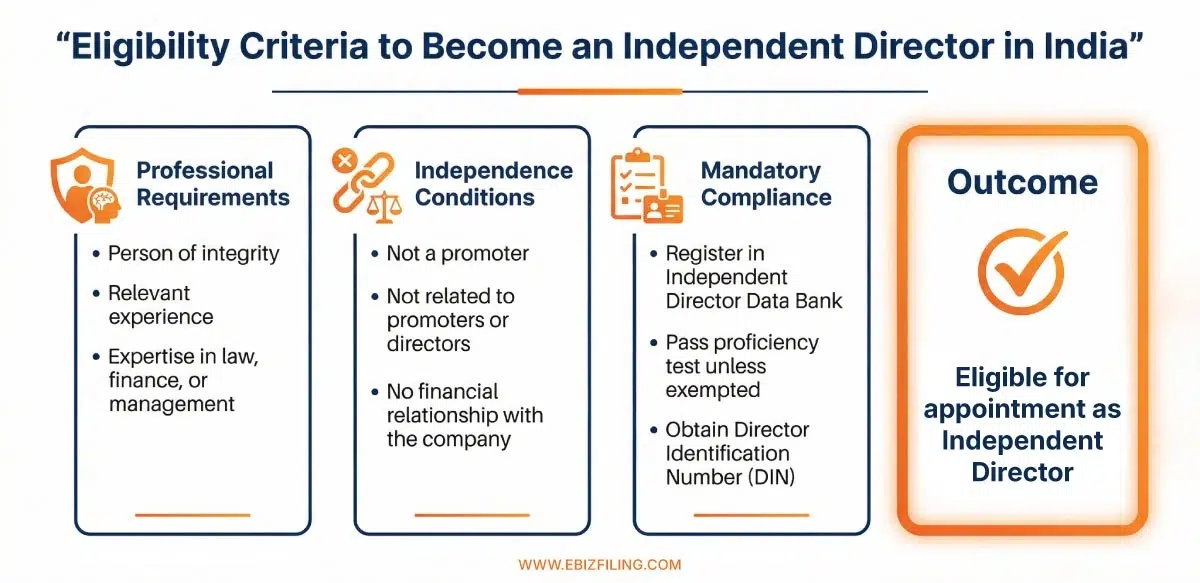
An independent director in India must possess integrity, relevant expertise and experience suitable for the company’s business and Board responsibilities. The individual may have knowledge and experience in areas such as finance, law, management, administration, corporate governance, marketing, research, technical operations or another discipline relevant to the company.
Steps to Become an Independent Director in India
1. Check Your Eligibility
First, confirm that you satisfy the eligibility and independence requirements under Section 149(6) of the Companies Act, 2013. You should possess integrity, relevant expertise and experience, and should not have any relationship or interest that may affect your independent judgment.
2. Register in the Independent Directors Databank
An individual who intends to become an independent director must include their name in the Independent Directors Databank maintained by the Indian Institute of Corporate Affairs.
Applicants must create an account, provide their personal, educational, and professional information, and pay the prescribed subscription fee.
Registration in the Databank does not guarantee appointment. The company remains responsible for conducting due diligence before selecting and appointing a candidate.
3. Complete the Online Proficiency Self-Assessment Test
Unless exempt under the prescribed rules, an individual whose name is included in the Databank must pass the Online Proficiency Self-Assessment Test within two years from the date of inclusion.
The test covers areas such as company law, securities law, basic accountancy, and corporate governance. A score of at least 50% is required to pass, and there is no limit on the number of attempts.
The test does not necessarily have to be passed immediately after registration or before every appointment. However, failure to pass it within the prescribed period may result in the individual’s name being removed from the Databank.
4. Build Your Profile and Explore Board Opportunities
After registration, the individual can complete their professional profile and explore suitable Board opportunities.
Companies may search the Independent Directors Databank for candidates with relevant industry knowledge, professional experience, financial expertise and corporate governance skills.
Registration or passing the proficiency test does not automatically provide a Board position. Selection depends on the company’s requirements, due diligence process and appointment procedure.
5. Obtain a Director Identification Number
A Director Identification Number is mandatory before an individual can be formally appointed as a director of a company.
An aspiring independent director may register in the Databank and explore suitable opportunities without already holding a DIN. However, where the selected candidate does not have a DIN, it must be obtained through the prescribed MCA process before the formal appointment is completed.
6. Complete the Company Appointment Process
The Board may identify and recommend a suitable candidate for appointment as an independent director.
The company must conduct due diligence and provide justification for selecting the proposed individual in the explanatory statement attached to the notice of the general meeting.
The appointment must be approved by the shareholders in accordance with the Companies Act, 2013. Listed entities must also follow the applicable requirements under the SEBI LODR Regulations.
After the appointment is completed, the company must undertake the applicable ROC filing, including Form DIR-12 filing.
Appointment, Tenure and Reappointment Rules for Independent Directors
Appointment
An independent director is appointed by the company after considering the individual’s skills, experience, knowledge, integrity, and ability to exercise independent judgment.
The Board may recommend the candidate, but the appointment must be approved by the shareholders in a general meeting. Under the Companies Act, the appointment for the first term is ordinarily approved through an ordinary resolution.
In the case of a listed entity, the appointment, reappointment or removal of an independent director must comply with Regulation 25(2A) of the SEBI LODR Regulations, including the applicable special-resolution requirement.
The appointment must be formalised through a letter of appointment. The letter should state the term of appointment, expected responsibilities, Board committees, fiduciary duties, remuneration, and other important conditions.
Tenure
An independent director may be appointed for a term of up to five consecutive years.
The individual may be reappointed for one additional term of up to five years, subject to the prescribed shareholder approval.
An independent director cannot hold office for more than two consecutive terms. After completing two consecutive terms, a cooling-off period of three years is required.
During the cooling-off period, the individual must not be appointed in or associated with the company in any other capacity, either directly or indirectly.
Reappointment
An independent director may be reappointed for a second term of up to five years.
The reappointment requires a special resolution passed by the shareholders and disclosure of the appointment in the Board’s report. The decision should also be based on the director’s performance evaluation and continued satisfaction of the independence requirements.
Remuneration of Independent Directors
Independent directors are non-executive directors and are not involved in the company’s day-to-day management.
They are not entitled to stock options. However, their remuneration may include:
- Sitting fees for attending Board and committee meetings;
- Reimbursement of expenses incurred for participating in meetings;
- Profit-related commission approved by the shareholders; and
- Remuneration permitted under Schedule V where the company has no profits or inadequate profits.
CS Khushbu Suthar, Compliance Head at Ebizfiling, explains that the actual remuneration may differ depending on the company, the responsibilities assigned to the director, the number of meetings attended, shareholder approval and the applicable provisions of the Companies Act, 2013.
The terms of remuneration should be clearly mentioned in the appointment letter and approved in accordance with the applicable legal requirements.
Legal Protection, Duties and Responsibilities
Independent directors must act honestly, objectively and diligently in the interests of the company. They should remain informed about the company, carefully review Board papers, attend meetings, and raise concerns where necessary.
Their responsibilities go beyond attending Board meetings. They are expected to review management performance, assess financial controls, examine risk-management systems, safeguard stakeholder interests, and promote good corporate governance.
The liability of an independent director is limited to company acts or omissions that occurred:
- With the director’s knowledge through Board processes;
- With their consent or connivance; or
- Where the director failed to act diligently.
Independent directors may face legal consequences where they knowingly participate in wrongdoing, consent to misconduct or fail to exercise reasonable diligence.
Before accepting an appointment, the individual should review the company’s financial position, compliance history, pending litigation, internal controls and governance practices. They should also verify whether Directors and Officers insurance is available. D&O insurance is not mandatory for every company; however, the SEBI LODR Regulations require specified listed entities, including the top 1,000 listed entities by market capitalisation, to provide D&O insurance for their independent directors. The appointment letter should mention the provision of such insurance, if any.
The duties and responsibilities of an independent director include providing objective judgment, monitoring management and protecting stakeholder interests.
Complete Assistance for Director Appointment
Ebizfiling assists companies with the process of adding a director and completing the related MCA compliance.
Our Assistance Includes:
- DIN-related guidance;
- Preparation of appointment documents;
- Board and shareholder resolution support;
- Filing of Form DIR-12; and
- Other director appointment compliances.
Planning to appoint a director in your company? Explore Ebizfiling’s Add a Director Service.
Conclusion
Becoming an independent director in India allows experienced professionals to contribute to corporate strategy, accountability, and good governance. The process requires proper Databank registration, compliance with eligibility conditions, and an understanding of the role’s duties and liabilities.
With appropriate preparation, professional knowledge, and regular learning, an individual can build a credible profile for suitable Board opportunities.
Suggested Reads:
MCA Updates for Directors: Latest Compliance and DIN Rules
Board of Directors in a Private Limited Company
Frequently Asked Questions About Independent Directors
1. What are the requirements for becoming an independent director in India?
A person must possess integrity, relevant expertise and experience, and satisfy the independence conditions under Section 149(6) of the Companies Act, 2013. No specific professional degree is compulsory, but qualifications such as CA, CS, CMA, MBA or LLB may strengthen the person’s professional profile.
2. Is there an age limit for independent directors in India?
The Companies Act, 2013 does not prescribe a general maximum age for an independent director. However, in the case of a listed entity, the appointment or continuation of a non-executive director who has attained the age of 75 years requires shareholder approval by special resolution, subject to the applicable SEBI LODR requirements.
3. Is an independent director a full-time director?
No. An independent director is a non-executive director and is not involved in the company’s daily management. However, the person must attend Board and committee meetings, review important matters, and devote sufficient time to their responsibilities.
4. How can I register in the Independent Directors Databank?
You can register online through the IICA Independent Directors Databank portal. The process generally involves creating an account, submitting personal and professional details, selecting a subscription plan, and paying the prescribed fee.
5. What is the passing score for the proficiency test?
A candidate must score at least 50% in the Online Proficiency Self-Assessment Test. Unless exempt, the individual must pass the test within two years from the date their name is included in the Databank. There is no limit on the number of attempts.
6. Who is exempt from the independent director proficiency test?
An individual may be exempt if they have served for at least three years in specified positions, such as a director or Key Managerial Personnel in prescribed companies or bodies corporate, a qualifying government position, or a senior position with specified financial regulators. An advocate or a practising CA, CMA or company secretary with at least ten years of experience may also qualify for exemption. Databank registration remains mandatory even when the test exemption applies.
7. What is the maximum tenure of an independent director?
An independent director may serve for a term of up to five consecutive years and may be reappointed for one additional term of up to five years. After completing two consecutive terms, a cooling-off period of three years is required before the person can be appointed again in the same company.
8. Can a CA, CS, CMA or lawyer become an independent director?
Yes. A CA, CS, CMA, lawyer or another experienced professional can become an independent director if they satisfy the eligibility, independence and conflict-of-interest requirements prescribed under the Companies Act, 2013.
9. How can Ebizfiling help me become an independent director?
Ebizfiling can assist a company with the procedural requirements involved in adding a director, including DIN-related guidance, preparation of appointment documents, Board and shareholder resolutions, and filing of Form DIR-12. The company must independently evaluate whether the proposed individual satisfies the eligibility and independence requirements.
10. Does Databank registration guarantee appointment as an independent director?
No. Registration in the Independent Directors Databank or passing the proficiency test does not guarantee a Board appointment. The company must conduct due diligence, select a suitable candidate, and complete the required Board and shareholder approval process.





Expert Business Compliance Services
Get expert support for company compliance, registrations, tax, and legal services with Ebizfiling.
About Ebizfiling -



October 27, 2026 By Srishti M
October 26, 2026 By Srishti M
October 21, 2026 By Srishti M
Tax Planning for NRI Returning to India Before Becoming ROR Introduction Tax planning for NRI returning to India should start before the person becomes Resident and Ordinarily Resident, also known as ROR. Under the Income-tax Act, 2025, residential status decides […]