


-
September 21, 2026
-
BySteffy A
Section 134 of the Income Tax Act, 2025: Rent Deduction Rules
Introduction
Section 134 of the Income Tax Act, 2025 allows eligible assessees to claim a deduction for rent paid for residential accommodation occupied as their own residence. It applies to furnished as well as unfurnished accommodation and is mainly relevant to individuals living in rented premises who do not receive a qualifying House Rent Allowance benefit.
Under the earlier Income tax Act, 1961, this deduction was covered by Section 80GG. Therefore, Section 80GG is the corresponding old provision for Section 134 of the Income Tax Act, 2025. The Income tax Act, 2025 came into force on 1 April 2026 and continues this rent deduction through the renumbered provision.
What Is Section 134 of the Income Tax Act, 2025?
Section 134 of the Income Tax Act, 2025 permits a deduction for expenditure incurred towards payment of rent, irrespective of the name used for that payment. However, the accommodation must be occupied by the taxpayer for their own residence.
The rented house may be furnished or unfurnished. Rent paid for an office, shop, warehouse, commercial property, guest house, or another person’s home will not qualify because the property must be used as the taxpayer’s own residence.
Paying rent does not make the complete amount deductible automatically. The taxpayer must satisfy the prescribed conditions, meet the property ownership restrictions, and calculate the eligible amount according to the limits stated in the section.
Who Can Claim the Rent Deduction?
The deduction is mainly available to eligible individuals who actually pay rent for a property used as their own residence and do not receive an eligible HRA-related benefit.
A claim under Section 134 of the Income Tax Act, 2025 may be made when:
- Rent is actually paid during the tax year.
- The accommodation is occupied as the taxpayer’s own residence.
- The taxpayer meets the residential property ownership conditions.
- The taxpayer does not have income covered under Schedule III, Table Sl. No. 11.
- The prescribed declaration and supporting details are furnished.
- Other conditions under the applicable Income tax Rules are satisfied.
The rules may also prescribe conditions or limitations based on the area or place where the accommodation is situated and other relevant factors.
Availability under the tax regime: The deduction under Section 134 is not available when income is calculated under the default new tax regime under Section 202. A taxpayer must validly opt out of the new tax regime and satisfy all other applicable conditions to claim this rent deduction.
Deduction Limit Under Section 134
The deduction available under Section 134 of the Income Tax Act, 2025 is restricted to the lowest of the following three amounts:
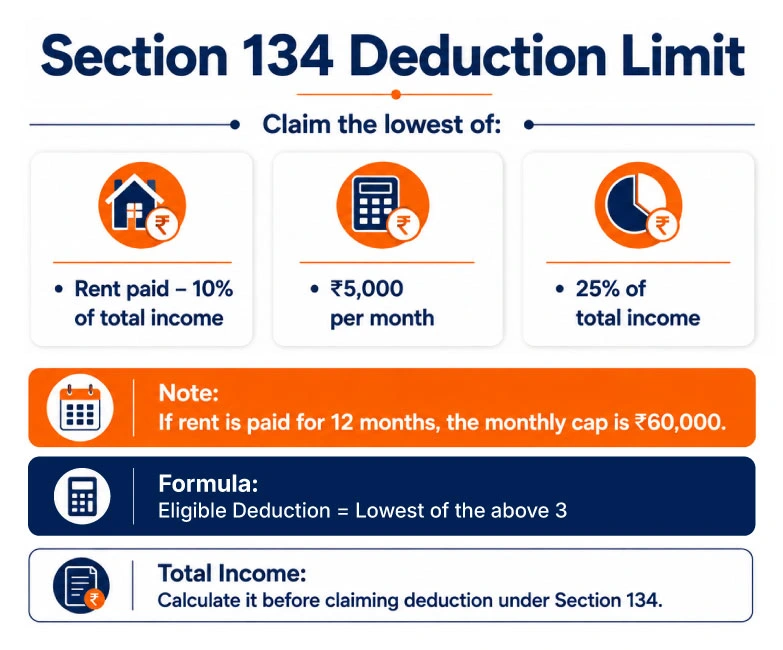
- Rent paid during the tax year minus 10% of total income;
- ₹5,000 for each eligible month; or
- 25% of total income for the tax year.
When eligible rent is paid for all 12 months, the monthly limit gives a maximum annual ceiling of ₹60,000. However, ₹60,000 is not an automatic deduction. The taxpayer must calculate all three amounts and claim only the lowest amount.
Formula for Calculating the Deduction
Eligible deduction = Lowest of:
- Annual rent paid minus 10% of total income;
- ₹5,000 multiplied by the number of eligible months; or
- 25% of total income.
Where rent is paid for only part of the tax year, the ₹5,000 monthly limit should be applied only to the eligible months. For example, where eligible rent is paid for six months, the monthly ceiling would be ₹30,000.
Meaning of Total Income
For Section 134 of the Income Tax Act, 2025, the expressions “10% of total income” and “25% of total income” mean total income calculated before allowing the deduction under this section. The taxpayer should not first subtract the rent deduction and then calculate the percentages on the reduced amount. The calculation must begin with total income before allowing the Section 134 deduction.
Example of Rent Deduction Calculation
Suppose an individual has a total income of ₹4,00,000 and pays annual rent of ₹1,20,000.
|
Calculation |
Amount |
|
Annual rent paid |
₹1,20,000 |
| Less: 10% of total income |
₹40,000 |
|
Rent paid minus 10% of total income |
₹80,000 |
| ₹5,000 per month for 12 months |
₹60,000 |
|
25% of total income |
₹1,00,000 |
The lowest amount is ₹60,000. Therefore, the taxpayer may claim a deduction of ₹60,000, provided all other conditions are fulfilled.
The calculation should be completed separately for every tax year based on the actual rent paid, eligible rental period and total income of the taxpayer.
When Is the Deduction Not Allowed?
Section 134 of the Income Tax Act, 2025 does not allow the deduction in certain circumstances.
1. Property Owned at the Place of Residence or Work
The deduction is not available where residential accommodation is owned by:
- The taxpayer;
- The taxpayer’s spouse;
- The taxpayer’s minor child; or
- The Hindu Undivided Family, of which the taxpayer is a member.
This restriction applies to property situated at the place where the taxpayer ordinarily resides, performs employment duties or carries on a business or profession.
For example, a taxpayer who owns residential accommodation at the place where they ordinarily reside, perform employment duties or carry on business may not qualify merely because they choose to live in another rented property.
2. Property Owned at Another Place
The deduction may also be unavailable where the taxpayer owns residential accommodation at another place, occupies that accommodation and its value is required to be determined under Section 21(6) or Section 21(7)(a).
The ownership, occupation, and tax treatment of a property located in another city should therefore be reviewed before the deduction is claimed.
3. Receipt of income covered by the prescribed HRA exemption provision
A taxpayer cannot claim the deduction when they have income falling under Schedule III, Table Sl. No. 11.
This restriction prevents overlapping relief through an HRA-related exemption and the deduction under Section 134 of the Income tax Act, 2025.
Salaried taxpayers should check their salary structure and Form 130, earlier known as Form 16, before making the claim.
Individuals who are unsure whether their salary allowance qualifies as HRA may seek professional tax consultancy services before claiming the deduction.
Documents and Details to Keep for Claiming the Deduction
Individuals claiming the deduction should maintain the following supporting documents and information:
- A valid rent agreement;
- Monthly or annual rent receipts;
- Rent payment details, including the amount and mode of payment;
- The complete address of the rented accommodation;
- The period for which the accommodation was occupied;
- The landlord’s name, PAN, and address; and
- Other supporting records relevant to the claim.
The taxpayer must furnish the prescribed declaration in Form 31 under Rule 65 of the Income-tax Rules, 2026. The form requires details relating to the rent paid, mode of payment, rented accommodation, rental period, and landlord. Form 31 is the corresponding declaration under the new law for the deduction earlier claimed through Form 10BA.
The information provided in Form 31, rent receipts, payment records, rent agreement, and income tax return should be consistent. Proper records can support the deduction if the Income Tax Department asks the taxpayer to verify the claim.
Claim Your Rent Deduction with Ebizfiling
Claiming a rent deduction under Section 134 of the Income Tax Act requires correct calculation, proper documents and compliance with HRA and property ownership conditions. Any error may lead to the deduction being reduced or disallowed.
Ebizfiling can help you:
- Check your eligibility under Section 134;
- Calculate the allowable rent deduction;
- Review rent receipts and payment records;
- Prepare and file Form 31;
- Report the deduction correctly in your income tax return; and
- Respond to related income tax queries.
Need help claiming your rent deduction? Contact Ebizfiling today for expert assistance with Section 134 compliance and income tax return filing.
Conclusion
Section 134 of the Income tax Act, 2025 provides tax relief to eligible assessees who pay rent for accommodation occupied as their own residence. It corresponds to old Section 80GG of the Income tax Act, 1961. The allowable deduction is the lowest of rent paid minus 10% of total income, ₹5,000 per eligible month or 25% of total income. Taxpayers should check their HRA income, property ownership, residential use, Form 31 filing requirement and supporting documents before claiming the deduction under Section 134 of the Income tax Act, 2025.
Suggested Reads:
Frequently Asked Questions
1. Can a self-employed individual claim rent deduction without HRA?
Yes, a resident individual, including a freelancer or self-employed person, may claim the deduction if rent is paid for their own residence and all conditions under Section 134 are met. The prescribed declaration in Form 31 must also be furnished. Ebizfiling can help verify eligibility and calculate the allowable deduction.
2. Can rent paid to parents qualify under Section 134 of the Income Tax Act?
Rent paid to parents may qualify if the arrangement is genuine, the parent owns the property, and the taxpayer actually lives there. Rent receipts and payment records should be maintained, and the rental income may be taxable in the parent’s hands.
3. Can rent paid to a spouse be claimed as a deduction?
No, the deduction is not available if the residential accommodation is owned by the taxpayer’s spouse at the place where the taxpayer ordinarily resides, works or carries on a business or profession. Paying rent to the spouse does not remove this ownership restriction.
4. Can I claim the deduction if I own a house in another city?
Owning a house in another city does not always disqualify the taxpayer. However, the use and tax treatment of that property must be checked, especially where it is occupied by the taxpayer or covered under Section 21(6) or 21(7)(a).
5. How is the deduction calculated for part of the year?
The ₹5,000 monthly limit applies only to the months for which eligible rent is paid. The final deduction remains the lowest of rent paid minus 10% of total income, ₹5,000 per eligible month or 25% of total income.
6. Can rent paid for two houses during the year be included?
Rent paid for two houses may be considered where the taxpayer changes residence during the tax year and each accommodation was occupied as their own residence during the respective period. Separate rent receipts, landlord details, and payment records should be maintained.
7. Is a registered rent agreement compulsory?
A registered rent agreement is not the only proof required, but keeping a valid rent agreement is advisable. Rent receipts, payment details, landlord information, and the details reported in Form 31 should support the claim.
8. Can HRA exemption and Section 134 deduction be claimed together?
No, a person receiving income covered under Schedule III, Table Sl. No. 11 cannot claim the deduction under Section 134 of the Income Tax Act. Taxpayers should review their salary structure before claiming a rent-paid deduction without HRA.
9. Is Form 31 compulsory for claiming the deduction?
Yes, the taxpayer must furnish the prescribed declaration in Form 31 and provide the required rent, accommodation, payment and landlord details to support the claim.
10. What happens if the rent deduction is claimed incorrectly?
An incorrect calculation, unsupported rent payment, or incomplete Form 31 may result in the deduction being adjusted or questioned. Ebizfiling can help review the calculation, documents and filing details before the return is submitted.




Income Tax Return Filing
Simplify your tax filing with reliable Income Tax Return services and end-to-end compliance support.
About Ebizfiling -



October 6, 2026 By Srishti M
October 7, 2026 By Srishti M
October 3, 2026 By Srishti M
Revised ITR Under Old Tax Regime: Change Rules Explained Overview A salaried taxpayer may file an Income Tax Return under the new tax regime and later realise that the old tax regime could be more suitable because of eligible deductions […]