


-
September 22, 2026
-
BySiddhi R
Tax Saving Schemes in India: Best Investments & Tax Saving Options
Introduction
Tax planning helps taxpayers reduce their tax liability legally while supporting long-term financial goals. In India, taxpayers can use tax saving schemes, eligible investments, insurance payments, housing-related deductions and other permitted expenses to reduce taxable income, depending on the tax regime chosen.
From 1 April 2026, the Income-tax Act, 2025 applies to tax years beginning on or after that date. Many familiar provisions have been renumbered. For example, the earlier Section 80C framework is now broadly covered by Section 123 read with Schedule XV. Therefore, taxpayers should check the current provision and tax regime before choosing tax saving investments.
Key Takeaways
- Tax saving schemes can help reduce taxable income while supporting long-term financial goals, depending on the tax regime selected.
- Under Section 123 of the Income-tax Act, 2025, eligible individuals and HUFs can claim up to ₹1.5 lakh for qualifying investments and payments.
- Eligible NPS contributions may provide an additional deduction of up to ₹50,000 under Section 124(3), subject to conditions.
- Health insurance, home-loan interest, rent payments, education-loan interest and eligible donations can also provide tax benefits under the applicable provisions.
- Taxpayers should compare the old and new tax regimes before choosing tax saving investments, as many deductions are restricted under the new tax regime.
How to Save Income Tax in India?
Tax planning should ideally begin at the start of the tax year. Waiting until year-end may lead to unsuitable investments or missed deductions.
Start by identifying payments already made during the year, such as life insurance premiums, provident fund contributions, eligible tuition fees, health insurance premiums, home-loan repayments or NPS contributions.
Under Section 123 of the Income-tax Act, 2025, an individual or HUF can claim a deduction of up to ₹1.5 lakh for eligible amounts listed in Schedule XV. This broadly corresponds to the earlier Section 80C deduction. Taxpayers searching for Section 80C tax saving investments should check the current provision for Tax Year 2026-27 onward.
Taxpayers should select tax saving schemes according to their financial goals, risk tolerance, liquidity needs and investment horizon.
What Are the Best Tax Saving Schemes in India?
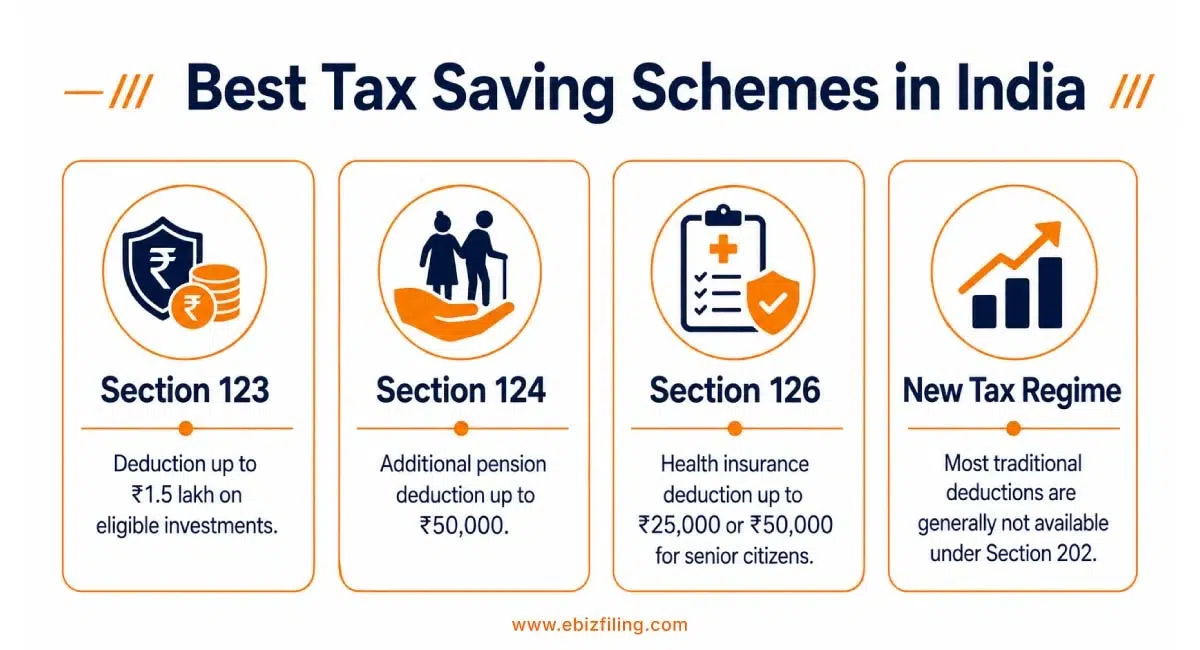
- Section 123: Eligible individuals and HUFs can claim up to ₹1.5 lakh for qualifying payments and investments listed in Schedule XV.
- Section 124: Eligible pension-scheme contributions can qualify for deduction. An individual’s qualifying contribution may provide an additional deduction of up to ₹50,000 under Section 124(3). However, Section 124(3) is generally not available under the default new tax regime. Eligible employer contributions under Section 124(1) and 124(2) receive separate treatment and remain permitted under Section 202.
- Section 126: This provision covers health insurance and broadly replaces the earlier Section 80D. The normal limit is ₹25,000 for self and family and a separate ₹25,000 for parents. The relevant limit can increase to ₹50,000 where the insured person is a senior citizen.
These benefits matter when comparing tax saving options in India, especially because many traditional deductions are restricted under the default new tax regime. Section 202 permits only specified Chapter VIII deductions while computing income under the new regime.
Important: Most deductions discussed in this article, including Section 123, Section 124(3), Section 126, Section 129, Section 130, Section 133 and Section 134, are generally available only when the taxpayer opts out of the default new tax regime. Under Section 202, only specified Chapter VIII deductions, including eligible employer pension contributions under Section 124(1) and 124(2), remain available.
Invest Your Money in Government-Backed Schemes
Several government-backed or notified tax saving schemes can combine savings with tax planning. Taxpayers can include eligible investments listed in Schedule XV within the overall ₹1.5 lakh limit under Section 123.
Common options include:
- Public Provident Fund (PPF)
- Senior Citizens’ Savings Scheme (SCSS)
- Sukanya Samriddhi Scheme
- Eligible provident fund contributions
- Five-year tax-saving bank deposits
NPS is also an important retirement-oriented option, but its deduction is governed separately under Section 124. Taxpayers should compare the lock-in period, expected return, liquidity and risk before investing in any tax saving schemes.
Donation for Saving Tax
Eligible donations can provide a tax deduction. Under Section 133 of the Income-tax Act, 2025, which broadly corresponds to the earlier Section 80G, qualifying donations may be eligible for a 100% or 50% deduction depending on the specified fund or institution and applicable limits.
A donation exceeding ₹2,000 qualifies for deduction only when made through a mode other than cash. Taxpayers should use traceable payment methods and verify the recipient’s eligibility before claiming the deduction.
Exemption under House Rent Allowance and Rent Paid
Salaried taxpayers receiving House Rent Allowance may claim the applicable HRA exemption when the prescribed conditions are satisfied. However, this HRA exemption is generally not available when income is computed under the default tax regime under Section 202.
A resident individual who does not receive HRA may examine the rent deduction available under Section 134, subject to the prescribed conditions:
- Rent paid over 10% of total income;
- ₹5,000 per month; or
- 25% of total income.
Rent benefits are not tax saving schemes themselves, but they can reduce taxable income where the prescribed conditions are satisfied.
What Other Income Tax Saving Options Are Available?
- Health insurance: Section 126 allows eligible deductions for health insurance premiums, preventive health check-ups and, in specified cases, medical expenditure for uninsured senior citizens.
- Home-loan interest: Section 22 allows a deduction of up to ₹2 lakh for interest on borrowed capital for a qualifying self-occupied property, subject to prescribed conditions. This deduction is not available for such self-occupied property when income is computed under the default new tax regime under Section 202.
- Home-loan principal: Eligible principal repayment may form part of the ₹1.5 lakh Section 123 limit when the conditions under Schedule XV are satisfied.
- Additional home-loan interest: Section 130, corresponding to the earlier Section 80EE, allows an additional deduction of up to ₹50,000 only for qualifying loans sanctioned between 1 April 2016 and 31 March 2017, subject to other conditions. It should not be treated as a general deduction for every new home loan.
- Education loan: Section 129 allows a deduction for interest paid on an eligible loan taken for higher education, subject to the prescribed conditions.
When comparing income tax saving options, taxpayers should first compare the old and new tax regimes. Choosing tax saving schemes without checking regime eligibility may result in an investment that does not provide the expected deduction.
Tax Planning and Compliance Support from Ebizfiling
Choosing the right tax saving schemes depends on your income, investments, deductions and the tax regime applicable to you. Ebizfiling can help individuals and businesses understand available tax saving options in India, review eligible deductions and plan their taxes in line with current Income-tax provisions.
Ebizfiling can assist with:
- Comparing the old and new tax regimes
- Reviewing eligible deductions and exemptions
- Guidance on tax saving investments and NPS contributions
- Income tax return filing and tax computation
- Tax advisory for complex income or investment situations
- Compliance support under the Income-tax Act, 2025
Need expert support with tax planning and business decisions? Ebizfiling offers professional Tax Consultancy and Business Advisory Services to help you evaluate tax implications, identify eligible deductions, structure transactions, and make informed financial decisions under applicable tax laws.
Conclusion
There are several legal ways to reduce taxable income in India, including tax saving schemes, eligible investments, health insurance, housing-related deductions, NPS contributions, rent benefits and qualifying donations. Each deduction has its own eligibility conditions, limits and tax-regime restrictions.
For Tax Year 2026-27 onward, taxpayers should refer to the Income-tax Act, 2025 and the corresponding new section numbers rather than relying only on older Section 80C, 80D or 80G references. The best approach is to compare both tax regimes, review existing deductions and choose tax saving schemes that match financial goals and tax-planning needs.
Frequently Asked Questions
1. Can a salaried taxpayer change the tax regime every year after making tax saving investments?
Yes. A taxpayer without business or professional income can generally choose between the old and new tax regimes for each tax year while filing the return within the prescribed timeline. Taxpayers with business or professional income have more restrictive switching rules, so the regime should be reviewed before making tax saving investments solely for deductions.
2. Can both husband and wife claim tax benefits on the same joint home loan?
Yes, provided both spouses are **co-owners and co-borrowers**, satisfy the applicable conditions and bear their respective share of the loan repayment. Each spouse should claim only the deduction attributable to their ownership share and eligible interest or principal payment.
3. Can school fees for children be included in Section 80C tax saving investments?
Eligible tuition fees for full-time education can form part of the deduction now covered under Section 123 read with Schedule XV. However, development fees, donations and similar payments do not qualify, and the benefit is restricted to tuition fees paid for the full-time education of up to two children of an individual in an educational institution situated in India.
4. Is interest earned on a five-year tax-saving fixed deposit also tax-free?
No. The qualifying investment in a five-year notified bank term deposit may be considered among eligible tax saving schemes, but this does not make the interest automatically tax-free. Interest from bank and post-office deposits is reportable as interest income in the income-tax return.
5. Does the three-year lock-in of ELSS mean that the redemption gains are completely tax-free?
No. The ELSS lock-in period and the tax treatment of gains are separate matters. Long-term capital gains from eligible equity-oriented mutual fund units are governed by Section 198 of the Income-tax Act, 2025; qualifying long-term gains exceeding ₹1.25 lakh are currently taxable at 12.5%, subject to the conditions of that section.
6. Can employer NPS contributions still provide a tax benefit under the new tax regime?
Yes. Employer contributions to an eligible pension scheme receive separate treatment from an employee’s personal tax saving investments. Section 202 permits specified deductions even under the new tax regime, so employer NPS contributions should be examined separately rather than treating them like ordinary Section 123 investments.
7. Can the same NPS contribution be claimed under both Section 123 and Section 124?
No. The same qualifying contribution cannot be used to obtain duplicate deductions. When evaluating income tax saving options, taxpayers should identify the correct provision under which an NPS contribution is being claimed and ensure that the same amount is not counted twice.
8. Can an eligible deduction be claimed in the ITR if investment proof was not submitted to the employer?
Yes. Failure to submit investment proof to the employer does not automatically prevent an otherwise eligible deduction from being claimed. If the taxpayer satisfies the applicable conditions, has valid supporting documents and has selected a tax regime that permits the deduction, the claim may generally be made while filing the income-tax return. Relevant receipts and investment records should be retained.
9. Which tax saving schemes are suitable for taxpayers having salary, rental income and capital gains?
The suitability of tax saving schemes depends on total taxable income, different sources of income, deductions already available and the tax regime selected. Additional investments may not always reduce the final tax liability. Ebizfiling can assist with reviewing the income structure, comparing tax regimes and identifying suitable tax saving options in India before filing the return.
10. Is investing the full ₹1.5 lakh necessary to claim benefits under Section 123?
No. Existing eligible payments such as provident fund contributions, tuition fees, insurance premiums and qualifying housing payments may already utilise part of the ₹1.5 lakh limit. Additional tax saving investments should be considered only after calculating the unused deduction limit and assessing financial goals. Ebizfiling can assist with tax computation and deduction review to determine whether further investment is required for tax planning.





ITR Filing
Filing of Income Tax return is necessary if you have earned any income. File your ITR with EbizFiling
About Ebizfiling -



Reviews
Amrish Ganatra
28 Nov 2017"Our Company being an Indian Subsidiary requires much compliance, but ebizfiling has provided us end to end services. They are very important part of our business. They handle all of the legal tasks in India. I highly recommend ebizfiling for non-residents thinking of starting a project in India."
Hemang Malhotra
08 Oct 2018I was new as an Entrepreneur when I had seen their post on social media. I contacted them regarding proprietorship and realized they their pricing is incomparable in the market also their services are really prompt. Thank you, Ebizfiling.
Kartar Singh Sandil
09 Mar 2018Your working team is genius. Thanks.
September 7, 2026 By Steffy A
Health Insurance Deduction Under Section 126: Rules & Limits Introduction Health insurance protects families from rising medical costs and can also provide a tax benefit when the legal conditions are satisfied. Section 126 of the Income Tax Act, 2025 provides […]
August 29, 2026 By Steffy A
OPC Compliance Calendar September 2026: Key Due Dates Introduction The OPC Compliance Calendar September 2026 lists the major tax, GST, labour law, and ROC obligations that One Person Companies may need to complete during the month. September includes important compliances […]
August 29, 2026 By Steffy A
TDS and TCS Compliance Calendar September 2026: Key Deadlines Introduction The TDS and TCS Compliance Calendar September 2026 helps deductors, collectors, government offices, property buyers and eligible individuals or HUFs identify the forms applicable to them. Reviewing these requirements in […]