


-
August 7, 2026
-
BySteffy A
Section 80GG Deduction: Limit, Eligibility and Form 10BA
Introduction
Section 80GG deduction allows eligible taxpayers who pay rent but do not receive House Rent Allowance to claim a deduction under the old tax regime. For income earned during FY 2025–26 and reported in AY 2026–27, the deduction continues to be governed by Section 80GG of the Income tax Act, 1961, and Form 10BA must be filed before submitting the Income Tax Return.
For income earned during Tax Year 2026–27, beginning on 1 April 2026, the corresponding deduction is governed by Section 134 of the Income tax Act, 2025, and Form 31 applies. The maximum monthly limit remains ₹5,000, subject to the prescribed income and rent-based calculation conditions.
What Is Section 80GG Deduction?
Section 80GG is a provision under Chapter VI-A of the Income tax Act, 1961 that allows eligible taxpayers to claim a deduction for rent paid for furnished or unfurnished residential accommodation occupied for their own residence.
It is particularly relevant for self-employed individuals, freelancers, and salaried employees whose salary structure does not include HRA.
To claim this deduction, the taxpayer must file Form 10BA, a mandatory declaration confirming the rent paid and compliance with the prescribed ownership and HRA-related conditions.
The acknowledgement number of Form 10BA must be entered in Schedule 80GG while filing the Income Tax Return (ITR).
Section 80GG Deduction Eligibility Criteria
To claim a deduction under Section 80GG, the taxpayer must satisfy the following conditions:
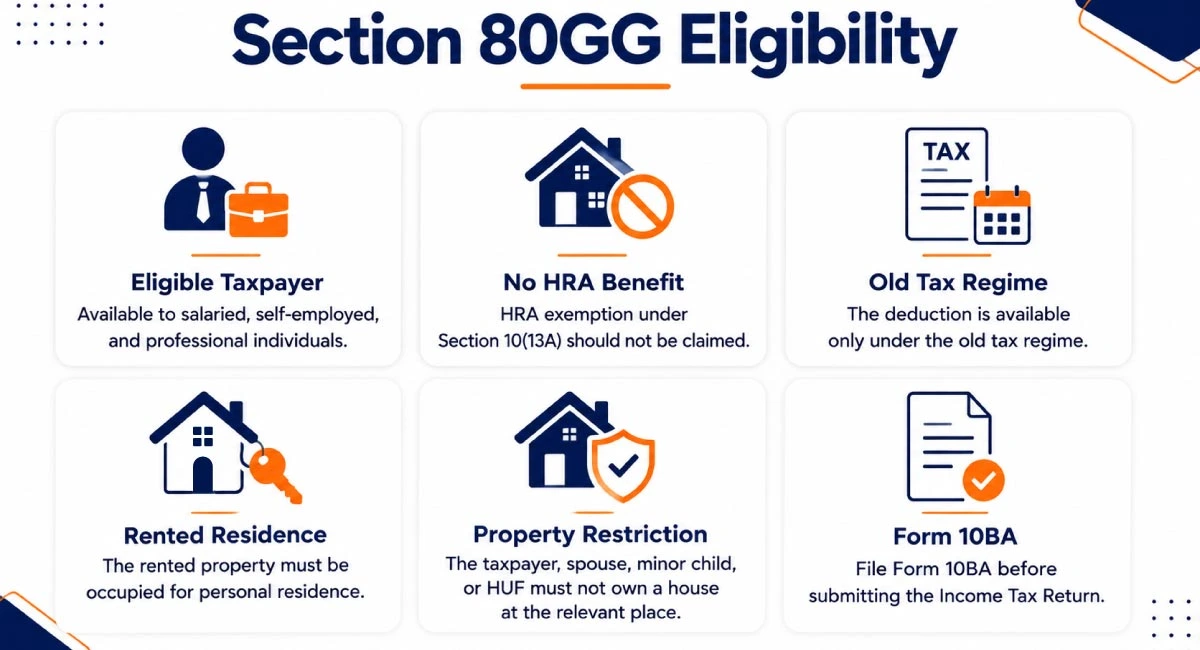
Eligible Taxpayers
The deduction may be claimed by an eligible individual, whether salaried, self-employed, or engaged in a profession.
In the case of an individual, the taxpayer may be salaried or self-employed. However, the deduction cannot be claimed for a period for which the taxpayer claims HRA exemption under Section 10(13A).
Old Tax Regime Requirement
Section 80GG is a Chapter VI-A deduction and is not available under the new tax regime. The taxpayer must opt for the old tax regime to claim it.
Residential Rent Requirement
The taxpayer must actually occupy the rented furnished or unfurnished accommodation for residential purposes.
Residential Property Ownership Conditions
The taxpayer, spouse, minor child, or the HUF of which the taxpayer is a member must not own residential accommodation at the place where the taxpayer ordinarily resides, performs employment duties, or carries on business or profession.
If the taxpayer owns a residential property at another place, the deduction may still be available only if that property is not treated as self-occupied under the applicable provisions.
Form 10BA Filing Requirement
Form 10BA must be filed before filing the ITR. It contains details such as the rented premises, period of occupation, rent paid, landlord details, and the required ownership declaration.
How to Claim Section 80GG Deduction?
1. Confirm Your Eligibility
Check whether you satisfy the prescribed conditions. You must not have HRA income covered under Section 10(13A), and the relevant residential-property ownership restrictions must be met.
You must also opt for the old tax regime.
2. Prepare Your Rent Documentation
Maintain rent receipts, a rental agreement or lease deed, and proof of rent payment. Enter the landlord’s name and complete address correctly in Form 10BA. For claims under Section 134 using Form 31, keep the landlord’s PAN and address ready, as these details are required in the form.
3. File Form 10BA Online
Log in to the Income Tax e-filing portal and file Form 10BA before submitting the Income Tax Return. The form records the rented property, period of occupation, rent paid, landlord details, and the prescribed ownership declaration. After submission, keep the acknowledgement number ready for reporting in Schedule 80GG of the applicable ITR.
4. Calculate Your Eligible Deduction Amount
Determine the lowest of the following three amounts:
- ₹5,000 for each eligible month for which rent is paid, subject to a maximum of ₹60,000 for 12 eligible months;
- 25% of adjusted total income; or
- Actual rent paid minus 10% of adjusted total income.
The lowest of these three amounts is the maximum deduction available under Section 80GG.
5. Claim the Deduction in Your Tax Return
After filing Form 10BA, enter its acknowledgement number and the eligible deduction amount in Schedule 80GG under Chapter VI-A of the applicable ITR. Select the old tax regime and complete the filing and verification of the return.
Section 80GG Deduction Calculation
The deduction allowed under Section 80GG is the least of the following three amounts:
₹5,000 Per Month
This limit is calculated at ₹5,000 for each eligible month, with a maximum of ₹60,000 where the conditions are satisfied for all 12 months.
25% of Adjusted Total Income
For Section 80GG calculation, adjusted total income generally refers to gross total income after reducing specified capital gains, income taxable at certain special rates, and eligible Chapter VI-A deductions other than Section 80GG. Taxpayers should use the amount computed in the applicable ITR utility because the calculation may vary according to the nature of income reported.
Actual Rent Paid Minus 10% of Adjusted Total Income
Calculate 10% of adjusted total income and deduct it from the actual rent paid during the financial year.
Example
If the adjusted total income is ₹6,00,000 and the annual rent paid is ₹1,80,000, the three amounts will be:
- ₹60,000;
- ₹1,50,000, being 25% of ₹6,00,000; and
- ₹1,20,000, being ₹1,80,000 minus ₹60,000.
The eligible deduction will therefore be ₹60,000, as it is the lowest amount.
Online CA Consultation for Section 80GG and ITR Filing
Confused about Section 80GG eligibility, Form 10BA filing, or the correct deduction amount? Ebizfiling’s Online CA Consultation for ITR helps you understand the applicable conditions and claim eligible deductions correctly.
Our tax experts can assist you with:
- Checking your Section 80GG eligibility
- Calculating the allowable rent deduction
- Reviewing rent receipts and supporting documents
- Guiding you on Form 10BA filing
- Helping you select the correct tax regime
Get expert guidance before filing your Income Tax Return.
Conclusion
Section 80GG deduction provides tax relief to eligible individuals and HUFs that pay rent for residential accommodation and satisfy the prescribed conditions. The deduction is available only under the old tax regime and is calculated as the lowest of ₹5,000 per month, 25% of adjusted total income, or actual rent paid minus 10% of adjusted total income.
To claim the deduction, taxpayers must satisfy the applicable ownership conditions, maintain supporting rent documents, file Form 10BA and report its acknowledgement number in Schedule 80GG. From Tax Year 2026–27, eligible resident individuals can claim the corresponding deduction under Section 134 of the Income tax Act, 2025 by filing Form 31.
Frequently Asked Questions
1. Is Section 80GG deduction available when HRA is reported in Form 16?
Section 80GG deduction is generally not available where HRA income covered under Section 10(13A) is reported in Form 16. A case involving HRA for only part of the year should be reviewed carefully before claiming the deduction.
2. Can an NRI or HUF meet the Section 80GG eligibility conditions?
A resident or non-resident individual may claim Section 80GG deduction if the prescribed conditions are satisfied. An HUF may also be eligible, subject to the rent-payment, residential-use and property-ownership conditions. However, Form 31 under the Income tax Act, 2025 is officially prescribed for eligible resident individuals.
3. Is deduction for rent paid to parents allowed under Section 80GG?
Generally, rent paid to parents may qualify if the property is genuinely owned by the parent, the taxpayer actually occupies it, and the rent payment is properly documented. The taxpayer should not be a co-owner, and the parent should report the rent received as taxable rental income where applicable. This follows from the ownership and rent-payment conditions prescribed for the deduction.
4. Is the landlord’s PAN mandatory for Form 10BA filing?
The prescribed Form 10BA asks for the landlord’s name and complete address but does not separately specify the landlord’s PAN. However, Form 31 under Section 134 of the Income tax Act, 2025 specifically requires the landlord’s PAN and address.
5. Can rent deduction without HRA be claimed without a registered rent agreement?
A registered rent agreement is not expressly listed as a mandatory condition for Section 80GG. However, the taxpayer should maintain Form 10BA, rent receipts, payment records, landlord details, and other evidence proving that the rented property was occupied as their residence.
6. What happens in the Section 80GG calculation if rent does not exceed 10% of adjusted total income?
If the actual rent paid is equal to or lower than 10% of adjusted total income, the “rent minus 10% of adjusted total income” calculation will be zero or negative. Since the allowable amount is the lowest of the three calculations, no Section 80GG deduction would generally be available.
7. Is Section 80GG for self-employed taxpayers subject to Form 10-IEA?
Self-employed individuals and taxpayers with business or professional income may claim Section 80GG under the old tax regime. Where required, they must file Form 10-IEA within the prescribed due date to opt out of the default new tax regime, in addition to completing Form 10BA filing before submitting the ITR.
8. Does Form 10BA continue under Section 134 of the Income tax Act, 2025?
No. Form 10BA applies to Section 80GG claims governed by the Income tax Act, 1961. From Tax Year 2026–27, an eligible resident individual claiming the corresponding deduction under Section 134 must furnish Form 31 along with the return of income.
9. Can Ebizfiling check whether I qualify for the full Section 80GG deduction limit?
Yes. Ebizfiling’s Online CA Consultation for ITR can help review your income, eligible rental period, property-ownership conditions, HRA details, and supporting records. A tax expert can calculate the lowest of the three prescribed amounts and determine whether your claim can reach the ₹60,000 annual limit.
10. How can Ebizfiling help me claim a house rent deduction under the old tax regime?
Ebizfiling can assist with Section 80GG eligibility review, deduction calculation, Form 10BA filing, old-regime selection, and reporting the acknowledgement details in Schedule 80GG. If the deduction was omitted or questioned, the team can review the return status and guide you on the available correction or notice-response process.





80G5 Registration of Income Tax Act
Register 80G5 of income tax in simple steps with Ebizfiling
About Ebizfiling -



October 14, 2026 By Srishti M
September 29, 2026 By Srishti M
Income Tax Compliance Calendar October 2026: Filing Guide Introduction The Income Tax Compliance Calendar October 2026 highlights important income tax obligations applicable to taxpayers, businesses and entities covered under audit and transfer pricing provisions. October 2026 includes key compliance […]
September 25, 2026 By Steffy A