EDF Filing will become an important FEMA compliance requirement for Indian service exporters from 1 October 2026. The new Foreign Exchange Management (Export and Import of Goods and Services) Regulations, 2026 introduce an express Export Declaration Form requirement for exports of services.
The change affects consulting firms, professional service providers, BPO/KPO businesses, software exporters, GCCs, and Indian subsidiaries billing overseas parent or group companies. This blog explains applicability, due dates, filing procedures, EDPMS reporting, and related compliance requirements.
Key Takeaways
EDF Filing for service exporters becomes applicable from 1 October 2026.
A service exporter can generally submit one EDF for services exported to one or more overseas recipients during a month.
The general filing timeline is within 30 days from the end of the month in which the invoice is raised.
The Authorized Dealer must enter the service EDF details into EDPMS within five working days of receiving the EDF.
Export proceeds generally need to be realized within 15 months from the invoice date, or 18 months where the export is invoiced or settled in Indian Rupees.
What Changes EDF Filing for Service Exporters Under FEMA 2026?
The regulations come into force on 1 October 2026 and supersede the Foreign Exchange Management (Export of Goods & Services) Regulations, 2015.
One of the major changes is the introduction of an express declaration requirement for service exports.
Export category
Up to 30 September 2026
From 1 October 2026
Ordinary non-software services
Generally no prescribed export declaration form
EDF required
Software exports
SOFTEX framework under existing regulations
EDF framework under 2026 Regulations
Goods exported through EDI port
Shipping Bill
EDF deemed to form part of Shipping Bill
Service export monitoring
Mainly receipt and repatriation monitoring
EDF and EDPMS monitoring
For the purposes of the 2026 Regulations, the term services also includes software.
What is an EDF Filing ?
EDF Filing refers to the process of submitting the Export Declaration Form (EDF), a prescribed FEMA declaration through which an exporter reports the export transaction and its full export value to the specified authority. The Export Declaration Form (EDF) is required for reporting eligible exports of services and helps ensure compliance with applicable foreign exchange regulations.
💡 Quick Insight
One invoice does not necessarily mean one separate EDF.
The regulations allow a service exporter that exports services to
one or more recipients during a month to submit a
single EDF covering those exports.
This can be particularly useful for businesses that raise multiple
foreign-client or inter-company invoices every month.
What Information Is Required for EDF Filing?
EDF Filing requires exporters to provide information related to the export transaction and its full export value. The Export Declaration Form records details such as exporter information, overseas recipient details, invoice particulars, service or export details, and other supporting transaction records.
The information provided during EDF Filing should correspond with the relevant invoices, payment records, and documents submitted to the specified authority or Authorised Dealer.
Annex I
Export Declaration Form (EDF)
Foreign Exchange Management Act, 1999
Hover over any section to learn what it means
1. General Information
Customs Security No.
Form No.
Nature of Cargo
□ Goods□ Services□ Others
Shipping Bill No. & Date
Mode of Transport
□ Air□ Sea□ Land□ Courier□ Internet
Category of Exporter
□ DTA□ SEZ□ 100% EOU□ Others
RBI Approval No.
IE Code
AD Code
Exporter Details
Exporter's Name & Address
GSTIN
AD Bank Name & Address
Consignee Details
Buyer's Name & Address
Country
Mode of Realisation
□ L/C□ Bank Guarantee□ Advance□ Remittance□ Others
Export Details
Port of Loading
Country of Destination
Port of Discharge
LEO Date
Commodity Description
2. Invoice Details
Particular
Reference / Currency
Value
Invoice No.
Invoice Date
Invoice Currency
Contract Nature
FOB / CIF / C&F / Other
FOB Value
Freight
Insurance
Commission
Deductions
Net Realisable Value
3. Declaration
I/We declare that the particulars stated in this Export Declaration Form are true and correct and that the full value of the goods/services exported will be realised and dealt with in accordance with the Foreign Exchange Management Act, 1999 and applicable regulations.
Date / Place
Signature of Exporter / Authorised Signatory
Customs Authority Section
For certification / endorsement by the designated Customs or specified authority.
Date
Signature / Stamp of Authorised Official
AD Bank Section
AD Bank Reference / Acknowledgement / Verification
AD Bank Reference
Bank Stamp / Signature
Exporters should also check the documentation and submission procedure prescribed by their respective AD bank. RBI requires Authorised Dealers to maintain documented policies and SOPs covering documents, timelines, charges and related processes.
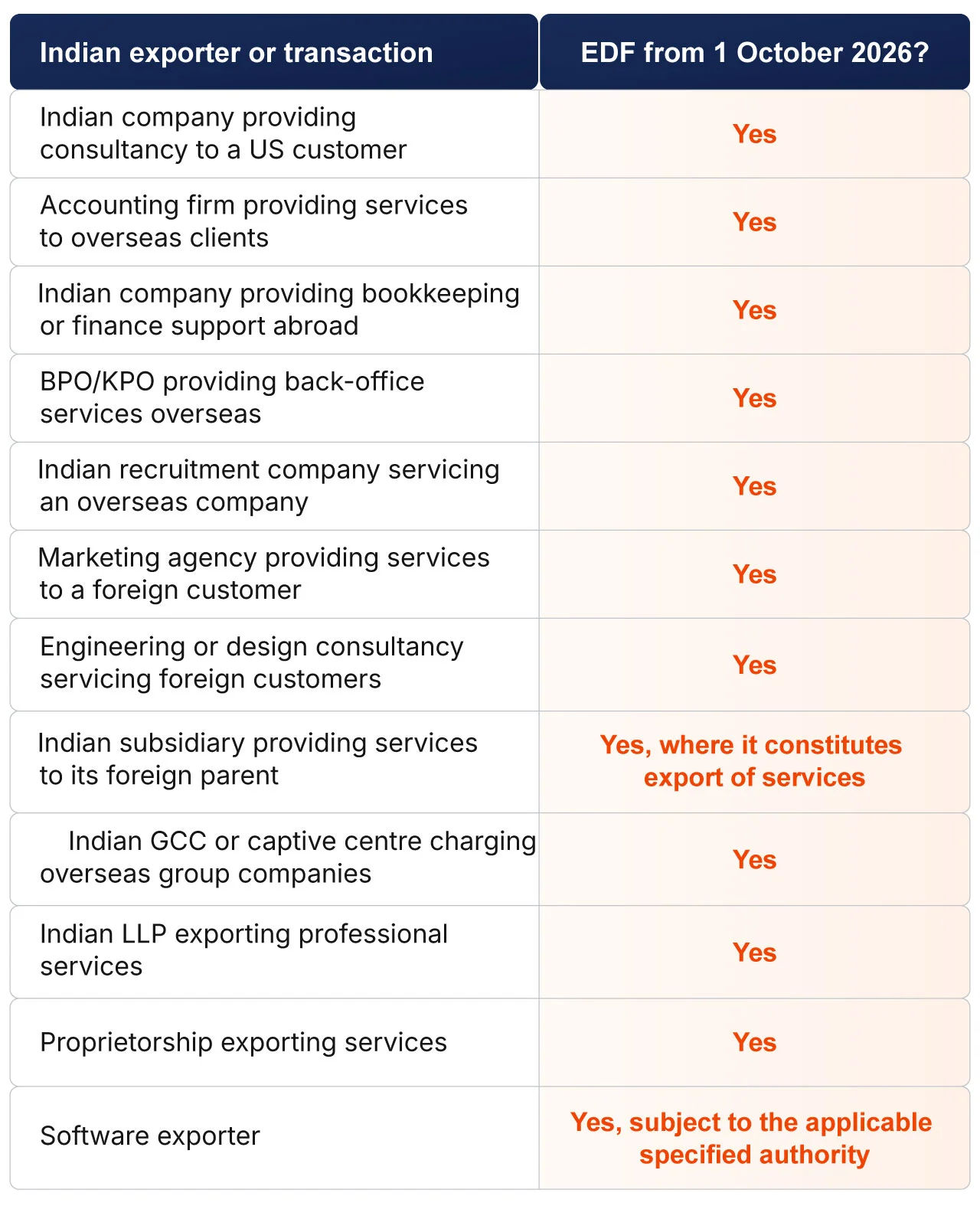
Who must file an EDF for export of services?
The regulation does not restrict the requirement to large companies, IT companies, or independent third-party exports.
If there is a provision of services from India to a person outside India, the transaction can constitute an export for FEMA purposes.
Typical examples include:
The 2026 Regulations do not provide a general exemption merely because an exporter is small, its customer is a related party, or the exporter is not registered under GST in a particular case.
Is EDF required when an Indian subsidiary invoices its foreign parent?
Yes, where the Indian subsidiary is actually providing services from India to the overseas parent.
Consider a hypothetical example.
ABC India Private Limited is a wholly owned subsidiary of ABC Inc., USA. ABC India employs staff in India and provides:
Finance and accounting support
Bookkeeping
HR and recruitment support
Management services
Compliance coordination
Marketing support
Research
Administrative services
Customer support
Other back-office services
ABC India raises monthly invoices on ABC Inc. under an inter-company service agreement, possibly using a cost-plus transfer-pricing model.
The transaction does not fall outside the EDF framework simply because ABC Inc. owns ABC India.
Where ABC India provides services from India to its overseas parent:
ABC India = Service exporter → ABC Inc. = Overseas recipient → EDF filing must be examined and complied with.
The 2026 Regulations do not provide a general related-party exemption from the service EDF requirement.
Suppose ABC India raises the following invoices in October 2026:
Invoice
Overseas recipient
Nature of service
Value
INV-101
ABC Inc., USA
Finance and accounting support
USD 30,000
INV-102
ABC Inc., USA
Management support
USD 10,000
INV-103
XYZ Group Ltd., UK
Business support
GBP 8,000
ABC India does not necessarily need three separate EDFs.
The regulations allow one EDF to cover services exported to one or more recipients during a month. Therefore, the eligible October service exports may be consolidated into a single EDF.
What if the Indian subsidiary exports software?
Software is also covered under the 2026 service-export framework.
However, the specified authority differs depending on the type and location of the exporter.
Type of service
Specified authority
Non-software services from DTA
Authorized Dealer
Software from DTA
Authorised Dealer or STPI
Services or software from SEZ
Development Commissioner of SEZ
Businesses should first determine whether the underlying activity falls within the FEMA definition of software. A technology-enabled, support, or back-office activity should not automatically be classified as software merely because technology is involved.
Who may not need a service EDF?
The main question is whether the underlying transaction is an export of services from India.
Situation
Service EDF?
An Indian company provides services to another Indian company.
Generally no service-export EDF
Indian subsidiary invoices an Indian group company
No service-export EDF merely because the ultimate parent is overseas
An Indian company imports services from a foreign supplier.
No export EDF; import requirements apply separately.
A foreign customer receives services from India.
The foreign customer does not file; the Indian exporter files.
Receipt represents genuine equity or share capital.
Not a service-export transaction.
A receipt represents a genuine loan or capital transaction.
Not a service-export EDF transaction; separate FEMA rules may apply.
Dividend from overseas investment
Not a service export.
Pure reimbursement with no underlying service element
May fall outside service EDF depending on substance
Export of goods only
Service EDF does not apply; goods-export reporting applies.
The classification should be based on the actual substance of the transaction, not only on the description used on an invoice.
Are reimbursements received from foreign parents exempt?
Not automatically.
Calling an amount a “reimbursement of expenses” does not by itself establish that there is no service export.
If an Indian company performs functions for an overseas group entity and recovers the associated expenses, the underlying agreement, activities performed and basis of recovery should be reviewed.
EDF classification under FEMA should also be considered separately from GST, income tax, transfer pricing and accounting treatment.
The service-export EDF provision itself does not prescribe a general minimum invoice threshold.
The 2026 Regulations separately use the ₹10 lakh threshold for certain EDPMS closure and reduction or non-realization procedures.
For example, where a service invoice is up to ₹10 lakh or its equivalent in foreign currency, an EDPMS entry may be closed on the basis of an exporter declaration regarding realisation. RBI also allows quarterly declarations for bulk closure in specified cases.
Therefore:
Invoice below ₹10 lakh ≠ automatic exemption from EDF filing.
When must a service exporter file the EDF?
Regulation 3(2) lays down the general rule that an exporter of services must furnish EDF within 30 days from the end of the month in which the service invoice is raised.
For example:
An invoice raised on 5 October 2026, 20 October 2026 or 31 October 2026 falls in the October reporting period.
The general 30-day timeline runs from the end of October, meaning the October EDF would ordinarily be submitted by 30 November 2026.
A single EDF may include all eligible October service exports.
Special provision for non-software services
The regulation additionally states that an exporter of services other than software may submit an EDF on or before the date of receipt of payment.
This is important, but it should not be read as saying that EDF filing itself is optional.
The underlying obligation uses mandatory language: an exporter of services “shall furnish” an EDF.
The provision relating to receipt of payment concerns the timing of submission for non-software services. Exporters should follow the operational SOP issued by their respective AD bank on how this option will be implemented.
The AD bank may also extend the period for submission where the exporter requests an extension, gives reasons for the delay, and the AD is satisfied with those reasons.
How will a non-software service exporter file EDF?
For a normal DTA service exporter, the process should broadly work as follows:
Maintain invoice-wise details of all services exported during the month.
Prepare the prescribed EDF covering the applicable export invoices.
Where appropriate, use a single consolidated EDF for multiple invoices and multiple overseas customers for the month.
Submit the EDF and supporting documents required under the AD bank’s SOP to the AD bank.
The AD bank records the service EDF in EDPMS, monitors receipt of the export proceeds, and closes or updates the transaction after realization.
RBI requires an AD to enter details of a service EDF into EDPMS within five working days of receiving the EDF from the exporter.
The Regulations also require every AD to maintain a documented internal policy and SOP dealing with export/import transactions, including documents, timelines and charges, and to disclose the main features of the SOP on its website.
Therefore, there may not be one identical customer-facing filing method across every bank. An exporter may ultimately submit through the bank’s trade portal, corporate banking system or another mechanism prescribed by that AD.
The exporter should follow its own bank’s published process.
Does the exporter directly upload the EDF into EDPMS?
Normally, no.
The regulation places the responsibility on the authorized dealer to enter its customer’s service EDF details into EDPMS within five working days after receiving the EDF.
So for an ordinary DTA non-software exporter, the practical chain is:
Exporter → AD bank → EDPMS
rather than:
Exporter → direct EDPMS filing
What happens after EDF is filed?
The filing creates an export record that can be tracked through EDPMS.
The AD bank must monitor the transaction and, once the export value is realized, mark off the corresponding entry in EDPMS.
Under the new regulations, the full export value of services generally has to be realized and repatriated within 15 months from the date of invoice.
Where the export is invoiced or settled in Indian rupees, the prescribed period is 18 months, subject to the regulations and permitted settlement framework. The AD may grant an extension where it is satisfied with the reasons for delay.
Does invoicing the foreign parent in INR avoid EDF?
No.
The EDF obligation and the currency in which an export invoice is denominated are separate issues.
The new regulations themselves contemplate exports being invoiced or settled in Indian Rupees and prescribe a separate 18-month realization period for such cases.
Accordingly, an Indian subsidiary cannot assume that an intercompany service invoice falls outside EDF merely because it is denominated in INR.
Does receiving payment through PayPal, Stripe or another payment platform remove the EDF requirement?
The method through which payment is collected does not by itself determine whether the transaction is an export of services.
If the underlying transaction is a service exported from India to a person outside India, the FEMA reporting requirement must be examined independently.
Exporters using payment gateways should particularly ensure that their invoice records, bank credits, purpose codes and EDF/EDPMS entries can ultimately be reconciled.
Does having or not having an IEC determine EDF applicability?
No. These are separate compliance questions.
IEC requirements arise primarily under the foreign trade framework administered by DGFT.
The EDF requirement discussed here arises under FEMA and the RBI’s Export and Import Regulations.
Whether a particular service exporter requires an IEC should therefore be analyzed separately; the presence or absence of an IEC should not by itself be used to determine whether a service transaction has to be declared under FEMA.
Practical checklist for Indian subsidiaries billing foreign parent companies
Indian subsidiaries that regularly raise inter-company invoices should review their process before 1 October 2026.
Particular attention should be given to the service agreement, nature of services, software versus non-software classification, invoice date, foreign parent/group-company details, invoice value and currency, AD bank through which receipts are routed, monthly EDF preparation, EDPMS reconciliation and realisation of outstanding export invoices.
For cost-plus arrangements, the final invoice amount reported for FEMA purposes should be capable of reconciliation with the invoice and the underlying inter-company arrangement.
EDF compliance should also be coordinated with the company’s GST, transfer-pricing, and accounting records, although those compliances operate under separate laws.
Planning or operating an Indian subsidiary?
Businesses with an Indian subsidiary that regularly invoices a foreign parent or overseas group company should review their FEMA, banking, transfer-pricing, and related compliance processes together.
Ebizfiling can assist businesses with Indian subsidiary setup and FEMA cross-border business advisory to understand the regulatory requirements connected with international operations.
Maintain a monthly service-export compliance tracker
containing:
Invoice number and date
Overseas recipient
Nature of service
Invoice currency and value
Authorised Dealer bank
EDF submission date
Payment receipt date
EDPMS status
How can Ebizfiling help with service export compliance?
Ebizfiling can assist businesses in reviewing connected compliance requirements for cross-border service transactions, including:
Reviewing FEMA requirements applicable to overseas service transactions
Understanding Indian subsidiary and foreign-parent transaction structures
Reviewing transfer-pricing considerations for inter-company transactions
Identifying GST and LUT requirements connected with service exports
Understanding IEC requirements separately from FEMA reporting
Reviewing cross-border business structures and related compliance requirements
Helping businesses prepare a compliance checklist for recurring overseas transactions
Actual EDF filing, EDPMS reporting, and regulatory processing remain subject to the procedure of the relevant authorized dealer and other competent authorities.
Contact Ebizfiling for EDF Filing Support.
Exporting services to overseas clients? Prepare for the new FEMA 2026 compliance framework with expert assistance.
Get support forEDF Filing Service, export documentation, and related FEMA compliance requirements.
Connect with Ebizfiling Experts Today.
Call: +91 9643203209 Email: info@ebizfiling.com
Conclusion
EDF filing will significantly change FEMA reporting for Indian service exporters from 1 October 2026. Businesses should identify whether their transactions qualify as service exports, determine the correct specified authority, and establish a monthly EDF and EDPMS reconciliation process.
Indian subsidiaries, GCCs, professional service firms, and other businesses with recurring overseas invoices should prepare their documentation and banking processes before the new framework takes effect.
Frequently Asked Questions
1. Is EDF filing mandatory for service exporters from 1 October 2026?
Yes. Regulation 3(2) of the 2026 Regulations states that an exporter of services shall furnish an EDF specifying the full export value of the services. The new regulations become effective from 1 October 2026.
2. Is EDF required when an Indian subsidiary invoices its foreign parent?
Yes, where the Indian subsidiary is providing services from India to its foreign parent. The regulations do not contain a general exemption simply because the overseas recipient is the holding company, parent company, or another related entity.
3. Can one EDF cover several invoices and foreign customers?
Yes. A service exporter may submit one EDF covering services exported to one or more recipients during a month. Therefore, qualifying multiple invoices raised during the same month can be included in a consolidated EDF.
4. Are service invoices below ₹10 lakh exempt from EDF filing?
No general EDF exemption is provided merely because an invoice is below ₹10 lakh. The ₹10 lakh provisions in the regulations relate to matters such as simplified EDPMS closure and reduction or non-realization procedures.
5. Where does a non-software service exporter file the EDF?
A non-software service exporter operating in the DTA generally furnishes the EDF to its authorized dealer. For an SEZ service exporter, the specified authority is the Development Commissioner of the SEZ.
6. What happens to software export reporting from 1 October 2026?
The 2026 Regulations include software within the meaning of services and prescribe the EDF framework. For a DTA software exporter, the specified authority can be the Authorized Dealer or STPI, while an SEZ unit reports to the Development Commissioner. Exporters should also follow applicable RBI, STPI and AD-bank operational instructions for transition to the new framework.
7. Does a service exporter directly update EDPMS?
Normally, no. The exporter furnishes the EDF to the applicable specified authority, and the AD bank is responsible for entering its customer’s service EDF details into EDPMS within five working days of receipt.
8. Is EDF required for reimbursement received from a foreign parent?
It depends on the substance of the transaction. A genuine reimbursement with no underlying service may require a different analysis, but describing a service charge as a reimbursement does not automatically remove it from the service-export framework. The underlying agreement, activities performed, and recovery mechanism should be reviewed.
9. Does invoicing an overseas customer in INR remove the EDF requirement?
No. The regulations specifically contemplate exports that are invoiced or settled in Indian Rupees. Such transactions have an 18-month realisation period, but INR invoicing does not itself create an EDF exemption.
10. Does receiving export payments through PayPal or Stripe remove EDF filing requirements?
Not by itself. The payment method does not change the nature of the underlying service transaction. Exporters using payment platforms should ensure that invoice details, remittances, bank credits, and EDF or EDPMS records can be properly reconciled and should follow their AD bank’s operating procedure.
EbizFiling is a concept that emerged with the progressive and intellectual mindset of like-minded people. It aims at delivering the end-to-end corporate legal services 0f incorporation, compliance, advisory, and management consultancy services to clients in India and abroad in all the best possible ways.
To know more about our services and for a free consultation, get in touch with our team on info@ebizfiling.com or call9643203209.
Author: steffy
Steffy Alvin is a Content Writer at Ebizfiling specializing in GST, income tax, and financial compliance content. She holds a degree in English Literature and a post-graduate qualification in Journalism and Mass Communication. She focuses on creating clear, engaging content that simplifies complex tax and financial concepts for businesses.
Compliance Calendar November 2026: Key Statutory Due Dates Introduction The compliance calendar November 2026 covers important statutory obligations under GST, Income Tax, TDS/TCS, Company Law, LLP regulations, EPF and ESI. It helps businesses identify the filings, payments and regulatory requirements […]
80G Approval Notice : How to Respond and Avoid Rejection Introduction Charitable trusts, societies, and other eligible institutions may receive an 80G Approval Notice from the Income Tax Department while their application for approval under Section 80G is being processed. […]
Hi, Welcome to EbizFiling!
Hello there!!! Let us know if you have any Questions.









October 10, 2026 By Srishti M
October 10, 2026 By Srishti M
Compliance Calendar November 2026: Key Statutory Due Dates Introduction The compliance calendar November 2026 covers important statutory obligations under GST, Income Tax, TDS/TCS, Company Law, LLP regulations, EPF and ESI. It helps businesses identify the filings, payments and regulatory requirements […]
October 9, 2026 By Srishti M
80G Approval Notice : How to Respond and Avoid Rejection Introduction Charitable trusts, societies, and other eligible institutions may receive an 80G Approval Notice from the Income Tax Department while their application for approval under Section 80G is being processed. […]