


-
August 1, 2026
-
BySteffy A
Section 153 of the Income Tax Act, 2025: Interest Deduction
Introduction
Section 153 of the Income tax Act, 2025 allows eligible individuals and HUFs to claim a deduction on interest from specified deposits. The limit is ₹10,000 for non-senior individuals/HUFs and ₹50,000 for resident senior citizens, including interest on time deposits. This deduction is not available under the default new tax regime under Section 202 and can be claimed only under the old tax regime. The Act came into force on April 1, 2026, and Section 153 combines the deductions previously covered under Sections 80TTA and 80TTB of the Income tax Act, 1961.
This blog explains the eligibility conditions, covered deposits, deduction limits, tax-regime restrictions, and differences between the new and old provisions.
What Is Section 153 of the Income tax Act, 2025?
Section 153 of the Income Tax Act provides a deduction from gross total income when an eligible assessee earns interest from deposits maintained with:
- A banking company
- A co-operative society carrying on banking business
- A specified Post Office
The deduction is not the same for every assessee. It depends on the taxpayer’s category and whether the interest arises from a savings account or a time deposit.
A non-senior individual or HUF can claim the deduction only against savings account interest. A resident senior citizen can claim it against interest from any eligible deposit account, including a time deposit.
Before Section 153 of the Income Tax Act came into effect, deductions for interest on deposits were covered under Sections 80TTA and 80TTB of the Income tax Act, 1961. Section 80TTA allowed non-senior individuals and HUFs to claim up to ₹10,000 on savings account interest, excluding time deposits. Section 80TTB allowed resident senior citizens to claim up to ₹50,000 on interest from savings accounts and time deposits.
Difference between Section 153 and Old Sections 80TTA and 80TTB
|
Basis |
Section 80TTA |
Section 80TTB |
Section 153 |
|
Applicable law |
Income tax Act, 1961 | Income tax Act, 1961 | Income tax Act, 2025 |
| Eligible assessee | Individual or HUF other than a resident senior citizen | Resident senior citizen |
Non-senior individual, resident senior citizen and HUF |
|
Maximum deduction |
₹10,000 | ₹50,000 | ₹10,000 or ₹50,000, depending on the assessee |
| Savings account interest | Allowed | Allowed |
Allowed |
|
Time-deposit interest |
Not allowed | Allowed | Allowed only for resident senior citizens |
| Fixed-deposit interest | Not allowed | Allowed |
Allowed only for resident senior citizens |
|
Structure |
Separate section | Separate section | Both provisions combined into one section |
| Tax-period terminology | Previous year | Previous year |
Tax year |
|
Post Office reference |
Indian Post Office Act, 1898 | Indian Post Office Act, 1898 | Post Office Act, 2023 |
| Change in basic limit | Not applicable | Not applicable |
No change in the ₹10,000 and ₹50,000 limits |
The principal change is the consolidation of two old provisions into Section 153 of the Income Tax Act. The eligibility conditions and basic deduction limits remain substantially the same.
Who Can Claim the Deduction?
Section 153(1) identifies three categories of eligible assessees:
- An individual who is not a senior citizen
- An individual who is a senior citizen
- A Hindu Undivided Family
Under the Income tax Act, 2025, a senior citizen means an individual who is resident in India and is 60 years of age or more at any time during the relevant tax year. Therefore, an individual must satisfy both the age and residential-status conditions to claim the ₹50,000 deduction.
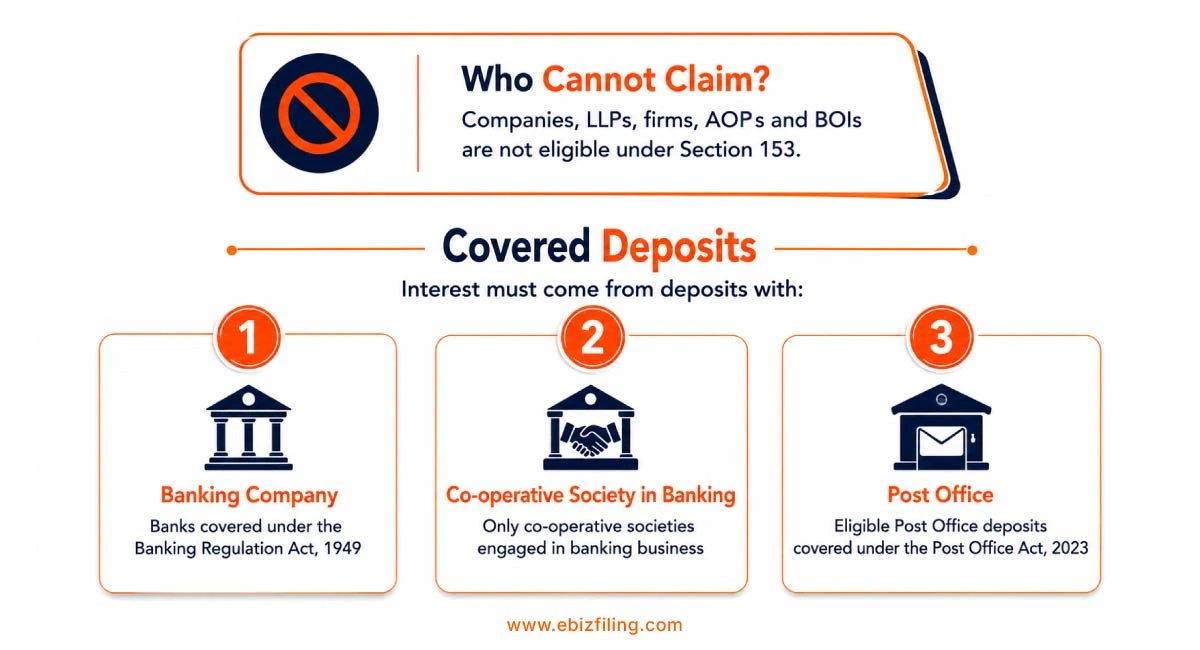
Companies, LLPs, partnership firms, Associations of Persons and Bodies of Individuals are not listed as eligible assessees under Section 153 of the Income Tax Act.
Deposits Covered under Section 153 of the Income Tax Act
The interest must arise from a deposit maintained with an institution specified in Section 153(1).
1. Banking Company
The deposit may be maintained with a banking company governed by the Banking Regulation Act, 1949.
This category also includes a bank or banking institution referred to in Section 51 of that Act.
2. Co-operative Society Engaged in Banking
Interest on a deposit with a co-operative society is covered only when the society carries on the business of banking.
The provision specifically includes:
- Co-operative land mortgage banks
- Co-operative land development banks
A co-operative society is not covered merely because it accepts money from its members. It must be engaged in banking business.
3. Post Office
Interest from eligible deposits maintained with a Post Office is also covered. For this purpose, the provision refers to a Post Office as defined under Section 2(d) of the Post Office Act, 2023.
₹10,000 Deduction for Non-Senior Individuals and HUFs
Section 153(2)(a) applies to:
- An individual who is not a senior citizen
- A Hindu Undivided Family
The deduction is equal to the actual eligible savings account interest or ₹10,000, whichever is lower.
For example, where the eligible savings account interest is ₹7,500, the entire ₹7,500 may be deducted. Where it is ₹16,000, the deduction is restricted to ₹10,000.
The ₹10,000 limit applies to the combined interest from all eligible savings accounts. It is not a separate limit for each account or each bank.
Interest from the following time deposits is not eligible for this category:
- Fixed deposits
- Term deposits
- Recurring deposits repayable after a fixed period
- Other deposits with a fixed maturity period
The interest from such deposits must not be included while calculating the ₹10,000 deduction.
₹50,000 Deduction for Senior Citizens
Section 153(2)(b) applies to an individual who qualifies as a resident senior citizen.
The deduction is equal to the actual eligible deposit interest or ₹50,000, whichever is lower.
The eligible interest may arise from:
- Savings accounts
- Fixed deposits
- Term deposits
- Recurring deposits
- Other eligible time deposits
The ₹50,000 amount is a combined limit for the tax year. A senior citizen cannot claim ₹10,000 separately for savings account interest and another ₹50,000 for fixed-deposit interest.
For example, where a senior citizen earns ₹12,000 from a savings account and ₹45,000 from fixed deposits, the total eligible interest is ₹57,000. The deduction is restricted to ₹50,000. The remaining ₹7,000 is not covered by Section 153 of the Income Tax Act.
Meaning of Time Deposit
Section 153(5) defines a time deposit as a deposit repayable on the expiry of a fixed period.
A savings account normally does not have a fixed maturity date. In comparison, a fixed deposit, term deposit or qualifying recurring deposit is repayable after an agreed period and is treated as a time deposit.
Deposits Held by a Firm, AOP or BOI
Sub-sections (3) and (4) restrict partners and members from claiming the deduction against interest from deposits held by or on behalf of:
- A partnership firm
- An Association of Persons
- A Body of Individuals
For example, where a partnership firm owns a fixed deposit, a senior citizen partner cannot claim the ₹50,000 deduction personally against the firm’s interest income.
Similarly, where an AOP owns a savings account, its members cannot divide the interest among themselves and claim separate deductions.
The restriction applies because the deposit is legally held by the firm, AOP or BOI and not by the individual partner or member.
Claim Your Section 153 Deduction with Ebizfiling
Ebizfiling can help individuals and HUFs correctly calculate and claim the deduction under Section 153 of the Income Tax Act while filing their Income tax returns.
- Classify savings account and time-deposit interest correctly
- Verify whether the ₹10,000 or ₹50,000 deduction limit applies
- Reconcile interest income with Form 168 and bank interest certificates for Tax Year 2026-27 onwards, or with AIS and Form 26AS for earlier periods.
- Report total interest income and claim the eligible deduction accurately
Conclusion
Section 153 of the Income tax Act, 2025 combines the interest deduction provisions previously covered under Sections 80TTA and 80TTB. A non-senior individual or HUF can claim up to ₹10,000 against eligible savings account interest. A resident senior citizen can claim up to ₹50,000 against interest from eligible savings accounts and time deposits. The deduction depends on the taxpayer’s category, residential status, type of deposit, institution maintaining the deposit, and legal ownership of the account. Section 153 is available only under the old tax regime and cannot be claimed where income is taxed under the default new tax regime under Section 202.
Frequently Asked Questions
1. Is the ₹10,000 savings account interest deduction available separately for every bank account?
No. Under Section 153 of the Income Tax Act, the ₹10,000 limit applies to the total eligible savings account interest earned from all specified banks, co-operative banks and Post Office accounts during the tax year. It is not available separately for each account.
2. Can a non-senior individual claim a fixed deposit interest deduction under Section 153?
No. A non-senior individual can claim a deduction only for interest earned from savings accounts. The fixed deposit interest deduction and other time-deposit interest deductions are not available within the ₹10,000 limit.
3. Can a senior citizen claim both ₹10,000 and ₹50,000 as separate deductions?
No. The senior citizen interest deduction is restricted to an overall maximum of ₹50,000 for the tax year. This combined limit covers eligible interest from savings accounts, fixed deposits, recurring deposits, and other qualifying time deposits.
4. Does interest from a recurring deposit qualify under Section 153 of the Income Tax Act?
A recurring deposit that is repayable after a fixed period is treated as a time deposit. Therefore, its interest may qualify for the ₹50,000 deduction available to resident senior citizens, but it does not qualify for the ₹10,000 deduction available to non-senior individuals and HUFs.
5. Can a non-resident individual claim a deduction under Section 153 of the Income Tax Act?
A non-resident individual cannot claim the ₹50,000 deduction available to resident senior citizens. However, the individual may claim up to ₹10,000 against eligible savings-account interest as an individual who is not a senior citizen, provided the old tax regime is selected and all other conditions are satisfied.
6. Is interest from every co-operative society eligible for deduction?
No. The deduction for interest on deposits applies only where the co-operative society is engaged in the business of banking. A society is not automatically covered merely because it accepts deposits or money from its members.
7. Can a partner claim a deduction for interest earned on a deposit owned by the partnership firm?
No. Where a deposit is held by or on behalf of a partnership firm, the partner cannot claim a bank deposit interest deduction against the firm’s interest income. The same restriction applies to members of an AOP or BOI.
8. Is Post Office interest deduction available on all Post Office deposits?
The Post Office interest deduction depends on the taxpayer’s category and the nature of the deposit. Non-senior individuals and HUFs can claim up to ₹10,000 only on eligible savings account interest, while resident senior citizens can include eligible time-deposit interest within the ₹50,000 limit.
9. Should the complete interest income be reported before claiming the deduction?
Yes. The complete interest income must first be included in the gross total income. The eligible amount can then be claimed as a deduction under Section 153 of the Income tax Act, 2025. Taxpayers should reconcile the interest with Form 168 and bank interest certificates for Tax Year 2026-27 onwards. AIS and Form 26AS may be referred to for earlier periods governed by the Income tax Act, 1961.
10. How is Section 153 different from Section 80TTA and Section 80TTB?
Section 80TTA and Section 80TTB were separate provisions under the Income tax Act, 1961. Section 80TTA covered savings account interest deduction for non-senior individuals and HUFs, while Section 80TTB covered eligible deposit interest for resident senior citizens. Section 153 of the Income Tax Act combines both provisions without changing the main ₹10,000 and ₹50,000 limits. Ebizfiling can assist taxpayers in identifying the applicable limit and claiming the deduction correctly.





Expert Income Tax Returns Filing
Simplify your tax filing with reliable Income Tax Return services and end-to-end compliance support.
About Ebizfiling -



October 6, 2026 By Srishti M
October 7, 2026 By Srishti M
October 3, 2026 By Srishti M
Revised ITR Under Old Tax Regime: Change Rules Explained Overview A salaried taxpayer may file an Income Tax Return under the new tax regime and later realise that the old tax regime could be more suitable because of eligible deductions […]