


-
August 7, 2026
-
BySteffy A
Section 140 of the Income Tax Act, 2025: Startup Deduction
Introduction
Section 140 of the Income Tax Act, 2025 allows eligible startups to claim a 100% deduction on profits from their eligible business for three consecutive tax years within the first ten years of incorporation. The benefit is subject to prescribed conditions relating to entity type, turnover, business activity, certification, and audit. From 1 April 2026, Section 140 replaces the earlier deduction available under Section 80-IAC.
This blog covers the startup deduction under Section 140, including eligibility, turnover limits, business conditions and IMB certification.
What Is Section 140 of the Income-tax Act, 2025?
Section 140 of the Income-tax Act, 2025 is a special deduction provision for eligible startups engaged in innovation, development, improvement, or a scalable business activity.
Where the gross total income of an eligible startup includes profits and gains derived from an eligible business, the startup may deduct 100% of such profits while computing its total income.
Although the heading of Section 140 of the Income Tax Act refers to a “specified business,” the provision specifically deals with eligible startups and their eligible businesses. It should not be confused with Section 46 of the Income Tax Act, 2025, which provides a separate deduction for capital expenditure incurred on certain specified businesses.
The benefit under Section 140 is a deduction from eligible profits. It is not a general exemption from all taxes, nor is it calculated on turnover, funding, investment, or total business receipts.
Amount and Period of Deduction
The startup tax deduction under Section 140 of the Income Tax Act is equal to 100% of the profits and gains derived from the eligible business.
The deduction can be claimed for any three consecutive tax years out of the ten-year period beginning with the year of incorporation.
For example, where a startup is incorporated in Tax Year 2026-27, it may choose Tax Years 2028-29, 2029-30, and 2030-31 for claiming the deduction. It cannot select three separate or non-consecutive years, such as the second, fourth and sixth years.
The startup should choose the three-year period carefully. A startup that expects higher profits in later years may decide not to claim the deduction during its initial loss-making or low-profit period.
Section 80-IAC vs. Section 140
From 1 April 2026, the corresponding provision for the startup profit deduction is Section 140 of the Income-tax Act, 2025, which broadly carries forward the framework previously contained in Section 80-IAC.
|
Parameter |
Section 80-IAC |
Section 140 |
|
Governing law |
Income-tax Act, 1961 | Income-tax Act, 2025 |
| Applicable period | Up to FY 2025-26 |
Tax Year 2026-27 onwards |
|
Deduction |
100% of eligible business profits | 100% of eligible business profits |
| Claim period | Three consecutive assessment years out of ten |
Three consecutive tax years out of ten |
|
Turnover threshold |
₹100 crore | ₹300 crore |
| Audit report | Form 10CCB |
Form 32 |
|
Eligible entity |
Private limited company or LLP |
Private limited company or LLP |
Eligibility Conditions Under Section 140
A startup must satisfy all the following conditions to claim the eligible startup tax deduction.
1. Eligible Legal Structure
The startup must be incorporated as:
- A Private limited company; or
- A limited liability partnership.
The Startup India portal presently identifies private limited companies and LLPs as eligible applicants for the profit-linked startup deduction. Sole proprietorships and traditional partnership firms cannot claim the deduction under Section 140 of the Income Tax Act.
2. Eligible Incorporation Period
The company or LLP must be incorporated:
- On or after 1 April 2016; and
- Before 1 April 2030.
Accordingly, an entity incorporated up to 31 March 2030 may qualify, provided all the other conditions are also satisfied.
3. Turnover Limit
The total turnover of the startup’s business must not exceed ₹300 crore in the tax year for which the deduction is claimed.
This condition must be checked separately for each claim year. If turnover exceeds ₹300 crore in any selected tax year, the startup will not qualify for the deduction for that year.
The ₹300 crore threshold under Section 140 should not be confused with the separate turnover limits applicable to general DPIIT Startup Recognition. DPIIT recognition and eligibility for the Section 140 deduction are governed by different conditions.
4. Eligible Business Activities
An eligible business under Section 140 of the Income Tax Act must involve:
- Innovation;
- Development of products, processes, or services;
- Improvement of products, processes, or services; or
- A scalable business model with high potential for employment generation or wealth creation.
A business does not qualify merely because it is newly incorporated or technology-based. The startup must demonstrate how its products, services, processes or business model satisfy the prescribed eligibility requirements.
5. Inter-Ministerial Board Certificate
The startup must hold a certificate of eligible business from the Inter-Ministerial Board of Certification.
DPIIT recognition and approval for the eligible startup tax deduction are different. DPIIT recognition may be required for accessing the application process, but it does not automatically make the startup eligible for the 100% startup profit deduction.
The Inter-Ministerial Board examines whether the startup satisfies the conditions for the profit-linked deduction. The official Startup India portal confirms that eligible private limited companies and LLPs may apply to the Board for this benefit.
Restrictions on Formation of the Startup
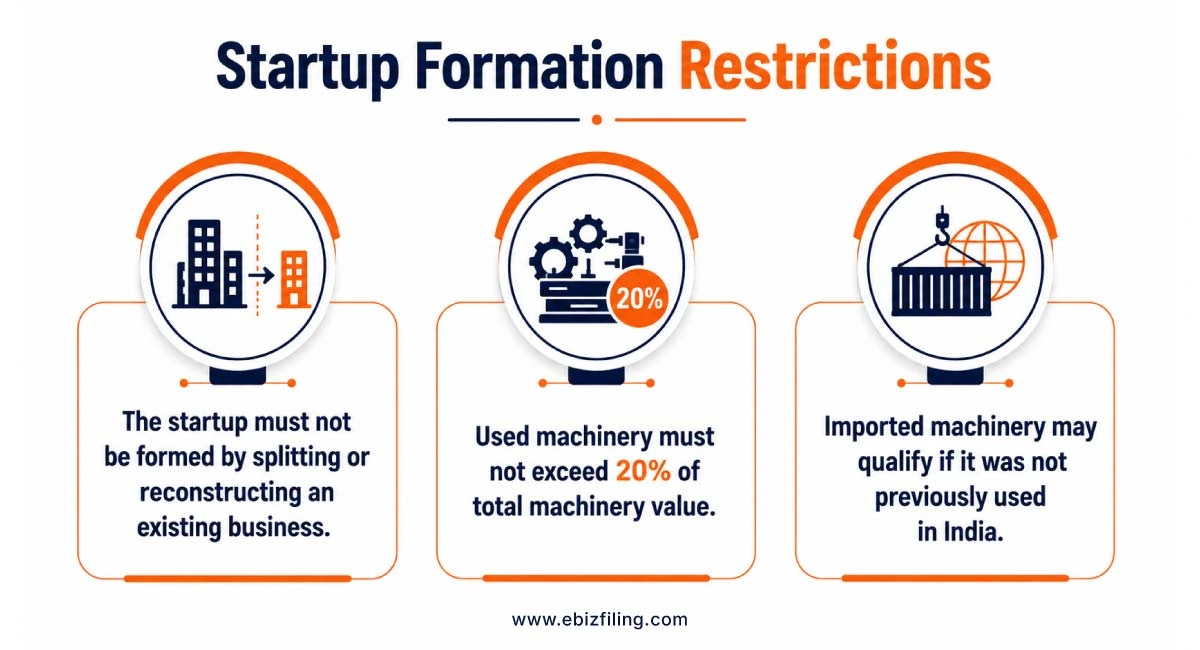
Section 140 of the Income-tax Act, 2025 prevents an existing business from being reorganised merely to claim the startup deduction.
No Splitting or Reconstruction
The startup must not be formed by splitting up or reconstructing a business that was already in existence.
The tax authorities may examine whether the new entity has simply taken over the assets, employees, customers, contracts, management, or business operations of an existing enterprise.
However, an exception applies where a business is reconstructed or revived after being discontinued due to extensive damage caused by events such as a flood, cyclone, earthquake, riot, accidental fire, explosion, or enemy action. The business must be re-established, reconstructed or revived before the expiry of three years from the end of the tax year in which it was discontinued.
Restriction on Used Machinery
The startup must not generally be formed by transferring machinery or plant that was previously used for another purpose.
However, the condition is treated as satisfied where the value of previously used machinery transferred to the new business does not exceed 20% of the total value of the machinery or plant used in that business.
Used machinery imported into India may also be permitted where:
- It was not previously used in India;
- It is imported into India; and
- No depreciation was previously allowed or allowable in India in respect of that machinery.
Profit Computation and Audit Requirements Under Section 140
To successfully claim the 100% startup profit deduction under Section 140 of the Income Tax Act, 2025, eligible startups must adhere to strict profit computation rules and complete a mandatory audit of the eligible business accounts.
1. Computation of Eligible Business Profits
The 100% deduction applies only to profits and gains derived from the eligible startup business. It is not calculated on total turnover, capital investment, funding or unrelated income.
For computing the deduction, the eligible business must be treated as if it were the startup’s only source of income. Where the startup carries on multiple business activities, it should maintain clear records that separately identify:
- Revenue from the eligible business
- Direct and indirect expenses relating to that business
- Depreciation and allocation of common assets
- Transactions with other business units
Proper records help establish the amount of profit that is directly attributable to the eligible business.
Income Generally Not Eligible for Deduction
Income that is not directly derived from the eligible startup business is generally not covered by the deduction. This may include:
- Interest earned on bank deposits
- Capital gains from the sale of assets or investments
- Rental or dividend income
- Income from unrelated business activities
The nature and direct connection of each income item with the eligible business should be examined before claiming the deduction.
Transactions Between Business Units: Where goods or services are transferred between the eligible business and another business carried on by the startup, the transaction should generally be recorded at market value. Where the transaction qualifies as a specified domestic transaction, the applicable arm’s length price should be considered. The Assessing Officer may recompute eligible profits where the recorded value does not reflect the applicable market value or where an arrangement produces more than ordinary profits.
No Double Deductions: Profits claimed and allowed as a deduction under Section 140 cannot be claimed again under another provision of the Income-tax Act for the same tax year. The deduction cannot exceed the actual profits and gains of the eligible business.
2. Mandatory Audit and Form 32
Obtaining an Inter-Ministerial Board certificate alone is not sufficient to claim the deduction. The accounts of the eligible business for the tax year in which the deduction is claimed must be audited by a practising Chartered Accountant.
|
Audit Requirement |
Details |
|
Prescribed audit form |
Form 32 |
| Applicable provision |
Section 140(8) of the Income-tax Act, 2025 |
|
Verification |
By a practising Chartered Accountant. |
| Filing deadline |
On or before the specified audit-report date referred to in Section 63 |
|
Nature of compliance |
A separate income-tax audit requirement for claiming the Section 140 deduction, regardless of whether an audit is required under the Companies Act or LLP Act. |
The startup must also claim the deduction correctly in its Income Tax Return filed within the applicable due date.
Ebizfiling’s Assistance for Section 140 Compliance
Claiming the deduction under Section 140 of the Income Tax Act involves a series of compliance requirements, and non-adherence to even a single condition may result in disallowance of the claim. Ebizfiling assists eligible startups in navigating this process in a compliant and structured manner:
- Assessing the startup’s eligibility under Section 140, including verification of the incorporation date, turnover threshold, and nature of business activity
- Assisting with the application and documentation required for obtaining the certificate of eligible business from the Inter-Ministerial Board (IMB)
- Assisting with records and profit computations that separately identify the income and expenses of the eligible business
- Coordinating with practising Chartered Accountants for the audit and timely filing of Form 32
- Reviewing the remaining deduction period for startups that previously claimed the benefit under Section 80-IAC
Conclusion
Section 140 of the Income Tax Act, 2025 offers a significant tax benefit by allowing eligible startups to claim a 100% deduction on profits and gains derived from an eligible business for three consecutive tax years within the first ten years beginning with the year of incorporation.
However, the deduction is not automatic. The company or LLP must satisfy the incorporation period, ₹300 crore turnover limit, eligible business test, IMB certification requirement, formation restrictions, audit conditions and return-filing requirements. Startups should select the three-year deduction period carefully and maintain proper records to support the nature and amount of eligible business profits.
Frequently Asked Questions
1. What deduction is available under Section 140?
An eligible startup can claim a deduction equal to 100% of the profits and gains derived from its eligible business. The deduction may be claimed for three consecutive tax years selected from the first ten years beginning with the year of incorporation.
2. Is DPIIT recognition sufficient to claim the Section 140 deduction?
No. DPIIT recognition does not automatically provide the eligible startup tax deduction. The startup must also satisfy Section 140 of the Income Tax Act and hold the required certificate of eligible business from the Inter-Ministerial Board of Certification.
3. Can a startup claim the deduction for three non-consecutive tax years?
No. The 100% startup profit deduction must be claimed for three consecutive tax years. The startup may choose when the three-year period begins within its first ten years, but the selected years must be continuous.
4. What happens if turnover exceeds ₹300 crore in the second claim year?
The turnover condition applies separately to each tax year for which the Section 140 deduction is claimed. If turnover exceeds ₹300 crore in a particular claim year, the startup will not qualify for the deduction for that year.
5. Does Section 140 provide a deduction on the startup’s total turnover?
No. The eligible startup tax deduction is calculated on profits and gains derived from the eligible business. It is not calculated on turnover, gross receipts, investment, funding, or the value of the startup.
6. Can a startup use previously used machinery and still claim the deduction?
Yes. A startup may remain eligible where the value of previously used machinery or plant transferred to the new business does not exceed 20% of the total value of the machinery or plant used in the business. Separate conditions apply to machinery previously used outside India.
7. Is timely filing of the Income Tax Return mandatory?
Yes. The startup must file its Income Tax Return by the applicable due date and claim the Section 140 deduction in that return. A delayed return may result in the deduction being disallowed.
8. Which audit report is required for the Section 140 deduction?
An eligible startup must furnish the audit report in Form 32. The eligible business accounts must be audited by a practising Chartered Accountant, and the report must be furnished by the specified audit-report date referred to in Section 63.
9. Can income from investments be included in the Section 140 deduction?
Generally, no. Section 140 applies to profits and gains derived from the eligible business. Interest, investment income, capital gains or income from unrelated activities must be examined separately and cannot automatically be included.
10. Can the same eligible business profits be claimed under another deduction?
No. Profits already claimed and allowed under Section 140 of the Income-tax Act, 2025 cannot be claimed again under another applicable profit-linked deduction. The deduction also cannot exceed the actual eligible business profits.





Income Tax Return Filing
Claim eligible deductions confidently with professional Income Tax Return filing and expert guidance.
About Ebizfiling -



October 6, 2026 By Srishti M
October 7, 2026 By Srishti M
October 3, 2026 By Srishti M
Revised ITR Under Old Tax Regime: Change Rules Explained Overview A salaried taxpayer may file an Income Tax Return under the new tax regime and later realise that the old tax regime could be more suitable because of eligible deductions […]