


-
August 7, 2026
-
BySteffy A
Tax Incentives for Startups in India Under Section 80-IAC
Overview
The Government introduced Section 80-IAC to provide Tax Incentives for Startups and support innovation, employment generation and business growth in India. Under this provision, an eligible startup can claim a deduction equal to 100% of the profits and gains derived from its eligible business for three consecutive years within its first ten years of incorporation.
However, DPIIT recognition alone is not sufficient to claim the deduction. The startup must satisfy the prescribed income-tax conditions and obtain a certificate of eligible business from the Inter-Ministerial Board of Certification. From 1 April 2026, the corresponding deduction is governed by Section 140 of the Income-tax Act, 2025.
What Is Section 80-IAC of the Income-tax Act, 1961?
Section 80-IAC was introduced under the Income-tax Act, 1961 to provide Tax Incentives for Startups. It allowed eligible startups to claim a deduction equal to 100% of the profits and gains earned from an eligible business.
The deduction was available for three consecutive assessment years selected from the first ten assessment years beginning from the year of incorporation or registration.
This benefit is commonly known as a startup tax holiday. However, it applies only to eligible business profits and does not exempt the startup from other taxes or compliance requirements.
From 1 April 2026, Section 140 of the Income-tax Act, 2025 replaced Section 80-IAC and continues to offer eligible companies and LLPs a 100% deduction on startup profits for three consecutive years within the first ten years, subject to the prescribed turnover, business and approval conditions.
Eligibility Conditions for Section 80-IAC
A startup must meet the following conditions to claim Tax Incentives for Startups under Section 80-IAC of the Income Tax Act:
Eligible Business Structure
The business must be incorporated as:
- A private limited company, or
- A Limited Liability Partnership
Although other entities may qualify for DPIIT startup recognition, the profit-linked deduction is specifically available to eligible companies and LLPs.
Incorporation Period
The startup must be incorporated on or after 1 April 2016 but before 1 April 2030.
Therefore, startups incorporated up to 31 March 2030 may qualify, subject to the remaining conditions. The eligible incorporation window was extended through the Finance Act, 2025.
Turnover Limit
For claiming the deduction under Section 80-IAC or Section 140, the startup’s turnover must not exceed ₹100 crore in the relevant year for which the deduction is claimed.
This tax-deduction threshold is different from the turnover threshold applicable to DPIIT Startup Recognition. Under the updated DPIIT criteria, the general recognition threshold is ₹200 crore, while a threshold of ₹300 crore applies to eligible DeepTech startups. Therefore, DPIIT recognition does not automatically establish eligibility for the income-tax deduction.
Eligible Business Activity
The startup must carry on a business involving:
- Innovation of products, processes, or services
- Development or improvement of products, processes, or services
- A scalable business model
- High potential for employment generation
- High potential for wealth creation
DPIIT Recognition
The startup must first obtain recognition from the Department for Promotion of Industry and Internal Trade under the Startup India initiative.
After receiving DPIIT recognition, the startup may separately apply for the income-tax exemption. DPIIT recognition by itself does not automatically grant the deduction.
Inter-Ministerial Board Approval
The startup must obtain a certificate of eligible business from the Inter-Ministerial Board of Certification.
The Board examines the business model, innovation, scalability, financial performance, employment generation, and supporting documents before approving the application.
Subject to the applicable eligibility, certification, and filing conditions, the startup may select any three consecutive years from its first ten years of incorporation for claiming the deduction.
Other Eligibility Conditions
To claim Tax Incentives for Startups, the entity must not be formed by splitting up or reconstructing an existing business. It should also not be created mainly by transferring previously used plant or machinery.
However, used plant or machinery may be transferred if its value does not exceed 20% of the total value of plant and machinery used in the startup’s business. Machinery previously used outside India may also qualify if it was not earlier used in India, was imported into India and no depreciation was previously claimed in India.
Documents Required for Startup Tax Exemption
The exact documents may depend on the startup’s structure, age and business activity. Generally, the following documents and information should be prepared:
- Certificate of Incorporation or LLP Registration Certificate
- DPIIT Recognition Certificate
- Memorandum and Articles of Association, for a company
- LLP Agreement, for an LLP
- Board resolution or partner authorization
- Original and current shareholding or contribution pattern
- Audited financial statements
- Income Tax Return acknowledgements
- Chartered Accountant’s declaration or certificate
- Details of business revenue and profitability
- Pitch deck explaining the business model, innovation, and scalability
- Startup video link
- Website, product or service details
- Details of employees and employment generation
- Intellectual property registrations or applications, where applicable
- Funding and investment details, where applicable
- Details of awards and recognitions, where applicable
- Declaration confirming that the startup was not formed by splitting up or reconstructing an existing business
- Details of plant and machinery used in the business, where applicable
The application for Tax Incentives for Startups may also require information about innovation, scalability, intellectual property, funding, revenue, profitability and employment generation.
How to Apply for Startup Tax Exemption?
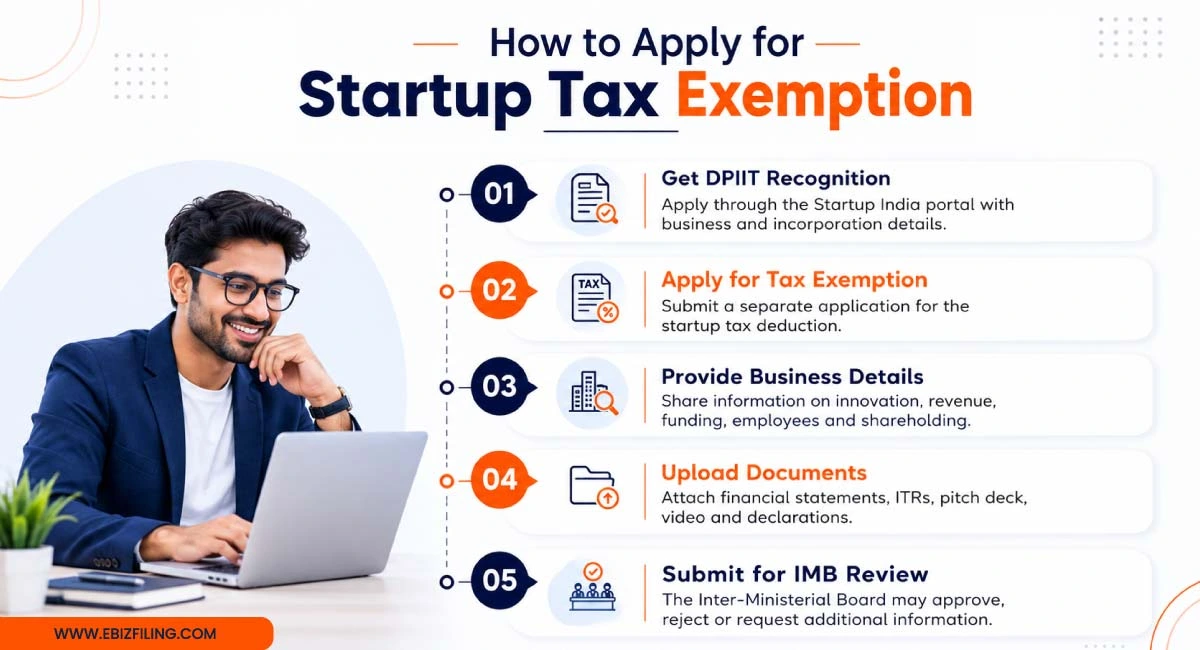
1. Obtain DPIIT Recognition
The entity must first apply for recognition under the Startup India initiative.
The application generally requires incorporation details, information about the business model, and an explanation of how the startup is innovative, scalable, or capable of generating employment or wealth.
2. Apply for the Tax Exemption
After obtaining DPIIT recognition, the startup can submit a separate application for the income-tax exemption through the Startup India portal.
3. Provide Business Information
The startup must provide details about:
- Business activities
- Innovation and scalability
- Revenue and profitability
- Employment generation
- Funding received
- Intellectual property
- Shareholding pattern
4. Upload Supporting Documents
The startup must upload its financial statements, Income Tax Returns, pitch deck, video link, declarations, and other required documents.
5. Submit the Application
After checking the information and completing the declarations, the startup can submit the application for examination by the Inter-Ministerial Board.
The Board may approve the application, request additional information, or reject it after examining the facts and documents.
Audit Report and Income Tax Return
Obtaining an IMB certificate alone is not sufficient to claim the startup profit deduction.
For deductions relating to periods governed by Section 80-IAC of the Income-tax Act, 1961, the eligible startup must furnish the prescribed audit report in Form 10CCB and file its Income Tax Return within the applicable due date.
From Tax Year 2026-27, an eligible startup claiming the deduction under Section 140 of the Income-tax Act, 2025 must furnish the prescribed audit report in Form 32. The report must be verified by a Chartered Accountant and filed within the prescribed time. The deduction must also be correctly claimed in the startup’s Income Tax Return.
Get Expert Support for Startup Tax Exemption
Claiming Tax Incentives for Startups under Section 80-IAC requires proper eligibility checks, accurate documentation, and approval from the Inter-Ministerial Board. Ebizfiling assists startups throughout the application process.
Our Assistance Includes
- Reviewing eligibility under Section 80-IAC or Section 140
- Assisting with DPIIT Startup Recognition
- Preparing the required documents and declarations
- Reviewing financial statements and business information
- Assisting with the startup’s applicable income-tax compliance
Ebizfiling also assists with Private Limited Company Registration, LLP Registration, Startup India Recognition and Business Income Tax Return Filing.
Apply for 80-IAC Tax Exemption with Ebizfiling.
Conclusion
The deduction formerly available under Section 80-IAC is one of the most important tax incentives for startups in India. It allows an eligible company or LLP to claim a deduction equal to 100% of the profits and gains derived from its eligible business for three consecutive years within its first ten years. From 1 April 2026, the corresponding deduction is governed by Section 140 of the Income-tax Act, 2025. Startups must verify their incorporation date, turnover, business activity, DPIIT recognition, IMB certification and filing requirements before claiming the benefit.
Frequently Asked Questions
1. What are the main Tax Incentives for Startups under Section 80-IAC?
The main benefit is a deduction equal to 100% of the profits and gains earned from an eligible business. The deduction can be claimed for three consecutive years selected from the startup’s first ten years of incorporation.
2. Which entities can claim the startup tax exemption under Section 80-IAC?
Only an eligible private limited company or Limited Liability Partnership can claim the startup tax exemption under Section 80-IAC. Partnership firms and cooperative societies may qualify for DPIIT recognition but cannot claim this specific profit-linked deduction.
3. Who is eligible to claim the Section 80-IAC deduction?
An eligible startup must be incorporated as a company or LLP within the prescribed period, operate an innovative or scalable business, stay within the applicable turnover limit and obtain approval from the Inter-Ministerial Board.
4. Can a startup choose any three years for claiming the deduction?
The startup may choose any three years from its first ten years of incorporation. However, the selected years must be consecutive and cannot be three separate years based only on profitability.
5. Is DPIIT recognition enough to claim the 80-IAC deduction for startups?
No, DPIIT recognition does not automatically provide the 80-IAC deduction for startups. The entity must separately meet the income-tax conditions and obtain an eligibility certificate from the Inter-Ministerial Board of Certification.
6. Which business activities qualify for Tax Incentives for Startups in India?
The startup should work towards innovation, development, or improvement of products, processes or services. A scalable business model having high potential for employment generation or wealth creation may also qualify.
7. Which documents are required to claim Tax Incentives for Startups?
The startup should prepare its DPIIT recognition certificate, incorporation documents, shareholding details, audited financial statements, Income Tax Return records, pitch deck and startup video. Ebizfiling can help review these documents before the application is submitted.
8. Can a startup using second-hand machinery claim the deduction?
A startup may qualify if the value of previously used plant and machinery does not exceed 20% of the total value of plant and machinery used in the business. Separate conditions apply to machinery previously used outside India.
9. Does the deduction apply to the startup’s total turnover?
No, the deduction applies only to profits and gains earned from the eligible business. It does not provide a 100% deduction on turnover, funding, capital investment, or income from unrelated business activities.
10. How can a startup apply for tax incentives under Section 80-IAC or Section 140?
The startup must first obtain DPIIT recognition and then submit a separate application for the income-tax exemption through the Startup India portal. It must satisfy the applicable incorporation, turnover, eligible business, IMB certification and filing conditions. Ebizfiling can assist with eligibility checks, document preparation, application filing and related income-tax compliance.





Income Tax Returns
Filing of Income Tax return is necessary if you have earned any income. File your ITR with EbizFiling
About Ebizfiling -



Reviews
Anshul Sharma
09 Apr 2022Great support from team ebizfiling. Whole process was very smooth and transparent. Package suggested to us was value for money. Compliance manager guided us throughout the process of LLP incorporation. Thanks for your kind support
Devangi Patnayak
11 Mar 2018I am very happy with the way they serve their clients. They are focused on providing the best help that they can and are result oriented.
Hemang Malhotra
08 Oct 2018I was new as an Entrepreneur when I had seen their post on social media. I contacted them regarding proprietorship and realized they their pricing is incomparable in the market also their services are really prompt. Thank you, Ebizfiling.
September 30, 2026 By Srishti M
September 29, 2026 By Srishti M
Income Tax Compliance Calendar October 2026: Filing Guide Introduction The Income Tax Compliance Calendar October 2026 highlights important income tax obligations applicable to taxpayers, businesses and entities covered under audit and transfer pricing provisions. October 2026 includes key compliance […]
September 18, 2026 By Srishti M
Professional Tax Registration Cancellation Process Explained Introduction Professional Tax is a state-level tax applicable to individuals and businesses engaged in professions, trades, callings, or employment, subject to the provisions prescribed under respective state laws. Businesses liable under applicable Professional Tax […]