


-
July 30, 2026
-
BySteffy A
Section 394 of the Income Tax Act, 2025: TCS Rules and Exemptions
Introduction
Section 394 of the Income Tax Act governs the collection of tax at source on specified transactions. Under this provision, sellers and other specified persons collect TCS from buyers and deposit it with the Government. It covers specified goods, high-value motor vehicles, foreign remittances, overseas tour packages and certain commercial rights. The section also explains the applicable TCS rates, collection timing and available exemptions.
This blog covers the meaning, applicability, TCS rates, collection timing, exemptions, declarations and compliance requirements under Section 394 of the Income Tax Act.
What Is Section 394 of the Income Tax Act?
Section 394 of the Income Tax Act contains the primary rules for the collection of tax at source. It requires the persons specified under the section to collect tax on prescribed receipts at the applicable rate.
The provision covers the sale of alcoholic liquor, tendu leaves, timber, forest produce, scrap, coal, lignite, iron ore, motor vehicles and other notified goods. It also covers remittances under the Liberalised Remittance Scheme, overseas tour programme packages and the commercial use of parking lots, toll plazas, mines and quarries.
The tax is collected from the buyer, licensee or lessee, depending on the nature of the transaction. Once deposited and correctly reported, the TCS amount may be claimed as tax credit by the person from whom it was collected.
TCS is not an additional income tax liability imposed on the seller. The seller or other specified person acts as a tax collector on behalf of the Government. The TCS provisions previously governed by Section 206C of the income tax Act, 1961 have been consolidated and renumbered as Section 394 under the Income Tax Act, 2025. Section 394 applies where the relevant debit or receipt triggering TCS occurs on or after April 1, 2026. Transactions triggered on or before March 31, 2026 continue to be governed by the income tax Act, 1961.
Meaning of Seller
For the sale of specified goods, motor vehicles and other notified goods covered under serial numbers 1 to 6 of the Section 394 table, “seller” means:
- The Central Government or a State Government;
- A local authority;
- A corporation or authority established by or under a Central, State or Provincial Act;
- A company, firm or co-operative society; or
- An individual or HUF whose total sales, gross receipts or turnover in the immediately preceding tax year exceeded ₹1 crore from business or ₹50 lakh from profession.
For overseas tour programme packages, “seller” means any person who sells such a package.
Section 206C vs Section 394
|
Basis |
Section 206C |
Section 394 |
|
Law |
Income tax Act, 1961 | Income tax Act, 2025 |
| Applicability | Relevant to periods before 1 April 2026 |
Applicable from 1 April 2026 |
|
Purpose |
Governed Tax Collected at Source (TCS) | Current provision governing TCS |
| Structure | Rules were divided across several sub-sections |
TCS transactions, collectors and rates are presented in a consolidated table |
|
Key change |
Contained older rates and provisions |
Introduces updated rates and simplified provisions |
Who Is Responsible for Collecting TCS?
The person responsible for collecting TCS depends on the transaction covered under Section 394 of the Income Tax Act.
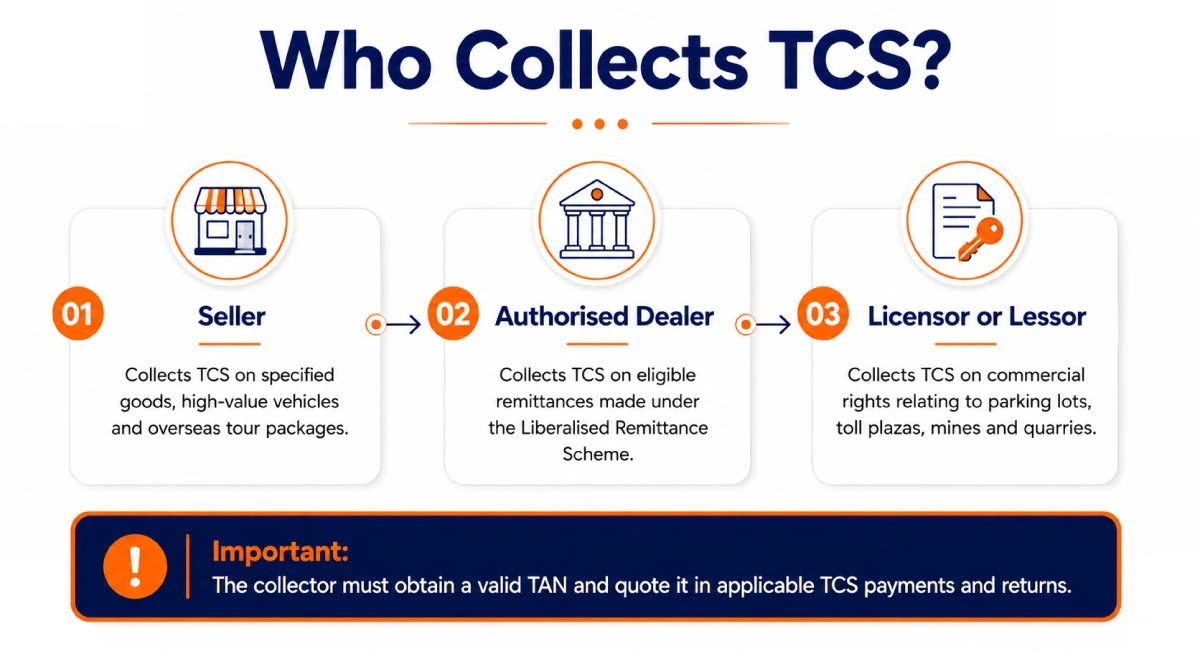
Seller
A seller may be required to collect TCS on receipts from the sale of:
- Alcoholic liquor for human consumption
- Tendu leaves
- Timber and covered forest produce
- Scrap
- Coal, lignite, and iron ore
- Motor vehicles exceeding the prescribed value
- Other goods notified by the Central Government
- Overseas tour programme packages
The seller must first determine whether the transaction is covered and whether any threshold or exemption applies.
A person responsible for collecting TCS must obtain a valid TAN and quote it in applicable TCS payments and returns. Businesses may use the TAN Application Online service to apply for it.
Authorised Dealer
An authorised dealer is responsible for collecting TCS on specified remittances made under the Liberalised Remittance Scheme.
The rate depends on the purpose for which the remittance is made. Different treatment applies to education or medical remittances and remittances made for other purposes.
Licensor or Lessor
A licensor or lessor must collect TCS where another person receives the right to use a parking lot, toll plaza, mine or quarry for business purposes.
However, the provision excludes mining and quarrying of mineral oil, including petroleum and natural gas.
When Should TCS Be Collected?
Under Section 394, TCS must be collected at the earlier of:
- Debiting the amount payable to the account of the buyer, licensee or lessee; or
- Receiving the amount from the buyer, licensee or lessee.
Subject to the applicable thresholds and exemptions, this timing rule applies to all transactions listed in the Section 394 table. The payment may be received through cash, cheque, draft or any other mode.
Businesses can refer to the TDS and TCS Compliance Calendar FY 2026-27 to track TCS deposit, return filing and certificate due dates.
TCS Rates and Transactions Covered Under Section 394
TCS Rate Table
The following rates apply according to the amended text of Section 394 of the Income Tax Act, 2025:
|
Nature of receipt |
Person responsible |
TCS rate |
|
Alcoholic liquor for human consumption |
Seller | 2% |
| Tendu leaves | Seller |
2% |
|
Timber or specified forest produce |
Seller | 2% |
| Scrap | Seller |
2% |
|
Coal, lignite or iron ore |
Seller | 2% |
| Motor vehicle or notified goods exceeding ₹10 lakh | Seller |
1% |
|
LRS remittance above ₹10 lakh for education or medical treatment |
Authorised dealer | 2% |
| LRS remittance above ₹10 lakh for other purposes | Authorised dealer |
20% |
|
Overseas tour programme package |
Seller | 2% |
| Business use of parking lot, toll plaza, mine or quarry | Licensor or lessor |
2% |
The Finance Act, 2026 revised several TCS rates under Section 394 of the Income Tax Act with effect from April 1, 2026. The amended rates include 2% for alcoholic liquor, tendu leaves, scrap, specified minerals, education or medical LRS remittances and overseas tour programme packages.
- Motor vehicles/notified goods: If the sale consideration exceeds ₹10 lakh, TCS at 1% applies to the entire sale consideration, not merely the amount exceeding ₹10 lakh.
- LRS remittances: The ₹10 lakh limit is cumulative, and TCS applies only to the amount exceeding ₹10 lakh during the tax year.
- Overseas tour packages: TCS applies at a flat 2% without any minimum threshold.
Exemption for Certain Resident Buyers
TCS is not required on the transactions listed under serial numbers 1 to 5 where the buyer is a resident of India and submits the prescribed written declaration in duplicate.
The buyer must state that the goods will be used for:
- Manufacturing
- Processing
- Producing articles or things
- Generating power
The buyer must also confirm that the goods will not be used for trading purposes.
Therefore, the declaration-based exemption is not available where the goods are purchased for resale or ordinary trading.
Transactions Covered by the Declaration
The declaration-based exemption applies to:
- Alcoholic liquor for human consumption
- Tendu leaves
- Timber and covered forest produce
- Scrap
- Coal, lignite and iron ore
It does not apply to motor vehicles, notified goods, LRS remittances, overseas tour packages, parking lots, toll plazas, mines or quarries.
Submission of Declaration
Where TCS is not collected based on the resident buyer’s declaration, the collector must submit one copy of the declaration to the prescribed income tax authority. The copy must be delivered on or before the seventh day of the month following the month in which the declaration was received.
For example, where the seller receives the declaration in June, one copy must be submitted to the relevant authority on or before July 7. The buyer must furnish the prescribed declaration in duplicate in Form 127. The seller must submit the required details through the TAN login by the seventh day of the following month.
Exclusion for Overseas Tour Package Amounts
An authorised dealer is not required to collect TCS on an LRS remittance to the extent that the seller of an overseas tour programme package has already collected TCS on the same amount.
This prevents tax from being collected twice on the same amount.
For a detailed overview of the earlier TCS rules applicable to foreign remittances, read our guide on TCS on foreign remittances under LRS.
Exemption for Education-Loan Remittances
An authorised dealer is not required to collect TCS where the amount remitted for education is financed through a loan obtained from a financial institution covered under Section 129(3)(b).
The exemption is subject to the following conditions:
- The remittance must be made for pursuing education.
- The amount must come from a qualifying loan.
- The loan must be obtained from a specified financial institution.
A remittance made from personal savings does not qualify for this particular loan-based exemption merely because it is used for education.
Non-Collection Where TDS Is Deducted
TCS is not required on an LRS remittance or overseas tour programme package where:
- The buyer is liable to deduct TDS under another provision of the Act; and
- The buyer has actually deducted the tax.
Both conditions must be satisfied. Merely being liable to deduct TDS may not be sufficient where the buyer has not completed the deduction.
TCS provisions involve different rates, thresholds, exemptions and reporting requirements. Staying updated with these rules can help businesses collect tax correctly and avoid compliance errors.
Ebizfiling’s Guide to TCS Compliance
Ebizfiling publishes easy-to-understand resources on:
- TCS rates and applicability
- Tax deposit and return due dates
- Income tax compliance updates
- Business and accounting requirements
Read: TCS Due Dates in July 2026: Complete Compliance Guide
Conclusion
Section 394 of the Income Tax Act establishes the rules for collecting tax at source on specified goods, motor vehicles, foreign remittances, overseas tour packages and certain commercial rights.
The responsible seller, authorised dealer, licensor or lessor must identify whether the transaction is covered, verify the applicable threshold and collect tax at the correct rate. TCS must generally be collected at the time of debit or receipt, whichever occurs earlier.
The section also provides relief in specified cases, including purchases for manufacturing or power generation, qualifying education-loan remittances, amounts already covered by TCS on overseas tour packages and transactions where TDS has been deducted.
Frequently Asked Questions
1. Which transactions are covered under Section 394 of the Income Tax Act?
Section 394 of the Income Tax Act, 2025 covers TCS on alcoholic liquor, tendu leaves, timber, forest produce, scrap, specified minerals, high-value motor vehicles, LRS remittances, overseas tour packages and certain commercial rights.
2. When must tax be collected under Section 394 of the Income Tax Act, 2025?
Tax must be collected when the amount is debited to the buyer’s, licensee’s or lessee’s account or when the payment is received, whichever occurs earlier. Payment may be received through cash, cheque, draft or another mode.
3. What are the Section 394 TCS rates for scrap and specified minerals?
The TCS rate under Section 394 of the Income Tax Act, 2025 is 2% on the sale of scrap and specified minerals such as coal, lignite and iron ore. The seller is responsible for collecting the applicable tax from the buyer.
4. What is the Tax Collection at Source rate on a motor vehicle above ₹10 lakh?
A seller must collect TCS at 1% where the sale consideration of a motor vehicle exceeds ₹10 lakh. The same provision may apply to other goods notified by the Central Government.
5. How does TCS under the Income Tax Act 2025 apply to LRS remittances?
Under the Liberalised Remittance Scheme, an authorised dealer must collect TCS where the amount or aggregate remittance exceeds ₹10 lakh. The rate is 2% for education or medical treatment and 20% for other purposes.
6. Is an overseas tour programme package covered under Section 394 of the Income Tax Act?
Yes. A seller must collect TCS at 2% on an overseas tour programme package. Such a package may include international travel, hotel accommodation, boarding, lodging and related expenditure.
7. Can a resident buyer claim exemption from collection of tax at source?
A resident buyer may submit the prescribed declaration where specified goods are purchased for manufacturing, processing, production or power generation and not for trading. Ebizfiling can help businesses understand whether the declaration-based exemption applies to their transaction.
8. By when must the TCS exemption declaration be submitted to the tax authority?
The person responsible for collecting tax must submit one copy of the buyer’s declaration to the prescribed income tax authority by the seventh day of the month following the month in which it was received.
9. Is TCS applicable when an education remittance is funded through a loan?
TCS is not required where an education remittance is made from a qualifying loan obtained from a financial institution covered under Section 129(3)(b). The loan must be specifically obtained for pursuing education.
10. Is collection of tax at source required where the buyer has deducted TDS?
TCS is not required on specified LRS remittances and overseas tour packages where the buyer is liable to deduct TDS and has actually deducted it. Ebizfiling can assist in reviewing the transaction and determining the correct TDS or TCS treatment. Businesses can use Ebizfiling’s TDS Return Filing Online assistance to meet applicable deduction and reporting requirements.




TCS Compliance Made Simple
Simplify TCS compliance with professional tax consultancy and timely regulatory support from experts.
About Ebizfiling -



October 15, 2026 By Srishti M
TDS and TCS Compliance Calendar November 2026: Compliance Guide Introduction The TDS and TCS Compliance Calendar November 2026 covers important tax deduction, collection, payment, certificate and reporting requirements applicable during the month. It helps businesses, government offices and other responsible […]
October 14, 2026 By Srishti M
GST Compliance Calendar November 2026: Key Due Dates & Filings Introduction The GST Compliance Calendar November 2026 highlights the major GST return filing, tax payment, invoice reporting and year-end adjustment deadlines applicable during the month. It covers regular taxpayers, QRMP […]
October 13, 2026 By Srishti M