


-
August 13, 2026
-
BySteffy A
Section 137 of the Income Tax Act, 2025 for Political Contributions
Introduction
Section 137 of the Income Tax Act allows an eligible assessee to claim a deduction for qualifying contributions made during a tax year to a registered political party or an electoral trust. The payment must be made through a mode other than cash. Local authorities and specified Government-funded artificial juridical persons are excluded from this benefit.
This blog explains the eligibility conditions, qualifying recipients, payment rules, deduction amount, documents, and filing process under Section 137 of the Income Tax Act. It also compares the provision with Section 80GGC of the Income-tax Act, 1961 and answers practical questions about reporting political contributions.
What is Section 137 of the Income Tax Act?
Section 137 of the Income Tax Act provides a deduction for an amount contributed during a tax year to a political party registered under Section 29A of the Representation of the People Act, 1951, or to an electoral trust. The contribution must not be made in cash.
The Income-tax Act, 2025, took effect on April 1, 2026. Official mapping identifies Section 137 as the corresponding provision for Section 80GGC. It is a replacement under the new law, not an additional deduction.
Who Can Claim the Deduction?
Section 137 of the Income Tax Act may apply to individuals, Hindu Undivided Families, firms, Limited Liability Partnerships, associations of persons, and bodies of individuals, subject to the provisions of the Act.
The provision excludes:
- A local authority
- An artificial juridical person wholly funded by the Government
- An artificial juridical person partly funded by the Government
Indian companies are covered separately by Section 136 of the Income-tax Act, 2025. A company making a political contribution should examine that provision rather than claiming the deduction under Section 137.
Which Contributions Qualify?
A deduction under Section 137 of the Income Tax Act is available only when the recipient is legally eligible.
Registered Political Party
The political party must be registered under Section 29A of the Representation of the People Act, 1951. A payment to an unregistered political organization or informal campaign group does not meet this condition.
Electoral Trust
A contribution to an electoral trust can also qualify. The taxpayer should verify the trust and retain an official receipt.
A direct payment to an individual political candidate does not qualify under Section 137, as the deduction applies only to contributions made to registered political parties or electoral trusts.
Are Cash Contributions Allowed?
No. Section 137 of the Income Tax Act expressly excludes every contribution made in cash. The restriction is not linked to a minimum amount, so even a small cash contribution will not qualify.
Taxpayers should use a traceable payment mode, such as:
- Account payee cheque
- Bank draft
- NEFT
- RTGS
- IMPS
- UPI
- Debit or credit card
- Online bank transfer
The payment record should identify the taxpayer, contribution amount, payment date, and recipient. A non-cash payment made to an unregistered organization will remain ineligible.
How Much Deduction Can Be Claimed?
Section 137 of the Income Tax Act permits a deduction for the eligible amount actually contributed through a non-cash mode. The section does not prescribe a separate fixed monetary ceiling.
However, Section 122 states that the total deductions claimed under Chapter VIII cannot exceed the assessee’s gross total income. The deduction therefore cannot create or increase a loss merely because the political contribution is greater than the available gross total income.
The deduction reduces the taxpayer’s total income rather than reducing tax payable on a rupee-for-rupee basis. The actual tax saving will depend on the taxable income and applicable tax rate.
Documents Required for Section 137 of the Income Tax Act
A taxpayer claiming Section 137 of the Income Tax Act should preserve records proving the recipient’s eligibility and the non-cash payment, including:
- Official contribution receipt
- Recipient’s name and PAN, where available
- Political party registration details
- Contribution date and amount
- Bank statement
- Cheque number or electronic transaction reference
- Written acknowledgement from the recipient
The receipt and bank record should contain matching information. Missing recipient details or differences in the contribution amount can make verification difficult.
How to Claim the Deduction under Section 137 of the Income Tax Act?
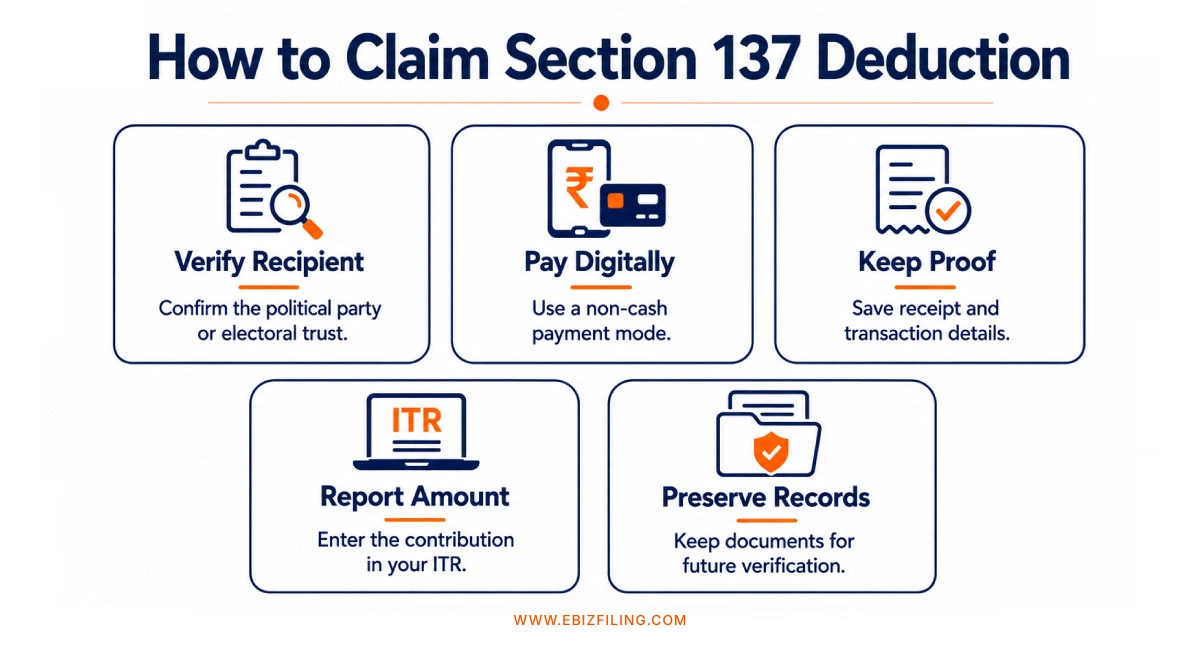
1. Verify the Recipient: Confirm that the political party is registered under Section 29A of the Representation of the People Act, 1951, or that the recipient is a valid electoral trust.
2. Use a Non-Cash Mode: Make the payment through a traceable banking or electronic channel. Do not use cash when claiming the deduction.
3. Collect Evidence: Obtain an official receipt and retain the bank statement, transaction reference, PAN and registration details available for the recipient.
4. Report the Amount: Enter the qualifying contribution in the relevant deduction schedule of the applicable income tax return for the correct tax year.
5. Preserve Records: Keep the receipt and payment evidence after filing the return. These records may be required during verification or while correcting a mismatch.
Section 80GGC vs Section 137
Section 80GGC and Section 137 of the Income Tax Act cover the same broad category of political contributions under different income tax laws.
|
Basis |
Section 80GGC |
Section 137 |
|
Governing law |
Income-tax Act, 1961 | Income-tax Act, 2025 |
| Relevant period | Period governed by the earlier Act |
Tax years governed by the new Act |
|
Eligible recipient |
Registered political party or electoral trust | Registered political party or electoral trust |
| Cash contribution | Not allowed |
Not allowed |
|
Excluded persons |
Local authority and specified Government-funded artificial juridical persons | Same exclusions |
| Time reference | Previous year |
Tax year |
|
Company contributions |
Covered under Section 80GGB |
Covered under Section 136 |
The main differences are the governing law, section number, and terminology. The official navigator maps Section 80GGC to Section 137. The same contribution cannot be deducted under both provisions.
Example of Deduction Under Section 137
Suppose an eligible individual contributes ₹75,000 through NEFT to a political party registered under Section 29A and receives a proper contribution receipt.
Since the payment is non-cash and the recipient is eligible, it may qualify under Section 137 of the Income Tax Act.
If the individual pays the same amount in cash or transfers it to an unregistered political organisation, the deduction will not be available.
Ebizfiling Support for Political Contribution Deductions
Claiming a deduction for political contributions requires accurate reporting, valid payment evidence and complete recipient details. Ebizfiling India Pvt Ltd can assist eligible taxpayers in reporting the deduction correctly while filing their income tax returns.
Ebizfiling can help with:
- Identifying the applicable income tax provision
- Selecting the correct tax year for the deduction
- Reviewing contribution receipts and payment records
- Reporting the eligible contribution in the relevant ITR schedule
- Filing an accurate income tax return
Need assistance with your income tax return? Contact Ebizfiling today to report your Section 137 deduction correctly.
Conclusion
Section 137 of the Income Tax Act allows eligible assessees to deduct qualifying non-cash contributions made to registered political parties or electoral trusts.
Taxpayers should verify the recipient, use a traceable payment channel, and preserve complete transaction records. The provision corresponds to Section 80GGC under the earlier income tax law. Taxpayers must select the correct provision for the relevant tax year and report the exact amount supported by the receipt and banking records.
Frequently Asked Questions
1. Does a cash contribution below ₹2,000 qualify for the deduction?
No. The provision excludes contributions made in cash without providing any lower-value exception. A cash contribution remains ineligible regardless of its amount.
2. Can a payment made directly to a political candidate be claimed?
The deduction covers payments made to a political party registered under Section 29A or to an electoral trust. A direct payment to an individual candidate should not automatically be claimed under this provision.
3. Is the complete non-cash contribution deductible?
The qualifying amount may be deducted because the section does not prescribe a separate fixed monetary cap. However, total deductions under Chapter VIII cannot exceed the assessee’s gross total income.
4. Can an Indian company claim a deduction under Section 137?
Indian companies should examine Section 136, which specifically covers political contributions made by companies under the Income-tax Act, 2025.
5. Is a bank statement sufficient without a contribution receipt?
A bank statement proves that a payment was made, but it may not establish the recipient’s eligibility or the purpose of the transfer. Taxpayers should keep both the official contribution receipt and banking evidence.
6. Can a contribution to an unregistered political group qualify?
No. The recipient must be a political party registered under Section 29A of the Representation of the People Act, 1951, or an eligible electoral trust.
7. Can Section 80GGC and Section 137 be claimed together?
No. They are corresponding provisions under different income tax laws. The applicable section depends on the relevant period, and the same contribution cannot be claimed twice.
8. What should be done if the contribution receipt has an incorrect PAN?
The taxpayer should request a corrected receipt from the political party or electoral trust before reporting the deduction. Ebizfiling can help review the available records while assisting with income tax return filing.
9. Can a missed deduction be claimed in a later tax year?
The contribution belongs to the tax year in which it was actually made. The available correction option will depend on the return status and applicable filing provisions. Ebizfiling can help assess the suitable income tax return filing or correction route.
10. Does a contribution made through UPI automatically qualify?
No. UPI satisfies the non-cash payment condition, but the recipient must still be an eligible registered political party or electoral trust. The taxpayer must also retain the contribution receipt and transaction details.




Expert Tax Consultancy for Smarter Tax Planning
Get professional tax consultancy support to understand your tax obligations, plan efficiently, and stay compliant.
About Ebizfiling -



October 13, 2026 By Srishti M
October 12, 2026 By Srishti M
October 12, 2026 By Srishti M
Company Compliance Calendar November 2026: Key Due Dates & Filings Introduction The Company Compliance Calendar November 2026 highlights important annual return, dematerialisation and income tax compliances that companies may need to complete during the month. November 2026 is particularly […]