


-
September 30, 2026
-
ByDhruvi D
Form ITR-1 (Sahaj) Filing Updated Guide for AY 2026-27
Overview
Form ITR-1 (Sahaj) filing is a form that most people start with in terms of complying with the income tax. By 2026, the process will be more data-driven as it is integrated with AIS and more rigorous validation checks. Although the shape appears easy, the slightest mistakes may cause delays or notices. This manual assists you in knowing when and how to make proper use of the ITR-1.
In What Cases Do You Select form ITR-1 (Sahaj) filing over the rest?
ITR-1 is confused with many other forms by many taxpayers. The actual choice will be based on the complexity of income, not the level of income.
Use ITR-1 when you are certain about your income, which is only by way of salary, interest, or one property. ITR-1 is no longer appropriate, the moment your financial profile contains investments such as stocks or freelance income.
It is always recommended to review your AIS report before going to the tax office. Form ITR-1 (Sahaj) filing is generally the appropriate type in case your transactions are simple.
Knowing the Simplicity of form ITR-1 (Sahaj) filing
Form ITR-1 (Sahaj) filing is popular because it will not make unnecessary disclosures. It only considers the necessary income heads and fundamental deductions.
- It does not demand, like other forms, that:
- Calculation of capital gains in detail.
- Business income breakdown
- Foreign asset disclosures
This is perfect in the case of salaried persons who would desire simplicity with speed.
Documents Required for form ITR-1 (Sahaj) filing
Before starting your filing, keep these documents ready:
- Form 16 from your employer
- Form 26AS and AIS
- PAN and Aadhar details
- Bank statements or passbook
- Investment proofs for deductions (80C, 80D, etc.)
- Interest certificates from banks
Having these documents ready helps you avoid errors and delays.
Read our guide :
7 Mandatory Disclosures in ITR-1 & ITR-4 for AY 2025–26 (Old Regime)
ITR-3 Form Filing AY 2026-27: Process and Eligibility
Who Can and Cannot File ITR-1 (Sahaj) in India?
|
Basis |
Who Can File ITR-1 (Sahaj) |
Who Cannot File ITR-1 (Sahaj) |
|
Residential Status |
Resident individuals only |
Non-residents or not eligible category |
|
Income Limit |
Total income up to ₹50 lakh |
Income exceeds ₹50 lakh |
|
Salary Income |
Income from salary or pension |
Not applicable if income is complex |
|
House Property |
Income from up to two house properties, subject to the other ITR-1 conditions and no ineligible brought-forward/carry-forward loss |
Cases outside the notified ITR-1 conditions require another applicable return form |
|
Other Income |
Interest from savings, FD, etc. |
Complex income like capital gains |
|
Capital Gains |
Not allowed |
Long-term capital gains under section 112A up to ₹1.25 lakh are permitted, Short-term capital gains and section 112A LTCG above ₹1.25 lakh are not eligible |
|
Business/Profession |
Not allowed |
Freelancer, consultant, or business owner |
|
Company Role |
Not applicable |
Director in a company |
|
Foreign Assets |
Not allowed |
Holds foreign assets or foreign bank accounts |
|
Agricultural Income |
Up to ₹5,000 |
Exceeds ₹5,000 |
|
Suitable For |
Salaried taxpayers with simple income |
Taxpayers needing ITR-2, ITR-3, or ITR-4 |
What Has Changed in ITR-1 Filing for 2026?
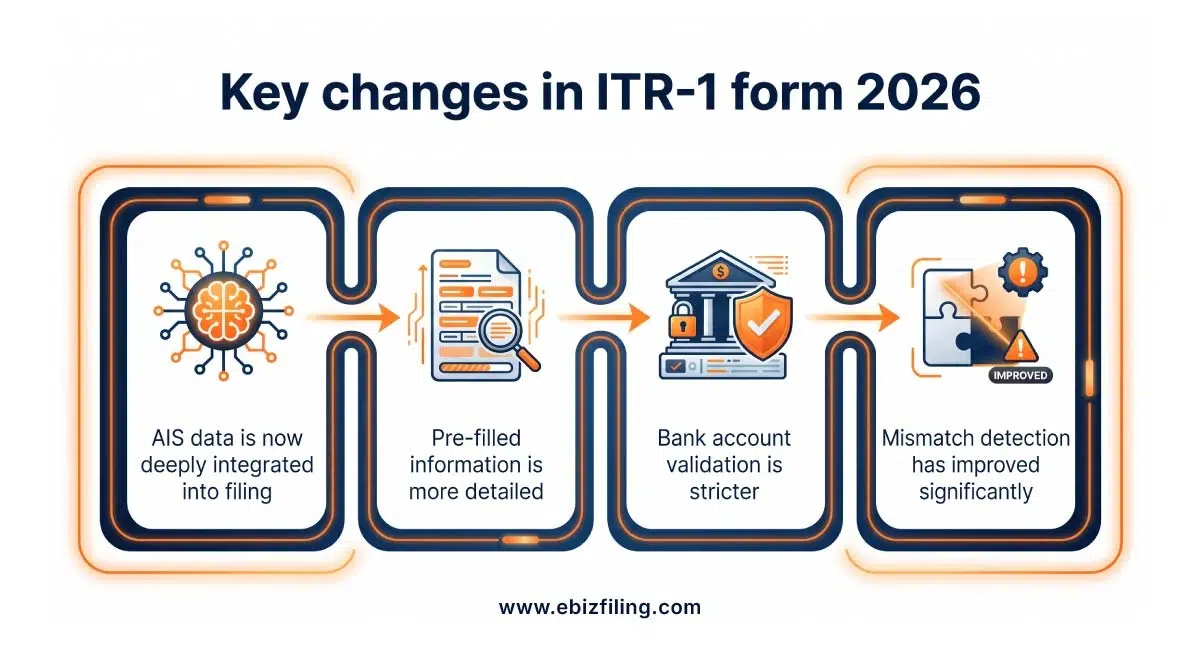
The 2026 filing process is more system-driven than before.
- AIS Integration : Your income is now cross-verified with third-party reports (such as banks and employers) with AIS data, which is directly linked to ITR filing.
- Detailed Pre-filled Data : Income has also been added to the pre-filled forms to include sources that are not limited to interest, dividends or capital gains with great consideration before filling the form.
- Stricter Bank Validation : To prevent delays in refunds or filing problems, bank accounts should be pre-validated and properly connected with PAN.
- Improved Mismatch Detection : The system is now able to easily identify discrepancies between AIS, TDS and reported income that would enhance higher probabilities of notices of errors.
According to recent updates, the system now flags inconsistencies faster, making accuracy more important than ever.
Why Form ITR-1 (Sahaj) Filing Still Matters
There are benefits to filing your return even when your income is less than the taxable limit.
- Lending assistance to loans.
- Builds financial credibility
- Easy claims of refunds.
- Maintains compliance document tidy.
Even when not mandatory, many financial advisors suggest submitting returns annually.
Why Choose Ebizfiling for ITR-1 (Sahaj) Filing?
At Ebizfiling, we make income tax filing simple and stress-free for individuals across India.
- We help you select the correct income tax returns based on your income.
- Our services ensure accurate filing with proper deduction claims.
- Get step-by-step guidance for salaried and first-time filers.
- Ensure timely ITR filing and avoid unnecessary penalties.
- Experience smooth document review and hassle-free final submission.
Take a CA consultation from Ebizfiling and file your ITR with confidence.
Conclusion
Form ITR-1 (Sahaj) filing remains the simplest option for individuals with straightforward income in AY 2026-27. It is designed to make income tax return filing quick and hassle-free for salaried taxpayers. However, choosing the correct form and verifying your details carefully is important to avoid errors or notices. Filing your ITR on time with accurate information ensures smooth processing and faster refunds.
Suggested read:
Documents required for finalizing Income Tax Return
ITR-3 Form Filing AY 2026-27: Process and Eligibility
Section 202 of the Income Tax Act
Frequently Asked Questions
1. What documents are required to file form ITR-1?
To file ITR-1 (Sahaj) Filing smoothly, you need documents that show your income, taxes paid, and deductions claimed during the financial year. These include Form 16 from your employer for salary details, Form 26AS and AIS for tax credits and transactions, PAN and Aadhaar for identity verification, and bank account details for refund processing. You should also keep investment proofs such as LIC, PPF, ELSS, and medical insurance receipts to claim deductions under sections like 80C and 80D. Having all documents ready helps in accurate filing and reduces the chances of errors or notices.
2. Under which head is pension income taxable?
Pensions received from former employers are classified as income and taxed under the heading “Income from Salary.” It is included in your overall income, just like a regular paycheck. However, family pensions received by a spouse or family member after the employee’s death are taxed as “Income from Other Sources.” In such circumstances, a standard deduction is permitted, lowering the taxable amount. Understanding the difference is critical for avoiding incorrect reporting.
3. Who can file ITR using paper form?
Paper filing is allowed only for super senior citizens, meaning individuals who are 80 years or older during the financial year. These individuals can choose to submit a physical return instead of filing online. For all other taxpayers, e-filing is mandatory as per Income Tax Department rules. Online filing is faster, more secure, and allows easy tracking of return status and refunds.
4. What happens if gifts exceed ₹50,000?
If the total value of gifts received in a financial year exceeds ₹50,000, the entire amount is taxable under “Income from Other Sources.” This includes money, property, and other valuable items received without payment. However, gifts from specified relatives, such as parents, spouses, or siblings, are completely exempt. Gifts received on occasions like marriage are also tax-free, regardless of the amount. Proper disclosure is required to avoid tax issues.
5. How are bank accounts reported in form ITR-1 (Sahaj) Filing?
While filing ITR-1, you are required to report all your active bank accounts held during the financial year, including savings and current accounts. You must also select one primary account where any refund will be credited. Even if no refund is expected, providing bank account details is mandatory. This helps the Income Tax Department maintain transparency and verify financial transactions.
6. Can I file form ITR-1 with agricultural income?
You can file form ITR-1 for agricultural income up to ₹5,000. Agricultural income is generally exempt from tax, but it must be reported if applicable. If your agricultural income exceeds ₹5,000, you must file another form, such as ITR-2. This ensures correct classification of taxpayers based on income sources.
7. Is ITR-1 (Sahaj) Filing required if income is below ₹2.5 lakh?
If your total income is below ₹2.5 lakh, ITR-1 (Sahaj) Filing is not mandatory. However, it is highly recommended to file your return as it helps in claiming refunds if excess tax has been deducted, builds your financial record, and is useful for loans, credit cards, or visa applications. It also ensures better compliance and avoids future complications.
8. Can I file ITR-1 with rental income?
Yes. For AY 2026-27, an eligible resident individual may report income from up to two house properties in ITR-1, provided all other ITR-1 conditions are satisfied. However, if you own multiple properties or have complex income, such as carry forward losses, you must file ITR-2 instead. Choosing the correct form helps avoid rejection of your return.
9. Should interest income be reported if TDS is deducted?
Yes, interest income must be fully reported under “Income from Other Sources” even if TDS has already been deducted by the bank. TDS is only a partial tax payment and does not mean the income is fully accounted for. You must include interest from savings accounts, fixed deposits, and recurring deposits for accurate tax calculation.
10. How can Ebizfiling help in ITR-1 (Sahaj) Filing?
Ebizfiling simplifies the ITR filing process by guiding you at every step. It helps you choose the correct ITR-1 (Sahaj) Filing based on your income, ensures proper reporting of all income sources, and assists in claiming eligible deductions. The team reviews your documents, manages the filing process, and ensures timely submission, giving you a smooth and hassle-free tax filing experience.





File Income Tax Returns.
Accurate ITR Filing, Every Time.
About Ebizfiling -



September 30, 2026 By Srishti M
September 29, 2026 By Srishti M
Income Tax Compliance Calendar October 2026: Filing Guide Introduction The Income Tax Compliance Calendar October 2026 highlights important income tax obligations applicable to taxpayers, businesses and entities covered under audit and transfer pricing provisions. October 2026 includes key compliance […]
September 18, 2026 By Srishti M
Professional Tax Registration Cancellation Process Explained Introduction Professional Tax is a state-level tax applicable to individuals and businesses engaged in professions, trades, callings, or employment, subject to the provisions prescribed under respective state laws. Businesses liable under applicable Professional Tax […]