

-
September 25, 2026
-
BySteffy A
80G Deduction Limit for Individuals: Section 80G and 133 Rules
Introduction
The 80G deduction limit for individual taxpayers allows eligible donors to reduce their taxable income when they contribute to specified funds, approved institutions, and charitable organizations holding valid approval under the applicable income-tax law.
The deduction available depends on the type of organization receiving the donation, the applicable deduction percentage, and whether the donation is subject to a qualifying limit. Some donations qualify for a 100% deduction, while others qualify for a 50% deduction. Certain donations are also restricted to 10% of the taxpayer’s adjusted gross total income.
Understanding these rules can help individuals calculate the eligible deduction correctly and avoid errors while filing their Income Tax Return.
Understanding Section 80G and Its Current Applicability
Section 80G of the Income-tax Act, 1961 allows eligible taxpayers to claim a deduction for monetary donations made to specified relief funds, charitable institutions, and approved organizations. The provision was introduced to encourage individuals and businesses to support charitable, social, and public welfare activities.
The deduction reduces the taxpayer’s taxable income. It does not provide a direct refund of the amount donated. The 80G Deduction Limit For Individual taxpayers may be 50% or 100% of the eligible donation, depending on the recipient and the applicable deduction category.
Tax Regime Applicability
For financial years governed by the Income-tax Act, 1961, an individual can claim the deduction under Section 80G only by opting for the old tax regime. For tax year 2026-27 onward, the corresponding deduction is available under Section 133 of the Income-tax Act, 2025. This deduction is also not available to individuals opting for the new tax regime under Section 202 of the Income Tax Act.
|
Relevant period |
Applicable law |
Donation section |
Donation forms |
|
FY 2025-26 and earlier |
Income-tax Act, 1961 | Section 80G | Forms 10BD and 10BE |
| Tax year 2026-27 onward | Income-tax Act, 2025 | Section 133 |
Forms 113 and 114 |
Meaning of Adjusted Gross Total Income Under the Income-tax Act, 1961
Adjusted gross total income is calculated by reducing deductions available under Sections 80C to 80U, except Section 80G, exempt income, long-term capital gains, short-term capital gains taxable under Section 111A, and certain income taxable at special rates from the gross total income. The 10% qualifying limit is calculated on this adjusted amount.
Suppose an individual has an adjusted gross total income of ₹8,00,000 and donates ₹1,00,000 to an approved charitable institution eligible for a 50% deduction subject to the qualifying limit. The qualifying limit is 10% of ₹8,00,000, which is ₹80,000. Therefore, only ₹80,000 of the donation is considered, and the final deduction is 50% of ₹80,000, which equals ₹40,000. For tax year 2026-27 onward, the qualifying limit must be calculated according to Section 133 of the Income-tax Act, 2025 and the provisions applicable to that tax year.
Eligibility Conditions for Individual Taxpayers
An individual must satisfy certain conditions to claim the eligible donation deduction correctly. The deduction under Section 80G or Section 133, as applicable, can be claimed only when all payment, recipient, documentation, and tax regime requirements are met.
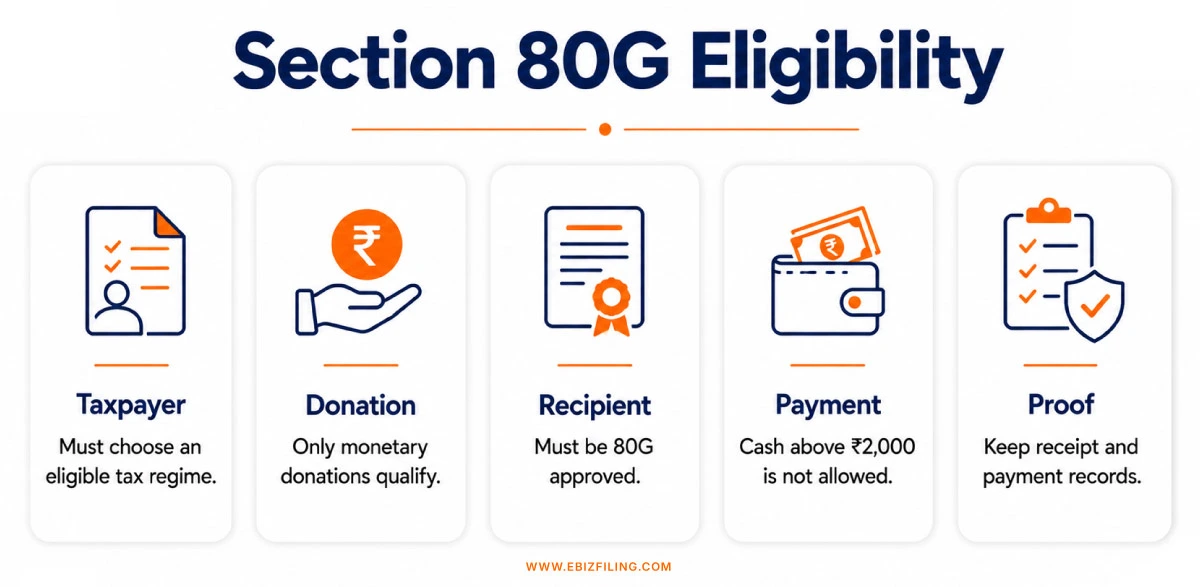
- Eligible Taxpayer: An individual with taxable income may claim the deduction when the donation is made to an eligible fund or institution and the taxpayer chooses a tax regime under which the deduction is permitted.
- Monetary Donation: The donation must be made in monetary form. Donations made in kind, such as clothes, food, medicines, books, or other goods, do not qualify for the deduction.
- Approved Recipient: The donation must be made to a specified fund or an institution holding valid approval under Section 80G of the Income-tax Act, 1961 or approval under Section 354 for the purposes of Section 133 of the Income-tax Act, 2025, as applicable.
- Permitted Payment: Cash donations exceeding ₹2,000 are not eligible for deduction. Donations above this amount should be paid through cheque, bank draft, bank transfer, UPI, card, or another permitted non-cash method. For example, if an individual donates ₹2,500 entirely in cash, the amount will not qualify for deduction under Section 80G Deduction Limit For Individual.
- Proper Records: The donor should obtain a valid donation receipt and retain proof of payment. The receipt should include the donor’s name, donation amount, name and address of the institution, PAN of the institution, and valid 80G registration details.
Types of Donations and Deduction Limits
The 80G Deduction Limit For Individual taxpayers is divided into four main categories. Identifying the correct category is necessary because the 80G Deduction Limit For Individual varies according to the fund or institution receiving the donation.
1. 100% Deduction Without a Qualifying Limit
Donations made to certain specified funds qualify for a deduction equal to the full eligible donation amount. The deduction is not restricted to 10% of the taxpayer’s adjusted gross total income.
Examples may include donations made to:
- Prime Minister’s National Relief Fund
- PM CARES Fund
- National Defence Fund
- National Children’s Fund
- National Foundation for Communal Harmony
- National Sports Development Fund
- National Cultural Fund
If an individual donates ₹40,000 to an eligible fund under this category, the full amount of ₹40,000 may be claimed as a deduction.
2. 50% Deduction Without a Qualifying Limit
Some specified funds qualify for a deduction equal to 50% of the donation amount without the restriction of 10% of adjusted gross total income.
For example, a donation made to the Prime Minister’s Drought Relief Fund may qualify under this category. If an individual donates ₹20,000, the eligible deduction will be ₹10,000.
3. 100% Deduction Subject to the Qualifying Limit
Certain donations made to the Government or approved institutions for promoting family planning may qualify for a 100% deduction. However, the qualifying donation amount is restricted to 10% of the taxpayer’s adjusted gross total income.
If the adjusted gross total income is ₹8,00,000, the maximum qualifying donation amount will be ₹80,000. Even if the individual donates ₹1,00,000, the deduction will generally be restricted to ₹80,000.
4. 50% Deduction Subject to the Qualifying Limit
Donations made to eligible charitable trusts, funds, and institutions approved under Section 80G generally qualify for a 50% deduction subject to the 10% qualifying limit, depending on the recipient’s applicable category.
After applying the qualifying limit, 50% of the eligible amount is allowed as a deduction. This is one of the most common categories considered while calculating the 80G Deduction Limit For Individual taxpayers.
For example, if the qualifying donation amount is ₹60,000, the eligible deduction will be 50% of ₹60,000, which is ₹30,000.
How to Claim 80G Deduction
- Check the Tax Regime: Confirm that the deduction is available under the tax regime selected for the relevant financial year. For years governed by the Income-tax Act, 1961, the deduction is available only under the old tax regime.
- Verify the organization: Check whether the fund, NGO, trust, or charitable institution held valid approval on the date of the donation. The organization should have valid registration under the applicable income-tax provisions.
- Use an Eligible Payment Method: For donations exceeding ₹2,000, use cheque, bank transfer, UPI, card, or another permitted non-cash payment method. Cash donations above ₹2,000 do not qualify for the deduction.
- Collect the Donation Receipt: Obtain a donation receipt containing the donor’s name, donation amount, and the name, address, PAN, and valid 80G registration number of the institution. The donor should separately retain proof of payment.
- Obtain the Donation Certificate: For periods governed by the Income-tax Act, 1961, collect Form 10BE from the charitable institution, wherever applicable. The details in Form 10BE should match the donation information reported by the organization in Form 10BD. For tax year 2026-27 onward under the Income-tax Act, 2025, the corresponding donation statement and certificate are Form 113 and Form 114.
- Enter Details in the ITR: While filing the income tax return, enter the donation details in the applicable deduction schedule. Select the correct category and mention the eligible donation and deduction amounts. Choosing the wrong category may result in an incorrect claim.
- Keep the Records Safe: The donation receipt and payment proof may not need to be uploaded with the income tax return. However, these documents should be retained in case the Income Tax Department requests verification.
Following these requirements can help taxpayers claim the 80G Deduction Limit For Individual correctly and avoid documentation or reporting errors.
Documents Required
Proper documentation supports the 80G Deduction Limit For Individual claimed in the Income Tax Return. Individuals should generally retain the following documents:
- Donation receipt issued by the institution
- Cheque, bank transfer, UPI, or other payment proof
- PAN and address details of the recipient
- Valid approval details under Section 80G or Section 354, as applicable
- Form 10BE or Form 114, as applicable
- Correct donor name and PAN details
The donation amount and other information claimed in the Income Tax Return should match the details reported by the charitable institution.
Charitable institutions applying for approval should also review the documents required for 12A and 80G registration before filing their application.
80G and Section 354 Approval Support by Ebizfiling
Ebizfiling assists NGOs, charitable trusts, societies, and Section 8 companies with approval applications under the applicable income-tax law. This includes Section 80G(5) compliance for periods governed by the Income-tax Act, 1961 and approval under Section 354 of the Income-tax Act, 2025 for current applications.
- Eligibility and document review
- Preparation of the registration application
- Online application filing support
- Assistance with departmental queries
- Guidance on renewal and related compliance
Apply for Section 80G(5) Registration with Ebizfiling today.
Conclusion
The 80G Deduction Limit For Individual depends on the donation category, percentage of deduction, qualifying limit, and adjusted gross total income. Some donations qualify for a full deduction without a qualifying limit. Donations made to eligible charitable trusts, funds, and institutions may qualify for a 50% deduction subject to the 10% qualifying limit, depending on the applicable category.
Individuals should verify the institution’s approval, use the correct payment method, collect the required documents, and select the appropriate tax regime before claiming the deduction. Understanding the 80G Deduction Limit For Individual taxpayers can help donors support charitable causes while claiming the available tax benefit correctly.
Suggested Reads:
Donation Eligibility under section 80G
Section 80G Covers Ayodhya Ram Mandir Donations
Frequently Asked Questions
1. Is the 10% limit applied before calculating the 50% deduction?
Yes. For donations qualifying for a 50% deduction subject to the qualifying limit, the eligible donation is first restricted to 10% of the adjusted gross total income, and the 50% deduction is then calculated on that qualifying amount. If the qualifying amount is ₹80,000, the eligible deduction will be ₹40,000.
2. Can the unused 80G donation deduction limit be carried forward?
No. If a donation exceeds the applicable qualifying limit, the unused amount cannot be carried forward to another financial year. The 80G donation deduction limit must be calculated and claimed in the year in which the donation was made.
3. What happens if Form 10BE shows a different donation amount?
The donor should contact the charitable institution and request a correction before claiming the deduction. For periods governed by the Income-tax Act, 1961, the institution may need to revise Form 10BD and issue a corrected Form 10BE, while the corresponding forms under the Income-tax Act, 2025 are Form 113 and Form 114.
4. Can an individual claim a deduction if the institution’s 80G approval has expired?
The institution should hold valid approval on the date of the donation. If its approval had expired before the donation was made, the contribution may not satisfy the 80G Deduction Limit For Individual eligibility conditions, so donors should verify the institution’s registration status before contributing.
5. Can an individual claim both cash and online donations under Section 80G?
Yes, both cash and non-cash donations may qualify. However, a donation exceeding ₹2,000 must be made through a non-cash mode to qualify. Cash donations not exceeding ₹2,000 may be eligible, subject to the recipient’s approval and the applicable deduction category.
6. Does the 80G deduction reduce tax payable by the full donation amount?
No. The deduction reduces the taxpayer’s taxable income and not the final tax liability by the full donation amount. The actual tax benefit depends on the eligible deduction, applicable tax slab, total taxable income, and selected tax regime.
7. Can an NRI claim the 80G Deduction Limit For Individual?
Yes. An NRI earning taxable income in India may claim the 80G Deduction Limit For Individual for an eligible donation, subject to the applicable tax regime, recipient approval, permitted payment method, and documentation requirements.
8. Are capital gains included while calculating the 10% qualifying limit?
Certain incomes, including long-term capital gains, short-term capital gains taxable under Section 111A, and certain incomes taxable at special rates, are excluded while calculating adjusted gross total income. Therefore, capital gains may affect the final 80G Deduction Limit For Individual calculation.
9. How can Ebizfiling help an NGO obtain Section 80G or Section 354 approval?
Ebizfiling assists NGOs, charitable trusts, societies, and Section 8 companies with eligibility checks, document review, application preparation, online filing, and responses to departmental queries for approval under Section 80G or Section 354, as applicable.
10. Can Ebizfiling help with donation reporting and donor certificates?
Yes. Ebizfiling can assist eligible charitable institutions with maintaining donor records, preparing donation details, filing the applicable statement, and issuing donor certificates. This may include Forms 10BD and 10BE under the Income-tax Act, 1961 or Forms 113 and 114 under the Income-tax Act, 2025, as applicable.




Register Under Seaction 80G(5)
Register under section 80G(5) in simple steps with Ebizfiling
About Ebizfiling -



September 28, 2026 By Srishti M
September 29, 2026 By Srishti M
Income Tax Compliance Calendar October 2026: Filing Guide Introduction The Income Tax Compliance Calendar October 2026 highlights important income tax obligations applicable to taxpayers, businesses and entities covered under audit and transfer pricing provisions. October 2026 includes key compliance […]
September 25, 2026 By Steffy A