


-
September 26, 2026
-
BySiddhi R
Does Section 80G Cover Ayodhya Ram Mandir Donations?
Introduction
The Ayodhya Ram Mandir has significant cultural and religious importance for millions of devotees across India. The Shri Ram Janmabhoomi Teerth Kshetra Trust was established in February 2020 to oversee the construction, management and related activities of the temple.
Many individuals and organisations have contributed towards the temple through donations made to the Trust. This raises an important question: Does Ayodhya Ram Mandir Donation qualify for tax benefits under Section 80G of the Income-tax Act, 1961?
Key Highlights
- Donations made to Shri Ram Janmabhoomi Teerth Kshetra may qualify for deduction under Section 80G, subject to prescribed conditions.
- Eligible donors can claim 50% deduction of the eligible donation amount under Section 80G.
- The deduction is subject to the 10% adjusted gross total income qualifying limit.
- Cash donations exceeding ₹2,000 and donations made in kind are not eligible for deduction.
- Section 80G deduction is generally available under the old tax regime, subject to applicable income-tax rules.
What is Shri Ram Janmabhoomi Teerth Kshetra Trust?
The Shri Ram Janmabhoomi Teerth Kshetra Trust was established by the Government of India to manage the construction, administration and maintenance-related activities of the Ayodhya Ram Mandir.
The Central Government, through CBDT Notification No. 24/2020 dated 8 May 2020, notified SHRI RAM JANMABHOOMI TEERTH KSHETRA under Section 80G(2)(b) of the Income-tax Act, 1961 as a place of historic importance and a place of public worship of renown from Financial Year 2020-21, relevant to Assessment Year 2021-22.
Therefore, donations made to the notified entity may qualify for deduction under Section 80G only when they are made for the eligible notified purpose and all prescribed conditions are satisfied.
Is Ayodhya Ram Mandir Donation Eligible for Section 80G Deduction?
Yes, Section 80G can cover Ayodhya Ram Mandir donations made to SHRI RAM JANMABHOOMI TEERTH KSHETRA, provided the donation is for the eligible notified purpose and the donor satisfies the payment mode, documentation, qualifying-limit and tax-regime conditions.
Taxpayers claiming the deduction should ensure that the donation is made through eligible payment methods and maintain proper proof of donation issued by the Trust.
Who Can Claim Tax Benefit on Ayodhya Ram Mandir Donation?
Eligible taxpayers who make qualifying donations to the notified entity can claim deduction under Section 80G, subject to the applicable conditions and limits.
The benefit may be available to:
- Individuals
- Hindu Undivided Families (HUFs)
- Companies
- Firms
- Other eligible taxpayers
Resident Indians and NRIs may consider the deduction only if they have taxable income in India and satisfy the applicable Indian income-tax conditions. Individual donors may also check the 80G deduction limit for individuals before claiming the benefit.
Eligibility Conditions for Ayodhya Ram Mandir Donation Tax Benefit
To claim deduction for Ayodhya Ram Mandir Donation, taxpayers should consider the following conditions:
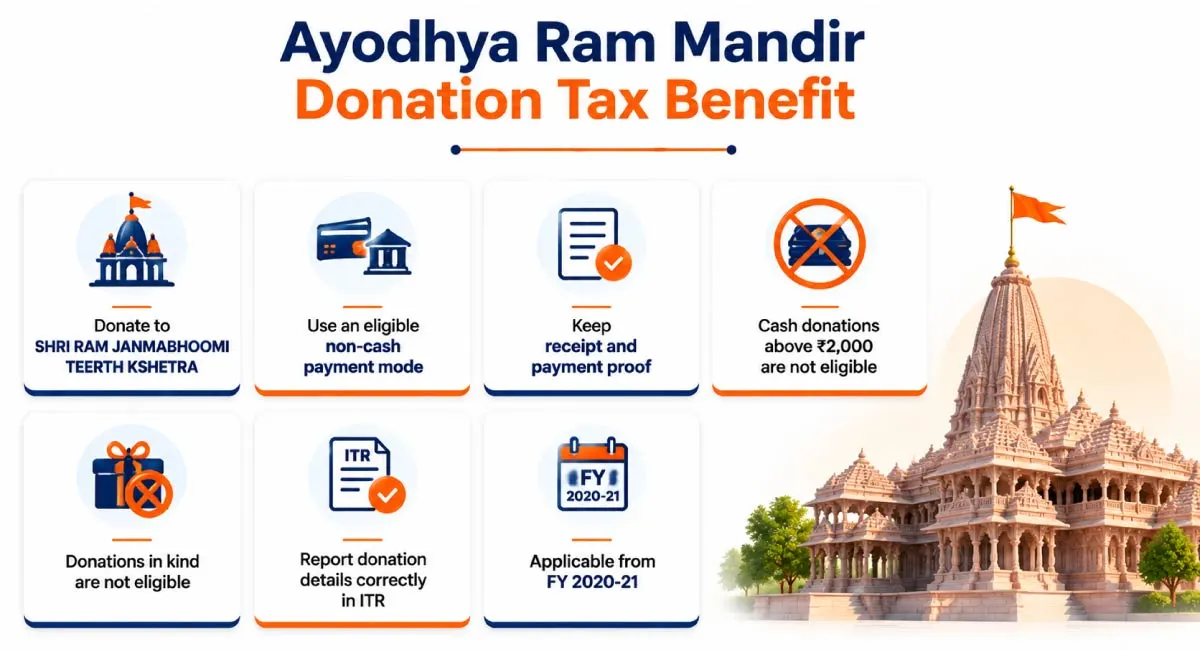
- Donation should be made to the notified SHRI RAM JANMABHOOMI TEERTH KSHETRA for the eligible notified purpose.
- Donation should be made in money through an eligible payment mode.
- A valid donation receipt/certificate and payment proof should be maintained.
- Cash donations exceeding ₹2,000 cannot be claimed as deduction.
- Donations made in kind, goods or services are not eligible.
- Required donation and donee details should be reported correctly while filing the Income Tax Return.
CBDT Notification No. 24/2020 applies from Financial Year 2020-21, relevant to Assessment Year 2021-22.
How Much Deduction Can Be Claimed for Ayodhya Ram Mandir Donation?
Donations covered in this category qualify for a 50% deduction of the eligible donation amount, subject to the 10% adjusted gross total income qualifying limit.
For example, if a taxpayer donates ₹1,00,000 and the full amount falls within the 10% adjusted gross total income qualifying limit, the deduction may be ₹50,000. If the qualifying limit is lower, the deduction will be restricted accordingly.
The deduction reduces taxable income and is not a direct refund of the donated amount.
|
Point |
Correct Position |
|
Notified entity |
Shri Ram Janmabhoomi Teerth Kshetra |
| Relevant provision |
Section 80G(2)(b), Income-tax Act, 1961 |
|
Notification |
CBDT Notification No. 24/2020 dated 8 May 2020 |
| Deduction percentage |
50% of the eligible donation amount |
|
Qualifying limit |
10% of adjusted gross total income |
| Cash donation rule |
Cash donation above ₹2,000 is not eligible |
|
Donation in kind |
Not eligible |
| Main documents |
Donation receipt/certificate, payment proof and donee details |
What is the Qualifying Limit Under Section 80G?
Donations in this category are subject to a qualifying limit of 10% of adjusted gross total income. Any amount above this limit is ignored while calculating the eligible deduction amount.
Therefore, taxpayers should consider:
- Calculate adjusted gross total income.
- Apply the 10% qualifying limit.
- Check whether other donations subject to the same limit were claimed.
- Apply the 50% deduction only on the eligible amount within the limit.
The deduction claimed should be within the limits prescribed under Section 80G.
Since this deduction is subject to a qualifying limit, taxpayers should know how to calculate the 80G limit before claiming the benefit.
Tax Benefit on Ayodhya Ram Mandir Donation Under Old and New Tax Regime
For years governed by the Income-tax Act, 1961, Section 80G deduction is generally claimable under the old tax regime.
Individuals opting for the new tax regime under Section 115BAC generally cannot claim the Section 80G deduction.
Therefore, taxpayers should evaluate both tax regimes before filing their Income Tax Return.
Documents Required to Claim Ayodhya Ram Mandir Donation Deduction
Taxpayers should maintain the following documents for claiming deduction:
- Donation receipt/certificate issued by Shri Ram Janmabhoomi Teerth Kshetra Trust
- Form 10BE or prescribed donation certificate, wherever applicable for the relevant assessment year
- Proof of payment, such as a bank statement, UPI record, card record, or cheque details
- Donee details, including name, PAN, address and notification/approval details
- Donation amount, date of donation, and payment mode
- ITR records showing correct reporting of the donation claim
Maintaining proper documentation helps taxpayers support their deduction claim during tax proceedings.
EbizFiling Support for Section 80G Donation Deduction
EbizFiling helps individuals and businesses with Income Tax Return filing, deduction review and documentation support for eligible Section 80G claims.
Our experts can assist with:
- Reviewing Section 80G eligibility for donation deduction
- Checking donation receipt/certificate and payment proof
- Evaluating the old and new tax regime impact
- Reporting eligible donation details correctly in the ITR
- Maintaining deduction-related documentation
For expert review of donation documents, deduction eligibility and tax-regime impact, you can consult EbizFiling’s tax consultancy services.
Conclusion
Ayodhya Ram Mandir Donation made to the notified Shri Ram Janmabhoomi Teerth Kshetra Trust may qualify for deduction under Section 80G when the eligible purpose and prescribed conditions are met. Eligible donors can claim 50% deduction of the eligible amount, subject to the 10% adjusted gross total income limit. Maintaining proper donation receipt/certificate, payment proof and accurate ITR reporting helps taxpayers claim the deduction correctly.
Frequently Asked Questions
1. Is Ayodhya Ram Mandir Donation considered a religious donation or charitable donation under Income Tax?
Ayodhya Ram Mandir Donation may qualify for deduction because SHRI RAM JANMABHOOMI TEERTH KSHETRA has been notified under Section 80G(2)(b), subject to the eligible purpose and prescribed conditions. It should not be treated like an ordinary temple donation without checking the notification and deduction conditions.
2. What is the role of Shri Ram Janmabhoomi Teerth Kshetra Trust in claiming tax benefits?
The Shri Ram Janmabhoomi Teerth Kshetra Trust acts as the authorised body responsible for managing donations related to the Ayodhya Ram Mandir. Donations made to the recognised Trust can qualify for tax benefits when the prescribed conditions are fulfilled.
3. Can a donor claim Ayodhya Ram Mandir Donation if the payment is made from a joint bank account?
Yes, a donation made from a joint bank account may be considered for deduction by the person who has actually made the contribution and is able to establish the payment details and ownership of the donation.
4. Can a company include Ayodhya Ram Mandir Donation in its Corporate Social Responsibility (CSR) expenditure?
Not automatically. Purely religious contributions should not be treated as CSR expenditure. A company should separately examine whether the proposed contribution fits any Schedule VII CSR category before treating it as CSR expenditure.
5. Does the tax benefit on Ayodhya Ram Mandir Donation apply if the donor has no taxable income?
Section 80G deduction reduces taxable income. Therefore, if a taxpayer does not have taxable income, the deduction may not provide any additional tax benefit.
6. Can a taxpayer revise an Income Tax Return if Ayodhya Ram Mandir Donation was missed?
If a taxpayer has missed claiming an eligible deduction, a revised return may be filed if permitted under the applicable income-tax provisions and within the prescribed timeline.
7. Is there any difference between donating for temple construction and temple maintenance for tax purposes?
Yes, the purpose matters. Section 80G(2)(b) covers donations for renovation or repair of a notified temple, place of public worship or place of historic importance. Donors should ensure that the donation purpose is covered before claiming deduction.
8. Can foreign donations to Shri Ram Janmabhoomi Teerth Kshetra Trust claim the same tax benefit?
Foreign donors cannot automatically claim the same Indian tax benefit. Deduction in India depends on whether the donor is eligible to file an Indian tax return, has taxable income in India, and satisfies the applicable Indian income-tax conditions.
9. Does Section 80G Ayodhya Ram Mandir Donation benefit apply automatically after making payment?
No, the tax benefit is not automatic. The taxpayer must fulfil the applicable Section 80G conditions, maintain proper documents and correctly claim the eligible deduction while filing the Income Tax Return.
10. How does Ayodhya Ram Mandir Donation impact taxable income?
Eligible Ayodhya Ram Mandir Donation reduces taxable income only to the extent of the deduction allowed after applying the deduction percentage and qualifying limit. The actual tax saving depends on the taxpayer’s taxable income, applicable tax slab, and chosen tax regime.





File Income Tax Returns
Filing of Income Tax return is necessary if you have earned any income. File your ITR with EbizFiling at INR 1199/- only.
About Ebizfiling -



Reviews
Aditi Doshi
18 Mar 2018The team really puts effort to help you with the procedure. They are very efficient with their work. Kudos to the team!
Devangi Patnayak
11 Mar 2018I am very happy with the way they serve their clients. They are focused on providing the best help that they can and are result oriented.
Rehan Khan
30 Jan 2018Timely services + Best Pricing + Efficient staff = Ebizfiling. It is the best company that I have come across for my compliance needs. Thank you, Ebizfiling
October 14, 2026 By Srishti M
GST Compliance Calendar November 2026: Key Due Dates & Filings Introduction The GST Compliance Calendar November 2026 highlights the major GST return filing, tax payment, invoice reporting and year-end adjustment deadlines applicable during the month. It covers regular taxpayers, QRMP […]
October 13, 2026 By Srishti M
October 12, 2026 By Srishti M