

-
September 26, 2026
-
BySiddhi R
How to calculate the 80G limit Under Income Tax Act?
Introduction
Donations made to eligible charitable organizations can provide tax benefits under Section 80G of the Income Tax Act, 1961. However, the deduction amount is not always equal to the donated amount. It depends on the type of donation, applicable deduction percentage, and whether the 10% Adjusted Gross Total Income (AGTI) limit applies.
Understanding how to calculate the 80G limit helps taxpayers claim the correct deduction and avoid errors while filing their Income Tax Return.
Key Highlights
- Section 80G allows taxpayers to claim deductions for eligible donations, and understanding how to calculate the 80G limit helps determine the correct deduction amount.
- Donations are classified into categories based on the applicable deduction percentage and limits while calculating the eligible deduction.
- Some donations qualify for 100% or 50% deduction without any upper limit under Section 80G.
- Certain donations are restricted to 10% of Adjusted Gross Total Income (AGTI), which must be considered while calculating the deduction.
- Cash donations above ₹2,000 are not eligible for deduction under Section 80G.
What is Section 80G Deduction Under Income Tax Act?
Section 80G of the Income Tax Act, 1961 allows taxpayers to claim deductions for donations made to specified charitable institutions, trusts, and funds. The provision encourages individuals and businesses to contribute towards charitable and social welfare activities by providing tax deductions.
The deduction available under Section 80G depends on the category of donation. Some donations are eligible for a full deduction, while others qualify for a partial deduction. In certain cases, the deduction is restricted to a specific percentage of the taxpayer’s Adjusted Gross Total Income (AGTI).
How to calculate the 80G limit for Donation Deduction?
To calculate the eligible deduction under Section 80G, taxpayers need to follow specific steps. The calculation depends on whether the donation falls under the unlimited deduction category or the category subject to the AGTI limit.
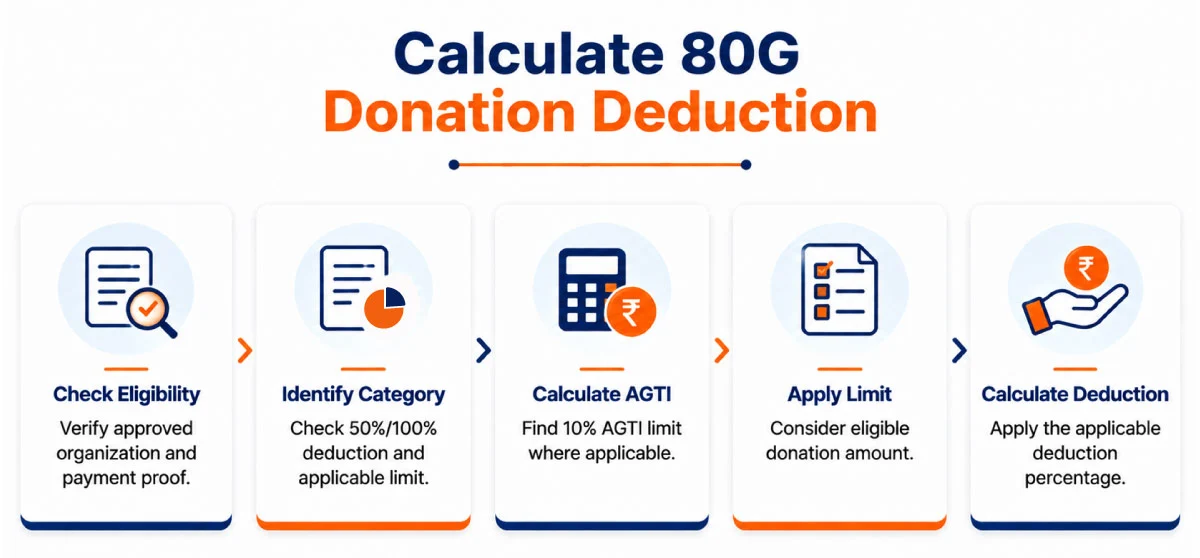
Check Whether the Donation Qualifies Under Section 80G
Before calculating the deduction, taxpayers must confirm that the donation is eligible under Section 80G.
The following conditions should be considered:
- The donation must be made to an organization approved under Section 80G.
- The donor should maintain a valid donation receipt.
- The receipt should contain details such as the name, PAN, and address of the donee organization.
- Cash donations exceeding ₹2,000 are not eligible for deduction.
- Donations should be made through eligible banking methods where applicable.
Only eligible donations can be considered while calculating the deduction amount.
Identify the Applicable Section 80G Deduction Category
The next step in the 80G donation limit calculation is identifying the category under which the donation falls.
|
Type of Donation |
Deduction Allowed |
Limit Applicable |
|
Donations to specified funds |
100% deduction | No limit |
| Donations to specified funds | 50% deduction |
No limit |
|
Donations for specified government-approved purposes |
100% deduction | Subject to 10% of AGTI |
| Donations to certain charitable organizations | 50% deduction |
Subject to 10% of AGTI |
The deduction percentage and limit depend on the fund or institution receiving the donation.
Calculate Adjusted Gross Total Income (AGTI)
For donations subject to the 10% limit, taxpayers need to calculate their Adjusted Gross Total Income.
The formula for AGTI is:
AGTI = Gross Total Income – deductions other than Section 80G – exempt income – long-term capital gains – short-term capital gains taxable under Section 111A – income taxable under special rates.
The 10% limit is calculated based on the AGTI amount.
Example of AGTI Calculation
Suppose a taxpayer has:
- Gross Total Income: ₹15,00,000
- Exempt income: ₹1,00,000
- Long-term capital gains: ₹2,00,000
- Other deductions: ₹1,00,000
AGTI calculation:
₹15,00,000 – ₹1,00,000 – ₹2,00,000 – ₹1,00,000
AGTI = ₹11,00,000
10% of AGTI:
₹11,00,000 × 10% = ₹1,10,000
Therefore, donations falling under the 10% limit category will be considered only up to ₹1,10,000.
Apply the Deduction Percentage
After identifying the eligible donation amount, apply the applicable deduction percentage.
Example 1: 50% Deduction Without Limit
A taxpayer donates ₹60,000 to an eligible organization where a 50% deduction applies.
Calculation:
₹60,000 × 50%
= ₹30,000
The taxpayer can claim ₹30,000 as deduction under Section 80G.
Example 2: Donation Subject to 10% AGTI Limit
A taxpayer has AGTI of ₹10,00,000 and donates ₹2,00,000 to an organization where the deduction is subject to the 10% limit.
Calculation:
Maximum eligible donation:
₹10,00,000 × 10%
= ₹1,00,000
If the applicable deduction rate is 50%:
₹1,00,000 × 50%
= ₹50,000
The taxpayer can claim ₹50,000 as deduction.
Who Can Claim Deduction Under Section 80G?
The following taxpayers can claim deduction for eligible donations:
- Individuals
- Hindu Undivided Families (HUFs)
- Companies
- Firms
- Non-Resident Indians (NRIs)
The deduction can be claimed only when the donation meets the conditions specified under Section 80G.
Documents Required for Section 80G Deduction Claim
Taxpayers should maintain proper records to support their deduction claim.
Required documents generally include:
- Donation receipt issued by the approved organization
- Name and PAN of the donee organization
- Date and amount of donation
- Payment details
- Form 10BE issued by the donee institution after filing Form 10BD, wherever applicable.
These documents help verify the donation details while filing the Income Tax Return. Organizations and taxpayers should maintain proper records. For detailed information, refer to the guide on documents required for Section 80G registration.
Assistance With Section 80G Registration and Compliance
Ebizfiling assists charitable organizations and trusts with support related to Section 80G registration requirements.
The assistance includes:
- Guidance on Section 80G registration requirements.
- Support in preparing required documents.
- Assistance with Income Tax registration-related procedures.
- Support for compliance-related queries.
Businesses, trusts, and NGOs requiring assistance with approval procedures can opt for professional support for Section 80G and 12A registration.
Conclusion
Knowing how to calculate the 80G limit helps taxpayers determine the correct deduction available for charitable donations. The calculation depends on the donation category, applicable deduction percentage, and AGTI limit wherever applicable. Maintaining proper records and donating to eligible organizations helps taxpayers claim deductions correctly while filing their Income Tax Return. Need assistance with obtaining Section 80G approval? Get expert support for Section 80G registration and complete the compliance process smoothly.
Suggested Reads:
Renew a Trust License in India
Difference between 12A and 80G
How to Download 12A and 80G Certificate?
Section 80G Covers Ayodhya Ram Mandir Donations
Frequently Asked Questions
1. How to calculate the 80G limit for donations eligible under the 10% AGTI restriction?
To calculate the 80G limit for donations subject to the AGTI restriction, first determine the Adjusted Gross Total Income (AGTI). The maximum eligible donation amount is restricted to 10% of AGTI. After applying this limit, the applicable deduction percentage, such as 50% or 100%, is calculated to determine the final deduction.
2. Is the entire donation amount considered while calculating the Section 80G deduction limit?
No. The entire donation amount may not qualify for deduction under Section 80G. The eligible amount depends on the category of donation, applicable deduction percentage, and whether the donation is subject to the 10% AGTI limit.
3. How to calculate 80G deduction when the donation exceeds the AGTI limit?
If a donation falls under the category where the 10% AGTI limit applies and the donation amount exceeds this limit, only the amount within the permitted AGTI limit is considered for deduction calculation. The remaining donation amount cannot be claimed as a deduction under Section 80G.
4. Does the Section 80G deduction limit apply to all types of donations?
No. The Section 80G deduction limit depends on the type of fund or institution receiving the donation. Certain specified donations qualify for 100% or 50% deduction without an upper limit, while some donations are restricted to 10% of AGTI.
5. Can cash donations be included in 80G donation limit calculation?
Cash donations are eligible for Section 80G deduction only up to the prescribed limit. Cash donations exceeding ₹2,000 are not eligible for deduction under Section 80G. Donations above this limit should be made through eligible banking channels.
6. How does the donation receipt help in calculating the Section 80G deduction?
A valid donation receipt provides details required to claim donation deduction under Section 80G. It generally contains the name, address, PAN of the donee organization, donation amount, and other prescribed details required while filing the Income Tax Return.
7. How to calculate the 80G limit for donations made by companies?
Companies can calculate the Section 80G deduction in the same manner as other eligible taxpayers. The company must identify the donation category, check whether the AGTI limit applies, and calculate the eligible deduction based on the applicable percentage.
8. Can NRIs claim deduction under Section 80G for donations made in India?
Yes, NRIs can claim deduction for eligible donations made to approved Indian charitable institutions or funds, subject to the conditions specified under Section 80G and applicable Income Tax rules.
9. What documents are required to support donation deduction under Section 80G?
To claim donation deduction under Section 80G, taxpayers should maintain supporting documents such as the donation receipt issued by the eligible organization, PAN details of the donee institution, payment details of the donation, and Form 10BE issued by the donee, wherever applicable. These records help verify the donation details and support the deduction claim while filing the Income Tax Return.
10. What happens if the Section 80G deduction is calculated incorrectly?
Incorrect calculation of Section 80G deduction may result in claiming an excess deduction in the Income Tax Return. Taxpayers should verify the donation category, applicable deduction percentage, and AGTI limit before claiming the benefit to avoid compliance issues.




80G5 Registration
Register 80G5 of income tax in simple steps with Ebizfiling
About Ebizfiling -



October 12, 2026 By Srishti M
October 12, 2026 By Srishti M
Company Compliance Calendar November 2026: Key Due Dates & Filings Introduction The Company Compliance Calendar November 2026 highlights important annual return, dematerialisation and income tax compliances that companies may need to complete during the month. November 2026 is particularly […]
October 10, 2026 By Srishti M