

-
September 25, 2026
-
BySteffy A
Donation Tax Deductions under Section 80G of the Income Tax Act
Introduction
Donation Tax Deductions under Section 80G allow eligible taxpayers to support approved charitable causes while reducing their taxable income. The benefit is available only when the donation meets the conditions prescribed under the Income Tax Act. Understanding the eligible organizations, payment modes, deduction percentages, and applicable limits can help taxpayers claim the correct benefit while filing their Income Tax Return. Section 80G of the Income-tax Act, 1961 provides donation deductions for applicable tax periods. From the tax year covered by the Income-tax Act, 2025, the corresponding deduction provisions are provided under Section 133.
What Are Donation Tax Deductions?
Donation Tax Deductions refer to tax benefits available on eligible donations made to specified funds, trusts, and charitable institutions. Under Section 80G, qualifying donations may be deductible at either 50% or 100%, depending on the category of the recipient. Some donations are allowed without any qualifying limit, while others are restricted to 10% of the taxpayer’s adjusted gross total income.
Only monetary contributions are eligible. Donations made in kind, such as clothes, food, medicines, property, shares, or equipment, do not qualify under Section 80G. Cash donations exceeding ₹2,000 are also not eligible for deduction.
Eligibility Criteria
To claim Donation Tax Deductions, taxpayers should check the following requirements:
- Eligible Organization: The donation must be made to a fund, trust, institution, or organization that qualifies under Section 80G.
- Valid Approval: The organization should have valid Section 80G approval for the relevant period.
- Proper Documentation: The donor should keep a valid donation receipt containing the required details of the organization and the contribution.
- Donation Certificate: For tax year 2026-27 onward, donors should obtain Form 114, where applicable. Form 10BE relates to the earlier Income-tax Act, 1961 framework.
- Payment Mode: Donations above ₹2,000 should be made through cheque, bank transfer, UPI, or another non-cash mode.
- Tax Regime: Taxpayers whose income is computed under the new tax regime under Section 202 generally cannot claim the donation deduction under Section 133, since most Chapter VIII deductions are excluded under that regime.
To understand who can claim the deduction and which donations qualify, read our detailed guide on Eligibility for Donation Under Section 80G of the Income Tax Act.
Types of Donations Eligible for Deduction Under Section 80G/133
Donation tax deductions are generally divided into four categories based on the deduction percentage allowed and whether a qualifying limit applies.
100% Deduction Without Qualifying Limit: Donations to specified funds such as the National Defence Fund, Prime Minister’s National Relief Fund, and PM CARES Fund may qualify for a 100% deduction without being restricted by the 10% qualifying limit.
100% Deduction With Qualifying Limit: Certain donations to the Government or approved authorities for promoting family planning may qualify for a 100% deduction, subject to the applicable qualifying limit.
50% Deduction Without Qualifying Limit: Certain specified donations, such as contributions to the Prime Minister’s Drought Relief Fund, may qualify for a 50% deduction without the qualifying limit.
50% Deduction With Qualifying Limit: Donations to many approved charitable trusts, institutions, and certain local authorities may qualify for a 50% deduction, subject to the 10% limit based on adjusted gross total income.
How to Claim the Deduction?
The process of claiming Donation Tax Deductions involves a few simple checks and reporting steps.
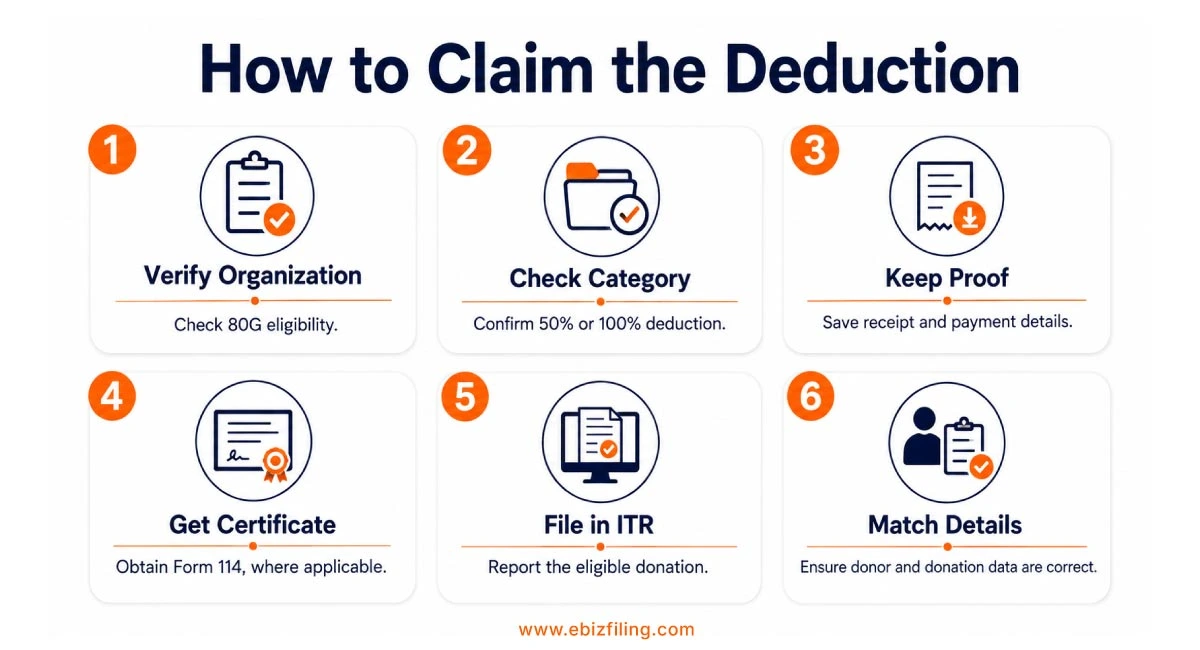
Verify the Organization: Confirm that the fund or charitable institution is eligible under Section 80G.
Check the Deduction Category: Determine whether the donation qualifies for a 50% or 100% deduction and whether a qualifying limit applies.
Keep the Receipt: Preserve the donation receipt and payment proof.
Obtain the Donation Certificate: For tax year 2026-27 onward, obtain Form 114 from the eligible organization, where applicable. For earlier periods governed by the Income-tax Act, 1961, Form 10BE may apply.
Enter the Details in ITR: Report the eligible donation under the relevant donation deduction schedule or section in the applicable Income Tax Return.
Match the Information: Ensure the donation amount and donor details match the information reported by the organization in the applicable Statement of Donations.
What Donations Do Not Qualify?
Not every contribution made for a charitable purpose receives a Section 80G tax benefit. Donations in kind, including food, clothes, medicines, property, shares, or equipment, are not eligible. The value of time spent volunteering is also not treated as a monetary donation under Section 80G.
Similarly, a donation made to an organization that does not have the required approval cannot be claimed merely because the organization carries out charitable activities. Taxpayers should verify the recipient before making the contribution if they intend to claim Donation Tax Deductions.
Get Section 80G and NGO Compliance Support with Ebizfiling
Ebizfiling assists NGOs and charitable organizations with registrations and compliance needed to operate properly and support eligible tax benefits for donors.
Get support for registration and approval applicable to eligible non-profit organizations under the current Income-tax framework.
Get assistance with NPO registration, documentation, donation-related approval, and compliance requirements.
Receive guidance on transitioning from earlier 12A/12AB and 80G terminology to the applicable Income-tax Act, 2025 provisions.
Need help with 80G or NGO registration? Contact Ebizfiling today.
Conclusion
Donation Tax Deductions can help eligible taxpayers reduce taxable income while supporting approved charitable causes under Section 80G. To claim the benefit correctly, taxpayers should verify the recipient, check the deduction percentage, understand the applicable limit, use an eligible payment mode, and maintain proper records. Careful reporting and documentation can help taxpayers claim the available deduction without unnecessary errors.
Suggested Reads:
Donation Eligibility under section 80G
Section 80G Covers Ayodhya Ram Mandir Donations
Frequently Asked Questions
1. Is Section 80G still applicable for Donation Tax Deductions in 2026?
Section 80G remains relevant for donations and tax periods governed by the Income-tax Act, 1961. From tax year 2026-27, the corresponding donation deduction provisions are contained in Section 133 of the Income-tax Act, 2025. Therefore, taxpayers should apply the provision relevant to the tax year for which they are claiming the deduction.
2. Is every Section 80G donation eligible for a 100% deduction?
No. A Section 80G donation may qualify for either a 50% or 100% deduction, depending on the fund or institution receiving the donation. Certain donations are also subject to a qualifying limit, so donors should verify the applicable category before claiming the deduction.
3. How does the Section 80G deduction limit affect the amount I can claim?
The Section 80G deduction limit applies to specified categories of donations. For these donations, the qualifying amount is generally restricted to 10% of adjusted gross total income. Donations falling under categories without a qualifying limit are not subject to this 10% restriction.
4. Can I claim a donation tax deduction in India if I donate more than ₹2,000 in cash?
No. For a donation tax deduction in India, a cash donation exceeding ₹2,000 does not qualify. Donations above this amount should be made through a non-cash mode such as bank transfer, cheque, UPI, or another permitted electronic payment method.
5. What donation certificate is required for tax year 2026-27 onward?
For tax year 2026-27 onward, eligible organizations report applicable donations through Form 113 and issue the donor a Certificate of Donation in Form 114. Form 10BE was used under the earlier Income-tax Act, 1961 framework. Donors should ensure that the details in their certificate match the donation being claimed.
6. Can a donation of shares, property, food, or medicines qualify for a charitable donation tax deduction?
No. A charitable donation tax deduction is available only for qualifying monetary donations. Contributions made in kind, including property, shares, food, clothes, medicines, or equipment, do not qualify for the donation deduction provisions.
7. Can Donation Tax Deductions be claimed under the new tax regime?
Generally, no. Under the Income-tax Act, 2025, the new tax regime under Section 202 excludes most deductions under Chapter VIII, which includes the donation deduction under Section 133. Therefore, taxpayers using the new regime generally cannot claim Donation Tax Deductions for these eligible charitable contributions.
8. What happens if my donation deduction details do not match Form 113?
For tax year 2026-27 onward, eligible reporting organizations submit donation details through Form 113. The donor should ensure that the donation amount and personal details used for claiming the deduction correspond with the information reported by the organization and reflected in Form 114. A mismatch may affect verification of the deduction claim.
9. How can an NGO become eligible to offer tax benefits to its donors?
Under the Income-tax Act, 2025, an eligible NPO may require registration under Section 332 for the applicable NPO tax-exemption framework and approval under Section 354 for donation-related deductions. Approval under Section 354 is particularly relevant where eligible donors are intended to claim deductions under Section 133.
10. Can Ebizfiling help an NGO with compliance related to Donation Tax Deductions?
Ebizfiling can assist NGOs and non-profit organizations with applicable registration, donation-related approval, documentation, and compliance under the current Income-tax framework, as well as matters relating to earlier 12A/12AB and 80G registrations where relevant.




Registration Under Seaction 80G of Income tax Act
Register under Section 80G of income tax act in simple steps with Ebizfiling
About Ebizfiling -



October 12, 2026 By Srishti M
Company Compliance Calendar November 2026: Key Due Dates & Filings Introduction The Company Compliance Calendar November 2026 highlights important annual return, dematerialisation and income tax compliances that companies may need to complete during the month. November 2026 is particularly […]
October 10, 2026 By Srishti M
October 10, 2026 By Srishti M
Compliance Calendar November 2026: Key Statutory Due Dates Introduction The compliance calendar November 2026 covers important statutory obligations under GST, Income Tax, TDS/TCS, Company Law, LLP regulations, EPF and ESI. It helps businesses identify the filings, payments and regulatory requirements […]