


-
September 25, 2026
-
BySiddhi R
Eligibility For Donation Under Section 80G of Income Tax Act, 1961
Introduction
Donations eligible under Section 80G can provide tax benefits to individuals and organizations contributing to charitable institutions, NGOs, trusts, and specified funds. The Eligibility For Donation Under Section 80G depends on factors such as the type of organization receiving the donation, its approval status, the mode of payment, and the applicable deduction category.
This provision encourages taxpayers to support approved charitable causes while allowing them to reduce their taxable income through eligible deductions. A donor should therefore verify the organization and maintain proper records before claiming the deduction while filing the Income Tax Return.
Key Highlights
- Section 80G allows eligible taxpayers to claim tax deductions on donations made to approved charitable institutions and specified funds.
- Donations may qualify for either a 50% or 100% deduction, depending on the recipient and applicable conditions.
- Cash donations above ₹2,000 are not eligible for Section 80G deduction and should be made through non-cash modes.
- Taxpayers should keep documents such as the donation receipt, Form 10BE or Form 114, as applicable, PAN of the donee, and payment details.
- The Eligibility For Donation Under Section 80G also depends on the taxpayer’s chosen tax regime, as the deduction is generally not available under the new tax regime.
Note: The Income-tax Act, 2025 came into effect from 1 April 2026, replacing the Income-tax Act, 1961. References to Section 80G in this article apply to donations and tax returns governed by the earlier Act. For tax year 2026-27 onwards, the corresponding provisions for eligible donations are governed by Section 133 of the Income-tax Act, 2025, along with the applicable rules and prescribed forms.
Permitted Donations Under Section 80G
The Eligibility For Donation Under Section 80G generally applies to monetary contributions made to specified funds and approved charitable organizations.
Donations may be made through:
- Cheque
- Demand draft
- Bank transfer
- UPI or other digital payment methods
- Cash, subject to the prescribed limit
Donations made in kind, such as clothes, food, medicines, books, or other goods, generally do not qualify for deduction under Section 80G.
The organization receiving the donation should also have valid approval under Section 80G wherever such approval is required.
Conditions for Claiming Deduction Under Section 80G
A taxpayer claiming a deduction should satisfy the applicable conditions.
First, the donation must be made to an eligible fund or approved charitable institution.
Second, cash donations exceeding ₹2,000 are not eligible for deduction. If the donation amount exceeds ₹2,000, payment should be made through cheque, draft, banking channels, or an electronic payment method. The Income Tax Department continues to specify this ₹2,000 cash restriction for Section 80G claims.
Third, the donor should maintain appropriate documentary evidence, including the donation receipt and the applicable donation certificate, such as Form 10BE under the Income-tax Act, 1961 framework.
The Eligibility For Donation Under Section 80G should therefore be verified before the donation is claimed in the tax return.
Categories of Donations Under Section 80G
Section 80G broadly divides eligible donations into four categories.
1. 100% Deduction Without Qualifying Limit
Certain specified donations qualify for a deduction equal to 100% of the donated amount without applying a qualifying income limit.
Examples may include donations to specified funds such as:
- National Defence Fund
- Prime Minister’s National Relief Fund
- PM CARES Fund
- National Children’s Fund
- National Foundation for Communal Harmony
2. 50% Deduction Without Qualifying Limit
Certain specified donations are eligible for a 50% deduction without being subject to the qualifying limit.
The Prime Minister’s Drought Relief Fund is one of the specified examples under this category.
3. 100% Deduction Subject to Qualifying Limit
Certain donations qualify for a 100% deduction but are subject to the qualifying limit.
This category includes eligible donations made to the Government or a local authority for promoting family planning. It may also include specified contributions made by eligible companies to the Indian Olympic Association or other notified institutions to develop sports infrastructure or sponsorship of sports and games, subject to the applicable conditions.
4. 50% Deduction Subject to Qualifying Limit
Donations made to approved charitable institutions and certain government or local authority funds for general charitable purposes may qualify for a 50% deduction subject to the prescribed qualifying limit.
The Income Tax Department continues to classify Section 80G deductions into these four broad categories.
Understanding these classifications is important when determining the Eligibility For Donation Under Section 80G.
What is the 10% Qualifying Limit?
For donations falling under categories subject to a qualifying limit, the deduction is calculated with reference to 10% of the taxpayer’s Adjusted Gross Total Income.
Adjusted Gross Total Income is generally calculated after reducing certain incomes and deductions as prescribed under the Income Tax Act.
If the qualifying donation exceeds the applicable 10% limit, the excess amount is not considered while computing the Section 80G deduction.
Therefore, taxpayers should not assume that the entire amount donated will always be deductible.
Eligibility to Claim Deduction Under Section 80G
The Eligibility For Donation Under Section 80G is not limited to salaried individuals.
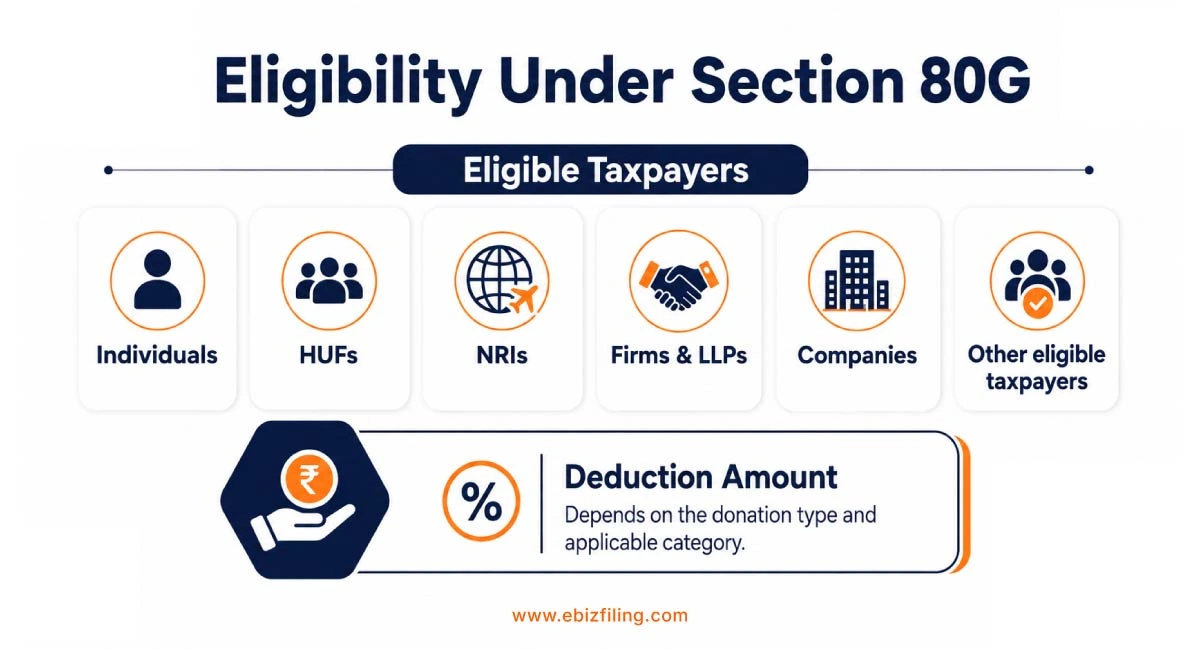
Subject to applicable conditions, the deduction may be claimed by:
- Individuals
- Hindu Undivided Families
- Non-resident individuals
- Firms
- LLPs
- Companies
- Other eligible taxpayers
The exact amount available as deduction will depend on the nature of the donation and the applicable deduction category.
Required Documents to Claim Deduction Under Section 80G
Taxpayers should retain supporting documents for the donation.
Important documents and details may include:
- Donation receipt
- Name of the donee organization
- PAN of the organization
- Address of the organization
- Amount donated
- Section 80G approval details
- Form 10BE, wherever applicable
- Payment transaction details
A proper donation receipt helps establish that the donation was actually made to the relevant institution.
Importance of Donation Certificates and Reporting Forms
Under the Income-tax Act, 1961 framework, eligible organizations report donation details through Form 10BD and issue Form 10BE to donors. For tax year 2026-27 onwards under the Income-tax Act, 2025, the corresponding donation reporting requirements are covered through Form 113 and Form 114. Donors and charitable organizations should use the applicable form based on the relevant tax year.
How to Claim Deduction Under Section 80G?
For returns governed by the Income-tax Act, 1961, the taxpayer should enter the required donation details in Schedule 80G of the applicable ITR.
Generally, the following details may be required:
- Name of the donee organization
- PAN of the organization
- Address of the organization
- Donation amount
- Eligible deduction amount
- Applicable deduction category
- Payment or transaction details, wherever required
Taxpayers should carefully match the information with the donation receipt and Form 10BE before submitting the return.
Where to Enter Section 80G Donation Details in ITR?
For returns governed by the Income-tax Act, 1961, eligible Section 80G donations are generally reported in Schedule 80G under the appropriate deduction category.
Section 80G donations are generally reported under the appropriate table depending on their deduction category:
- Table A: 100% deduction without qualifying limit
- Table B: 50% deduction without qualifying limit
- Table C: 100% deduction subject to qualifying limit
- Table D: 50% deduction subject to qualifying limit
Selecting the correct table is important because the tax deduction is calculated based on the category of donation.
The Donation Tax Deduction Under Section 80G allows eligible taxpayers to reduce their taxable income by claiming deductions on qualifying donations made to approved charitable institutions and specified funds.
Get Professional Assistance for Section 80G / Section 354 Approval
Ebizfiling assists NGOs, charitable trusts, and eligible institutions with Section 80G registration, documentation, and related compliance requirements.
Our team helps with:
- Checking eligibility for Section 80G registration
- Preparing and reviewing required documents
- Filing the application correctly
- Supporting follow-up and compliance requirements
If your organization wants to obtain the applicable approval for receiving tax-deductible donations, Ebizfiling can guide you through the process under the relevant provisions of the Income-tax Act.
Apply for Section 80G registration with Ebizfiling today.
Conclusion
The Eligibility For Donation Under Section 80G allows eligible taxpayers to claim deductions for donations made to approved charitable institutions and specified funds. However, donors must verify the organization, payment method, deduction category, and required documentation before claiming the benefit.
The deduction may be available at 50% or 100%, depending on the recipient and the applicable qualifying limit. The taxpayer’s chosen tax regime can also affect whether the deduction is available. Keeping proper donation receipts, Form 10BE (where applicable) and payment records can help taxpayers claim the deduction correctly and reduce the risk of discrepancies while filing their Income Tax Return.
Suggested Reads:
How to Calculate the Section 80G Deduction Limit
Frequently Asked Questions
1. Can a donor claim a Section 80G deduction if the NGO’s approval has expired?
No. The donee should have valid Section 80G approval for the relevant period. Donors should verify the approval status before making the claim because the Eligibility For Donation Under Section 80G depends on whether the recipient is properly approved.
2. Does every donation to a registered NGO qualify for a Section 80G tax deduction?
No. Registration as an NGO or trust alone does not make every contribution deductible. The Eligibility For Donation Under Section 80G applies only when donations are made to approved institutions or specified funds and the applicable conditions are satisfied.
3. How does the 80G deduction limit work for donations subject to a qualifying limit?
For specified categories, the qualifying amount is restricted to 10% of Adjusted Gross Total Income. The 80G deduction limit is applied before calculating whether 50% or 100% of the qualifying donation can be deducted.
4. Can I split a cash donation above ₹2,000 into smaller payments to claim the deduction?
No deduction is available under Section 80G for a donation exceeding ₹2,000 if it is made in cash. For donations above ₹2,000, the donor should use an eligible non-cash payment mode such as bank transfer, cheque, draft, or another permitted electronic method.
5. What are the main documents required for 80G deduction claims?
The documents required for 80G deduction generally include the donation receipt, donee details, PAN, Section 80G approval information, Form 10BE where applicable, and payment records. Proper documentation is an important part of establishing the Eligibility For Donation Under Section 80G while filing the Income Tax Return.
6. Can a company claim a Section 80G deduction for donations made to an approved charitable institution?
Yes. An eligible company may claim a Section 80G deduction subject to the conditions applicable to the donation and the recipient. Companies should also check whether the donation falls under a 50% or 100% deduction category and whether the qualifying limit applies.
7. How to claim 80G deduction if Form 10BE contains incorrect donation details?
If Form 10BE contains incorrect details, the donor should first contact the charitable institution and request correction of the reported information before filing the claim. When checking how to claim 80G deduction, consistency between the donor’s ITR and the donee’s reporting is important.
8. Can Section 80G deduction be claimed under the new tax regime?
Generally, no. Chapter VI-A deductions such as Section 80G are not available under the new tax regime, except for limited specified deductions permitted under Section 115BAC. Therefore, the Eligibility For Donation Under Section 80G should also be checked according to the tax regime selected by the taxpayer.
9. Can Ebizfiling help an NGO become eligible to receive donations qualifying under Section 80G?
Yes. Ebizfiling can assist eligible NGOs, trusts, and charitable institutions with Section 80G registration, documentation, and related compliance support. Proper registration can help an organization meet the relevant requirements for donors seeking a Section 80G tax deduction.
10. How can Ebizfiling help with Section 80G registration and compliance?
Ebizfiling can guide charitable organizations through eligibility checks, document preparation, application filing, and related compliance requirements. This support can help organizations understand the registration process associated with the Eligibility For Donation Under Section 80G and maintain the necessary records for donation reporting.





80G(5) Registration
Register under 80G(5) of income tax in simple steps with Ebizfiling
About Ebizfiling -



October 14, 2026 By Srishti M
September 29, 2026 By Srishti M
Income Tax Compliance Calendar October 2026: Filing Guide Introduction The Income Tax Compliance Calendar October 2026 highlights important income tax obligations applicable to taxpayers, businesses and entities covered under audit and transfer pricing provisions. October 2026 includes key compliance […]
September 21, 2026 By Siddhi R
Section 130 of the Income Tax Act: Home Loan Interest Deduction Introduction Buying a residential house property often involves taking a home loan, and the interest paid on such loans can provide tax benefits under certain provisions of the Income […]