

-
October 9, 2026
-
BySteffy A
Section 80G of the Income Tax Act,1961: Deduction Rules and Limits
Introduction
Section 80G of the Income Tax Act allows taxpayers to claim a deduction for donations made to specified funds, charitable institutions and approved organizations. It encourages charitable giving while helping eligible taxpayers reduce their taxable income.
However, every donation does not qualify. Depending on the organization receiving the donation, the deduction may be 50% or 100% of the eligible amount. Certain donations are also restricted to 10% of the taxpayer’s adjusted gross total income. Section 80G of the Income tax Act, 1961, applies to donations relating to FY 2025-26 and earlier. For Tax Year 2026-27 beginning on 1 April 2026, the corresponding deduction is governed by Section 133 of the Income tax Act, 2025.
What Is Section 80G of the Income Tax Act?
Section 80G of the Income Tax Act provides a deduction from gross total income when a taxpayer makes a monetary donation to an eligible fund, trust, institution or organization.
It is important to understand that Section 80G of the Income Tax Act provides a deduction and not a direct tax exemption or rebate. The amount donated and the amount allowed as a deduction may be different.
The recipient must either be specifically listed under the law or hold valid approval under Section 80G(5). Taxpayers should verify the organization’s registration status and deduction category before donating.
Who Can Claim the Section 80G Deduction?
The deduction may be claimed by:
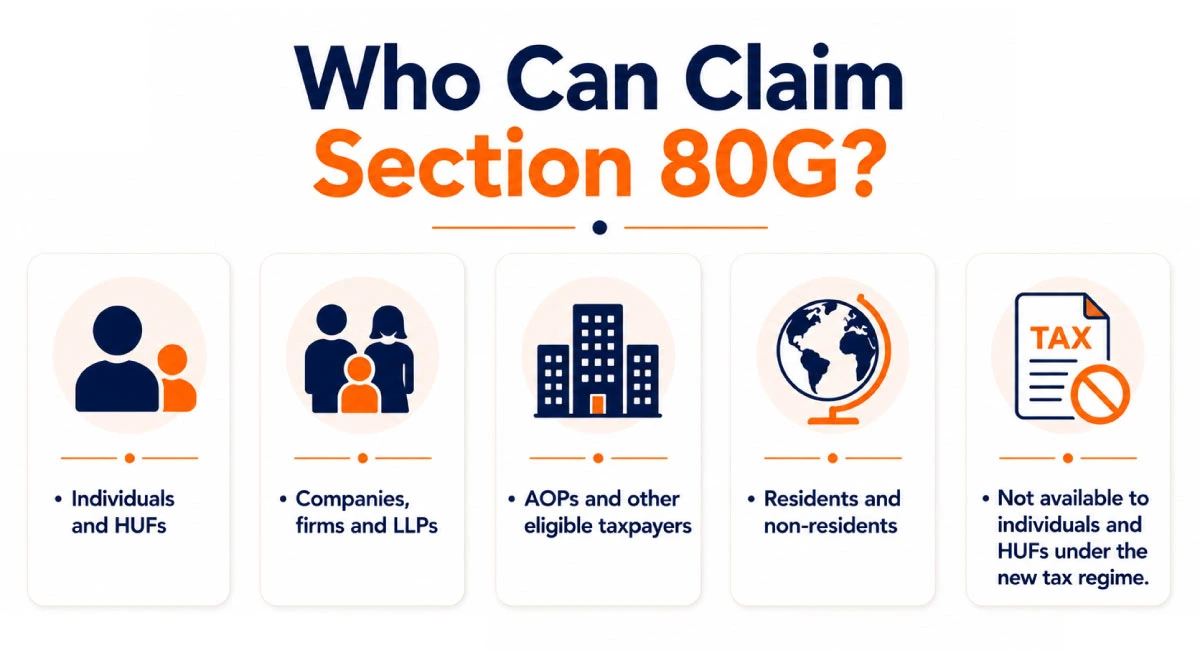
- Individuals
- Hindu Undivided Families
- Companies
- Partnership firms
- Limited Liability Partnerships
- Associations of Persons
- Other eligible taxpayers
Both resident and non-resident taxpayers may claim the deduction if they make a donation to an eligible organization and satisfy the prescribed conditions.
Individuals and HUFs opting for the new tax regime under Section 115BAC cannot claim the Section 80G deduction. The deduction is generally available when income is calculated under the old tax regime. Other taxpayers should check the conditions of the tax regime applicable to them.
Categories of Section 80G Deduction
Donations eligible under Section 80G of the Income Tax Act are divided into four categories:
- 100% deduction without a qualifying limit
- 50% deduction without a qualifying limit
- 100% deduction with a qualifying limit
- 50% deduction with a qualifying limit
For donations falling under the limited categories, the qualifying donation is restricted to 10% of adjusted gross total income. Any amount exceeding this limit is ignored while calculating the deduction and cannot be carried forward.
1. Donations Eligible for 100% Deduction Without Limit
Under this category, the entire eligible donation can be deducted without applying the 10% qualifying limit.
Examples include donations made to:
- National Defence Fund
- Prime Minister’s National Relief Fund
- PM CARES Fund
- National Children’s Fund
- National Foundation for Communal Harmony
- National Illness Assistance Fund
- National Sports Development Fund
- National Cultural Fund
- Fund for Technology Development and Application
Donations to the Swachh Bharat Kosh qualify for a 100% deduction without a qualifying limit, except where the contribution is treated as Corporate Social Responsibility expenditure. Donations to the Clean Ganga Fund qualify only when made by a resident taxpayer, and contributions treated as CSR expenditure are not eligible.
2. Donations Eligible for 50% Deduction Without Limit
A donation made to the Prime Minister’s Drought Relief Fund qualifies for a deduction equal to 50% of the eligible amount without applying the 10% adjusted gross total income limit.
Donations to the Jawaharlal Nehru Memorial Fund, Indira Gandhi Memorial Trust and Rajiv Gandhi Foundation are no longer eligible under this category with effect from 1 April 2024.
3. Donations Eligible for 100% Deduction With Limit
The following donations generally qualify for a 100% deduction, subject to the qualifying limit of 10% of adjusted gross total income:
- Donations to the Government or an approved authority, institution or association for promoting family planning
- Donations made by a company to the Indian Olympic Association or another notified organization for developing sports infrastructure or sponsoring sports in India
The sports-related deduction is available only when the donor is a company.
4. Donations Eligible for 50% Deduction With Limit
A deduction equal to 50% of the qualifying donation may be available for:
- Donations to approved charitable trusts and institutions
- Donations to the Government or a local authority for charitable purposes other than family planning
- Donations to specified housing, planning or development authorities
- Donations for repairing or renovating notified places of worship having historic, archaeological or public importance
The recipient organization must hold valid approval under Section 80G of the Income Tax Act.
What Is Adjusted Gross Total Income?
Adjusted gross total income is used to calculate the 10% qualifying limit.
Adjusted gross total income is generally calculated by reducing deductions under Chapter VI-A, other than Section 80G, and income that is exempt or taxable at specified special rates, including applicable long-term capital gains and short-term capital gains under Section 111A, from the gross total income.
For example, suppose a taxpayer has an adjusted gross total income of ₹8,00,000. The qualifying limit will be ₹80,000.
If the taxpayer donates ₹1,00,000 to an institution eligible for a 50% deduction with a qualifying limit, only ₹80,000 will be considered. The final deduction will be 50% of ₹80,000, which is ₹40,000.
The remaining ₹20,000 cannot be claimed or carried forward.
Taxpayers can also understand how to calculate the Section 80G deduction limit before reporting the donation in their return.
Payment Conditions for Section 80G Deduction
The following conditions must be satisfied:
- The donation must be made in money.
- Donations in clothes, food, medicines, land, property or other goods do not qualify.
- Cash donations of up to ₹2,000 may qualify.
- Donations exceeding ₹2,000 must be made through cheque, bank draft, UPI, bank transfer or another non-cash mode.
- The recipient must have valid eligibility under Section 80G of the Income Tax Act.
The same donation cannot be claimed twice under different provisions.
Documents Required to Claim Section 80G Deduction
Taxpayers should keep the following documents and information:
- Donation receipt issued by the recipient
- Name, PAN, and address of the recipient
- Section 80G registration number or Unique Registration Number
- Date and amount of donation
- Mode of payment
- Bank statement or transaction proof
- Form 10BE, wherever applicable
Specified donee institutions required to report donations under the applicable rules file Form 10BD and issue Form 10BE for donations governed by the Income tax Act, 1961. Under the Income tax Act, 2025 framework, the corresponding forms are Form 113 and Form 114. The deduction claimed in the income tax return should match the details reported by the recipient institution.
How to Claim Section 80G Deduction in ITR
The deduction is claimed through Schedule 80G of the applicable income tax return.
The taxpayer must select the correct donation category and enter the recipient’s name, PAN, address, registration details, donation amount and payment mode.
The information should match the donation receipt and Form 10BE. Incorrect recipient details, expired approval or a mismatch in the reported donation may result in the deduction being questioned.
Donations Not Eligible Under Section 80G
The following donations generally do not qualify:
- Donations made in kind
- Cash donations exceeding ₹2,000
- Donations to institutions without valid approval
- Donations to foreign charitable institutions not covered by the provision
- Political contributions
- Donations made for substantially religious purposes, except eligible contributions for notified places of worship
Political contributions are covered separately under Section 80GGB for Indian companies and Section 80GGC for other eligible taxpayers. Under the Income tax Act, 2025, the corresponding provisions are Sections 136 and Section 137 of the Income Tax Act.
Ebizfiling Assistance for Section 80G Deduction
Ebizfiling can assist taxpayers in claiming the Section 80G of the Income Tax Act, 1961 deduction correctly while filing their income tax return. Our experts can help with:
- Reviewing the donation receipt and Form 10BE
- Checking whether the recipient institution holds valid Section 80G approval
- Identifying whether the donation qualifies for a 50% or 100% deduction
- Calculating the eligible deduction and applicable qualifying limit
- Reporting the donation correctly in Schedule 80G of the income tax return
- Identifying mismatches between the donation receipt, Form 10BE, and reported details
Proper reporting is important because incorrect PAN, registration details, donation category, or payment mode may result in the deduction being questioned or disallowed.
Ebizfiling can assist you with income tax return filing and reporting eligible deductions under Section 80G of the Income Tax Act.
Conclusion
Section 80G of the Income Tax Act allows taxpayers to support eligible charitable causes while reducing their taxable income. However, the deduction depends on the organization receiving the donation, the applicable percentage, the qualifying limit, the mode of payment, and the tax regime selected.
Before making a donation, taxpayers should verify the recipient’s registration, confirm whether the deduction is 50% or 100%, and obtain a proper donation receipt and Form 10BE. For donations relating to Tax Year 2026-27 beginning on 1 April 2026, taxpayers should refer to Section 133 of the Income tax Act, 2025.
Suggested Reads:
Section 354 of the Income Tax Act
FCRA Prior Approval for New Section 8 Companies
Donation Eligibility under section 80G
80G Donation Limit for Salaried Persons
Difference between Form 10BD and Section 80G
How to respond to 80G Approval Notice
Frequently Asked Questions
1. Can a donation made through a crowdfunding platform qualify under Section 80G of the Income Tax Act?
A payment through a crowdfunding platform does not automatically qualify for a Section 80G of the Income Tax Act deduction. The final recipient must be an approved fund or institution, and the donor should receive an 80G donation receipt or Form 10BE from that recipient. A payment confirmation issued only by the platform may not be sufficient.
2. What should a donor do if the 80G donation receipt and Form 10BE contain different details?
The donor should ask the recipient institution to correct its Form 10BD and issue a revised Form 10BE. The PAN, donation amount, payment mode, financial year and approval details should match before the Section 80G of the Income Tax Act deduction is reported in the ITR. The Income Tax Department permits revision of Form 10BD and Form 10BE.
3. How can taxpayers verify Section 80G eligible institutions before donating?
The taxpayer should verify the institution’s name, PAN, Unique Registration Number, and approval period through the Income Tax Department’s records. Approval should cover the actual date on which the donation was made. Ebizfiling can help review the approval details and supporting documents before the deduction is reported.
4. Can one family member claim a donation paid by another family member?
The Section 80G deduction should be claimed by the person who actually made the donation. The bank transaction, donor details, Form 10BE, and receipt should support the same claimant. Merely obtaining the receipt in another family member’s name may not establish eligibility if that person did not bear the payment.
5. Can a missed Section 80G deduction be claimed in a later financial year?
A donation must be claimed for the financial year in which it was paid. It cannot be shifted to a later year merely because the taxpayer forgot to report it. Where legally permitted, the taxpayer may correct the omission by filing a revised return for the relevant year.
6. Can the 80G deduction limit create or increase a taxable loss?
No. The total deductions allowed under Chapter VI-A cannot exceed the taxpayer’s gross total income. Therefore, the Section 80G of the Income Tax Act deduction limit may reduce taxable income to nil, but it cannot create or increase a loss. The separate 10% adjusted gross total income restriction must also be applied where relevant.
7. Can members of an AOP or BOI claim their share of a donation made by the entity?
Where an AOP or BOI claims the deduction for a donation made by it, its members cannot separately claim the same deduction against their share of income from the entity. This prevents duplication of the same donation deduction.
8. Can an employee claim a donation deducted through payroll?
An employee may claim the deduction where the donation was funded from the employee’s salary and the supporting certificate identifies the employee as the donor. A general payment made by the employer without employee-specific documentation may not support an individual claim.
9. Can splitting a cash donation into smaller receipts guarantee a Section 80G deduction?
No. Section 80G of the Income Tax Act does not allow a deduction where a donation exceeding ₹2,000 is paid in cash. Artificially splitting one intended donation into smaller receipts may be questioned. A donation above ₹2,000 should therefore be made through a permitted non-cash mode.
10. What should a taxpayer do if a Section 80G claim is questioned due to a reporting mismatch?
The taxpayer should compare the ITR entry with the bank proof, 80G donation receipt, Form 10BE and the institution’s approval details. Where the recipient reported incorrect information, it should revise Form 10BD and issue a corrected certificate. Ebizfiling can assist in identifying the mismatch and determining the appropriate ITR revision, rectification or notice-response process.




Income Tax Returns
Filing of Income Tax return is necessary if you have earned any income. File your ITR with EbizFiling
About Ebizfiling -



Reviews
Deepika Khan
29 Sep 2018I would rate 5/5 for their services, pricing and transparency.
Ganesh Pujari
15 Oct 2017I would give 5 stars to Ebizfiling for everything. Service, Professionalism, Dedication, Timely Action and Good Pricing.
John Mello
13 Mar 2018I am associated with Ebizfiling since a year now. And all my IT returns and GST returns are managed successfully by them. Really happy with the services.
September 28, 2026 By Srishti M
September 29, 2026 By Srishti M
Income Tax Compliance Calendar October 2026: Filing Guide Introduction The Income Tax Compliance Calendar October 2026 highlights important income tax obligations applicable to taxpayers, businesses and entities covered under audit and transfer pricing provisions. October 2026 includes key compliance […]
September 25, 2026 By Steffy A