


-
September 7, 2026
-
BySteffy A
Health Insurance Deduction Under Section 126: Rules & Limits
Introduction
Health insurance protects families from rising medical costs and can also provide a tax benefit when the legal conditions are satisfied. Section 126 of the Income Tax Act, 2025 provides a health insurance deduction for eligible payments made by individuals and Hindu Undivided Families.
The provision covers qualifying health insurance premiums, contributions to the Central Government Health Scheme or another notified scheme, preventive health check-ups, and specified medical expenditure for senior citizens. The Income-tax Act, 2025, came into force from 1 April 2026, so taxpayers should understand how this deduction works for tax years governed by the new Act.
What is Health Insurance Deduction Under Section 126?
Section 126 of the Income Tax Act, 2025 allows an eligible individual or HUF to deduct specified health-related payments from income, subject to prescribed ceilings and conditions.
For an individual, the law separately covers payments for self and family, and payments for parents. “Family” means the spouse and dependant children of the assessee. Parents are dealt with separately.
The Act defines a senior citizen as an individual resident in India who is 60 years of age or more at any time during the relevant tax year. This matters because senior citizen status can increase the applicable health insurance deduction limit.
However, taxpayers should note that the deduction under Section 126 is generally not available when income is computed under the default tax regime under Section 202. An eligible taxpayer must opt out of the default regime, subject to the applicable conditions, to claim this deduction.
Section 80D vs Section 126 of Income Tax Act
|
Basis |
Section 80D |
Section 126 |
|
Applicable Law |
Income-tax Act, 1961 | Income-tax Act, 2025 |
| Provision | Section 80D |
Section 126 |
|
Eligible Taxpayers |
Individuals and HUFs | Individuals and HUFs |
| Basic Health Insurance Deduction Limit | Up to ₹25,000 |
Up to ₹25,000 |
|
Senior Citizen Limit |
Up to ₹50,000 | Up to ₹50,000 |
| Preventive Health Check-Up Deduction | Up to ₹5,000 within the overall limit |
Up to ₹5,000 within the overall limit |
|
Medical Expenditure for Senior Citizens |
Up to ₹50,000, subject to conditions | Up to ₹50,000, subject to conditions |
| Cash Payment for Preventive Check-Up | Allowed |
Allowed |
|
Other Eligible Payments |
Non-cash mode required | Non-cash mode required |
| Multi-Year Health Insurance Premium | Proportionate deduction allowed |
Proportionate deduction allowed |
|
Time Period Terminology |
Previous year |
Tax year |
For income relating to FY 2025-26 (AY 2026-27), taxpayers should continue to refer to Section 80D of the Income-tax Act, 1961. Section 126 applies to Tax Year 2026-27 and subsequent tax years under the Income-tax Act, 2025.
Who Can Claim the Deduction?
An individual may claim eligible payments relating to self, spouse, dependant children and parents. A Hindu Undivided Family may claim eligible payments relating to its members.
The benefit does not automatically extend to every relative. The person for whom the payment is made must fall within the categories specified in Section 126.
Which Payments Qualify Under Section 126?
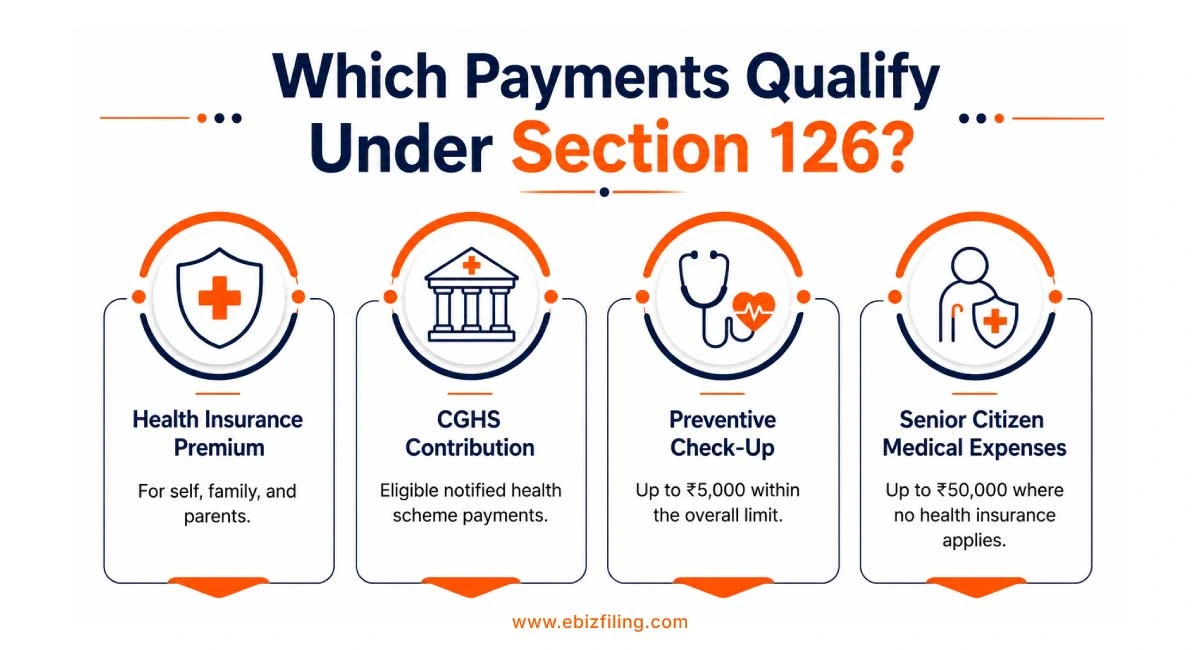
Health Insurance Premium
An individual can claim qualifying premium paid to effect or keep in force health insurance for self, spouse and dependant children. A separate category applies to premium paid for parents.
The medical insurance premium deduction is ordinarily subject to a ₹25,000 ceiling for the relevant category. Where the insured person is a senior citizen, the amount specified in the law is substituted with ₹50,000.
CGHS or Other Notified Scheme
Contributions made to the Central Government Health Scheme or another scheme notified by the Central Government for self and family may also qualify within the applicable limit.
Preventive Health Check-Up
Payments for preventive health check-ups of self, family, or parents may qualify. The preventive health check-up deduction is restricted to ₹5,000 in aggregate. This amount is included within the applicable overall ceiling and is not an extra deduction over the ₹25,000 or ₹50,000 limit.
Medical Expenditure for Senior Citizens
Medical expenditure may qualify up to ₹50,000 where it is incurred on the health of a senior citizen and no amount has been paid to effect or keep in force health insurance for that person.
Health Insurance Deduction Limit Under Section 126
|
Category |
Applicable Limit |
|
Self, spouse and dependent children |
Up to ₹25,000 |
| Relevant insured person is a senior citizen |
Up to ₹50,000 |
|
Parent or parents |
Up to ₹25,000 |
| Relevant parent is a senior citizen |
Up to ₹50,000 |
|
Preventive health check-up |
Up to ₹5,000 within the overall limit |
| Eligible medical expenditure for an uninsured senior citizen |
Up to ₹50,000, subject to conditions |
Section 126 also places an aggregate ceiling of ₹50,000 on the relevant combination of insurance and qualifying medical expenditure for self and family. A similar ₹50,000 aggregate ceiling applies to the parent category.
Therefore, taxpayers should not simply add every amount mentioned in the section. The health insurance deduction must be calculated within the relevant category and aggregate ceiling.
Rules for Senior Citizens
Where the relevant insured person is a senior citizen, the ₹25,000 insurance limit is replaced with ₹50,000. The law also recognises medical expenditure of up to ₹50,000 where no amount has been paid to effect or keep in force health insurance for that senior citizen.
For example, if an individual pays ₹42,000 as health insurance premium for senior citizen parents, the amount falls within the ₹50,000 ceiling, subject to the other conditions.
Senior citizens may also be eligible for other income tax benefits for senior citizens, depending on their income and applicable provisions.
Get Help With Your Health Insurance Deduction
Calculating a health insurance deduction may appear simple, but the eligible amount can depend on who is covered, whether the person is a senior citizen, the type of expense, the payment method, and the tax regime selected.
Ebizfiling provides online income tax return filing assistance and can help taxpayers correctly report eligible deductions while preparing their return.
Eligibility Check: Understand whether payments made for self, spouse, dependant children, parents or eligible HUF members can be considered under Section 126.
Limit Calculation: Determine the applicable health insurance deduction limit based on insurance premiums, senior citizen status, preventive health check-ups and eligible medical expenditure.
Document Review: Organise relevant policy details, premium receipts, payment records and other supporting information required while preparing the income tax return.
ITR Filing: Get assistance with selecting the applicable return form, preparing the return and reporting eligible deductions correctly.
With Ebizfiling, taxpayers can get professional support for income tax return filing while ensuring that eligible health insurance premium deduction claims are considered according to the applicable provisions.
Conclusion
Section 126 of the Income Tax Act, 2025 provides a structured health insurance deduction for eligible individuals and HUFs. It covers qualifying insurance premiums, specified scheme contributions, preventive health check-ups and certain medical expenditure for senior citizens.
To claim it correctly, taxpayers should identify the relevant category, apply the ₹25,000 or ₹50,000 ceiling as applicable, keep the ₹5,000 preventive check-up cap within the overall limit and follow the prescribed payment rules. Taxpayers should also check their tax regime because Section 126 is generally unavailable when income is computed under the default tax regime under Section 202.
Suggested Reads:
Mistakes to Avoid When Claiming Deduction under Section 80D
Frequently Asked Questions
1. Is the ₹5,000 preventive health check-up deduction additional to the ₹25,000 limit?
No. The preventive health check-up deduction of up to ₹5,000 is included within the applicable health insurance deduction limit. It is not an additional deduction over the ₹25,000 or ₹50,000 limit.
2. Can I claim health insurance deduction for parents who are not financially dependent on me?
Yes. Section 126 separately covers health insurance payments made for the parent or parents of an individual. Unlike dependant children, the provision does not specify that parents must be financially dependent on the taxpayer.
3. What is the health insurance deduction limit for senior citizens?
Where the relevant insured person is a senior citizen, the health insurance premium limit increases from ₹25,000 to ₹50,000. The ₹5,000 preventive health check-up limit continues to form part of the applicable overall ceiling.
4. Can medical expenses of a senior citizen be claimed if there is no health insurance policy?
Yes. Eligible medical expenditure incurred for a senior citizen may qualify for a health insurance tax deduction of up to ₹50,000 where no amount has been paid to effect or keep in force health insurance for that person.
5. Can health insurance premium be paid in cash to claim the deduction?
No. A health insurance premium deduction generally requires payment through a mode other than cash. However, payment for a preventive health check-up can be made in cash, subject to the applicable ₹5,000 limit.
6. How is a multi-year health insurance premium claimed under Section 126?
If a lump sum health insurance premium is paid for a policy covering more than one tax year, the qualifying amount is divided across the relevant tax years using the appropriate fraction prescribed under Section 126.
7. Can an HUF claim health insurance deduction under Section 126?
Yes. A Hindu Undivided Family can claim a health insurance deduction for eligible payments made for its members. The basic insurance limit is ₹25,000, which may increase to ₹50,000 where the insured HUF member is a senior citizen.
8. Can I claim ₹50,000 for senior citizen health insurance premium and another ₹50,000 for medical expenses?
No. The applicable insurance premium and eligible medical expenditure are subject to the aggregate limits prescribed under Section 126. The ₹50,000 amount cannot automatically be claimed separately for both expenses for the same relevant category.
9. Can Section 126 deduction be claimed for health insurance paid for an independent child?
No. For an individual, Section 126 covers health insurance payments for self, spouse and dependant children. A premium paid for a financially independent child would not qualify under the family category for this deduction.
10. Can Ebizfiling help calculate and claim the correct health insurance deduction?
Yes. Ebizfiling can assist taxpayers in reviewing eligible health insurance premiums, senior citizen medical expenditure, preventive health check-ups and the applicable health insurance deduction limit while preparing their income tax return.



Navigate Your Tax Filing With Expert Guidance
Get professional assistance for accurate Income Tax Return filing and stay prepared to address tax-related requirements.
About Ebizfiling -



October 12, 2026 By Srishti M
Company Compliance Calendar November 2026: Key Due Dates & Filings Introduction The Company Compliance Calendar November 2026 highlights important annual return, dematerialisation and income tax compliances that companies may need to complete during the month. November 2026 is particularly […]
October 10, 2026 By Srishti M
October 10, 2026 By Srishti M
Compliance Calendar November 2026: Key Statutory Due Dates Introduction The compliance calendar November 2026 covers important statutory obligations under GST, Income Tax, TDS/TCS, Company Law, LLP regulations, EPF and ESI. It helps businesses identify the filings, payments and regulatory requirements […]