


-
September 7, 2026
-
BySteffy A
Mistakes to Avoid When Claiming Deduction under Section 80D
Introduction
A deduction under Section 80D can reduce taxable income for eligible health insurance premiums, preventive health check-ups and specified medical expenditure.
However, incorrect limits, payment methods or family details can result in an incorrect deduction claim. This guide explains the common Section 80D mistakes taxpayers should check before filing their Income Tax Return.
Summary
- Deduction under Section 80D is available to individuals and Hindu Undivided Families, subject to prescribed conditions.
- Health insurance premiums generally cannot be paid in cash for claiming the deduction.
- Preventive health check-ups qualify up to ₹5,000 within the overall Section 80D deduction limit.
- Medical expenditure may qualify for eligible senior citizens where no health insurance premium is paid for that person, subject to the applicable conditions.
- For AY 2026-27, Section 80D applies under the old tax regime, while Section 126 applies from Tax Year 2026-27 onwards.
What Is Deduction under Section 80D?
Section 80D of the Income-tax Act, 1961 provides a deduction for specified payments towards health insurance, preventive health check-ups and certain medical expenses.
For an individual, the deduction can cover health insurance for self, spouse, dependent children and parents. A Hindu Undivided Family can claim eligible amounts relating to its members. However, an HUF cannot claim the preventive health check-up deduction.
For Assessment Year 2026-27, the Income Tax Department continues to recognise Section 80D for income earned during FY 2025-26. The Department also confirms that the deduction is available only where the old tax regime is selected.
What Is the Section 80D Deduction Limit?
|
Eligible category |
Maximum deduction |
|
Self, spouse and dependent children |
₹25,000 |
| Self/family where an eligible person is a senior citizen |
₹50,000 |
|
Parents |
Additional ₹25,000 |
| Parents where an eligible parent is a senior citizen |
Additional ₹50,000 |
|
Preventive health check-up |
Up to ₹5,000 within the above limits |
The overall deduction may reach ₹1,00,000 where both the self/family block and the parents’ block separately qualify for the ₹50,000 limit. ₹1,00,000 is therefore not a standard limit available to every taxpayer. For Section 80D, a senior citizen means an individual resident in India who is aged 60 years or more at any time during the relevant financial year.
2026 update: The Income-tax Act, 2025 applies from Tax Year 2026-27 onwards, and the corresponding health insurance deduction is provided under Section 126.
However, this deduction is generally not available under the default tax regime under Section 202. Returns relating to FY 2025-26 and AY 2026-27 continue to be governed by the Income-tax Act, 1961.
What Mistakes Should You Avoid When Claiming Section 80D?
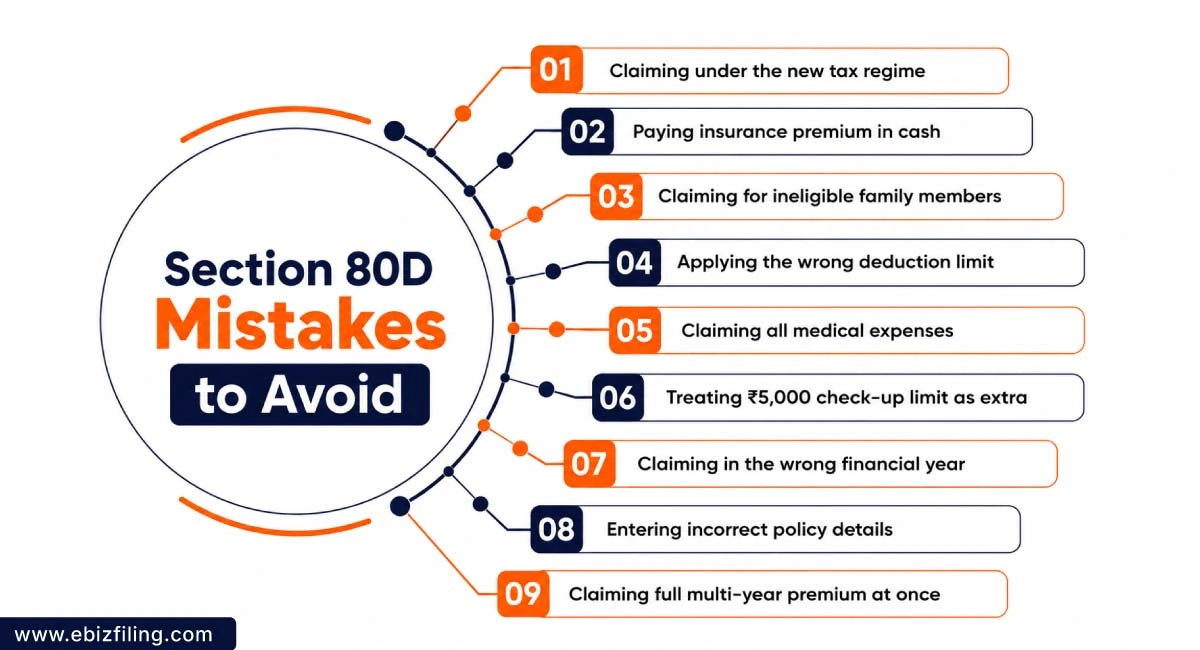
Mistake 1: Claiming Section 80D under the new tax regime
One of the most important mistakes while claiming Section 80D deduction is ignoring the tax regime selected in the return.
For AY 2026-27, Section 80D is not available where the taxpayer chooses the new tax regime. The Income Tax Department’s validation rules specifically require Schedule 80D to remain blank when the new tax regime is selected.
Mistake 2: Paying health insurance premium in cash
Health insurance premium must be paid through a mode other than cash, such as UPI, net banking, card, cheque or another permitted banking mode.
Cash is allowed for preventive health check-up expenses. Therefore, claiming a cash-paid insurance premium is one of the common Section 80D mistakes.
Mistake 3: Claiming deduction for an ineligible family member
A Deduction under Section 80D for an individual covers:
- Self
- Spouse
- Dependent children
- Parents
Premium paid for siblings, grandparents, parents-in-law or non-dependent children does not fall within the normal individual eligibility categories under Section 80D.
Importantly, parents do not have to be dependent on the taxpayer for their qualifying health insurance premium to be considered.
Mistake 4: Treating ₹1,00,000 as a single deduction limit
The limit for Deduction under Section 80D operates through separate blocks for self/family and parents.
For example, a taxpayer cannot claim ₹1,00,000 merely because ₹1,00,000 was spent on health insurance. The ₹50,000 higher limit applies where the relevant insured person is a senior citizen.
The claim must therefore be calculated separately for each eligible category.
Mistake 5: Claiming every medical expense under Section 80D
Section 80D does not provide a general deduction for all hospital bills, medicines or medical treatment expenses.
Medical expenditure of up to ₹50,000 may qualify where it is incurred for an eligible senior citizen and no amount has been paid to keep health insurance in force for that person.
Taxpayers should therefore avoid treating ordinary medical expenses as a general Section 80D health insurance deduction.
Mistake 6: Treating ₹5,000 preventive check-up deduction as additional
Preventive health check-up expenses qualify up to ₹5,000 in aggregate.
However, the ₹5,000 amount is included within the applicable ₹25,000 or ₹50,000 limit. It is not an additional deduction over and above those limits.
Mistake 7: Claiming premium that was not actually paid in the relevant year
Section 80D claim should relate to eligible payments made during the relevant financial year. However, a lump-sum premium covering multiple years is apportioned across the relevant years as specifically permitted under Section 80D.
Taxpayers should check bank statements, premium receipts and policy records before entering the amount in the ITR instead of relying only on the insurance premium due date.
Mistake 8: Entering incorrect insurance policy details
For AY 2026-27, taxpayers claiming Section 80D are required to provide details such as:
- Name of the insurer
- Policy number
- Health insurance amount
Incorrect policy information may create inconsistencies in the return. Keep the premium receipt, policy document and payment evidence available for verification.
Mistake 9: Claiming the entire multi-year premium in one year
A single health insurance premium may sometimes cover more than one year.
Where an eligible lump-sum premium covers multiple years, the deduction is apportioned across the relevant years rather than allowing the complete multi-year amount in the year of payment, subject to the statutory limits.
This treatment also continues under Section 126 of the Income-tax Act, 2025.
How Can You Claim Deduction under Section 80D Correctly?
To claim Deduction under Section 80D correctly, taxpayers should check the following before completing the return:
- Confirm that the applicable tax regime permits the deduction.
- Identify whether the expense relates to self/family or parents.
- Check whether any covered person qualifies as a senior citizen.
- Verify the applicable ₹25,000 or ₹50,000 limit.
- Keep preventive health check-ups within the ₹5,000 sub-limit.
- Do not claim cash-paid health insurance premiums.
Match the insurer name, policy number and eligible payment amount with supporting records.
Ebizfiling Support for Section 80D Deduction Filing
Ebizfiling can assist taxpayers with:
- Reviewing eligible deductions while preparing the ITR.
- Checking applicable deduction limits and tax regime implications.
- Reviewing tax documents and health insurance payment details.
- Preparing and filing the applicable Income Tax Return.
The availability of any deduction depends on the taxpayer’s facts and the applicable provisions.
Conclusion
A Deduction under Section 80D should be claimed only after checking eligibility, payment mode and the applicable deduction limit. Preventive health check-ups and senior citizen medical expenses also have specific conditions. For AY 2026-27, taxpayers should additionally confirm that they are eligible to claim Section 80D under the tax regime selected in the ITR.
Frequently Asked Questions
1. Can Deduction under Section 80D be claimed if the employer did not include it in Form 16?
Yes. An eligible Deduction under Section 80D can generally be claimed while filing the Income Tax Return even if the employer did not consider it while calculating TDS. Relevant premium receipts and payment records should be kept for verification.
2. Can both husband and wife claim the same health insurance premium under Section 80D?
No. The same premium payment should not be claimed twice. The deduction should generally be claimed by the person who actually paid the eligible premium. If both spouses pay separate eligible premiums, each may claim the amount actually paid, subject to the applicable Section 80D deduction limit.
3. Is Section 80D deduction based on the insurance coverage amount?
No. The deduction is based on the eligible health insurance premium paid and not on the sum insured under the policy. For example, a policy may provide coverage of ₹10 lakh, but the Section 80D deduction claim will depend on the eligible premium paid and the prescribed deduction limit.
4. Is an insurance claim or hospitalisation required to claim Section 80D deduction?
No. Hospitalisation or an insurance claim is not required for claiming a Section 80D health insurance deduction. Eligibility is generally based on payment of a qualifying health insurance premium and satisfaction of the prescribed conditions.
5. Can health insurance premium paid for parents be claimed even if the policy is in their names?
Yes. Eligible health insurance premium paid for parents can be considered for Deduction under Section 80D, even when the policy is issued in the parents’ names. The person claiming the deduction should have actually paid the eligible premium and satisfy the applicable conditions.
6. Does contribution to the Central Government Health Scheme qualify under Section 80D?
Yes. Eligible contributions made to the Central Government Health Scheme or another notified scheme can qualify under Section 80D for self, spouse and dependent children, subject to the applicable limits and conditions.
7. Can an HUF claim Section 80D deduction for health insurance of its members?
Yes. A Hindu Undivided Family can claim a deduction for eligible health insurance premiums paid for its members. The applicable Section 80D deduction limit depends on whether the insured member qualifies as a senior citizen.
8. Can Section 80D deduction be claimed for more than one health insurance policy?
Yes. A taxpayer may have more than one eligible health insurance policy. Premiums paid for qualifying policies can be considered together, but the total deduction cannot exceed the applicable statutory limit.
9. What happens if Section 80D deduction is missed while filing the original ITR?
A missed deduction may be considered through a revised return if revision is legally available for that return and the prescribed time limit has not expired. Eligibility and supporting documents should be checked before revising the return. Ebizfiling can assist with reviewing the return, eligible deductions and the applicable ITR filing requirements.
10. Does Deduction under Section 80D reduce tax liability by the same amount?
No. A Deduction under Section 80D reduces taxable income rather than reducing tax payable rupee-for-rupee. The actual tax saving depends on the taxpayer’s taxable income and applicable tax rate. Ebizfiling can assist with tax computation and reviewing eligible deductions while preparing the Income Tax Return.




File Income Tax Returns
Filing of an Income Tax return is necessary if you have earned any income. File your ITR with EbizFiling at INR 1199/- only.
About Ebizfiling -



Reviews
Aditi Doshi
29 Mar 2018They manage Accounting and Book-keeping for my company. I must say the team is really doing a good job.
Ashish Paliwal
29 Sep 2018Let me be honest and tell you that I did not choose eBiz filing after my initial LLP company registration did to pricing. A lot of companies contact me with better rates so I generally choose them. However, I will still rate eBiz filing 10/10 on work ethics. You guys are professionals in true sense.
Rakshit Shah
03 Feb 2018I am definitely going to come back if ever I need your services. Too good!
October 6, 2026 By Srishti M
October 7, 2026 By Srishti M
October 3, 2026 By Srishti M
Revised ITR Under Old Tax Regime: Change Rules Explained Overview A salaried taxpayer may file an Income Tax Return under the new tax regime and later realise that the old tax regime could be more suitable because of eligible deductions […]