

-
September 7, 2026
-
BySteffy A
Section 80D of the Income Tax Act: Deduction Limits and Tax Benefits
Introduction
Health insurance helps families manage medical expenses, while Indian tax law has also provided deductions for eligible premiums and certain medical costs. Section 80D of the Income Tax Act was one of the main provisions that allowed individuals and Hindu Undivided Families to claim such deductions.
From Tax Year 2026-27 onwards, the Income-tax Act, 2025 applies with revised section numbering. The deduction relating to health insurance premiums and eligible medical expenses, earlier covered under Section 80D of the Income-tax Act, 1961, is provided under the corresponding provision of the Income-tax Act, 2025.
What is Section 80D under Income Tax?
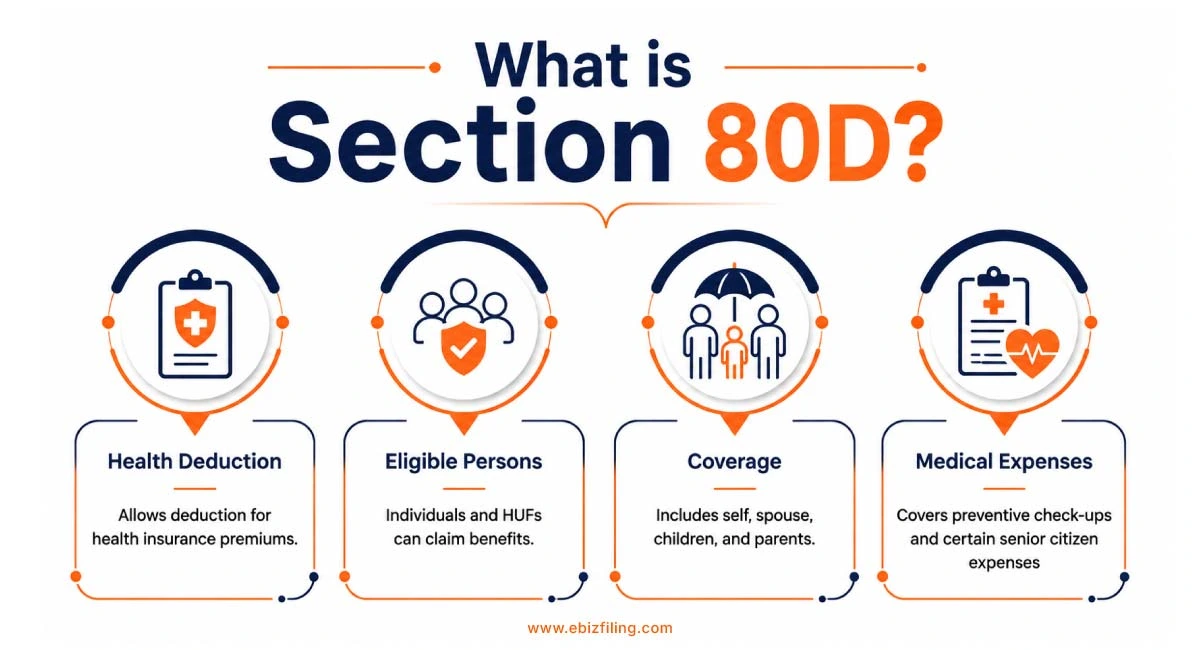
Section 80D of the Income Tax Act allowed eligible individuals and HUFs to claim deductions for health insurance premiums and certain medical expenses. An individual could claim the deduction for insurance covering self, spouse, dependent children, and parents, subject to the prescribed conditions.
It also covered preventive health check-ups within the overall limit and, in specified cases, medical expenses for uninsured senior citizens.
Who Can Claim the Deduction?
The deduction was available to individual taxpayers and Hindu Undivided Families.
An individual could claim eligible payments made for:
- Self
- Spouse
- Dependent children
- Parents
Parents did not need to be financially dependent on the taxpayer. However, the deduction for children was generally available only where the children met the prescribed dependency conditions.
A HUF could claim eligible health insurance premiums paid for its members. Companies, LLPs, partnership firms and other entities were not eligible for a deduction under Section 80D of the Income Tax Act.
Deduction Limits under Section 80D
For self, spouse and dependent children, the normal deduction limit was up to Rs 25,000. Where an eligible insured person was a senior citizen, the limit could increase to Rs 50,000.
A separate deduction was available for parents. If the parents were below 60 years of age, the maximum deduction was Rs 25,000. If one or both parents qualified as senior citizens, the limit could increase to Rs 50,000.
Therefore, the maximum deduction under Section 80D of the Income Tax Act could reach Rs 1,00,000 where both the taxpayer’s eligible family category and the parents’ category qualified for the higher Rs 50,000 limit.
Preventive Health Check-up Deduction
Preventive health check-up expenses were eligible within the overall deduction limit. A taxpayer could claim up to Rs 5,000 for preventive health check-ups.
This Rs 5,000 was not an extra deduction above the overall limit. For example, if an individual below 60 years paid Rs 22,000 as health insurance premium and Rs 5,000 for a preventive health check-up, the maximum deduction would still be Rs 25,000.
Health insurance premiums generally had to be paid through a non-cash mode. However, preventive health check-up expenses could be paid in cash and still qualify under Section 80D of the Income Tax Act.
Medical Expenses for Senior Citizens
Where an eligible senior citizen was not covered by health insurance, medical expenditure incurred for that senior citizen could qualify for deduction up to Rs 50,000, subject to the applicable conditions.
The medical expense amount was not an additional Rs 50,000 over a separate Rs 50,000 insurance deduction for the same category. The overall limit still applied.
This provision was particularly useful for senior citizens who did not have qualifying health insurance coverage.
Payment Rules for Health Insurance Premiums
Health insurance premiums generally had to be paid through non-cash payment modes. Eligible methods could include:
- Debit card
- Credit card
- UPI
- Net banking
- Cheque
- Other permitted electronic payment methods
Cash payment of health insurance premiums was generally not eligible. The exception was preventive health check-up expenditure, which could be paid in cash.
It was also important that the taxpayer claiming the deduction had actually made the qualifying payment. If another person had entirely paid the premium, the taxpayer could not simply claim the deduction without meeting the prescribed conditions.
To avoid errors while claiming this deduction, check the common Mistakes You Need to Avoid when Claiming for Deduction under Section 80D before filing your income tax return.
Group Health Insurance and Employer Policies
If an employer paid the entire premium for a group health insurance policy and the employee did not bear the cost, the employee generally could not claim a deduction because any qualifying payment had been made by the employee.
If an employee personally paid an eligible additional premium for enhanced coverage or a separate qualifying policy, that payment could be considered, subject to the applicable conditions. Group health insurance should therefore not be treated as automatically disqualified under Section 80D of the Income Tax Act.
New Tax Regime and Section 80D
Taxpayers should check which tax regime applies before claiming the deduction. Section 80D deduction was generally not available to taxpayers opting for the new tax regime under Section 115BAC of the Income-tax Act, 1961.
This means that taxpayers opting for the new tax regime generally cannot reduce taxable income by claiming health insurance deductions under Section 80D.
Under the Income-tax Act, 2025, the corresponding health insurance deduction is contained in Section 126. The new tax regime provisions under Section 202 generally do not allow this deduction either.
Taxpayers should therefore consider the applicable tax regime along with available deductions before calculating their tax liability.
Ebizfiling Support for Tax Deductions and Filing
Ebizfiling helps taxpayers understand applicable income tax provisions and complete their filings with greater clarity. If you are unsure about deduction eligibility, tax regime selection, or treatment of health insurance expenses, our team can guide you based on the law applicable to your tax year.
With Ebizfiling, you can get support for:
- Reviewing eligible deductions and supporting documents
- Understanding whether Section 80D or the corresponding current provision applies
- Checking the impact of the old and new tax regimes
- Preparing and filing your income tax return accurately
- Addressing basic tax compliance queries related to health insurance deductions
For assistance with income tax filing and deduction-related compliance, you can connect with Ebizfiling and get professional support based on your specific requirements.
Conclusion
Section 80D of the Income Tax Act provided an important tax benefit for eligible health insurance premiums, preventive health check-ups, and certain medical expenses for senior citizens. It could cover expenses relating to self, spouse, dependent children, and parents, with higher limits available where senior citizens were involved. From 1 April 2026, the corresponding health insurance deduction is governed by Section 126 of the Income-tax Act, 2025. Taxpayers should therefore check the applicable tax year, tax regime, deduction limits, and payment conditions before claiming any health insurance-related tax benefit.
Suggested Reads:
Mistakes to Avoid When Claiming Deduction under Section 80D
Frequently Asked Questions
1. Can Section 80D deduction be claimed for parents who are not dependent?
Yes. Parents do not need to be financially dependent on the taxpayer. Eligible health insurance premiums paid for parents can be claimed separately, subject to the applicable Section 80D deduction limit.
2. What is the maximum Section 80D deduction limit for parents?
The deduction can be up to Rs 25,000 if the parents are below 60 years of age. For senior citizen parents, the limit can increase to Rs 50,000.
3. Can preventive health check-up expenses be claimed separately?
Preventive health check-up expenses of up to Rs 5,000 can be claimed, but this amount forms part of the overall Section 80D deduction limit. It is not an additional deduction.
4. Can preventive health check-up expenses be paid in cash?
Yes. Although health insurance premiums generally need to be paid through non-cash modes, preventive health check-up expenses can be paid in cash and still qualify for the deduction.
5. Are medical expenses for uninsured senior citizens deductible?
Yes. Section 80D allowed eligible medical expenditure of up to Rs 50,000 where the senior citizen was not covered by qualifying health insurance, subject to prescribed conditions.
6. Can health insurance premiums for an independent adult child be claimed under Section 80D?
Generally, no. The Section 80D health insurance deduction covers dependent children. Premiums paid for financially independent adult children generally do not qualify for the parent’s deduction.
7. Can a deduction be claimed for employer-provided group health insurance?
If the employer pays the entire premium, the employee generally cannot claim the deduction. However, an eligible additional premium personally paid by the employee may qualify for a health insurance tax deduction.
8. Can both the parent and child claim a deduction for the same insurance premium?
If both taxpayers genuinely pay separate portions of an eligible premium, each may claim the amount actually paid, subject to the relevant limits and other conditions.
9. Can both insurance premiums and senior citizen medical expenses be claimed?
Not as separate full deductions for the same person. Eligible medical expenses are generally considered where no qualifying health insurance premium has been paid for that senior citizen, subject to the overall limit.
10. Is Section 80D of the Income Tax Act still applicable after April 2026?
Section 80D remains relevant for tax periods governed by the Income-tax Act, 1961. For Tax Year 2026-27 onwards, taxpayers should refer to the corresponding provisions under the Income-tax Act, 2025.




Income Tax Return
Filing of Income Tax return is necessary if you have earned any income. File your ITR with EbizFiling
About Ebizfiling -



Reviews
Devang Panchal
09 Sep 2018They helped me with my company’s name change and I was quite satisfied with the way they served me. I am surely coming back to you in case of any compliance problem.
Dev Desai
19 Nov 2021Loves their services
Devangi Patnayak
11 Mar 2018I am very happy with the way they serve their clients. They are focused on providing the best help that they can and are result oriented.
September 28, 2026 By Srishti M
September 29, 2026 By Srishti M
Income Tax Compliance Calendar October 2026: Filing Guide Introduction The Income Tax Compliance Calendar October 2026 highlights important income tax obligations applicable to taxpayers, businesses and entities covered under audit and transfer pricing provisions. October 2026 includes key compliance […]
September 21, 2026 By Siddhi R
Section 130 of the Income Tax Act: Home Loan Interest Deduction Introduction Buying a residential house property often involves taking a home loan, and the interest paid on such loans can provide tax benefits under certain provisions of the Income […]