


-
September 10, 2026
-
BySiddhi R
Startup Tax Exemption in India: Filing, Eligibility & Tax Benefits
Introduction
Starting a business involves more than registration and incorporation. Once operations begin, startups must comply with income tax, GST, MCA, TDS, accounting, and other applicable requirements. At the same time, eligible businesses may qualify for startup tax exemption and other tax benefits provided under Indian law.
Understanding annual filing requirements and available tax incentives can help startups avoid penalties and manage their tax liabilities effectively. This article explains important startup filings, eligibility for startup tax exemption, and key tax benefits available to eligible startups in India.
Quick Insights
- Startups may have annual compliance requirements under income tax, GST, MCA, and TDS laws.
- Filing requirements depend on the legal structure, turnover, transactions, and registrations of the startup.
- Eligible startups can claim a 100% deduction of qualifying business profits for three consecutive tax years out of ten years.
- Startup tax exemption is subject to specific incorporation, turnover, business, and certification conditions.
- Not every DPIIT-recognised startup automatically qualifies for every income tax benefit.
What are the Important Annual Filings for a Startup?
The annual filing requirements of a startup depend on its legal structure, registrations, turnover and business transactions. Some important compliances include:
1. Income Tax Return
Startups must file an Income Tax Return according to their legal structure, income and the provisions applicable to the relevant year.
For Assessment Year 2026-27, commonly applicable forms include:
- ITR-3: Generally applicable to individuals and HUFs earning income from business or profession, including proprietorship businesses.
- ITR-5: Generally applicable to partnership firms, LLPs and certain other entities.
- ITR-6: Generally applicable to companies, including private limited companies and OPCs, subject to applicable conditions.
For Tax Year 2026-27, income earned from 1 April 2026 onward is governed by the Income-tax Act, 2025. The return for Tax Year 2026-27 will be filed after the tax year ends using the applicable return form prescribed for that tax year. Assessment Year 2026-27 relates to FY 2025-26 and continues under the Income-tax Act, 1961. The Income-tax Act, 2025 applies from Tax Year 2026-27, beginning on 1 April 2026.
Timely filing is particularly important where a startup intends to carry forward eligible losses or claim an applicable startup tax deduction.
2. GST Returns
A GST-registered startup must file returns according to its registration type and filing frequency.
Common returns include:
- GSTR-1: Reports outward supplies and is generally filed monthly or quarterly, as applicable.
- GSTR-3B: Summary return filed monthly or quarterly, depending on the applicable scheme.
- GSTR-9: Annual return for taxpayers to whom the annual return requirement applies.
The exact GST filing requirement depends on factors such as turnover, registration category and filing scheme.
3. MCA Annual Filing for Companies
Companies registered under the Companies Act, 2013 must complete applicable annual filings with the Registrar of Companies.
Important forms generally include:
- AOC-4: For filing financial statements and related documents.
- MGT-7: Annual return for applicable companies.
- MGT-7A: Annual return for OPCs and small companies.
Companies must also prepare the financial statements, Board’s Report and other documents required under the Companies Act, 2013.
4. LLP Annual Filing
LLPs have separate annual filing requirements from companies.
The main forms are:
These compliances apply independently of the LLP’s income tax filing requirements.
5. TDS Statements
A startup required to deduct tax at source must deposit the TDS and file the applicable quarterly statement.
For Tax Year 2026-27, the relevant forms include:
- Form 138: TDS statement relating to salary payments, corresponding to earlier Form 24Q.
- Form 140: TDS statement for specified non-salary payments to residents, corresponding to earlier Form 26Q.
- Form 144: TDS statement for specified payments to non-residents, corresponding to earlier Form 27Q.
The applicable form depends on the nature of payment and the status of the recipient.
6. Tax Audit Report
A startup does not require a tax audit merely because it is recognised as a startup.
Under Section 63 of the Income-tax Act, 2025, a business is generally subject to tax audit where its total sales, turnover or gross receipts exceed ₹1 crore. The threshold increases to ₹10 crore where cash receipts do not exceed 5% of total receipts and cash payments do not exceed 5% of total payments.
For Tax Year 2026-27, the tax audit report is filed in Form 26, which replaces and combines the earlier Forms 3CA, 3CB and 3CD.
Separately, a startup claiming deduction under Section 140 must get the accounts of its eligible business audited and furnish the prescribed audit report in Form 32 before the audit-report due date specified under Section 63 of the Income-tax Act, 2025.
What is Startup Tax Exemption in India?
Although commonly referred to as a startup tax exemption, Section 140 technically provides a deduction from eligible business profits rather than a blanket exemption from income tax.
A business does not automatically receive income tax exemption merely because it is newly incorporated or recognised as a startup. Different benefits have separate eligibility criteria.
For Tax Year 2026-27 onward, an important income tax benefit for eligible startups is provided under Section 140 of the Income-tax Act, 2025.
Who is Eligible for Startup Tax Exemption?
For the profit-linked deduction under Section 140, an eligible startup must satisfy prescribed conditions.
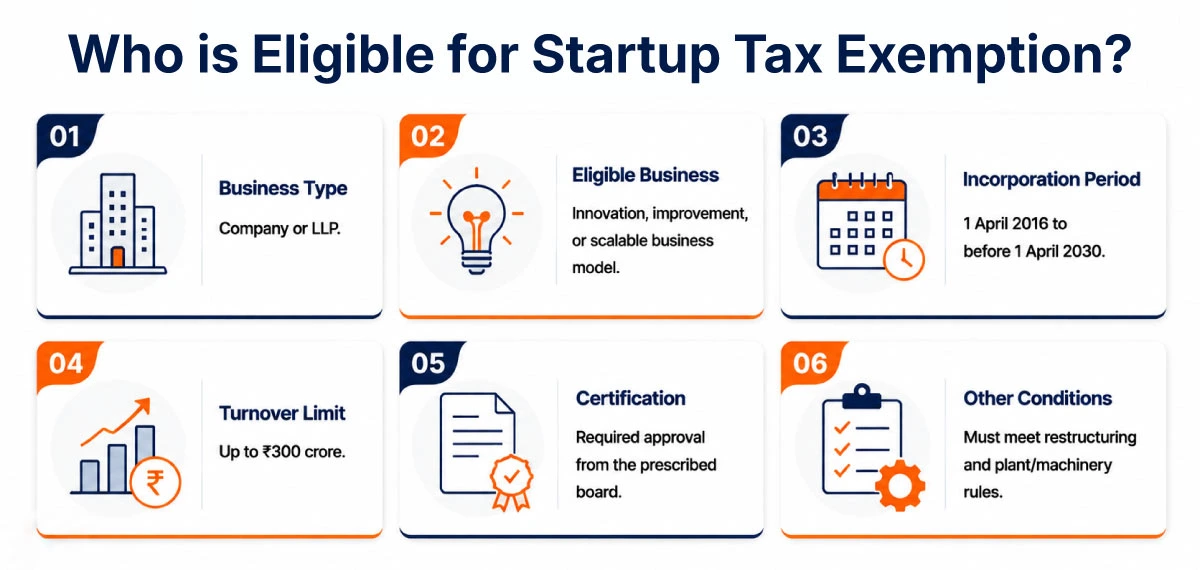
Broadly, the eligible startup must:
- Be a company or Limited Liability Partnership.
- Carry on an eligible business involving innovation, development or improvement of products, processes, or services, or have a scalable business model with high potential for employment generation or wealth creation.
- Be incorporated on or after 1 April 2016 but before 1 April 2030.
- Have total turnover of its business not exceeding ₹100 crore in the tax year for which the Section 140 deduction is claimed.
- Hold the required certificate of eligible business from the prescribed Inter-Ministerial Board of Certification.
- Not be formed by splitting up or reconstructing an existing business, subject to prescribed exceptions.
- Comply with conditions relating to previously used plant and machinery.
Meeting the general definition of a startup does not by itself guarantee eligibility for startup tax exemption. The conditions of the relevant tax provision must also be fulfilled.
What are the Major Tax Benefits Available to Eligible Startups?
1. 100% Profit Deduction for Three Years
One of the most important startup tax exemption benefits is the profit-linked deduction available to eligible startups.
Under Section 140 of the Income-tax Act, 2025, an eligible startup can claim a deduction equal to 100% of profits and gains derived from its eligible business for three consecutive tax years.
Subject to satisfying the Section 140 conditions, including the required IMB certification, the startup can claim the deduction for any three consecutive tax years out of the ten-year period beginning from the year of incorporation.
This benefit can help qualifying startups retain more of their business profits during the selected deduction period.
Section 80-IAC of the Income-tax Act, 1961 earlier governed this benefit.
2. Relaxation for Carry Forward and Set-Off of Losses
An eligible startup company may receive relaxation relating to the carry forward and set-off of losses when its shareholding changes.
Under Section 119 of the Income-tax Act, 2025, an eligible startup company referred to in Section 140 may carry forward and set off qualifying losses despite changes in its percentage of shareholding when the prescribed conditions are satisfied.
Broadly:
- Shareholders who held shares carrying voting power on the last day of the year in which the loss was incurred must continue to hold those shares on the last day of the tax year in which the loss is set off.
- The loss must have been incurred during the ten-year period beginning from the year in which the company was incorporated.
- This specific shareholding relaxation applies to eligible startup companies and does not extend to LLPs.
This relaxation is especially relevant for startups that undergo funding rounds and changes in ownership percentages during their growth stage.
3. Angel Tax Provision No Longer Applies
Earlier, Section 56(2)(viib) of the Income-tax Act, 1961 could tax certain amounts received by closely held companies when shares were issued at a price exceeding their prescribed fair market value. Taxpayers commonly called this provision the “Angel Tax” provision.
However, this provision does not apply from Assessment Year 2025-26.
Therefore, Angel Tax under the erstwhile Section 56(2)(viib) should not be presented as a current tax liability for startups.
Startups receiving investment should nevertheless review other applicable income tax, FEMA, Companies Act, valuation, and reporting requirements.
How Does DPIIT Recognition Relate to Startup Tax Exemption?
DPIIT recognition can provide startups access to various benefits under the Startup India initiative. However, recognition and income tax exemption should not be treated as the same thing.
DPIIT recognition and the Section 140 deduction have separate eligibility conditions. Under the current DPIIT framework, the turnover limit is ₹200 crore for a general startup and ₹300 crore for a Deep Tech Startup. Separately, Section 140 allows the tax deduction where the total turnover of the eligible startup’s business does not exceed ₹300 crore in the tax year for which the deduction is claimed.
Therefore, businesses should separately review:
- Eligibility for DPIIT startup recognition
- Eligibility under the applicable income tax provision
- Required certification
- Turnover conditions
- Nature of eligible business
- Incorporation date requirements
This distinction is important when planning startup tax benefits.
Startup Tax Compliance Services by Ebizfiling
Startup compliance may involve multiple filings across the Income Tax Department, MCA, GST portal, and other regulatory authorities.
Ebizfiling can assist startups with annual company filing, LLP annual compliance, OPC filing, income tax compliance, GST-related filings, and other applicable business registrations and statutory requirements.
Need help with startup annual compliance or Section 140 eligibility? Ebizfiling can assist with income tax, GST, MCA, LLP and other startup compliance requirements. Talk to an expert to understand the filings and tax benefits applicable to your startup.
Conclusion
Annual filing and startup tax exemption are two important aspects of running a compliant startup in India. While annual filings help businesses meet statutory obligations, tax incentives can provide financial relief to eligible startups that fulfil the prescribed conditions.
For Tax Year 2026-27 onward, eligible startups should particularly review the requirements of Section 140 of the Income-tax Act, 2025 before claiming the 100% profit deduction. Startups should also evaluate GST, MCA, TDS, tax audit, and loss carry-forward requirements according to their business structure and transactions.
Regular compliance, accurate records, and timely review of available tax benefits can help startups avoid penalties and make better use of the incentives available under Indian law.
Frequently Asked Questions
1. Does startup tax exemption apply to interest, rental income, or capital gains earned by a startup?
No. The deduction under Section 140 is specifically linked to profits and gains derived from the eligible business. Interest income, rental income, capital gains, or other income streams do not automatically qualify merely because they are earned by an eligible startup. The nature and direct connection of the income with the eligible business must be examined separately.
2. Can a startup claim the Section 140 deduction through a belated income tax return?
The startup should claim the Section 140 deduction through a return filed within the applicable due date under Section 263(1). Under the Income-tax Act, 2025, a deduction claimed under Chapter VIII-C can be disallowed during return processing where the return is furnished after the due date specified under Section 263(1). Timely return filing is therefore important for claiming startup tax exemption.
3. Is an audit required for startup tax exemption even when the startup is below the normal tax audit turnover limit?
Yes. The audit requirement under Section 140 applies independently of the general tax audit turnover limits. The accounts of the eligible business for the tax year in which the deduction is claimed must be audited, and the prescribed audit report in Form 32 must be furnished before the audit-report due date specified under Section 63. Therefore, this requirement can apply even if the startup does not cross the general tax audit turnover threshold.
4. If a startup operates more than one business, does startup tax exemption apply to profits from all activities?
No. The deduction is restricted to profits and gains derived from the eligible business. Where a startup carries on both eligible and non-eligible activities, the profits relating to the eligible activity should be properly identified and computed. This makes appropriate segment-wise accounting important for businesses carrying on multiple activities.
5. Is the ₹100 crore turnover test calculated only on the eligible business?
No. Section 140 refers to the total turnover of the startup’s business for the relevant tax year. Therefore, where the entity carries on multiple business activities, the ₹100 crore turnover condition should not be tested only against the eligible business segment.
6. How are transactions between an eligible startup business and another business of the same entity treated?
Where goods or services are transferred between the eligible business and another business of the same assessee, the transaction should generally be considered at market value for computing the eligible profits. If the recorded consideration differs from market value, the eligible business profit may be recomputed for the purpose of the deduction.
7. Can the Assessing Officer adjust profits where transactions with related parties increase the startup's exempt profit?
Yes. If arrangements with a closely connected person result in the eligible business earning profits higher than what would ordinarily be expected, the Assessing Officer may recompute the profit considered for the deduction. Where a specified domestic transaction is involved, the arm’s length price rules may also apply.
8. Can the same eligible business profit be used to claim another income-linked deduction?
No. Once profits and gains have been claimed and allowed as a deduction under Section 140, the same profits cannot again be deducted under another provision of Part C of Chapter VIII. The deduction also cannot exceed the profits and gains of the eligible business.
9. Does using second-hand machinery automatically disqualify a startup from claiming the exemption?
Not necessarily. Section 140 provides specific exceptions. The condition relating to previously used plant or machinery may still be treated as satisfied where the value of such transferred machinery does not exceed 20% of the total value of plant and machinery used in the business. Separate conditions also apply to certain machinery previously used outside India and later imported into India.
10. Does claiming startup tax exemption remove GST, TDS, MCA, or other annual filing obligations?
No. Startup tax exemption relates to a specific income tax benefit and does not by itself remove separate statutory obligations under GST, TDS, the Companies Act, LLP law, or other applicable regulations. Businesses undertaking startup filing in India should continue to assess each compliance requirement independently. Proper startup annual compliance remains necessary even during a year in which an income tax deduction is claimed.





ROC compliance filing of Pvt Ltd Company
File ROC compliance of Pvt Ltd company in simple steps with Ebizfiling
About Ebizfiling -



October 6, 2026 By Srishti M
October 7, 2026 By Srishti M
October 3, 2026 By Srishti M
Revised ITR Under Old Tax Regime: Change Rules Explained Overview A salaried taxpayer may file an Income Tax Return under the new tax regime and later realise that the old tax regime could be more suitable because of eligible deductions […]