


-
September 30, 2026
-
BySteffy A
ITR-6 Form Filing: The Compliance Guide for Companies 2026
An Overview of ITR-6 Form Filing
The ITR-6 form submission is more than simply an annual regulatory requirement for businesses. It is a vital compliance obligation that directly affects your financial situation and future tax planning. Businesses must be aware of deadlines, paperwork, and filing correctness throughout Year 2026-27. Even minor errors result in increased fines or the loss of key tax benefits. This is where having the right assistance, such as expert guidance from Ebizfiling, may help make every step go more smoothly and less stressful.
Key Deadlines: Avoiding Penalties After the ITR-6 Due Date
For companies where a tax audit is applicable, the tax audit report filing due date for AY 2026-27 has been extended from 30 September 2026 to 21 October 2026, while the ITR-6 filing due date has been extended from 31 October 2026 to 21 November 2026. Companies requiring a report under Section 92E (Transfer Pricing) may have a separate due date.
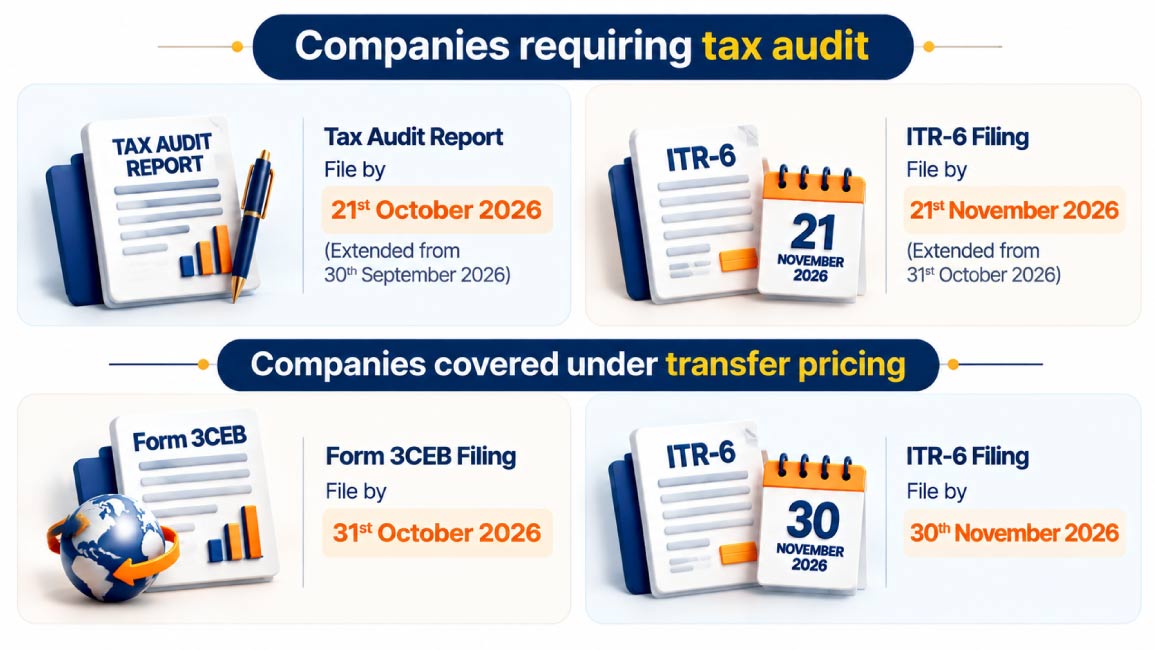
Filing beyond these deadlines is more than simply an procedural mistake; it can also be costly. Section 234F penalty charges a late fee of ₹5,000 (reduced to ₹1,000 for total income below ₹5 Lakh). In addition, Section 234A charges a 1% monthly interest rate on any unpaid tax due. Perhaps most importantly, a late return stops you from carrying forward company losses, which may have offset future earnings.
You can also read the penalty for late Income tax filing Under Section 234F of the Income Tax Act for better understanding.
Who Must Prioritize ITR-6 Form Filing This Year?
The ITR-6 form is especially created for businesses that do not ask for tax breaks for charity or religious reasons. If your company falls in any of the following categories, filling the ITR-6 form is an essential annual requirement.
Private limited companies : They are the most typical forms of business structure for startups and small businesses.
Public limited companies : These companies are big companies with a public shareholding.
One-Person Companies (OPCs) : Corporate filing standards apply even when there is just one stakeholder.
Foreign Companies : Entities that do business in India must record their Indian income.
How to File ITR-6 for AY 2026-27
Knowing how to correctly submit the ITR-6 form means that you do not get a “Defective Return” warning. Follow these guidelines for an effortless submission:
Collect documents first
Collect audited financials, balance sheets, profit and loss statements, and tax audit reports (if necessary, use Form 3CD). Ensure that all ledgers are in line with your books.
Access the portal
Log in to the Income Tax e-filing portal using your company’s PAN and registered credentials. Download the most latest ITR-6 tool for offline preparation or use it online.
Fill in the form
Fill out Part A with business information, income schedules, deductions, and tax computations. Review your capital gains, depreciation, and MAT calculations for validity.
Generate and upload
Validate the data, then generate a JSON file and upload it. Verify using the director’s or authorized signatory’s Digital Signature Certificate (DSC).
Track Status
Online, you may monitor the status of acknowledgment and processing. Address any flaws within the response timeframe to avoid rejection.
You can check the official pdf to know about the structure of ITR-6 form filing.
The Ebizfiling Advantage : Smooth Tax Compliance
How We Work
- Examine your financials for discrepancies and assure 100% correctness.
- Prepare and e-file ITR-6 forms using your DSC to meet deadlines with ease.
- Offer real-time tracking and respond to any tax notices swiftly.
- Provide post-filing reports and optimization tips for next year.
Conclusion
Suggested Reads:
Documents Required for Income Tax Return: Complete Checklist
FAQs on ITR-6 Form Filing
1. Do I need to file ITR-6 if my company has no income?
Yes, if your company has no income in the financial year, you still have toITR-6 form filing. While companies believe that “no income, no return”, the Income Tax Department expects a return. A NIL return keeps your company compliant and free from notices or problems.
2. Why do I get notices after filing ITR-6?
Generally, it is due to data mismatches and under-reporting. This may be because of GST vs ITR mismatches, wrong deductions, or not filing audit details. The notice is typically to clarify but may lead to a penalty or investigation if not addressed.
3. Can I correct errors in ITR-6?
Yes, if you have made mistakes in the return, you can amend the ITR-6 form filing within the time. It’s important to amend errors because you may receive notices or pay incorrect tax. Make sure you check the data you will correct.
4. Should I do my ITR-6 form filing myself?
A company may file ITR-6 independently if its transactions are simple, books are finalized, and tax reporting is straightforward. Professional review may help where audits, MAT, losses, foreign transactions, or complex tax adjustments are involved.
5. What happens if my company files ITR-6 late?
This may attract penalties, interest on tax, and may lead to the loss of some benefits, such as carry-forward losses. Not only will your company be liable to financial penalties, but it will also affect your company’s compliance rating, which can create issues with audits or getting loans.
6. Why must the GST match ITR-6 form filing?
GST turnover and ITR-6 figures should be reconciled, but they need not match exactly. Differences may arise due to timing, credit notes, advances, or accounting adjustments, provided they are properly documented.
7. Is it possible to file ITR-6 when audit is pending?
Where statutory or tax audit applies, the relevant audit report should be completed and furnished within the applicable timeline. Final audited figures should generally be used for ITR-6 filing to avoid inconsistencies.
8. How do I check the status of my ITR-6?
You will receive an acknowledgment on the e-filing portal. You can also check the status online. Once the return is verified, it is deemed filed, but do not ignore updates in case a correction/notice is required.Ebizfiling provides expert help to Income tax return filing and assistance to check the status.
9. What are the mistakes done by companies in filing ITR-6?
Common errors occur from a mismatch between the books of accounts and the tax return. Discrepancies in profits, depreciation, or other items in schedules can cause issues. These errors can be prevented by proof reading. To avoid the mistakes, Choose Ebizfiling for better compliance and filing.
10. Why is timely filing of ITR-6 important for expansion?
Timely ITR-6 filing helps maintain a clean compliance record and may preserve eligible loss carry-forward benefits. It also supports lender, investor, and due-diligence requirements during funding or future transactions.





Don’t Miss ITR-6 Compliance in 2026
Stay ahead of deadlines and file your company return correctly with expert guidance.
About Ebizfiling -



October 13, 2026 By Srishti M
October 12, 2026 By Srishti M
October 12, 2026 By Srishti M
Company Compliance Calendar November 2026: Key Due Dates & Filings Introduction The Company Compliance Calendar November 2026 highlights important annual return, dematerialisation and income tax compliances that companies may need to complete during the month. November 2026 is particularly […]