


-
June 17, 2026
-
BySteffy A
Detailed guide to audit under Goods and Service Tax
Introduction to Audit under Goods and Service Tax
Audit under Goods and Service Tax in India refers to the verification of a taxpayer’s records, GST returns, and financial statements. This audit can be done to ensure correct tax payment and accurate Input Tax Credit claims. As per latest GST updates, mandatory audit by Chartered Accountant based on turnover has been removed from FY 2020-21 onwards. However, GST authorities can still conduct departmental audits, scrutiny, and special audits depending on risk and discrepancies.
Requirement of Audit under Goods and Service Tax in India
Even though the old turnover-based audit format is no longer the key rule, the following taxpayers should remain especially careful:
- Businesses with high turnover
- Taxpayers with large input tax credit claims
- Exporters
- E-commerce sellers
- Businesses with frequent amendments in returns
- Taxpayers facing a mismatch between returns and books
- Persons receiving departmental notices or scrutiny communications.
Earlier, businesses with turnover above ₹2 crore were required to undergo GST audit by CA or CMA. This requirement has now been removed.
However, taxpayers with turnover above ₹5 crore must file GSTR-9C (self-certified reconciliation statement).
Types of Audit under Goods and Service Tax
1. Audit by Tax Authorities under Section 65
This is the standard departmental audit under Goods and Service Tax. GST authorities can audit a registered person’s records, returns, and related documents. The law empowers tax authorities to initiate this audit and examine compliance in detail.
2. Special Audit under Section 66
A special audit under Goods and Service Tax can be ordered when the case is complex or when the officer believes that the value declared or input tax credit claimed is not correctly reflected. In such cases, the registered person is directed through FORM GST ADT-03 to get records audited by a chartered accountant or cost accountant nominated under the law.
3. Scrutiny of Returns
Although scrutiny is not the same as a full audit, it is often the starting point for deeper GST examination. Where discrepancies are found in returns, the officer may issue a notice and seek explanation within the specified period.
Suggested Read : Types of GST Returns in India
Audit under Goods and Service Tax vs GSTR-9 vs GSTR-9C
|
Compliance Item |
Meaning |
Who files it |
Current relevance |
|
Audit under Goods and Service Tax |
Examination by department or special audit mechanism | Tax authority or nominated CA/CMA in special audit cases |
Still relevant in 2026 |
| Annual return under GST | Eligible registered person | Still relevant where applicable | |
| GSTR-9C | Reconciliation statement with annual return and audited annual financial statements | Taxpayer in applicable cases |
Still relevant, with self-certified format in current framework |
This distinction is important because many pages still confuse GSTR-9C filing with the old mandatory GST audit model. That confusion makes content outdated. CBIC’s 2025 clarification itself discusses GSTR-9C as part of the continuing compliance framework.
Process of Audit under Goods and Service Tax
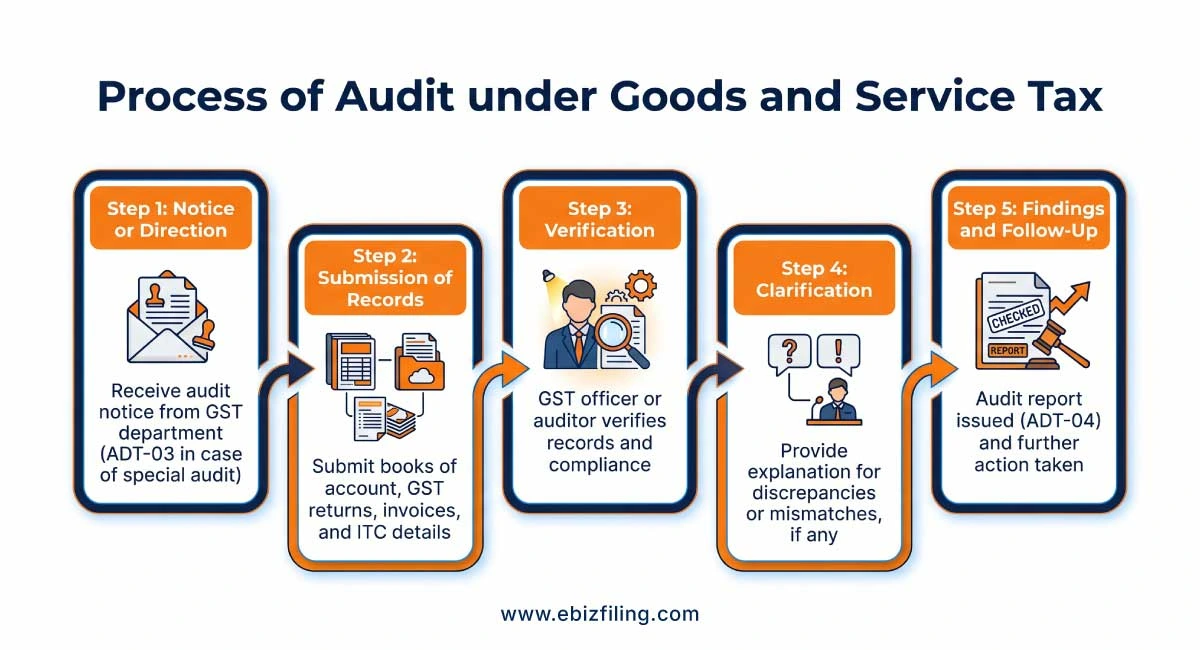
Note : There is no specific penalty only for GST audit; however, general GST provisions apply. Penalties may include fines up to ₹25,000, interest, tax demand, and ITC reversal in case of discrepancies.
List of accounts that needed to be audited by the GST Auditor
- Register of Sales
- Expenses ledgers
- Input tax credit (ITC) claimed and utilized
- Register of purchase
- GST payable and paid
- Register of Stock
- All the e-Way bills generated
- Any other document or record as may be necessary for that relevant period.
In case if the auditor finds any mismatch or problem in these accounts or records, the GST auditor shall add a comment in the audit report. Moreover, the taxpayer can rectify such a mismatch reported by the auditor in the C-03 Form.
How Ebizfiling Supports Audit under Goods and Service Tax Compliance?
Ebizfiling provides professional assistance to help businesses stay compliant with GST laws.
Our services include:
- GST compliance review and audit under Goods and Service Tax support.
- Preparation and reconciliation of GST records.
- Assistance in GSTR filings and annual returns.
- Guidance in preparing documents required for GST audit.
- Professional support from experienced tax experts.
Conclusion
Audit under Goods and Service Tax is important to ensure financial accounts are maintained and GST laws are complied with. It verifies if payments for tax, input tax credit (ITC) and financial accounts in GST returns are correct. For higher turnover or extensive transaction businesses, record-keeping and GST compliance is required. GST audit compliance helps avoid fines and increases tax system credibility.
Frequently Asked Questions on Audit under Goods and service tax
1. What is the purpose of Goods and Service Tax Audit?
GST Audit is a process to ensure that the taxpayer has reported turnover, tax paid and Input Tax Credit as per the GST law. It helps verify whether returns are reconciled with financial books and compliances are followed, thereby avoiding tax and legal issues.
2. When should a business have an audit under Goods and Service Tax?
The earlier mandatory GST audit based on turnover is no longer applicable. However, businesses may still need to file GSTR-9C as a self-certified reconciliation statement. Additionally, departmental audit under Section 65 or special audit under Section 66 may be conducted by tax authorities.
3. Does audit under Goods and Service Tax apply to all GST registrations?
GST audit is applicable on a GST registration basis. While audit by CA/CMA is not mandatory, the GST department can audit each registration separately. Businesses operating in multiple states must maintain books of accounts for each GSTIN.
4. Who can perform Audit in Goods and Service Tax in India?
GST audit is primarily conducted by GST authorities under Section 65. In special cases under Section 66, a Chartered Accountant or Cost Accountant may be appointed. Taxpayers are required to maintain proper documents and compliance records.
5. What are the documents required for Audit under Goods and Service Tax?
Businesses must maintain sales and purchase registers, ITC records, stock registers, expense records, and GST returns. Proper documentation of invoices, taxes paid, and reconciliations ensures smooth audit and reduces the chances of notices.
6. What is GSTR 9 and 9C?
GSTR-9 is the annual GST return for a financial year. GSTR-9C is a reconciliation statement between GST returns and financial statements. Currently, GSTR-9C is self-certified by the taxpayer and not certified by a CA.
7. Will GST authorities conduct audit?
Yes, GST officers can conduct audits under Section 65 of the GST Act. These audits review compliance related to returns, accounts, and records, and are usually initiated through official notices.
8. What happens if errors are found in Audit under Goods and Service Tax?
If discrepancies are found, they are reported in the audit report. Taxpayers may need to justify or rectify them, often by filing Form GST DRC-03. Additional actions or penalties may apply depending on the issue.
9. Is there a penalty for non-compliance with audit under Goods and Service Tax?
There is no direct penalty for GST audit non-compliance. However, penalties, interest, or tax demands may arise due to non-compliance with GST provisions or late filing of GSTR-9 or GSTR-9C. Timely compliance helps avoid such consequences.
10. How can businesses prepare for audit under Goods and Service Tax?
Businesses should regularly reconcile GST returns with books of accounts, properly maintain records, and ensure timely filing of returns. Organized documentation and compliance reduce audit risks and ensure smooth processing.





Detailed Guide to Audit under GST
Understand GST audit requirements, procedures, and compliance essentials with ease.
About Ebizfiling -



Reviews
Anaya Patel
16 Sep 2018I was so satisfied with the services they provided to me. I had a great time working with them.
Palak Shah
14 Jul 2018I must say they have a really efficient team. I had contacted them for Trademark Registration and it was done within no time. Kudos to you and your team.
September 19, 2026 By Steffy A
September 18, 2026 By Srishti M
Professional Tax Registration Cancellation Process Explained Introduction Professional Tax is a state-level tax applicable to individuals and businesses engaged in professions, trades, callings, or employment, subject to the provisions prescribed under respective state laws. Businesses liable under applicable Professional Tax […]
September 18, 2026 By Siddhi R
EPFO Wage Ceiling Increased to ₹25,000: Key Impact Explained Introduction The EPFO wage ceiling increased proposal has been approved by the Union Cabinet based on the recommendation of the Ministry of Labour & Employment to enhance the mandatory EPFO coverage […]