

-
August 13, 2026
-
BySteffy A
E-Way Bill under GST: Meaning and Applicability
Introduction
The E-Way Bill under GST is an important document required for the transportation of goods in India. It helps the government track the movement of goods and ensures compliance with GST regulations. Businesses, traders, and transporters involved in moving goods from one place to another should understand the rules related to the E-Way Bill and avoid penalties and delays.
In this article, we’ll explain what an E-Way Bill is, when it is required, the documents needed, the generation process, and its validity in simple terms.
What is an E-Way Bill under GST?
An E-Way Bill under GST is an electronic document generated on the E-Way Bill portal before transporting goods from one location to another. It contains details of the goods being transported, the supplier, the recipient, and the transporter.
Generally, an E-Way Bill under GST is required when the value of the goods being transported exceeds ₹50,000. Once the bill is generated, a unique E-Way Bill Number (EBN) is issued, which can be used to verify the details of the shipment.
The main purpose of the E-Way Bill is to ensure that goods are transported legally and that GST rules are properly followed.
When is an E-Way Bill Required Under GST?
An E-Way Bill under GST is usually required when goods worth more than ₹50,000 are transported from one place to another. This may happen for the sale of goods, transfer of goods between branches, job work, or other business-related reasons.
The responsibility for generating the E-Way Bill may fall on the supplier, recipient, or transporter, depending on the transaction.
For example:
- If a registered supplier is sending goods, the supplier usually generates the E-Way Bill.
- If goods are received from an unregistered supplier, the registered recipient may need to ensure compliance.
- If neither the supplier nor recipient generates the bill, the transporter may generate it before moving the goods.
In some cases, an E-Way Bill under GST may be required even when the value of goods is below ₹50,000, such as for certain inter-state movements of handicraft goods or goods sent for job work.
What Documents Are Required for E-Way Bill Generation?
To generate an E-Way Bill under GST, the following documents and details are generally required:
- Tax Invoice or Bill of Supply
- Delivery Challan, where applicable
- Details of the supplier and recipient
- Transporter ID, if a transporter is involved
- Vehicle number used for transportation
Keeping these details ready helps in generating the E-Way Bill quickly and accurately. Businesses looking for a step-by-step guide can also learn how to generate GST E-Way Bill online.
What is the Validity of an E-Way Bill Under GST?
The validity depends on the distance the goods need to travel.
|
Distance |
Validity |
|
Up to 200 km |
1 Day |
| Every additional 200 km or part thereof |
Additional 1 Day |
The validity period starts from the date and time the E-Way Bill is generated. Businesses should ensure that the goods are transported within the validity period to avoid compliance issues.
What Happens If Goods Are Transported Without an E-Way Bill?
If goods are transported without a valid E-Way Bill under GST when one is required, the authorities may stop the vehicle and inspect the goods. This can lead to the detention of goods and the vehicle. The taxpayer may also be required to pay applicable penalties under GST laws.
To avoid unnecessary delays and penalties, businesses should always ensure that a valid E-Way Bill is generated before transporting goods.
How to Generate an E-Way Bill Online?
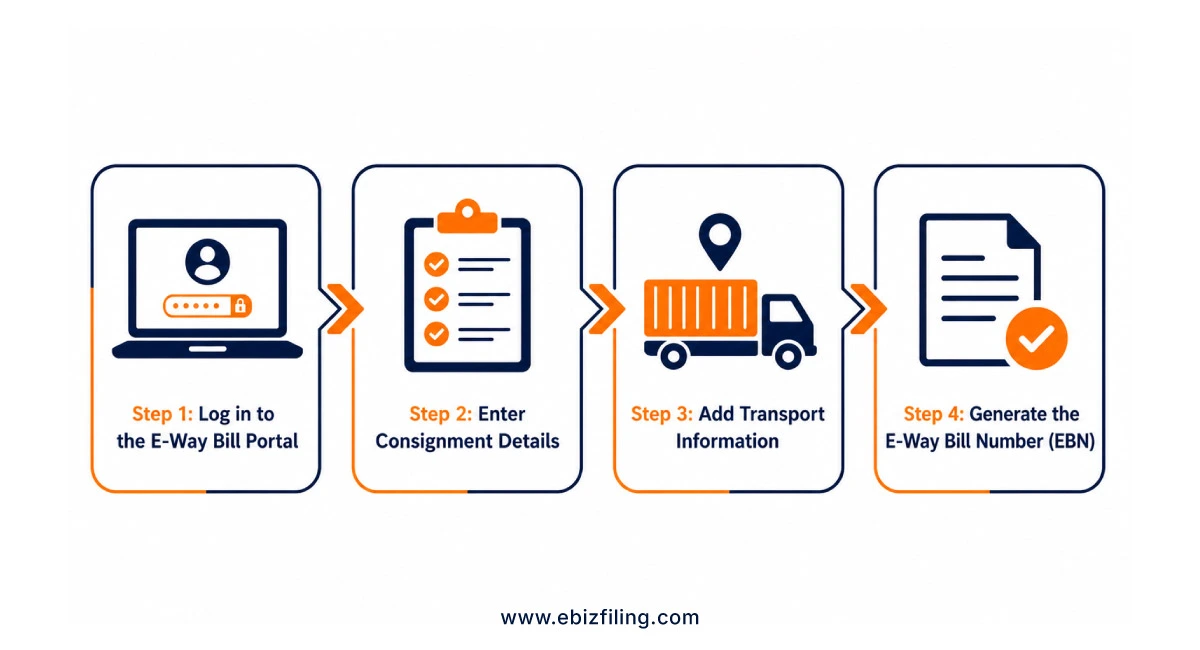
Step 1: Log in to the E-Way Bill Portal
Access the official E-Way Bill portal using your registered username and password.
Step 2: Enter Consignment Details
Provide the invoice, supplier, recipient, goods value, HSN code and movement details.
Step 3: Add Transport Information
Enter the transporter ID, transport document number, vehicle number and mode of transport.
Step 4: Generate the E-Way Bill Number
Review the entered details and submit the form to generate the unique E-Way Bill Number.
Benefits of the E-Way Bill System Under GST
The E-Way Bill under GST offers several advantages to businesses, including:
- Easy tracking of goods during transportation
- Better compliance with GST regulations and the overall benefits of GST registration for businesses.
- Reduced chances of tax evasion
- Faster movement of goods
- Improved transparency in business transactions
The system helps businesses maintain proper records and ensures smooth transportation across different locations.
Need Help with GST Compliance?
An E-Way Bill is only one part of GST compliance. Businesses involved in the movement of goods must ensure that they have a valid GST registration and file GST returns accurately and on time. Proper GST compliance helps avoid penalties, ensures smooth transportation of goods, and supports seamless business operations.
At Ebizfiling, our experts can assist you with GST Registration, GST Return Filing, and other GST-related compliance requirements. Whether you are starting a new business or managing ongoing GST obligations, we provide end-to-end support to help you stay compliant.
Register your GST and stay GST-compliant with expert assistance from Ebizfiling.
Conclusion
The E-Way Bill under GST is an important requirement for businesses involved in the transportation of goods. It helps ensure legal movement of goods and supports GST compliance.
By understanding when an E-Way Bill is required, keeping the necessary documents ready, and generating it correctly, businesses can avoid penalties and ensure stress-free transportation. Proper use of the E-Way Bill also helps improve transparency and efficiency in business operations.
Suggested Reads:
Understanding GST for freelancers
Blocking and Unblocking of E-Way Bill Generation Under GST
Frequently Asked Questions
1. Is an E-Way Bill required for stock transfers between branches located in different states?
Yes. An E-Way Bill is generally required for inter-state branch transfers when the consignment value exceeds ₹50,000, even though the transfer is between branches of the same business entity.
2. Can an E-Way Bill be generated after the goods have already started moving?
Yes. However, the E-Way Bill should ideally be generated before the commencement of movement. Failure to do so may result in penalties and detention of goods during transit inspections.
3. Why should businesses obtain GST Registration before generating E-Way Bills?
GST Registration is a fundamental requirement for businesses making taxable supplies. Having a valid GSTIN enables businesses to generate E-Way Bills, issue tax invoices, and comply with GST obligations efficiently.
4. What happens if the vehicle carrying goods changes during transit?
If the vehicle changes during transportation, the transporter or supplier must update the new vehicle details in Part B of the E-Way Bill before continuing the movement of goods.
5. Can multiple invoices be transported under a single E-Way Bill?
No. Generally, one E-Way Bill is generated for one invoice. However, transporters carrying multiple consignments can generate a Consolidated E-Way Bill containing multiple E-Way Bill numbers.
6. How does GST Return Filing support accurate E-Way Bill compliance?
Accurate GST Return Filing helps ensure consistency between invoices, outward supplies, and E-Way Bill details. Mismatches may lead to notices, scrutiny, or compliance issues under GST.
7. Can an E-Way Bill be cancelled after it is generated?
Yes. An E-Way Bill can be cancelled within 24 hours of generation if the goods are not transported or if the details entered are incorrect. It cannot be cancelled once it has been verified in transit by a proper officer.
8. How is the consignment value calculated for E-Way Bill applicability?
The consignment value includes the value of goods, applicable GST, cess (if any), and other charges reflected in the invoice. It determines whether the E-Way Bill threshold requirement is triggered.
9. What is the difference between Part A and Part B of an E-Way Bill?
Part A contains transaction-related details such as GSTIN, invoice number, consignee details, and consignment value. Part B contains transportation details, including the vehicle number or transporter document number.
10. Can a transporter generate an E-Way Bill if the supplier has not generated one?
Yes. If the consignor or consignee has not generated an E-Way Bill and the movement requires one under GST, the transporter may generate the E-Way Bill based on the documents provided by the supplier.




GST Return
File your GST return on time to avoid penalties with Ebizfiling.com
About Ebizfiling -



Reviews
Pranab Maji
04 Aug 2020Thanks and complements for rendering necessary service as to incorporation and Registration of Pratyasha Agro Pvt. Ltd.
Karthik
05 Apr 2019Awesome Service! I am very happy with the way the process is being handled. Snehal also followed up constantly to ensure that the items are completed on time successfully. Thanks for your service.
Ahmed Shaikh
23 Sep 2018Ms. Ishani and other team members are very helpful in the entire process of GST filing.
I really appreciate their support superb team.
Cheers!!!!*****
September 28, 2026 By Srishti M
GST Section 74 Notice: Key Supreme Court Guidelines for Valid SCNs Overview A GST Section 74 notice is a serious GST communication because it may involve allegations of fraud, wilful misstatement or suppression of facts to evade tax. For tax […]
August 29, 2026 By Steffy A
GST Compliance Calendar September 2026: Key Due Dates & Filings Introduction The GST Compliance Calendar for September 2026 provides a clear overview of the applicable deadlines, filing requirements and taxpayer categories. September 2026 includes several important GST return filing and […]
August 26, 2026 By Steffy A
GST Compliance Calendar August 2026: Key Due Dates & Filings Introduction The GST Compliance Calendar August 2026 provides a comprehensive overview of the important GST due dates that taxpayers should keep track of during the month. In this blog, you […]