

-
September 22, 2026
Form 10G for 80G Registration: Process, Eligibility & Requirements
Introduction
If you manage an NGO, trust, society, or Section 8 company, obtaining 80G approval can make donations more attractive because eligible donors may claim tax deductions. Many organizations still search for Form 10G for 80G registration while understanding the current application process, eligibility criteria, and documentation requirements. However, organizations should be aware that the current 80G approval framework generally uses Form 10A or Form 10AB, depending on the nature and status of the application. Form 10G is an older form associated with 80G approval and continues to appear in searches and older guidance.
Understanding the current filing requirements, documentation, eligibility conditions, and approval process can help charitable organizations avoid mistakes while applying for 80G registration.
Key Takeaways
- Form 10G for 80G registration is commonly searched for, but current 80G approval applications are generally made through Form 10A or Form 10AB.
- Eligible donors can claim deductions for qualifying donations made to approved organizations.
- Organizations applying for 80G registration should maintain registration documents, financial records, activity reports, and details of key persons.
- 80G approval is granted for a prescribed validity period depending on the approval category and may require renewal or revalidation as applicable.
- Approved organizations must continue maintaining proper donation records and meet applicable reporting requirements.
Understanding Form 10G in the Current 80G Framework
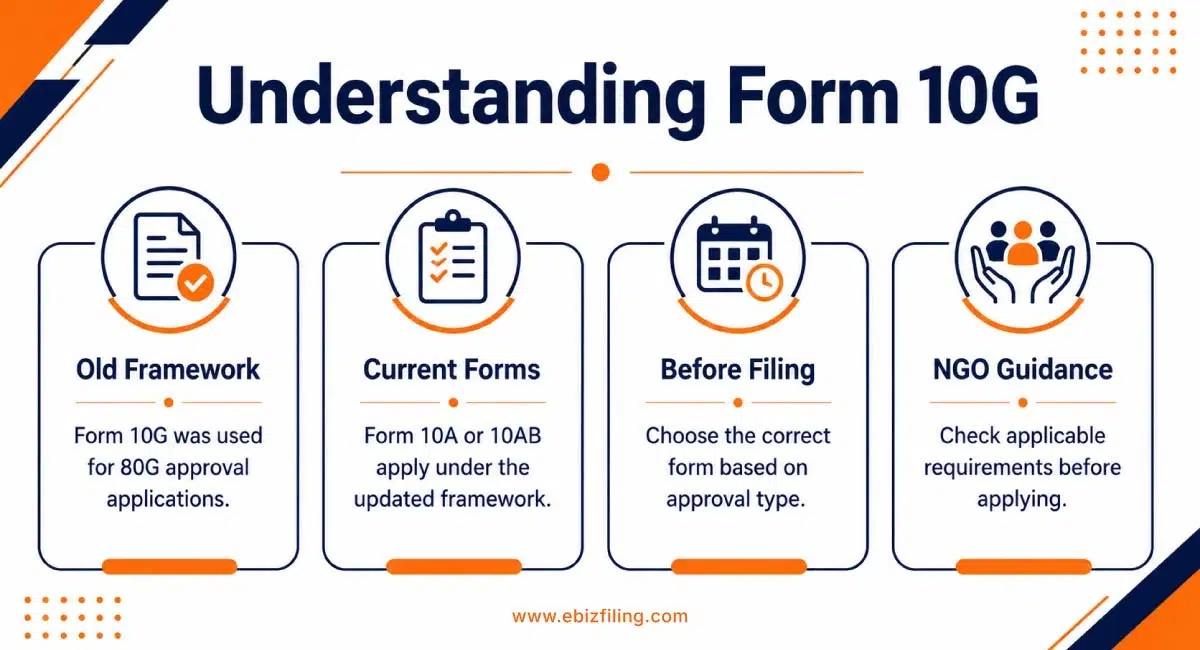
Form 10G was traditionally associated with applications for approval under Section 80G of the Income Tax Act. This is why Form 10G for 80G registration continues to be a commonly used search term among NGOs and charitable institutions.
Under the current registration framework, however, eligible organizations generally apply using Form 10A or Form 10AB, depending on whether they are seeking provisional approval, regular approval, renewal, or another prescribed registration.
Therefore, organizations looking for the Form 10G filing process for 80G registration should first determine which current form applies to their situation before proceeding with the online application.
Note: This article uses the term Section 80G as it is commonly used by NGOs, trusts, and charitable institutions while referring to tax-deductible donation approvals. Organizations should refer to the latest Income Tax Department guidelines and applicable provisions while filing their applications.
Which Organizations Can Seek 80G Approval?
Different types of charitable organizations may apply for 80G approval if they satisfy the prescribed conditions.
These generally include:
- Charitable trusts
- Registered societies
- Section 8 companies
- Eligible charitable institutions
- Certain institutions carrying out both charitable and religious activities, subject to applicable conditions
For organizations seeking 80G registration for NGO operations or 80G registration for trust activities, their constitutional documents, charitable objectives, financial records, and tax registration status should be properly maintained before filing.
Conditions an NGO or Trust Should Check Before Applying
Before starting an application connected with Form 10G for 80G registration, the organization should review whether it meets the basic conditions for approval.
The organization should be properly constituted under the applicable law and should carry out genuine charitable activities. Its income and assets should be used for its stated charitable purposes and should not be applied for the personal benefit of founders, trustees, directors, or specified persons.
It should also maintain proper books of account, financial statements, and supporting records.
The organization’s governing documents should clearly reflect its charitable objectives. Any business activity, private benefit, or religious activity should be reviewed carefully because these factors may affect eligibility depending on the facts of the case.
Documents required for Form 10G for 80G registration
Proper documentation is one of the most important parts of the 80G registration process. Incomplete or inconsistent records may result in queries or delays.
Organizations should generally keep the following records ready:
- Trust deed, memorandum, rules, or Section 8 company incorporation documents
- PAN of the organization
- Registration certificate under the applicable law
- Existing 12A, 12AA, or 12AB registration order, where applicable
- Existing 80G approval order, in case of renewal
- Financial statements for previous years, where available
- Audit reports, where applicable
- Income and expenditure accounts
- Receipts and payments accounts
- Activity reports explaining charitable work
- Details of trustees, directors, founders, or governing body members
- Bank account information
- Details of assets and liabilities
- FCRA registration details, where applicable
- Details of any previous approval, rejection, or registration application
The exact list for Form 10G for 80G registration may vary depending on the nature of the organization and the type of application being filed.
Process to Apply for 80G Registration Online
Organizations searching for the Form 10G filing process for 80G registration should note that the current 80G approval application process is generally completed through Form 10A or Form 10AB, depending on the nature of the application.
- Log in to the Income Tax Portal: Visit the official Income Tax e-Filing portal and log in using the organization’s PAN and registered credentials.
- Select the Applicable Form: Choose Form 10A or Form 10AB based on whether the organization is seeking provisional approval, regular approval, renewal, or another applicable registration under Section 80G.
- Provide Organization Details: Enter details such as the organization’s name, PAN, registered address, legal structure, date of establishment, and registration information.
- Add Registration and Activity Details: Provide information about existing registrations, charitable objectives, activities carried out, and details of trustees, directors, or governing body members.
- Upload Supporting Documents: Attach the required documents, such as the trust deed or incorporation documents, registration certificates, previous approval orders, financial statements for up to three preceding years where applicable, and a note on the organization’s activities.
- Verify and Submit the Application: Review all the information carefully and submit the applicable form electronically. The application must be verified using a Digital Signature Certificate or Electronic Verification Code, as applicable.
- Track the Application: After submission, keep track of the application through the e-Filing portal. The Income Tax Department may request additional information or clarification before deciding the application.
If approval is granted, the organization receives an approval order and a Unique Registration Number under the applicable 80G registration framework.
Complete 80G Registration Assistance by Ebizfiling
Applying for 80G registration involves more than filling out a form. NGOs and charitable organizations need to identify the correct application route, prepare supporting documents, and ensure that their registration and financial details are accurate. Ebizfiling helps simplify this process with professional filing support.
- We help review trust deeds, registration certificates, financial statements, activity reports, and other supporting records.
- Our team helps determine whether Form 10A or Form 10AB applies based on the organization’s registration status and application type.
- Ebizfiling assists with preparing and submitting the 80G registration application through the Income Tax e-Filing portal.
- We also assist with 12AB registration, 80G registration for NGOs and trusts, and renewal-related requirements.
- Our team helps organizations understand the applicable filing requirements and avoid common documentation or application errors.
Need help with 80G registration? Connect with Ebizfiling today for professional assistance with your application and related compliance requirements.
Conclusion
Organizations researching Form 10G for 80G registration should understand that the filing framework for 80G approval has changed over time. While Form 10G remains a familiar search term, current applications are generally handled through Form 10A or Form 10AB depending on the organization’s circumstances.
A successful application requires more than simply submitting a form. NGOs and trusts should review their eligibility, maintain proper financial records, prepare activity reports, keep registration documents updated, and follow applicable filing timelines.
With accurate documents and a clear understanding of the current 80G registration process, charitable organizations can approach the application with greater confidence and maintain better compliance after approval.
Suggested Reads:
Renew a Trust License in India
Difference between 12A and 80G
How to Download 12A and 80G Certificate?
Frequently Asked Questions
1. Is Form 10G still the correct form for obtaining 80G registration?
Form 10G is historically associated with approval under Section 80G, which is why Form 10G for 80G registration remains a commonly searched term. Under the current Rule 11AA framework, however, applications for 80G approval are generally made using Form 10A or Form 10AB, depending on the nature of the application.
2. How do I know whether to file Form 10A or Form 10AB for 80G approval?
The applicable form depends on the type and status of the application. Rule 11AA prescribes Form 10A for specified categories of applications and Form 10AB for other prescribed cases. Organizations applying for 80G approval should therefore identify their application category before filing.
3. Can an NGO apply for 80G registration before completing three years of activities?
Yes, an NGO may apply for 80G approval before completing three years of activities in certain cases. Organizations that are newly established may be eligible to apply for provisional approval, subject to meeting the applicable conditions and filing requirements. NGOs should review their registration status, available documents, and applicable approval category before submitting the application.
4. What happens if incorrect information is submitted with an 80G application?
Organizations should ensure that all information and supporting documents are complete and accurate. Rule 11AA provides consequences where Form 10A contains incomplete, false, or incorrect information or documents. Proper verification of registration details, activities, and records is therefore important during the registration process.
5. Does receiving 80G approval mean every donation qualifies for a tax deduction?
No. The deduction available to a donor depends on the category of the eligible fund or institution and the applicable limits. Organizations completing Form 10G for 80G registration should also maintain proper records to support compliance requirements related to approved donations.
6. Can a donor claim an 80G deduction for a cash donation?
A donor cannot claim an 80G deduction for the portion of a donation made in cash that exceeds ₹2,000. Organizations handling 80G registration for NGO or trust activities should therefore maintain clear records of the mode through which donations are received.
7. What compliance is required after completing 80G registration online?
Obtaining approval is not the end of the compliance process. An approved organization is generally required to maintain donation records, file the prescribed statement of donations in Form 10BD, and issue Form 10BE certificates to eligible donors. These requirements should be considered after completing Form 10G for 80G registration and receiving approval.
8. When should an approved NGO file Form 10BD and issue Form 10BE?
Form 10BD is generally required to be filed by 31 May immediately following the financial year in which the donations were received. Form 10BE must also generally be issued to donors by 31 May. These post-registration requirements should be considered part of ongoing 80G compliance.
9. Can Ebizfiling help determine the correct form instead of using Form 10G?
Yes. Since Form 10G for 80G registration is still commonly searched even though the current filing framework generally uses Form 10A or Form 10AB, Ebizfiling can help organizations understand which application route applies to their situation and assist with preparing the required documents.
10. Can Ebizfiling assist with both 80G registration for a trust and an NGO?
Yes. Ebizfiling can assist with 80G registration for trust and 80G registration for NGO applications by helping review registration records, supporting documents, financial information, and the applicable online filing requirements. Assistance can also be provided for related registration and renewal requirements. Ebizfiling can also guide organizations regarding the applicable filing process and related compliance requirements.





80G Registration
Register for 80G of income tax act in simple steps with Ebizfiling
About Ebizfiling -



September 22, 2026 By Srishti M
Maharashtra Professional Tax Notice: Filing & Compliance Guide Introduction Receiving a Maharashtra Professional Tax Notice can create confusion for businesses, especially when the notice mentions pending PTRC returns, delayed filings, professional tax dues, late fees, or interest implications. Businesses often […]
September 21, 2026 By Srishti M
Raw Sugar Import Under TRQ: DGFT Eases Processing & Sale Deadline Introduction India has introduced an important change to the raw sugar import framework under the Tariff Rate Quota (TRQ) scheme. On 20 August 2026, the Directorate General of Foreign […]
September 21, 2026 By Srishti M
UPI MDR Charges 2026: 0.4% MDR on Payments Above ₹2,000 Introduction UPI MDR Charges 2026 introduce an important change for selected merchant payments made through the Unified Payments Interface. From 15 October 2026, a Merchant Discount Rate (MDR) of 0.4% […]