


-
September 2, 2026
-
BySteffy A
Difference Between GSTR 1 and GSTR 3B: Everything You Need to Know
Introduction
Understanding the difference between GSTR 1 and GSTR 3B is important for every GST registered taxpayer to maintain accurate GST compliance. Every registered taxpayer under GST is required to file applicable GST returns based on their registration type, turnover, and filing frequency. GST return filing helps taxpayers report their business transactions, discharge tax liability, and enable eligible recipients to claim Input Tax Credit (ITC). There are several types of GST returns filed by taxpayers based on their registration type and compliance requirements.
In this blog, we will focus on two important GST returns: GSTR-1, which is filed for reporting outward supplies, and GSTR-3B, which is filed for reporting outward supplies, eligible Input Tax Credit (ITC), reverse charge liabilities, and GST tax liability.
GSTR-3B vs GSTR-1
GSTR-3B is a self-assessed summary return filed by taxpayers to report outward supplies, eligible Input Tax Credit (ITC), reverse charge liabilities, and GST payable. The due date depends on the taxpayer’s filing frequency and scheme opted under GST. Taxpayers use GSTR-3B to declare their GST liability, claim eligible ITC, and pay the applicable tax for the relevant period.
GSTR-1 is a monthly or quarterly return used to report details of outward supplies made during the tax period. It contains invoice-level details of sales, debit notes, credit notes, exports, and other outward supplies. The invoice-wise details reported in GSTR-1 help maintain transparency in outward supply reporting and enable recipients to verify eligible Input Tax Credit (ITC) through GSTR-2B. The details reported in GSTR-1 are used to generate recipients’ GSTR-2B, which helps them verify and claim eligible Input Tax Credit (ITC).
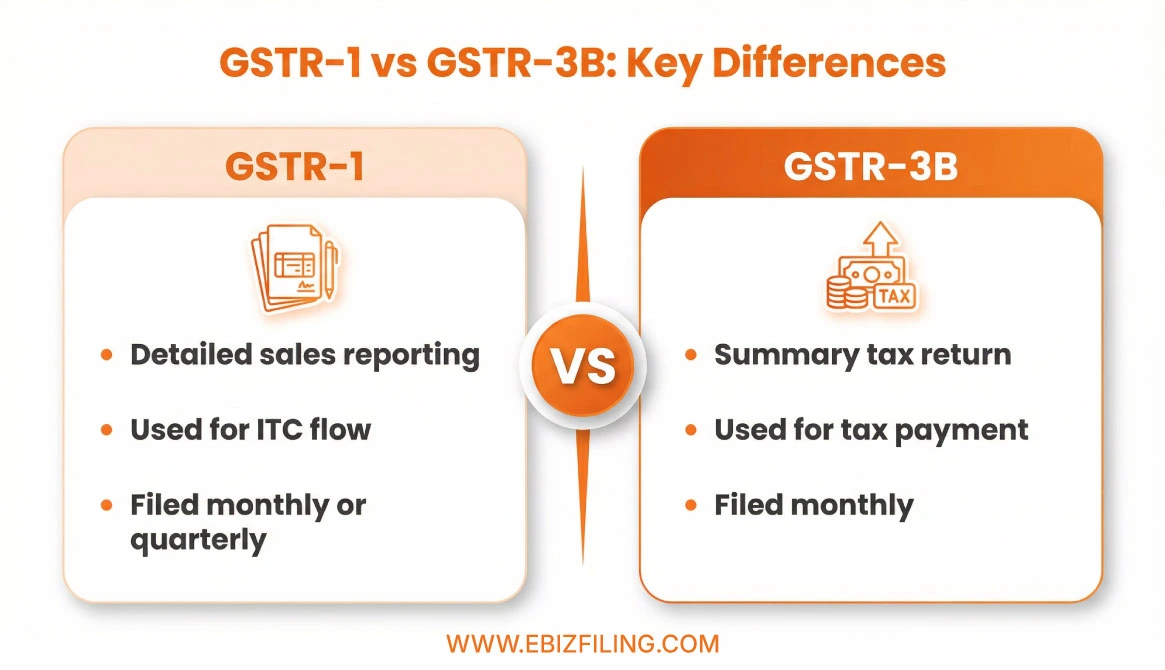
Difference between GSTR 1 and GSTR 3B return
The table below explains the Difference between GSTR 1 and GSTR 3B by highlighting their key roles, filing requirements, and importance in the GST filing process.
|
Basis |
GSTR-1 |
GSTR-3B |
|
Content |
Contains detailed invoice-wise details of outward supplies, including B2B invoices, B2C supplies, exports, debit notes, credit notes, and amendments. |
Contains summary details of outward supplies, inward supplies liable to reverse charge, eligible Input Tax Credit (ITC), and GST tax liability. |
|
Purpose |
Used for reporting outward supply details made by the taxpayer during the tax period. The details reported are used for generating recipients’ GSTR-2B for ITC verification. |
Used for declaring GST liability, claiming eligible ITC, and making payment of applicable GST. |
|
Filing Frequency |
Filed monthly by regular taxpayers. Eligible taxpayers under the QRMP scheme can file quarterly, subject to applicable conditions. |
Generally filed monthly by regular taxpayers. Taxpayers under the QRMP scheme file GSTR-3B quarterly, with monthly tax payment requirements through Form GST PMT-06 as applicable. |
|
Reconciliation |
Outward supply details reported in GSTR-1 should be reconciled with books of accounts and sales records to avoid mismatches. |
Taxpayers should reconcile tax liability, sales reported in GSTR-1, and eligible ITC with records and GSTR-2B before filing. |
|
Tax Payment |
No GST payment is required while filing GSTR-1, as it only reports outward supply details. |
GST payment is required while filing GSTR-3B after considering output tax liability, eligible ITC, and other applicable adjustments. |
|
Late Filing Fees |
Late fees for delayed filing of GSTR-1 depend on the taxpayer category, type of return, and applicable GST notifications. |
Late fees for delayed filing of GSTR-3B depend on whether the return is a nil return or contains tax liability, along with applicable turnover-based limits and GST notifications. |
Details to be Included in GSTR-1 & GSTR-3B Returns:
GSTR-1:
- Invoice Details: Must include information on business-to-business (B2B) and consumer-to-business (B2C) transactions.
- Exempt Supplies: Details of any exempt supplies during the period.
- Exports: Information on the export of goods and services.
- Overview of Supplies: A summary of all supplies made during the period.
- Amendments: Details of corrections or modifications made to previously reported invoices and outward supplies.
GSTR-3B:
- Turnover: Includes the total turnover for the month.
- Exempt Supplies: Information on exempt supplies.
- Exports: Details on the export of goods or services.
- Tax Details: Specifies the taxable value and amounts for CGST, SGST, and IGST.
- Input Tax Credit (ITC): The total input tax credit available during the month.
- Inward Supply under Reverse Charge: Details of inward supplies where the reverse charge mechanism is applicable.
Reconciliation Between GSTR-1 and GSTR-3B
Understanding the Difference between GSTR 1 and GSTR 3B also includes knowing how reconciliation works. Reconciliation means matching the data reported in both returns to ensure accuracy.
- GSTR-1 contains detailed sales (invoice-level data)
- GSTR-3B contains summary figures and tax payment
When you reconcile, you check whether:
- Total sales in GSTR-1 = Total sales reported in GSTR-3B
- Tax liability reported through outward supplies in GSTR-1 should generally match the liability declared in GSTR-3B.
If both match, your GST compliance is accurate.
Businesses should also review the GST Compliance Checklist for FY 2026-27 to ensure timely filings, accurate record maintenance, and compliance with essential GST requirements.
Expert Assistance With GSTR-1 and GSTR 3B filing
At Ebizfiling, we help businesses manage their GST compliance through accurate preparation and filing of GSTR-1 and GSTR-3B returns.
- Our team assists in reviewing sales data, tax liability, and Input Tax Credit (ITC) details to help reduce errors and maintain accurate GST records.
- We support businesses with GST return filing, reconciliation of reported data, and timely compliance to help avoid unnecessary penalties and notices.
- With professional assistance, businesses can ensure proper reporting of outward supplies, eligible ITC claims, and compliance with applicable GST requirements.
Need help with accurate GSTR-1 and GSTR 3B filing? Contact Ebizfiling today for expert GST return filing and reconciliation support.
Conclusion
Understanding the difference between GSTR 1 and GSTR 3B is important to understand as both returns play important but different roles in GST compliance. GSTR-1 focuses on detailed reporting of outward supplies, while GSTR-3B ensures proper calculation and payment of tax liability. Maintaining consistency between these two returns is essential to avoid notices, penalties, and ITC-related issues. Regular reconciliation and timely filing can help businesses stay compliant and avoid unnecessary complications.
FAQs
1. Can the sales reported in GSTR-1 be different from the sales declared in GSTR-3B?
A mismatch between GSTR-1 and GSTR-3B may occur when sales figures reported in both returns are different. Ideally, the outward supply values reported in GSTR-1 return and GSTR-3B return should match. However, differences may occur due to timing adjustments, amendments, credit notes, or missed invoices. Any difference should be reviewed before filing subsequent returns to avoid GST compliance issues.
2. What happens if GSTR-1 is filed but GSTR-3B is not filed?
Non-filing of GSTR-3B may result in late fees, interest liability, blocking of e-way bill generation in certain cases, and other compliance restrictions as applicable under GST provisions.
3. Why is GSTR-1 data reflected in the recipient’s GSTR-2B?
GSTR-1 filing plays an important role in the Input Tax Credit (ITC) process. The invoice details reported by suppliers in GSTR-1 return are used to generate recipients’ GSTR-2B, which helps businesses determine eligible Input Tax Credit (ITC). Therefore, incorrect reporting in GSTR-1 can impact the recipient’s ITC claim.
4. Can a taxpayer claim Input Tax Credit (ITC) while filing GSTR-1?
No, Input Tax Credit (ITC) cannot be claimed through GSTR-1 filing. GSTR-1 is only used to report outward supplies made by the taxpayer. ITC details are reported and claimed while filing GSTR-3B return, subject to applicable GST conditions. This is one of the key points when understanding GSTR-3B vs GSTR-1.
5. What is the Difference between GSTR 1 and GSTR 3B filing due dates?
GSTR-1 and GSTR-3B have different due dates. GSTR-1 is generally filed before GSTR-3B because it reports outward supply details, which help in determining and verifying GST liability. GSTR-3B is filed later for reporting tax liability, claiming eligible Input Tax Credit (ITC), and paying applicable GST. The exact due dates depend on the taxpayer’s filing frequency and scheme opted under GST.
6. How can businesses correct an invoice error reported in GSTR-1?
It can be corrected through amendment provisions available in subsequent GSTR-1 filings.
7. Does GSTR-3B include purchase invoice details like GSTR-1 includes sales invoices?
No, GSTR-3B return does not require invoice-wise purchase details. It requires summary reporting of inward supplies, eligible Input Tax Credit (ITC), and tax liabilities. GSTR-1 mainly focuses on invoice-level details of outward supplies, which makes it different from GSTR-3B.
8. What should businesses check before filing GSTR-1 and GSTR-3B?
Before completing GSTR 1 and GSTR 3B filing, businesses should verify sales invoices, taxable values, GST rates, credit/debit notes, reverse charge transactions, and eligible ITC. Proper reconciliation between GSTR-1 and GSTR-3B helps prevent mismatches and improves GST compliance.
9. How does Ebizfiling help businesses with GSTR-1 and GSTR 3B filing?
Ebizfiling assists businesses with GSTR-1 and GSTR 3B filing by helping verify transaction details, reconcile GST data, and prepare accurate returns. Our GST experts help businesses manage GSTR-1 filing and GSTR 3B filing requirements while maintaining proper compliance.
10. Why do businesses prefer professional support for GSTR-1 and GSTR-3B reconciliation?
Proper reconciliation of GST returns requires checking transaction details, tax calculations, and Input Tax Credit (ITC)-related information. Professional support from Ebizfiling helps businesses identify mismatches early, maintain accurate GST records, and complete filing requirements properly.





GST Return Filing
File error-free GST Return and in-time. Get your GST return filings done through experts ebizfiling.com
About Ebizfiling -



Reviews
Ashish Paliwal
29 Sep 2018Let me be honest and tell you that I did not choose eBiz filing after my initial LLP company registration did to pricing. A lot of companies contact me with better rates so I generally choose them. However, I will still rate eBiz filing 10/10 on work ethics. You guys are professionals in true sense.
Hemang Malhotra
08 Oct 2018I was new as an Entrepreneur when I had seen their post on social media. I contacted them regarding proprietorship and realized they their pricing is incomparable in the market also their services are really prompt. Thank you, Ebizfiling.
madhu mita
24 Aug 2021It's an awesome experience with Ebizfiling India Pvt Ltd. My special thank you to LATA Mam and i really appreciate her for the services she provide. LATA Mam is so cooperative always and always ready to help and solve any query related to their services.The way they communicate as per the time schedule is really awesome and satisfying, This is second financial year we are connected with Ebizfiling for Annual Returns filing as I really like their work culture, every employees are so cooperatives and available to respond any query whenever needed.Thank you so much to Ebizfiling Team!
October 12, 2026 By Srishti M
September 30, 2026 By Srishti M
GST Appeal Against NIL Demand Now Allowed on GST Portal Introduction The Goods and Services Tax Network (GSTN) has introduced a portal-level update allowing eligible taxpayers to file appeals against GST demand orders where the demand amount is reflected as […]
September 28, 2026 By Srishti M
GST Section 74 Notice: Key Supreme Court Guidelines for Valid SCNs Overview A GST Section 74 notice is a serious GST communication because it may involve allegations of fraud, wilful misstatement or suppression of facts to evade tax. For tax […]