


Non-Filer Compliance Notice for Cryptocurrency: How to Respond
Overview
Receiving a Non-Filer Compliance Notice for Cryptocurrency can be concerning, especially when the transaction value reported by the Income Tax Department is much higher than the actual income earned. Cryptocurrency and other Virtual Digital Asset transactions may appear in tax information records even when the taxpayer believes there was little or no profit.
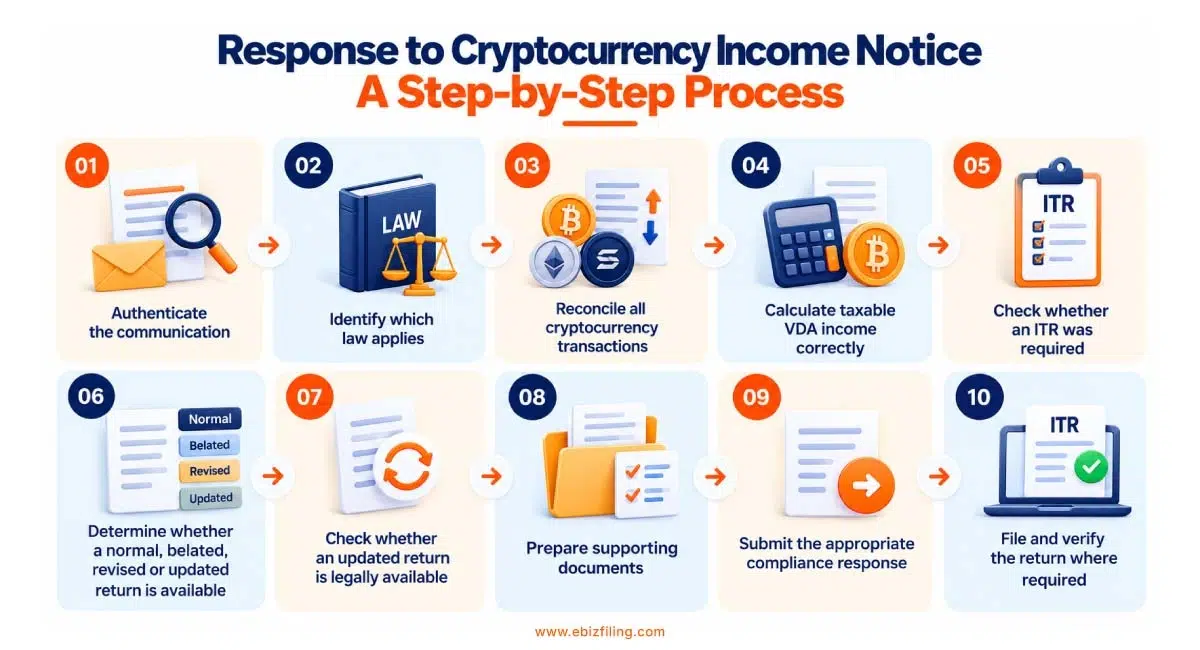
However, a high transaction value does not automatically mean that the entire amount is taxable income. The taxpayer must identify the relevant year, verify the reported transactions, calculate taxable VDA income correctly and determine whether an Income Tax Return or compliance response is required.
Summary
- A Non-Filer Compliance Notice for Cryptocurrency may arise when reported financial activity does not match the taxpayer’s return-filing status.
- Gross cryptocurrency transaction value is not automatically the same as taxable VDA income.
- Income from transfer of Virtual Digital Assets is generally taxable at 30%, subject to the applicable law and permitted cost of acquisition.
- Loss from one VDA transaction cannot generally be adjusted against positive income from another VDA transaction or carried forward.
- Taxpayers should reconcile AIS, TDS, exchange statements, wallet records and bank transactions before filing a response or return.
What Is a Non-Filer Compliance Notice for Cryptocurrency?
A Non-Filer Compliance Notice for Cryptocurrency generally refers to a compliance communication where information available with the Income Tax Department shows financial activity connected with a taxpayer who has not filed an Income Tax Return for the relevant period or whose filing status requires clarification.
The term should not be treated as the name of one specific statutory notice issued under a single section. The exact nature of the communication may differ depending on the taxpayer’s case, the relevant year and the information available with the Department.
Crypto-related information may reach the Department through tax deduction records, financial reporting systems, crypto-asset reporting requirements and other information linked with the taxpayer’s PAN.
Taxpayers should therefore review their Annual Information Statement and compare the information with their own financial records.
A Non-Filer Compliance Notice for Cryptocurrency is not, by itself, proof that the entire reported transaction amount is taxable. It is important to understand what the reported amount represents before calculating tax or submitting a response.
Why can cryptocurrency transactions attract compliance attention?
Crypto trading often involves frequent purchases, sales and exchanges. A taxpayer may repeatedly use the same pool of capital to complete several transactions during a year.
For example, assume a person initially invests ₹5 lakh and subsequently buys and sells different crypto assets several times. The total value of all sale transactions during the year may reach ₹30 lakh or ₹40 lakh even though the taxpayer never had that amount invested at one time.
This means the following figures can be very different:
|
Particular |
What it represents |
|
Amount invested |
Capital initially used for purchasing VDAs |
|
Gross transaction value |
Total value of purchases or sales during the period |
| Bank credits |
Amounts received in the taxpayer’s bank account |
|
Sale consideration |
Amount received on transfer of a particular VDA |
| Taxable VDA income |
Income calculated under the applicable VDA tax provisions |
A Non-Filer Compliance Notice for Cryptocurrency should therefore not be answered merely by comparing total bank credits with the taxpayer’s salary or other income.








November 16, 2026 By Srishti M
November 14, 2026 By Srishti M
The compliance calendar December 2026 covers important statutory obligations under GST, Income Tax, TDS/TCS, Company Law, LLP regulations, EPF and ESI. It helps businesses identify the filings, tax payments and regulatory requirements applicable during the month. Companies, LLPs, OPCs, employers and registered taxpayers should review the compliance calendar December 2026 based on their entity type, registration status, filing frequency and transaction profile. Timely compliance planning can help avoid late fees, interest, penalties and filing delays.
November 12, 2026 By Srishti M