


-
September 22, 2026
-
BySteffy A
Section 133 of the Income Tax Act, 2025: Donation Deduction
Introduction
Section 133 of the Income Tax Act, 2025 allows taxpayers to claim a deduction for monetary donations made to specified funds, charitable institutions, government bodies and approved organizations. The provision becomes applicable from Tax Year 2026-27, beginning on 1 April 2026. It replaces Section 80G of the Income Tax Act, 1961 for donations governed by the new Act.
Although the general deduction structure remains similar, Section 133 introduces new section references, approval provisions and reporting forms while continuing the reporting-based verification framework.
What Is Section 133 of the Income Tax Act, 2025?
Section 133 allows an assessee to reduce total income by the eligible amount of specified donations. Depending on the recipient and purpose, the deduction may be 100% or 50% of the eligible donation. Certain categories are also restricted to 10% of adjusted gross total income.
The deduction is available only for donations made as money. Donations made in the form of food, clothes, medicines, equipment, property or other goods do not qualify. A cash donation above ₹2,000 does not qualify for the Section 133 deduction.
Applicability of Section 133 of the Income Tax Act
The applicable provision depends on the period in which the donation is made.
|
Donation period |
Applicable provision |
|
Donations governed up to 31 March 2026 |
Section 80G of the Income Tax Act, 1961 |
| Donations made from 1 April 2026 |
Section 133 of the Income Tax Act, 2025 |
A taxpayer should not apply Section 133 of the Income Tax Act merely because the income tax return is filed after 1 April 2026. The date and tax year of the donation must first be identified.
Availability Under the Default Tax Regime
Individuals, HUFs, associations of persons, bodies of individuals and specified artificial juridical persons cannot claim the Section 133 deduction while computing income under the default tax regime provided under Section 202.
Such taxpayers may claim the deduction only if they validly opt out of the Section 202 regime, subject to the applicable conditions. The eligibility of companies and other taxpayers will depend on the tax regime under which their total income is computed.
Section 133 Deduction Rates and Qualifying Limits
Section 133 of the Income Tax Act continues the broad deduction structure available under the earlier law.
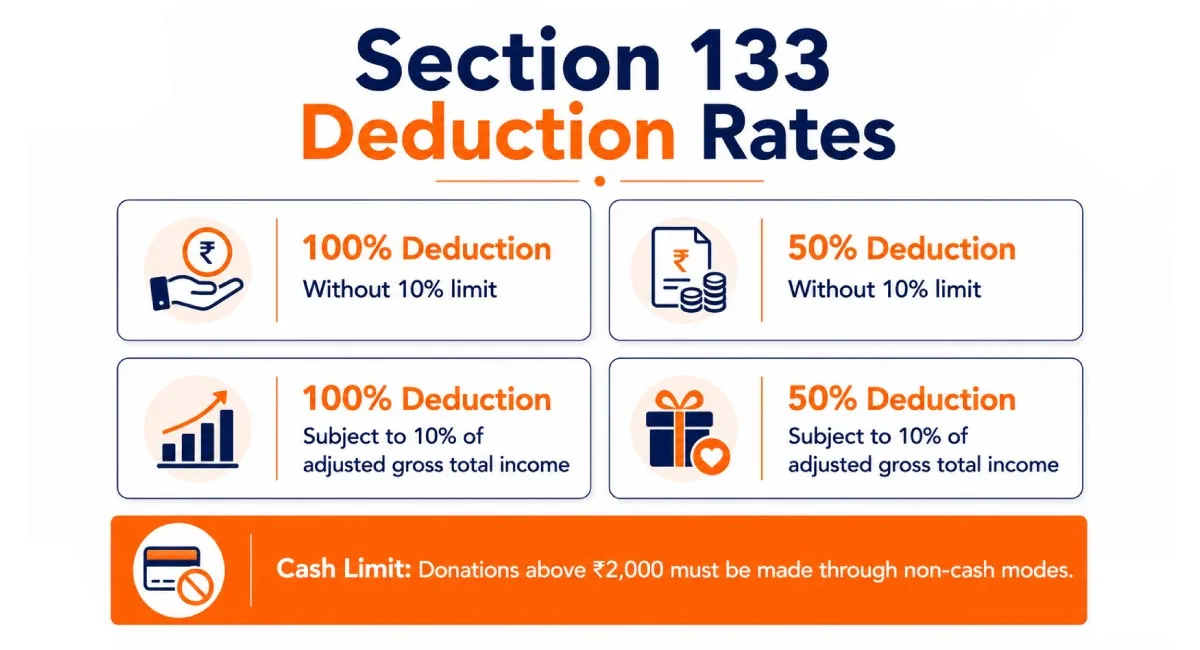
100% Deduction Without the 10% Limit
The entire eligible donation may be deducted where the contribution is made to specified funds, such as:
- National Defence Fund;
- Prime Minister’s National Relief Fund;
- PM CARES Fund;
- National Children’s Fund;
- National Foundation for Communal Harmony;
- National Sports Development Fund;
- National Cultural Fund;
- Swachh Bharat Kosh; and
Clean Ganga Fund, subject to prescribed conditions.
50% Deduction Without the 10% Limit
A donation made to the Prime Minister’s Drought Relief Fund qualifies for a deduction equal to 50% of the eligible amount without applying the 10% adjusted gross total income limit.
Meaning of Adjusted Gross Total Income
Adjusted gross total income means the taxpayer’s gross total income reduced by:
- Any portion of income on which income tax is not payable under the Income tax Act, 2025; and
- Deductions available under other provisions of Chapter VIII.
Where the qualifying limit applies, eligible donations are restricted to 10% of the adjusted gross total income.
100% Deduction Subject to the 10% Limit
This category includes specified donations made for:
- Promoting family planning; and
- Developing sports infrastructure or sponsoring sports in India by a company.
50% Deduction Subject to the 10% Limit
This category generally covers donations to:
- Approved charitable institutions;
- The Government or a local authority for charitable purposes;
- Specified housing and development authorities;
- Notified minority community corporations; and
- Notified places of worship having historic, archeological, artistic or recognized public importance.
Where the qualifying limit applies, the eligible donation is restricted to 10% of adjusted gross total income.
Special Conditions for Certain Donations
Certain funds and purposes carry additional restrictions under Section 133 of the Income Tax Act.
Clean Ganga Fund
A donation to the Clean Ganga Fund qualifies only when the donor is a resident taxpayer.
A contribution treated as Corporate Social Responsibility expenditure under the Companies Act, 2013 is not eligible for deduction under this category.
Swachh Bharat Kosh
A donation to the Swachh Bharat Kosh may qualify for a deduction. However, the amount is not eligible where it is incurred as part of the company’s mandatory CSR expenditure.
Sports-Related Donations
A donation to the Indian Olympic Association or another notified sports institution under the specified category is available only when the donor is a company.
Notified Places of Worship
A donation for the renovation or repair of a temple, mosque, Gurudwara, church or another place of worship qualifies only when the Central Government has notified the place for its historic, archaeological, artistic or public importance.
Approval of Institutions Under Section 354
A charitable institution covered under Section 133(1)(b)(ii) must hold a valid approval under Section 354 of the Income tax Act, 2025.
The institution must generally:
- Be established in India for a charitable purpose;
- Not be established for the benefit of a particular religious community or caste;
- Not incur expenditure of a religious nature exceeding 5% of its total income during the tax year;
- Maintain regular accounts of its receipts and expenditure;
- Ensure that its governing documents do not permit the use of assets for non-charitable purposes;
- File Form 113 and any required correction statement;
- Issue the prescribed donation certificate to the donor; and
- Comply with the other approval and reporting conditions.
The approval must be valid on the date of the donation. Donors should verify the institution’s legal name, PAN, approval number, and approval validity before claiming the deduction.
Eligible charitable entities may operate as trusts, societies, or Section 8 companies through Non-Profit Organization Registration.
Meaning of Charitable Purpose
For Section 133, a charitable purpose does not include a purpose that is wholly or substantially religious.
However, the law separately permits eligible donations for the renovation or repair of notified places of worship. Therefore, donations to religious institutions do not automatically qualify unless they fall within a specifically permitted category.
Payment Conditions Under Section 133
The following payment conditions must be satisfied:
Donation Must Be Monetary
Only donations made as a sum of money are eligible.
Donations made in the form of:
- Food;
- Clothes;
- Medicines;
- Equipment;
- Land;
- Property; or
- Other goods
- Do not qualify for deduction.
- Cash Donation Limit
A donation exceeding ₹2,000 is eligible only when it is made through a mode other than cash.
Permitted non-cash modes may include:
- Cheque;
- Demand draft;
- Bank transfer;
- UPI;
- Debit or credit card; and
- Other prescribed electronic modes.
Reporting Through Forms 113 and 114
Registered non-profit organizations and persons referred to in Schedule VII (Table: Sl. No. 1) that are covered under Section 133(1)(b)(ii) and approved under Section 354 must report eligible donations through Form 113.
|
Reporting requirement |
Income Tax Act, 1961 |
Income Tax Act, 2025 |
|
Donation statement filed by institution |
Form 10BD |
Form 113 |
|
Donation certificate issued to donor |
Form 10BE |
Form 114 |
The reporting organization must furnish the donor’s identification details, donation amount, payment mode and other prescribed particulars in Form 113.
After filing Form 113, the organization must download and issue Form 114 to the donor. Form 114 is generally generated after Form 113 has been successfully filed and processed. Where the prescribed pre-acknowledgement facility is used, the related donation details must subsequently be reported correctly in Form 113. The taxpayer’s deduction claim should match the information reported by the organization.
Form 113 must be furnished electronically before 31 May immediately following the end of the relevant tax year. Form 114 must be issued within the prescribed time.
Risk-Based Verification of Donation Claims
A deduction for a donation made to an institution or fund covered under Section 133(1)(b)(ii) will be allowed only on the basis of the donation information furnished by that institution or fund.
The claim will also be subject to verification under the risk management strategy formulated by the Central Board of Direct Taxes.
The verification process may compare:
- Donor PAN or other identification details;
- Recipient PAN;
- Donation amount;
- Payment date;
- Payment mode;
- Tax year;
- Approval status; and
- Information reported by the institution.
A mismatch may result in the deduction being questioned, delayed, or disallowed.
Section 80G vs Section 133
|
Basis |
Section 80G of the Income Tax Act, 1961 |
Section 133 of the Income Tax Act, 2025 |
|
Applicability |
Donations governed under the old Act | Donations from Tax Year 2026-27 onwards |
| Time reference | Previous year and assessment year |
Tax year |
|
Approval provision |
Section 80G(5) | Section 354 |
| Deduction rates | 50% or 100% |
50% or 100% |
|
Qualifying limit |
10% for specified donations | 10% for specified donations |
| Cash donation limit | ₹2,000 |
₹2,000 |
|
Donation statement |
Form 10BD | Form 113 |
| Donation certificate | Form 10BE |
Form 114 |
|
Donations in kind |
Not eligible | Not eligible |
| Claim verification | Reporting through Form 10BD and Form 10BE, subject to risk-based verification |
Reporting through Form 113 and Form 114, subject to risk-based verification |
|
Double deduction |
Not permitted | Expressly restricted |
| CSR restriction | Applicable to specified contributions |
Continues for specified funds |
The major change is therefore not in the basic percentage of deduction. The practical change lies in the new section references, approval under Section 354, Forms 113 and 114 and the reporting-based verification system.
Restriction on Double Deduction
A donation claimed and allowed under Section 133 cannot be claimed under another provision for the same or any other tax year.
The total deductions permitted under the relevant Chapter also cannot exceed the taxpayer’s gross total income. Where an association of persons or body of individuals claims the deduction, its members cannot separately claim the same amount against their share of income.
Ebizfiling Support for Section 133 Donation Compliance
Ebizfiling can assist taxpayers and charitable institutions with compliance under Section 133 of the Income Tax Act, 2025.
Our experts can help with:
- Checking the institution’s approval status;
- Reviewing Form 113 and Form 114 details;
- Identifying donation reporting mismatches; and
- Determining the correct deduction category.
Get expert assistance with donation reporting, deduction claims, and income tax return filing under Section 133 of the Income Tax Act, 2025.
Conclusion
Section 133 of the Income Tax Act, 2025 continues the tax deduction available for donations to specified funds and charitable institutions from 1 April 2026. While the 50% and 100% deduction categories broadly continue, taxpayers must pay attention to the new approval provision under Section 354, Forms 113 and 114, the ₹2,000 cash limit and the reporting-based verification process. Before claiming a deduction, the donor should verify the recipient’s eligibility and ensure that the donation receipt, payment proof and prescribed certificate contain consistent information.
Suggested Reads:
Difference between 12A and 80G of Income Tax Act
Benefits of NGO Donation Tax Exemption under Section 12A and 80G
Donation Eligibility under section 80G
80G Donation Limit for Salaried Persons
Difference between Form 10BD and Section 80G
Frequently Asked Questions
1. Which section applies to donations made before 1 April 2026?
Donations made up to 31 March 2026 are generally governed by Section 80G of the Income Tax Act, 1961. Section 133 of the Income Tax Act applies to donations made from Tax Year 2026-27 beginning on 1 April 2026.
2. Will an existing Section 80G approval remain valid after 1 April 2026?
Yes. An approval granted under Section 80G of the Income tax Act, 1961 remains valid for its approved period and is protected under the transition provisions of the Income tax Act, 2025. Donors should verify that the approval was valid on the date of the donation.
3. What happens to an approval application pending on 31 March 2026?
The treatment of a pending approval application depends on the relevant transition provisions, the period for which approval is requested and applicable CBDT directions. The institution should check the status of the application and any communication issued by the Income Tax Department instead of assuming that approval has automatically continued under Section 354.
4. Can Form 114 be issued before Form 113 is filed?
Form 114 is generally generated after Form 113 has been successfully filed and processed. Where the prescribed pre-acknowledgement process is available, the donee must ensure that the related donation is subsequently reported correctly in Form 113.
5. Can incorrect details in Form 113 be corrected?
Yes. The institution may file a revised Form 113 to change or delete incorrect donor and donation details, such as the donor’s name, identification number, donation amount or payment mode. The correction statement should correctly refer to the original reported entry and the applicable acknowledgement or pre-acknowledgement details.
6. Is a donation receipt sufficient to claim the deduction?
A donation receipt supports the payment, but it may not be sufficient for donations covered by institutional reporting requirements. The donation deduction under Section 133 of the Income Tax Act should also match the information furnished by the institution through Form 113.
7. What happens if an online donation is reported as a cash donation?
The donor should request the institution to file a revised Form 113 and correct the payment mode. The deduction should be claimed only after the reported donation details match the actual online payment records and supporting documents.
8. Can an old Section 80G approval number appear in Form 114?
An earlier Section 80G approval number may appear where the approval continues under the transition provisions. The donor should verify that the approval remained valid when the donation was made and that the institution was eligible to issue the certificate.
9. How can Ebizfiling help with a donation reporting mismatch?
Ebizfiling can review Form 114, the donation receipt, payment proof and approval details to identify the mismatch. Our experts can also guide taxpayers on the required correction. You may also read about Reply to Various Income Tax Notices for further guidance.
10. How can Ebizfiling assist charitable institutions under Section 133?
Ebizfiling can help charitable institutions review their approval status, maintain donor records and understand Form 113 and Form 114 reporting requirements. This helps reduce errors that may affect taxpayers claiming eligible donations under Section 133 of the Income Tax Act.




Optimize Your Tax Savings
Simplify tax compliance with trusted consultancy services for donations, deductions, and tax planning.
About Ebizfiling -



October 2, 2026 By Siddhi R
September 30, 2026 By Srishti M
September 30, 2026 By Srishti M
GST Appeal Against NIL Demand Now Allowed on GST Portal Introduction The Goods and Services Tax Network (GSTN) has introduced a portal-level update allowing eligible taxpayers to file appeals against GST demand orders where the demand amount is reflected as […]