


-
September 19, 2026
-
BySiddhi R
80G Donation Limit for Salaried Persons: Rules and Benefits
Introduction
The 80G donation limit for salaried persons is important to understand when planning charitable donations for tax benefits. Under the Income-tax Act, 1961, Section 80G allowed eligible taxpayers to claim deductions on donations made to specified funds and approved charitable organizations. From Tax Year 2026-27, eligible charitable donation deductions are governed by Section 133 of the Income-tax Act, 2025. However, the term ‘80G deduction’ continues to be widely used because Section 80G applied under the Income-tax Act, 1961.
For salaried individuals, the 80G donation limit for salaried persons depends on the type of donation, applicable deduction rate, qualifying limit, and tax regime selected. This article explains the deduction rates, 10% AGTI limit, payment restrictions, eligibility conditions, and claim process.
Quick Insights
- The 80G donation limit for salaried persons depends on the type of donation, deduction rate, and applicable qualifying limit.
- Eligible donations may qualify for a 100% or 50% deduction, either with or without a qualifying limit.
- Certain donations are restricted to 10% of Adjusted Gross Total Income (AGTI) for deduction purposes.
- Cash donations above ₹2,000 are not eligible for deduction and should be made through non-cash modes.
- Salaried taxpayers should verify the recipient’s eligibility, keep proper donation records, and check the applicable tax regime before claiming the deduction.
80G donation limit for salaried persons
Is There a Fixed Limit on Donation Amount?
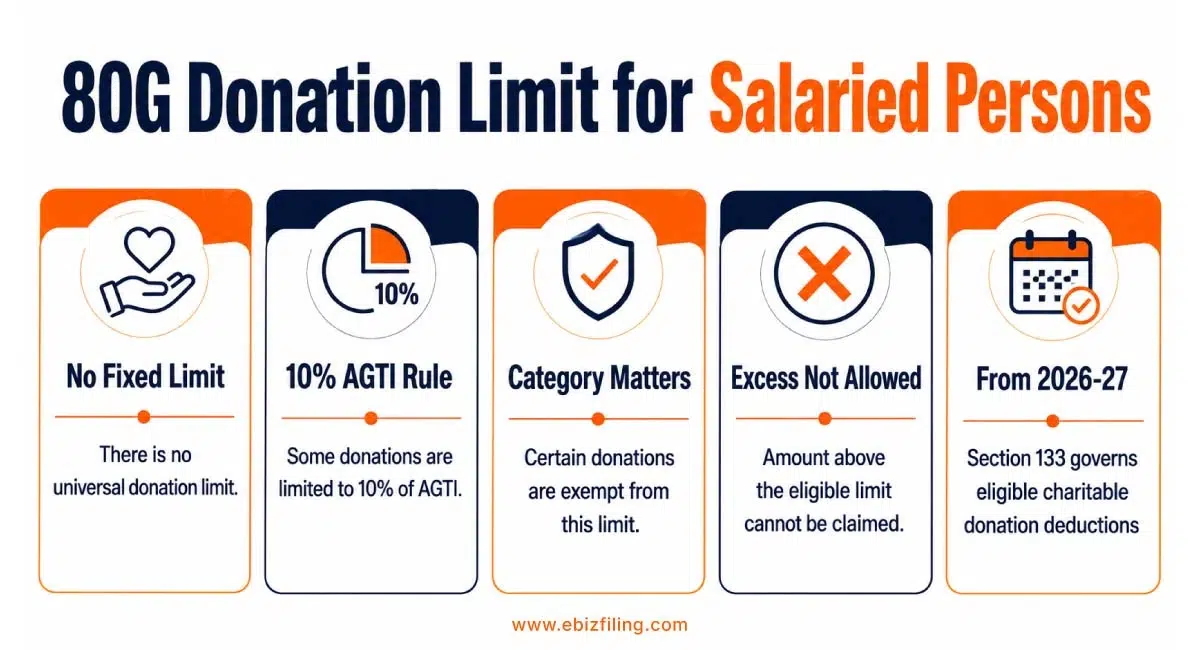
There is no absolute fixed monetary limit on how much a salaried individual can donate. However, the amount that qualifies for deduction may be subject to a ceiling depending on the category of donation.
The 80G donation limit for salaried persons is therefore not one universal rupee amount. Some eligible donations are deductible without any qualifying limit, while others are subject to a limit based on the taxpayer’s Adjusted Gross Total Income.
Understanding the 10% Limit
The 10% limit does not apply to every donation eligible for a 50% or 100% deduction. It applies only to specified categories of donations that are subject to a qualifying limit.
For such donations, the qualifying amount is restricted to 10% of the taxpayer’s Adjusted Gross Total Income, or AGTI. This distinction is important when calculating the 80G donation limit for salaried persons because applying the 10% limit to all donations would result in an incorrect deduction.
For donations subject to the qualifying limit, the eligible amount is restricted to 10% of Adjusted Gross Total Income (AGTI). The applicable AGTI should be calculated according to the provisions governing the relevant tax year.
For example, if your AGTI is ₹10,00,000, the maximum amount considered for donations that are subject to the 10% qualifying limit will be ₹1,00,000.
What if You Donate More Than the Limit?
If a donation falls under a category that is subject to the 10% AGTI limit and the eligible donation exceeds that limit, the excess amount does not qualify for deduction for that year.
For example, if the applicable qualifying limit is ₹1,00,000 and you donate ₹1,20,000 to an institution falling under a limited category, only ₹1,00,000 will be considered for calculating the deduction. The excess amount cannot be carried forward for deduction in a future year.
Important Update: Section 80G governed eligible charitable donation deductions under the Income-tax Act, 1961. From Tax Year 2026-27, eligible charitable donation deductions are governed by Section 133 of the Income-tax Act, 2025. However, the term “80G deduction” continues to be commonly used, particularly when referring to deductions relating to earlier tax years.
Types of Donations and Their Deduction Rates
Not all donations qualify for the same deduction rate. Understanding these categories is essential for correctly calculating the 80G donation limit for a salaried person.
100% Deduction Without Any Qualifying Limit
Certain specified donations receive a 100% deduction without being subject to the 10% AGTI limit. Examples include:
Prime Minister’s National Relief Fund
National Defence Fund
PM CARES Fund
In these cases, the 80G donation limit for salaried persons is not restricted by the 10% AGTI qualifying limit, provided the donation satisfies all other applicable conditions.
50% Deduction Without Any Qualifying Limit
Certain specified donations qualify for a 50% deduction without being subject to the 10% AGTI limit. For example, donations to the Prime Minister’s Drought Relief Fund fall under this category, subject to the applicable provisions and conditions.
100% Deduction Subject to 10% of AGTI
Certain donations qualify for a 100% deduction but remain subject to the qualifying limit of 10% of AGTI. Donations made to the Government or approved institutions for promoting family planning are examples of donations that may fall under this category, subject to the applicable provisions.
50% Deduction Subject to 10% of AGTI
Many donations to approved charitable trusts, institutions, or funds fall under this category. In such cases, the qualifying donation amount is first restricted to the applicable 10% AGTI limit, and 50% of that qualifying amount is allowed as a deduction.
This category is especially relevant while calculating the 80G donation limit for salaried persons because the taxpayer must first apply the qualifying limit and then calculate the applicable deduction percentage.
Donations made in cash above ₹2,000 are not eligible for deduction. Donations made to organizations that are not specified or approved under the applicable provisions also do not qualify.
How Does a Salaried Person Claim 80G Deduction?
Before filing the return, the 80G donation limit for salaried persons should be calculated using the correct donation category and applicable qualifying limit.
A salaried taxpayer should not look only at the 80G donation limit for salaried persons. The eligibility of the recipient, payment mode, supporting documents, and tax regime must also be checked before making a claim.
Process:
- Verify the NGO’s eligibility: Ensure that the organization has a valid approval or registration for receiving donations eligible for deduction during the relevant year.
- Keep Proof of Donation: Obtain a donation receipt containing relevant details such as the donor’s name, donation amount, date, PAN of the institution, and registration details.
- Obtain the Donation Certificate: For eligible donations covered under the Income-tax Act, 2025, organizations subject to the applicable reporting requirements file the Statement of Donations in Form 113 and issue the donor a Certificate of Donation in Form 114.
- Mode of Donation: Donations exceeding ₹2,000 should be made through a non-cash mode such as cheque, demand draft, bank transfer, or digital payment.
- Claim Deduction in Income Tax Return: Report the eligible donation and required details in the appropriate donation deduction schedule while filing the income tax return.
- Keep Supporting Documents: Donation receipts, Form 114 for donations governed by the Income-tax Act, 2025, Form 10BE for earlier applicable periods, and payment records should be retained for verification if required.
To complete the registration process, applicants should keep the documents required for Section 12A and Section 80G Registration ready, as proper documentation helps establish the organization’s identity, activities, financial details, and eligibility for tax registration and donation approval.
Impact of 80G Deduction on Taxable Income
Where the deduction is available under the taxpayer’s chosen tax regime, claiming an eligible donation deduction reduces taxable income and may reduce the overall tax liability.
For example, if you donate ₹50,000 to an eligible institution that qualifies for a 50% deduction and the donation is within the applicable qualifying limit, the deduction will be ₹25,000. This example also shows why the 80G donation limit for salaried persons must be checked before calculating the actual amount deductible from taxable income.
Professional Assistance for NGO Tax Registration and Donation Approval
For NGOs, charitable trusts, societies, and other eligible non-profit organizations, obtaining the applicable tax registration and donation approval is important for accessing available tax benefits and enabling eligible donors to claim deductions. Under the Income-tax Act, 2025, the registration and approval framework for non-profit organizations is covered under Sections 332 and 354. Ebizfiling assists organizations with applicable registration, approval, documentation, and filing requirements.
- Registration Guidance: Get professional guidance on the applicable tax registration and donation approval requirements for charitable and non-profit organizations, including provisions commonly referred to as 12A/12AB and 80G.
- Document Support: Receive assistance in preparing and organizing the documents required for the registration application.
- Application Filing: Ebizfiling assists with preparing and filing the registration application through the Income Tax portal.
- Compliance Assistance: Get support with application-related requirements, status updates, and queries raised during the registration process.
Need assistance with charitable tax registration or donation approval, commonly referred to as 12A/12AB and 80G? Connect with Ebizfiling for professional support with documentation, application filing, and registration-related compliance.
Conclusion
The 80G donation limit for salaried persons depends on the category of donation, applicable deduction rate, qualifying limit, and the tax regime selected by the taxpayer. While Section 80G applied to eligible charitable donations under the Income-tax Act, 1961, the corresponding deduction from Tax Year 2026-27 is governed by Section 133 of the Income-tax Act, 2025. Some eligible donations qualify for a 100% or 50% deduction without any qualifying limit, while others are subject to the 10% Adjusted Gross Total Income limit.
Salaried taxpayers should also ensure that donations above ₹2,000 are made through non-cash modes and that proper supporting documents are maintained. Understanding these rules can help taxpayers determine the applicable deduction and claim eligible tax benefits correctly.
Frequently Asked Questions
1. Does the 10% AGTI limit apply to every 80G donation made by a salaried person?
No. The 80G donation limit for salaried persons based on 10% of Adjusted Gross Total Income applies only to donation categories that are specifically subject to the qualifying limit. Certain specified donations qualify for a 100% or 50% deduction without this 10% restriction.
2. If my AGTI is ₹10 lakh and I donate ₹1.20 lakh, how much deduction can I claim?
It depends on the donation category. If the donation qualifies for a 50% deduction subject to the 10% AGTI limit, only ₹1 lakh, which is 10% of ₹10 lakh, will be considered. The allowable deduction would therefore be ₹50,000. This calculation is important when determining the 80G deduction limit for salaried taxpayers.
3. Can a salaried employee claim an 80G deduction under the new tax regime?
No. Under the earlier Income-tax Act, 1961 framework, Section 80G deduction was not available to taxpayers opting for the new tax regime. Under the Income-tax Act, 2025, Section 133 contains the corresponding donation deduction, while Section 202 generally excludes Chapter VIII deductions under the new tax regime except for specifically permitted provisions. Section 133 is not among those exceptions.
4. Is a cash donation of exactly ₹2,000 eligible for an 80G deduction?
Yes, subject to all other eligibility conditions. The 80G cash donation limit provides that a donation exceeding ₹2,000 will qualify only if it is made through a mode other than cash. Therefore, a cash donation of ₹2,000 may qualify, but a cash donation of ₹2,001 would not qualify for the deduction.
5. Can I claim an 80G deduction if I donate clothes, food, medicines, or other goods to an NGO?
No. The deduction is available only for donations made as a sum of money. Donations made in kind, such as clothes, food, medicines, books, or other goods, do not qualify as 80G eligible donations, even if they are given to an eligible charitable organization.
6. What happens if I donate to an NGO whose 80G approval has expired?
The donor should verify that the organization was eligible and approved during the relevant period in which the donation was made. A donation made after the cancellation or expiry of the recipient’s applicable 80G approval may not qualify for deduction. Therefore, checking the organization’s current eligibility is important before calculating the Section 80G donation limit.
7. What if the donation details in my donation certificate are incorrect?
The taxpayer should contact the charitable organization and request correction of the donation details. Under the Income-tax Act, 2025 framework, eligible organizations report applicable donations through Form 113 and issue the Certificate of Donation in Form 114. The details claimed by the donor should correspond with the information reported by the recipient organization.
8. Can the amount exceeding the 10% AGTI limit be carried forward to the next year?
No. If a donation is subject to the 10% qualifying limit, the amount exceeding that limit is ignored while calculating the deduction. The excess cannot be carried forward and claimed as part of the Section 80G deduction for salaried employees in a later year.
9. Does a 50% deduction mean that I can always deduct half of my total donation?
Not necessarily. If the donation falls under the 50% deduction without qualifying limit category, 50% of the eligible donation may be deductible. However, if it falls under the 50% deduction subject to the 10% AGTI limit category, the qualifying limit must first be applied and only 50% of the resulting eligible amount can be deducted. This distinction directly affects the 80G donation limit for salaried persons.
10. Can the same charitable donation be claimed as a deduction under more than one tax provision?
No. Once a deduction is allowed for an eligible donation under the applicable donation provision, the same amount cannot also be claimed as a deduction under another provision for the same or another tax year. This prevents taxpayers from claiming more than one deduction for the same contribution.





80G Registration
Register for 80G of income tax act in simple steps with Ebizfiling
About Ebizfiling -



September 7, 2026 By Steffy A
Health Insurance Deduction Under Section 126: Rules & Limits Introduction Health insurance protects families from rising medical costs and can also provide a tax benefit when the legal conditions are satisfied. Section 126 of the Income Tax Act, 2025 provides […]
August 29, 2026 By Steffy A
OPC Compliance Calendar September 2026: Key Due Dates Introduction The OPC Compliance Calendar September 2026 lists the major tax, GST, labour law, and ROC obligations that One Person Companies may need to complete during the month. September includes important compliances […]
August 29, 2026 By Steffy A
TDS and TCS Compliance Calendar September 2026: Key Deadlines Introduction The TDS and TCS Compliance Calendar September 2026 helps deductors, collectors, government offices, property buyers and eligible individuals or HUFs identify the forms applicable to them. Reviewing these requirements in […]