


-
August 21, 2026
-
BySteffy A
Benefits of NGO Donation Tax Exemption under Section 12A and 80G
Introduction
NGO Donation Tax Exemption provides important tax benefits to eligible charitable organizations and their donors in India. NGOs, charitable trusts, registered societies, and Section 8 companies often depend on donations to carry out activities related to education, healthcare, poverty relief, environmental protection, and other social causes.
Under the Income-tax Act, 1961, Sections 12A, 12AB, and 80G were commonly associated with NGO tax benefits. Section 12A registration allowed eligible organizations to claim tax exemptions on qualifying income, while Section 80G registration enabled eligible donors to claim deductions on qualifying donations.
The Income-tax Act, 2025 introduces changes to the framework applicable to charitable organizations and donation deductions. NGOs should refer to the provisions applicable for the relevant assessment year and transition requirements.
Important 2026 Update on Sections 12A and 80G
The Income-tax Act, 2025, applies from 1 April 2026. Under the current framework, registration of eligible non-profit organizations is primarily governed by Section 332. Deduction for eligible charitable donations is provided under Section 133, while Section 354 deals with the approval of eligible organizations for certain donor deductions.
Therefore, the terms Section 12A, 12AB, and 80G continue to be important when discussing earlier tax years, transitional matters, and commonly understood NGO tax terminology.
For NGOs seeking NGO Donation Tax Exemption, it is important to follow the provisions applicable to the relevant tax year rather than relying only on the older terminology.
What is Section 12A?
Under the Income-tax Act, 1961, Section 12A and Section 12AB provided the registration framework for eligible charitable or religious trusts and institutions seeking tax exemption under Sections 11 and 12. Organizations should refer to the applicable provisions and transitional rules for the relevant tax year.
Registration did not automatically make all income of an NGO tax-free. The organization was required to satisfy applicable conditions relating to its charitable objects, activities, use of income, accounts, returns, and other compliance requirements.
Who is Eligible for Section 12A Registration?
Under the earlier tax framework, organizations seeking charitable tax exemptions generally included:
- Public charitable trusts
- Registered societies
- Section 8 companies
- Charitable institutions
- Eligible religious or charitable trusts
For registration and continued tax benefits, the organization generally had to carry out genuine activities in accordance with its stated charitable or religious objects. Proper books and financial records were also required, along with returns and audits wherever applicable.
Income or property of the organization should not be improperly used for private benefit. Organizations were also expected to report specified changes in their objects and comply with other prescribed requirements.
Under Section 332 of the Income-tax Act, 2025, public trusts, registered societies, Section 8 companies, and certain other eligible entities can apply for registration as registered non-profit organizations, subject to the prescribed conditions.
Benefits of Section 12A for NGOs
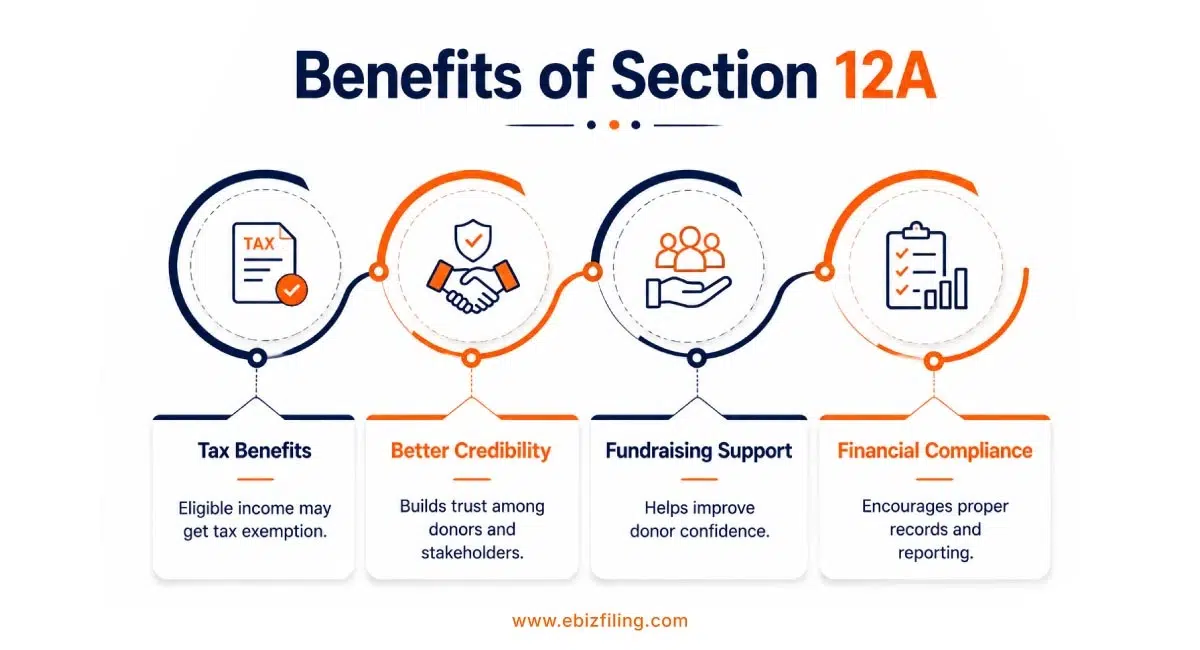
1. Tax Benefits
The primary advantage of the earlier Section 12A framework was the ability of eligible charitable organizations to claim exemption on qualifying income, subject to compliance with the law.
This tax treatment can help NGO’s direct more eligible resources towards their charitable activities.
2. Better Credibility
Proper tax registration shows that an organization has followed the prescribed income-tax registration process. It can improve confidence among donors, institutions, and other stakeholders.
However, tax registration itself is not proof of the legal existence of an NGO. The relevant trust deed, society registration certificate, Section 8 incorporation certificate, or similar constitutional document establishes its legal status.
3. Fundraising Support
A properly registered and compliant organization may be better positioned when approaching donors and funding institutions. NGO Donation Tax Exemption can therefore support an NGO’s overall fundraising efforts.
Tax registration, however, does not guarantee government grants or private funding.
4. Better Financial Compliance
Maintaining registration requires NGOs to pay close attention to financial records, application of income, returns, reporting requirements, and other applicable compliance obligations.
What is Section 80G?
Section 80G of the Income-tax Act, 1961 provided tax deductions to eligible taxpayers who made qualifying donations to approved charitable organizations and specified funds.
This benefit was primarily for the donor rather than the NGO. The NGO’s own tax exemption and the donor’s deduction were separate tax benefits.
Under the Income-tax Act, 2025, Section 133 provides deductions for qualifying donations, while Section 354 governs approval of eligible registered non-profit organizations for specified donations under Section 133.
This distinction is important when understanding NGO Donation Tax Exemption.
Who is Eligible for Section 80G Approval?
Under the earlier framework, organizations seeking 80G approval commonly included charitable trusts, registered societies, Section 8 companies, and other eligible charitable institutions.
Under the current framework, a registered non-profit organization may apply for approval under Section 354 for the purpose of Section 133(1)(b)(ii). Among other requirements, the organization must be established in India for charitable purposes, maintain regular accounts of receipts and expenditure, satisfy restrictions relating to religious benefits and expenditure, and comply with prescribed reporting requirements.
Therefore, organizations seeking benefits connected with NGO Donation Tax Exemption must continue maintaining proper accounts and meeting the conditions attached to their registration and approval.
Benefits of Section 80G for NGOs
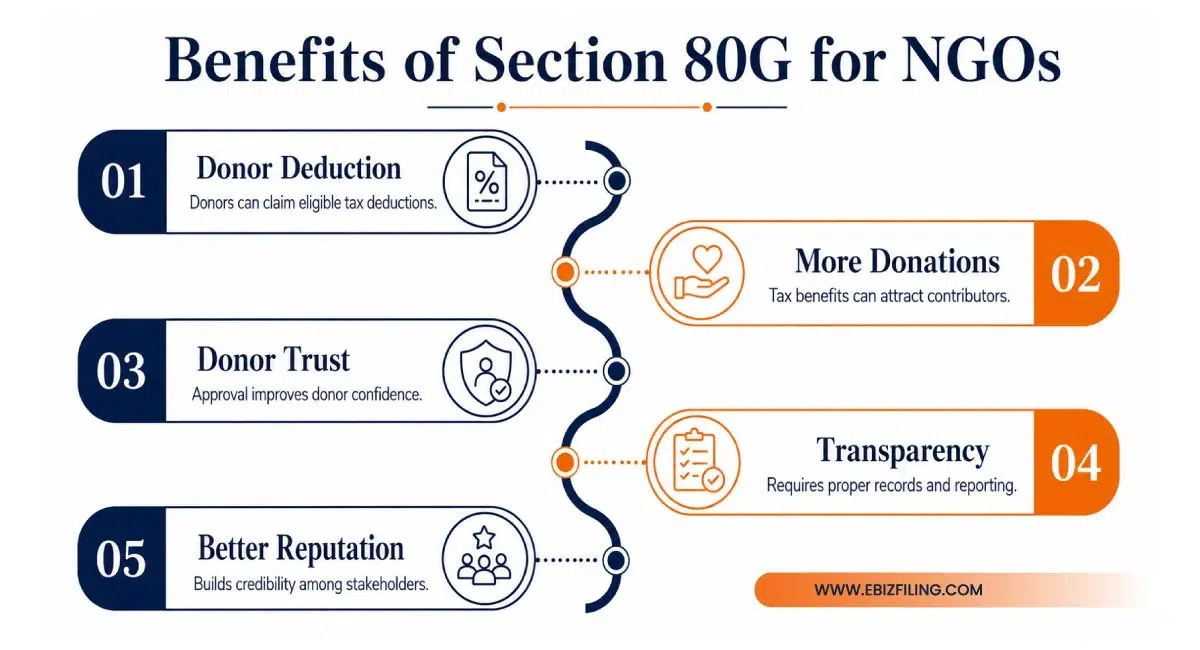
1. Deduction for Donors
The biggest benefit is that eligible donors can claim a deduction for qualifying monetary donations, subject to the applicable percentage, limits, and conditions.
Under Section 133 of the current Act, different categories of donations receive different deduction treatment. Certain donations can also be subject to a qualifying limit linked to adjusted gross total income.
2. Attract More Donors
A tax deduction gives eligible taxpayers an additional financial reason to contribute to charitable causes. This can help an approved NGO strengthen its fundraising efforts.
3. Donor Confidence
Approval under the applicable tax provisions can increase confidence that the NGO follows prescribed financial and reporting requirements. This can help build stronger relationships with existing and potential donors.
4. Transparency and Accountability
Approved organizations must maintain proper accounts and comply with specified reporting requirements. This creates better financial transparency and supports responsible management of donations.
5. Stronger Reputation
Compliance with applicable tax requirements can strengthen an NGO’s reputation among donors, institutions, and the public. However, approval does not guarantee grants or donations.
These benefits make NGO Donation Tax Exemption valuable not only from a tax perspective but also for building long-term donor relationships.
Important Points Donors Should Know
Not every donation automatically qualifies for a tax deduction.
Under Section 133 of the Income-tax Act, 2025, the deduction is available only for donations made as a sum of money. Donations exceeding ₹2,000 must be made through a mode other than cash to qualify. Certain donations are also subject to a limit of 10% of adjusted gross total income.
Donors should therefore verify the approval status of the recipient organization and understand the applicable deduction before claiming NGO Donation Tax Exemption benefits.
Professional NGO Tax Compliance Support
Ebizfiling provides professional assistance to NGOs, charitable trusts, societies, and Section 8 companies with tax registration and compliance requirements. Our experts help organizations understand the applicable provisions, prepare the required documents, and complete the registration process correctly.
For organizations seeking NGO Donation Tax Exemption, Ebizfiling can assist with:
- 12A/12AB Registration: Assistance with registration requirements for eligible charitable organizations seeking applicable income-tax benefits.
- 80G Registration: Support for NGOs seeking approval that enables eligible donors to claim deductions on qualifying donations.
- Document Preparation: Guidance in preparing and reviewing the documents required for registration and approval.
- Compliance Support: Assistance in understanding ongoing filing, reporting, and record-maintenance requirements.
With Ebizfiling, NGOs can get professional support for their tax registration and compliance needs while focusing on their charitable activities.
Conclusion
NGO Donation Tax Exemption benefits both eligible charitable organizations and donors by supporting charitable activities while providing tax benefits under prescribed conditions.
Sections 12A, 12AB, and 80G were important provisions under the Income-tax Act, 1961. From 1 April 2026, the corresponding framework is primarily covered through Sections 332, 133, and 354 of the Income-tax Act, 2025.
NGOs should maintain proper registration, records, and compliance, while donors should confirm the eligibility of their donations before claiming deductions.
Understanding these requirements can help both organizations and donors receive the intended benefits of NGO Donation Tax Exemption while remaining compliant with the applicable tax law.
Frequently Asked Questions
1. Can a newly formed NGO claim NGO tax exemption in India immediately after registration?
No. Simply registering an NGO as a trust, society, or Section 8 company does not automatically provide NGO tax exemption in India. To claim NGO Donation Tax Exemption, the organization must obtain the applicable income-tax registration or approval and continue meeting the prescribed conditions.
2. What records should donors keep when claiming an 80G deduction for donors?
For claiming an 80G deduction for donors, taxpayers should maintain proper proof of the donation and relevant details of the recipient organization. They should also confirm that the organization holds the required approval for the relevant tax year before claiming a deduction in their income-tax return.
3. Is charitable trust tax exemption the same as an 80G benefit?
No. Charitable trust tax exemption relates to the tax treatment available to an eligible charitable organization on its qualifying income. An 80G-related benefit applies to eligible donors making qualifying donations. Both are different aspects of NGO Donation Tax Exemption and have separate requirements.
4. What happens to an NGO's earlier 12AB registration after the 2026 tax law changes?
Existing 12AB registrations should be reviewed according to the transitional provisions and applicable requirements notified for the relevant tax year. NGOs should verify the validity of their existing registration and understand any new compliance obligations applicable to their organization. NGOs should verify the applicable transitional provisions and notifications to understand how existing approvals will be treated under the updated framework.
5. Is tax exemption for NGO donations available when goods are donated instead of money?
A donor should not assume that tax exemption for NGO donations applies to donations made in goods, materials, or other items. Under the current charitable donation deduction framework discussed above, the qualifying deduction applies to donations made as a sum of money, subject to the prescribed conditions.
6. Can a donor claim an NGO donation deduction without checking the NGO's approval?
No. A donor should verify the recipient organization’s applicable approval before claiming an NGO donation deduction. Checking the approval status is important when determining whether NGO Donation Tax Exemption benefits are available for a particular donation.
7. Does changing an NGO's charitable objects affect its tax registration?
It can affect compliance requirements. Registered organizations are expected to carry out activities according to their stated charitable or religious objects and report specified changes where required. NGOs should therefore review the applicable registration requirements before making substantial changes to their objects or activities.
8. Can an NGO lose NGO Donation Tax Exemption benefits after obtaining registration?
Yes. Registration alone does not guarantee permanent NGO Donation Tax Exemption benefits. An organization must continue complying with applicable conditions relating to its activities, use of income, financial records, returns, reporting, and other requirements for the relevant tax year.
9. Can Ebizfiling help an NGO understand which tax registration applies after the 2026 changes?
Yes. Ebizfiling can assist NGOs in understanding the registration and compliance requirements applicable to their circumstances, including earlier Section 12A or 12AB terminology and the corresponding provisions under the Income-tax Act, 2025. Professional assistance can also help reduce errors while preparing the required application and documents.
10. Can Ebizfiling assist with Section 80G registration and related NGO compliance?
Yes. Ebizfiling can provide professional assistance with Section 80G-related registration requirements, documentation, and applicable NGO tax compliance. Since the tax framework changed from 1 April 2026, organizations should ensure that their application follows the provisions applicable to the relevant tax year.





Section 12A Registration
Get the benefits of Income Tax exemption under Section 12A of the Income Tax Act by registering your Trust or Organisation under Section 12AB of Income Tax Act with Ebizfiling.com at just INR 3,999/- only.
About Ebizfiling -



Reviews
Abhijit Chirde
04 Mar 2024Ebizfilling team explained every details and supported in compliance fillings. Mr. Rakesh B has been very helpful in getting things done swiftly and efficiently.
Aditi Doshi
29 Mar 2018They manage Accounting and Book-keeping for my company. I must say the team is really doing a good job.
Ajit Gopal Pandit
20 Feb 2018Very efficient service to get yourself registered with your Business. Had a very good experience.
October 15, 2026 By Srishti M
TDS and TCS Compliance Calendar November 2026: Compliance Guide Introduction The TDS and TCS Compliance Calendar November 2026 covers important tax deduction, collection, payment, certificate and reporting requirements applicable during the month. It helps businesses, government offices and other responsible […]
October 14, 2026 By Srishti M
GST Compliance Calendar November 2026: Key Due Dates & Filings Introduction The GST Compliance Calendar November 2026 highlights the major GST return filing, tax payment, invoice reporting and year-end adjustment deadlines applicable during the month. It covers regular taxpayers, QRMP […]
October 13, 2026 By Srishti M