


-
August 10, 2026
-
BySteffy A
TDS Return Form 26Q: Due Dates, Filing Process and Penalty
Introduction
TDS Return Form 26Q is a quarterly statement used to report tax deducted from non-salary payments made to resident persons. When a person makes certain specified payments, Tax Deducted at Source (TDS) must be deducted before the payment is made or credited to the recipient.
Under the Income-tax Act, 1961, these transactions were reported through Form 26Q, which included details of payments, TDS deducted, tax deposited, deductees and challans. From 1 April 2026, Form 26Q has been renumbered as Form 140 under the Income Tax Act, 2025. Therefore, statements relating to Tax Year 2026-27 and later must be filed using Form 140.
In this blog, we explain the meaning, applicability, due dates, filing process, interest, late filing fees and penalties related to Form 26Q and Form 140.
What Is TDS Return Form 26Q?
TDS Return Form 26Q is a quarterly statement used for reporting TDS deducted from non-salary payments made to resident persons.
It is commonly called a TDS return, although it is legally a quarterly TDS statement. It reports information such as:
- Nature and amount of payment
- Applicable TDS provision
- Amount of tax deducted
- Date of deduction
- Date of depositing TDS
- Deductee’s PAN and other details
- TDS challan information
- Details of lower or nil deduction, where applicable
Form 26Q was used for payments such as contractor charges, professional fees, commission, brokerage, rent, interest, and other specified payments made to residents.
It should not be confused with the return used for salary payments or payments made to non-residents.
The Income Tax Act, 2025 came into effect on 1 April 2026, under which Form 26Q was renumbered as Form 140. Form 140 is used for reporting TDS deducted from non-salary payments made to resident persons. TDS Return Form 26Q applies to periods governed by the Income-tax Act, 1961, while Form 140 applies from Tax Year 2026-27 onward. Taxpayers must select the correct form based on the relevant reporting period.
Form 140 is the quarterly TDS statement prescribed under Section 397(3)(b) of the Income-tax Act, 2025, read with Rule 219 of the Income-tax Rules, 2026.
Businesses should also understand the other new TDS and TCS forms under the Income-tax Act, 2025 that apply from 1 April 2026.
Who Is Required to File Form 26Q?
TDS Return Form 26Q or its replacement, Form 140, must be filed by a person who:
- Makes a specified non-salary payment to a resident
- Is required to deduct TDS from that payment
- Has deducted TDS during the relevant quarter
- Holds a valid Tax Deduction and Collection Account Number, or TAN
The requirement may apply to:
- Companies
- Limited Liability Partnerships
- Partnership firms
- Government offices
- Trusts and associations
- Co-operative societies
- Individuals and HUFs covered by the applicable TDS provisions
- Other persons responsible for deducting tax
A valid TAN must be registered on the Income Tax e-Filing portal.
A deductor who does not hold a valid TAN can apply for TAN online before starting the quarterly TDS return filing process.
Payments Not Reported in Form 26Q
The following should not ordinarily be included in TDS Return Form 26Q:
- Salary payments reported through Form 24Q
- Payments to non-residents reported through Form 27Q
- Purchase of immovable property reported through Form 26QB
- Rent covered by Form 26QC
- Certain payments by individuals or HUFs reported through Form 26QD
- Specified virtual digital asset transactions reported through Form 26QE
Under the new Act, the specified challan-cum-statements have been reorganised under Form 141 with separate schedules.
TDS Return Form 26Q Due Dates
Form 26Q and Form 140 must be filed quarterly.
|
Quarter |
Period covered |
Due date |
|
Quarter 1 |
April to June | 31 July |
| Quarter 2 | July to September |
31 October |
|
Quarter 3 |
October to December | 31 January |
| Quarter 4 | January to March |
31 May of the following year |
These due dates apply unless the Central Board of Direct Taxes issues a specific extension.
For example, the statement for the quarter ending 30 June is ordinarily due on 31 July of the same year.
Deductors can refer to the complete guide on TDS return due dates and late filing fees to plan their quarterly compliance.
How to Prepare and File Form 26Q/Form 140
TDS Return Form 26Q is not generally downloaded as a simple blank PDF for manual filing. The deductor must use the latest Return Preparation Utility (RPU) and File Validation Utility (FVU).
For Tax Year 2026-27 onward, the statement is prepared and uploaded as Form 140.
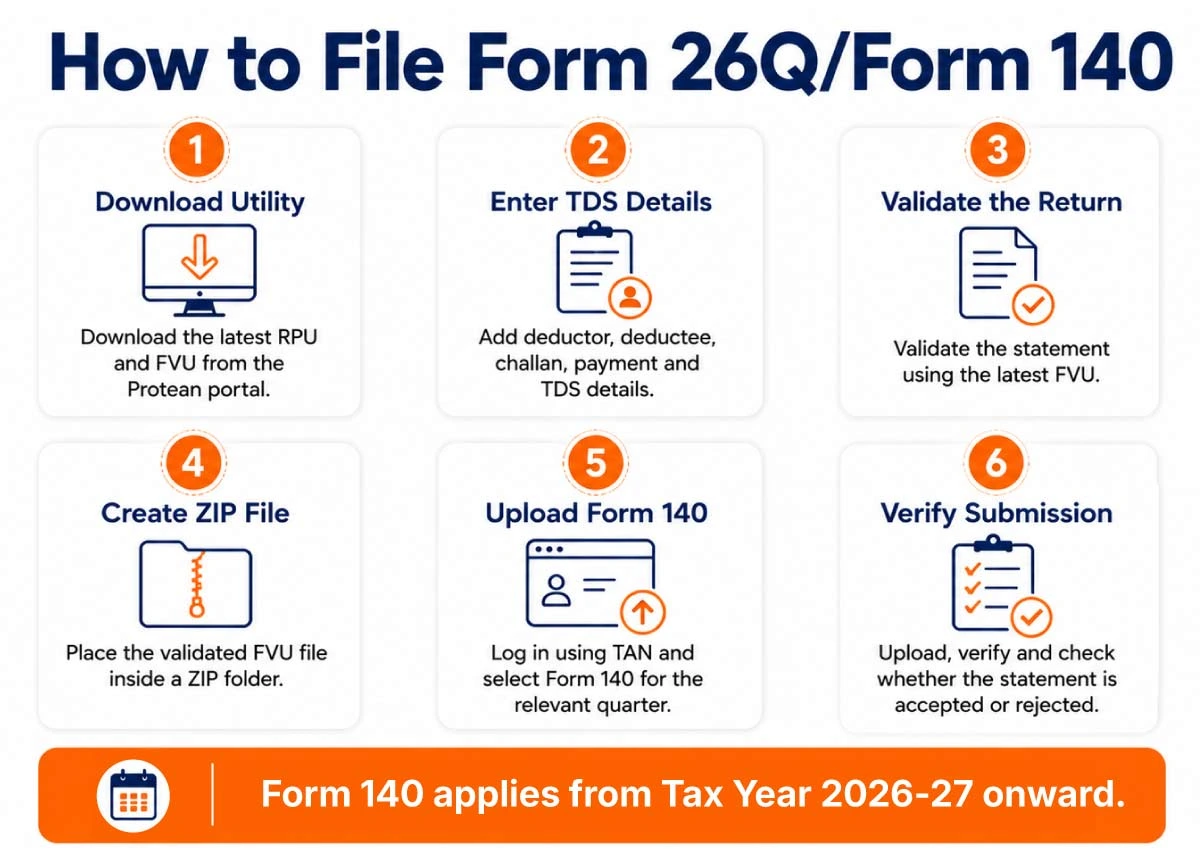
1. Download the Latest Return Preparation Utility
Visit the Protean e-TDS or e-TCS section.
Go to:
Downloads – e-TDS/e-TCS – Quarterly Return – Regular or Correction
Download the latest version of the Return Preparation Utility applicable to the statement.
2. Enter the TDS Details
Enter the following information in the utility:
- Deductor details
- Quarter and applicable year
- Challan details
- Deductee records
- Payment amounts
- TDS rates and amounts
- Reasons for lower or non-deduction, where applicable
3. Validate the Statement
Validate the completed statement through the latest File Validation Utility.
After successful validation, the utility generates an FVU file, which must be placed in a ZIP folder for online submission.
4. Log In Using TAN
Log in to the Income Tax e-Filing portal using the deductor’s TAN.
Go to:
e-File – Income Tax Forms – File Income Tax Forms
5. Select the Correct Form
For Tax Year 2026-27 onward:
- Open the “Forms as per Income Tax Act, 2025” section.
- Select “Deduction and Collection at Source.”
- Choose Form 140.
- Select the relevant tax year.
- Select the quarter.
Choose regular or correction as the upload type.
6. Upload and Verify
Upload the ZIP file containing the validated FVU file.
Proceed with verification using the permitted verification method. After submission, the form will be processed, and its status will appear as accepted or rejected.
A statement may be rejected due to an incorrect tax year, mismatched TAN, incorrect FVU version, incorrect upload type or duplicate filing for the same quarter.
Interest, Late Filing Fee and Penalty for Form 26Q/Form 140
Different consequences may arise for:
- Failure to deduct TDS
- Delay in deducting TDS
- Delay in depositing the deducted tax
- Delay in filing the quarterly TDS statement
- Furnishing incorrect information in the statement
- Interest for Failure to Deduct TDS
For statements governed by the Income-tax Act, 1961, interest is charged under Section 201(1A). For statements governed by the Income-tax Act, 2025, the corresponding provision is Section 398(3).
Where TDS was required to be deducted but was not deducted on time, interest may be charged at 1% per month or part of a month.
The interest is calculated from the date on which the tax was deductible until the date on which it is actually deducted.
Interest for Delay in Depositing TDS
Where TDS was deducted but not deposited within the prescribed period, interest may be charged at 1.5% per month or part of a month.
Interest is calculated from the date of deduction until the date on which the tax is paid to the Central Government.
These interest provisions are covered under Section 201(1A) of the Income-tax Act, 1961 and Section 398(3) of the Income-tax Act, 2025.
Late Filing Fee Under Section 234E and Section 427
For statements governed by the Income-tax Act, 1961, a late filing fee may be charged under Section 234E.
For statements governed by the Income-tax Act, 2025, the corresponding late filing fee is covered under Section 427.
A fee of ₹200 per day may be charged for every day during which the failure to file the quarterly TDS statement continues. However, the total late filing fee cannot exceed the amount of tax deductible for the relevant statement.
Penalty Under Section 271H and Section 461
For statements governed by the Income-tax Act, 1961, a penalty may be imposed under Section 271H. For statements governed by the Income-tax Act, 2025, the corresponding penalty provision is Section 461.
The Assessing Officer may impose a penalty ranging from:
- Minimum penalty: ₹10,000
- Maximum penalty: ₹1,00,000
The penalty may apply where the deductor fails to file the quarterly TDS statement within the prescribed time or furnishes incorrect information in the statement.
This penalty is separate from the applicable late filing fee.
Relief from the penalty for delayed filing may be available where the deductor:
- Deposits the TDS with the Central Government
- Pays the applicable interest and late filing fee
- Files the quarterly TDS statement within one month from the prescribed due date
This relief applies to delayed filing or non-filing and does not apply where incorrect information has been furnished in the TDS statement.
Ebizfiling Support for TDS Return Form 26Q
Ebizfiling can assist businesses, companies, LLPs, firms and other deductors with the preparation and filing of quarterly TDS returns. Our team helps review deductor details, deductee records, challan information, TDS rates and payment data before the return is submitted.
We can help with:
- TDS Return Form 26Q and Form 140 filing
- Quarterly TDS return preparation
- TAN and deductee detail verification
- Challan and deduction entry matching
Accurate and timely filing helps reduce the risk of return rejection, TDS credit mismatches, interest and penalties. Contact Ebizfiling for assistance with your TDS return filing requirements.
Final Thoughts
TDS Return Form 26Q is used to report TDS deducted from non-salary payments made to resident persons. From 1 April 2026, Form 26Q has been renumbered as Form 140 under the Income Tax Act, 2025. Deductors must select the correct form based on the relevant reporting period and file it within the prescribed quarterly due date.
Before filing, deductors should carefully verify PAN details, challan information, payment amounts, TDS rates and deduction records. Accurate and timely filing helps avoid return rejection, interest, late filing fees, penalties and TDS credit mismatches. Businesses that need assistance with TDS Return Form 26Q or Form 140 filing can contact Ebizfiling for professional support.
Frequently Asked Questions
1. Which form should be used when a payment was made before 1 April 2026 but the TDS return is filed later?
The applicable Act and form depend on when the earlier of credit or payment occurs. If the earlier event occurred on or before 31 March 2026, the Income-tax Act, 1961 and Form 26Q apply. If it occurred on or after 1 April 2026, the Income Tax Act, 2025, and Form 140 apply.
2. Can salary and professional-fee TDS be reported in the same TDS Return Form 26Q?
No. TDS Return Form 26Q is meant for specified non-salary payments made to resident persons. Salary-related TDS must be reported through the applicable salary TDS statement and should not be included in Form 26Q or Form 140.
3. What happens if an incorrect PAN is entered during Form 26Q filing?
An incorrect deductee PAN may cause a TDS credit mismatch and may require the deductor to file a correction statement. Deductee details should therefore be checked carefully before completing the quarterly TDS return.
4. Can Form 26Q filing be completed without a registered TAN?
No. A valid TAN registered on the Income Tax e-Filing portal is required for uploading Form 140. The deductor must also prepare a valid FVU file using the latest Return Preparation Utility.
5. Is the Form 26Q due date different for the January-to-March quarter?
Yes. The TDS Return Form 26Q due date for the January-to-March quarter is 31 May of the following financial year. The due dates for the other three quarters are 31 July, 31 October, and 31 January.
6. Can one challan be linked to multiple deductee entries in Form 26Q?
Yes. A challan may be linked to multiple deductee records when the deposited amount covers those deductions. However, the total TDS mapped to the challan must not exceed the amount available in that challan.
7. What should a deductor do if the Form 140 upload is rejected?
The deductor should check the rejection reason, correct the relevant details and generate a fresh FVU file. Rejection may occur due to an incorrect tax year, invalid TAN, incorrect utility version, duplicate filing or mismatched upload details.
8. Is the Form 26Q or Form 140 penalty limited to the ₹200-per-day late filing fee?
No, the penalty is not limited to the ₹200-per-day late filing fee. Under the Income-tax Act, 1961, this fee is charged under Section 234E, while a separate penalty of ₹10,000 to ₹1,00,000 may apply under Section 271H. Under the Income-tax Act, 2025, similar provisions exist under Sections 427 and 461, respectively. The late fee is also capped so it does not exceed the tax deductible or collectible for the statement.
9. Can Ebizfiling help correct challan and deductee mismatches in a quarterly TDS return?
Yes. Ebizfiling can help review challan details, deductee records, PAN information, payment amounts and TDS entries before filing a regular or correction statement. This review can reduce the risk of mismatches and rejection during TDS return filing.
10. How can Ebizfiling assist businesses that need to file Form 140 for the first time?
Ebizfiling can assist with TAN verification, quarterly data review, Form 140 preparation, challan mapping, FVU validation and return submission. Businesses can seek professional support when transitioning from TDS Return Form 26Q to Form 140 for Tax Year 2026-27 onward.





TDS Return
Quickly file error-free TDS Returns with EbizFIling. This ensures seamless credit to the deductee
About Ebizfiling -



Reviews
Amit Tripathi
01 Jun 2018Easy and Fast Thanks for the Help, Very Nice Services will contact for other services too.
Shareef
24 Sep 2018Dear Ishani
I really appreciate you and all the team support in entire process.
You guys are wonderful...keep it up. ????
Thank again,
Cheers!!!!
Shareef
Vijay Gangadhar Kharat
09 Feb 2019September 29, 2026 By Srishti M
TDS and TCS Compliance Calendar October 2026: Compliance Guide Introduction The TDS and TCS Compliance Calendar October 2026 provides an overview of important tax deduction and collection obligations applicable to deductors and collectors. It helps businesses, government offices and other […]
September 2, 2026 By Steffy A
TDS Demand Notice: How to Correct Filing Errors & Short Deduction Issues Introduction Receiving a TDS demand notice for a property purchase can be worrying, especially when tax has already been deducted or deposited. Before making any additional payment, it […]
September 7, 2026 By Steffy A
Health Insurance Deduction Under Section 126: Rules & Limits Introduction Health insurance protects families from rising medical costs and can also provide a tax benefit when the legal conditions are satisfied. Section 126 of the Income Tax Act, 2025 provides […]