

-
September 10, 2026
-
BySteffy A
Section 397 of the Income Tax Act, 2025: Compliance and Reporting
Introduction
Section 397 of the Income Tax Act, 2025 lays down the main compliance and reporting requirements related to tax deducted at source and tax collected at source. It covers TAN and PAN requirements, higher TDS and TCS rates, tax deposits, statement filing and correction of reporting errors.
This blog explains the major compliance and reporting provisions covered under Section 397.
What Is Section 397 of the Income Tax Act?
Section 397 of the Income Tax Act explains the procedures that must be followed where tax is required to be deducted or collected.
The section broadly covers three areas:
- TAN application and quotation
- PAN requirements and higher TDS or TCS rates
- Payment, statement filing and reporting obligations
These requirements help the Income Tax Department identify the person responsible for deducting or collecting tax. They also help match tax payments with statements and ensure that the correct credit is reflected against the taxpayer’s PAN.
TAN Requirements Under Section 397 of the Income Tax Act
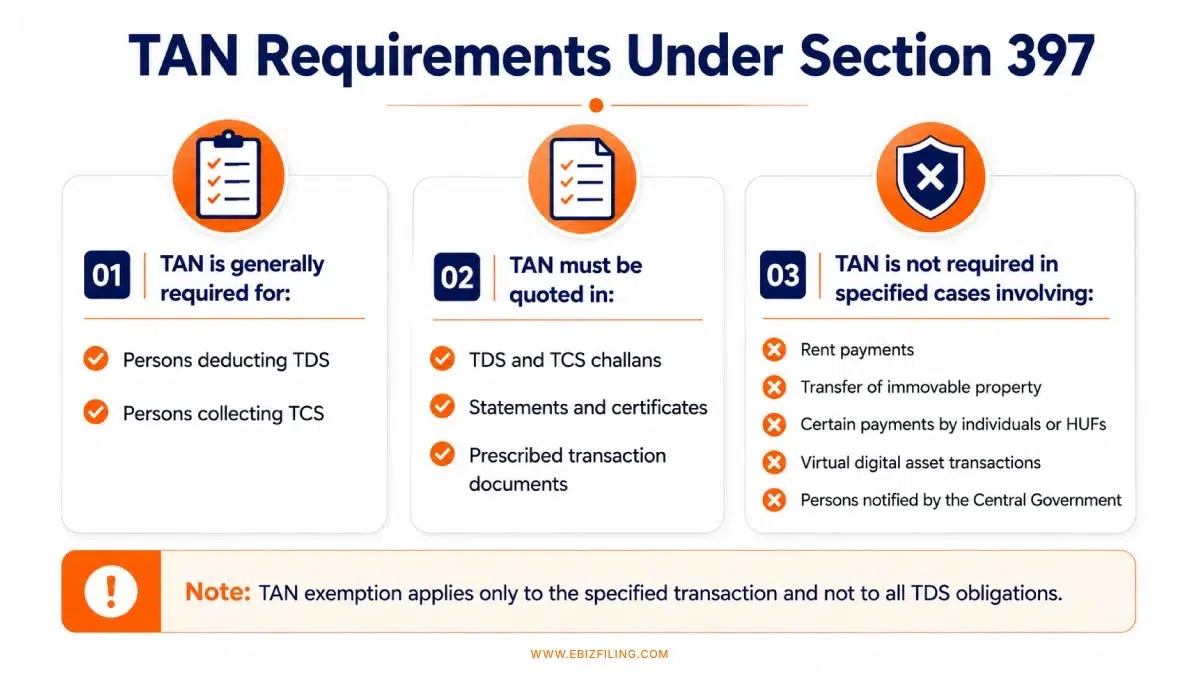
Every person responsible for deducting or collecting tax must generally apply for a Tax Deduction and Collection Account Number, commonly known as TAN.
The application must be made to the Assessing Officer within the prescribed time if the person has not already been allotted a TAN.
Once TAN has been allotted, it must be quoted in:
- TDS and TCS payment challans
- TDS and TCS statements
- Tax deduction and collection certificates
- Prescribed transaction documents
- Other documents required under the applicable rules
TAN identifies the deductor or collector and connects the tax payment with the statement filed. Incorrect or missing TAN details may result in reporting mismatches.
Cases Where TAN Is Not Required
Section 397 of the Income Tax Act provides specific exemptions from the requirement to obtain TAN. These exemptions apply to:
- A person deducting tax under Section 393(1), Table Serial No. 2(i), relating to specified rent payments;
- A person deducting tax under Section 393(1), Table Serial No. 3(i), relating to specified transfers of immovable property;
- A person deducting tax under Section 393(1), Table Serial No. 6(ii), relating to specified payments made by an individual or Hindu undivided family;
- A person referred to in Section 393(4), Table Serial No. 12.C(a), where tax is required to be deducted on consideration for the transfer of a virtual digital asset under Section 393(1), Table Serial No. 8(vi); and
- A person notified by the Central Government.
These exemptions apply only to the specified transactions. An individual or Hindu undivided family is not generally exempt from obtaining TAN for every TDS transaction.
TAN Exemption From 1 October 2026
Effective from 1 October 2026, a resident individual or Hindu undivided family will not be required to obtain TAN when deducting tax on consideration paid for the transfer of immovable property under Section 393(2), Table Sl. No. 17.
This relaxation removes only the requirement to obtain TAN. The buyer must still deduct and deposit the applicable tax and complete the prescribed reporting requirements.
|
Transaction |
TAN Requirement |
|
Regular TDS or TCS transaction |
Generally required |
| Specified rent transaction |
Not required in prescribed cases |
|
Specified transfer of immovable property involving a resident seller |
Not required |
| Specified contractual, professional, commission or brokerage payment by an individual or HUF |
Not required in prescribed cases |
|
Specified virtual digital asset transaction |
Not required in prescribed cases |
|
Consideration paid by a resident individual or HUF for transfer of immovable property covered under Section 393(2), Table Sl. No. 17, from 1 October 2026 |
Not required |
| Person notified by the Central Government |
Not required |
The availability of an exemption must be checked with reference to the exact entry under Section 393.
PAN Requirements for TDS and TCS
A person receiving an amount on which tax is deductible must furnish a valid Permanent Account Number to the deductor.
Similarly, a person paying an amount on which tax is collectible must furnish a valid PAN to the collector.
The PAN must also be indicated in:
- Bills
- Vouchers
- Correspondence
- Transaction records
- Other relevant documents exchanged between the parties
A correct PAN helps ensure that the tax deducted or collected is credited to the correct taxpayer account.
Higher TDS Rate When PAN Is Not Furnished
Where the recipient does not furnish a valid PAN, the deductor must apply the higher applicable TDS rate.
The following rates must be compared:
- The rate specified in the relevant provision
- The rate or rates in force
- The special rate prescribed for failure to furnish PAN
For specified payments covered under Section 393(1), Table Serial Nos. 8(ii) and 8(v), the special rate is 5%. In other cases, the special rate is 20%.
|
Basis for Determining TDS |
Applicable Rule |
|
Rate specified under the relevant TDS provision |
Considered while determining the highest applicable rate |
| Rate or rates in force |
Considered while determining the highest applicable rate |
|
Payments under Section 393(1), Table Sl. Nos. 8(ii) and 8(v) |
5% comparison rate |
| Other payments |
20% comparison rate |
The 5% or 20% rate is not automatically the final TDS rate. The deductor must compare all the applicable rates and deduct tax at the highest rate.
Therefore, TDS is not automatically deducted at 20% in every case where PAN is not provided.
Higher TCS Rate When PAN Is Not Furnished
Where the collectee fails to furnish a valid PAN, tax must be collected at the higher of:
- Twice the rate specified in the relevant provision; or
- 5%
However, the higher TCS rate cannot exceed 20%.
The collector must verify the PAN before applying the normal TCS rate. Where the PAN is missing or invalid, the higher-rate provision becomes applicable.
Exceptions and Special Rules
Section 397 of the Income Tax Act provides limited exceptions from the higher TDS and TCS provisions.
Exceptions for Non-Residents
The higher TDS provision does not apply to a non-resident other than a company, or to a foreign company, in respect of interest payments covered under Section 393(2), Table Sl. Nos. 2, 3 and 4. It also does not apply to other prescribed payments, subject to the prescribed conditions.
This is a transaction-specific exemption and should not be treated as a general exemption for every payment made to a non-resident or foreign company.
The higher TCS rule does not apply to a non-resident who does not have a permanent establishment in India.
A permanent establishment includes a fixed place of business through which the business of an enterprise is wholly or partly carried on.
Special Rule for Rent Payments
For specified rent payments, higher TDS due to non-furnishing of PAN cannot exceed the rent payable for:
- The last month of the tax year; or
- The last month of the tenancy
The applicable limit depends on whether the tenancy continues until the end of the tax year or ends earlier.
Businesses should also understand the new TDS and TCS forms applicable from 1 April 2026.
Consequences of Not Furnishing PAN
Where a valid PAN is not furnished in a declaration under Section 393(6) or Section 394(2), the declaration becomes invalid.
Similarly, where PAN is not furnished in an application under Section 395(1) or Section 395(3), the relevant certificate cannot be granted.
If a declaration becomes invalid, the deductor or collector must deduct or collect tax at the higher rate applicable under Section 397.
Consequences of Non-Compliance With Section 397
Failure to comply with Section 397 may result in higher TDS or TCS rates, reporting mismatches and other consequences under the Act.
Under Section 468, the Assessing Officer may impose a penalty of ₹10,000 where a person fails to comply with Section 397. A separate penalty of ₹10,000 may also be imposed where a person knowingly quotes a false Tax Deduction and Collection Account Number in the prescribed documents.
Payment and Filing of TDS and TCS Statements
Every person responsible for deducting or collecting tax must deposit the amount with the Central Government within the prescribed time.
This obligation also applies to an employer referred to in Section 392(2)(a).
Depositing tax and filing a statement are separate compliance requirements. After depositing the tax, the deductor, collector or employer must file a prescribed statement with the income-tax authority or authorised person.
The statement must be:
- Filed for the prescribed period
- Submitted in the prescribed form
- Verified in the prescribed manner
- Filed within the prescribed time
- Supported by the required particulars
The statement may include tax payment details, PAN, TAN, transaction particulars and deductee or collectee information.
In specified TCS cases covered under Section 394(1), Table Serial Nos. 1 to 4 or 9, the prescribed authority must furnish a statement to the relevant buyer, licensor or lessee in the prescribed form and manner.
Deductors and collectors can refer to the TDS and TCS compliance calendar for important filing and payment dates.
Liability Where TCS Is Not Collected
A person responsible for collecting tax remains liable to pay the amount to the Central Government even if the tax was not actually collected.
Failure to collect TCS under Section 394 does not remove this liability. In practice, the collector may have to deposit the amount before recovering it from the collectee.
Correction and Special Reporting Requirements
A person who has delivered a statement under Section 397(3)(b), or a government-office statement under Section 397(3)(e), may correct a discrepancy or update the information by filing a correction statement in the prescribed form and manner.
The correction statement must be filed within two years from the end of the tax year in which the original statement was required to be delivered. This time limit also covers relevant statements required under Section 200 of the Income-tax Act, 1961.
The correction may relate to:
- PAN or TAN details
- Tax payment information
- Transaction particulars
- Deductee or collectee information
A person responsible for paying any sum to a non-resident other than a company, or to a foreign company, must furnish the prescribed information relating to the payment. This requirement applies whether or not the sum is chargeable to tax in India.
Where a government office deposits TDS or TCS without a challan, the prescribed statement must be filed by the Pay and Accounts Officer, Treasury Officer, Cheque Drawing and Disbursing Officer or another responsible officer.
Specified banking companies, cooperative societies and public companies must furnish prescribed statements for certain interest payments made to residents, even where the payment does not exceed the applicable TDS threshold. The Board may also require other persons responsible for making payments to residents to furnish similar statements.
TDS Compliance Support from Ebizfiling
Section 397 of the Income Tax Act requires deductors to maintain correct PAN and TAN details, deposit TDS within the prescribed time and file accurate TDS statements. Errors in challan details, deductee information or PAN records may also require a correction statement.
Ebizfiling Can Assist With:
- Preparation and filing of TDS returns
- Verification of PAN, TAN and deductee details
- Checking TDS challan and payment information
- Correction of errors in previously filed statements
- Support in meeting applicable TDS filing timelines
With Ebizfiling’s TDS Return Filing service, businesses, employers and other deductors can complete their reporting requirements accurately and reduce the risk of mismatches or filing errors.
Conclusion
Section 397 of the Income Tax Act brings together the main procedural requirements connected with TDS and TCS. It covers TAN application and quotation, PAN furnishing, higher tax rates, tax deposits, statement filing, correction statements, and special reporting obligations.
Deductors and collectors must identify the requirements applicable to each transaction and complete the prescribed payment and reporting obligations on time. Maintaining accurate PAN, TAN and transaction details can help prevent reporting mismatches and ensure that tax credit is correctly reflected.
Suggested reads:
Frequently Asked Questions
1. Is TAN compulsory for every transaction under Section 397 of the Income Tax Act?
TAN is generally required for a person responsible for deducting or collecting tax. However, Section 397 provides exemptions for specified rent, immovable property, individual or HUF payment and virtual digital asset transactions. Persons notified by the Central Government may also be exempt. The relevant entry under Section 393 must be checked before claiming an exemption.
2. Where must the allotted TAN be quoted?
The deductor or collector must quote TAN in TDS and TCS challans, statements and certificates. It must also be mentioned in other prescribed documents connected with the transaction. Correct TAN details help link the tax payment with the relevant statement.
3. What TDS rate applies when PAN is not furnished under Section 397?
Under Section 397 of the Income Tax Act, TDS must be deducted at the higher of the rate under the relevant provision, the rate in force or the special rate for non-furnishing of PAN. The special rate is 5% for specified payments and 20% in other cases.
4. Is TDS always deducted at 20% without PAN?
No, TDS is not automatically deducted at 20% in every case. Certain specified payments covered under Section 393 attract a 5% rate for non-furnishing of PAN. The deductor must compare the applicable rates and deduct tax at the highest rate.
5. What is the TCS rate when PAN is not furnished?
TCS must be collected at the higher of twice the rate specified in the relevant provision or 5%. However, the resulting rate cannot exceed 20%. The collector should verify the validity of PAN before applying the normal TCS rate.
6. Are non-residents exempt under Section 397 of the Income Tax Act?
The higher TDS provision does not apply to a non-resident other than a company, or to a foreign company, for interest payments covered under Section 393(2), Table Serial Nos. 2, 3 and 4. It may also not apply to other prescribed payments, subject to the applicable conditions. The higher TCS provision does not apply to a non-resident without a permanent establishment in India.
7. What happens when a declaration is submitted without PAN?
A declaration made under the specified provisions becomes invalid if a valid PAN is not furnished. The deductor or collector must then apply the higher TDS or TCS rate. A certificate under Section 395(1) or Section 395(3) cannot be granted where the applicant does not furnish a valid PAN.
8. What is the time limit for correction under Section 397?
Section 397 allows correction statements relating to statements filed under Section 397(3)(b) and specified government-office statements under Section 397(3)(e) to be filed within two years from the end of the tax year in which the original statement was required to be delivered.
9. Can Ebizfiling help correct an already filed TDS statement?
Yes, Ebizfiling can assist with filing a correction statement for an already filed TDS statement. This may include correcting PAN application, TAN, challan, deductee, transaction or tax payment details, subject to the applicable time limit and prescribed procedure.
10. How can Ebizfiling help with Section 397 compliance?
Ebizfiling can assist businesses with compliance under Section 397 of the Income Tax Act through TAN-related support, TDS return preparation and review of PAN, TAN, challan and deductee details. It can also help with challan checks and correction of previously filed statements.





File Your ITR with Confidence
Get complete Income Tax Return assistance for accurate filing and smooth compliance with tax regulations.
About Ebizfiling -



October 10, 2026 By Srishti M
October 10, 2026 By Srishti M
Compliance Calendar November 2026: Key Statutory Due Dates Introduction The compliance calendar November 2026 covers important statutory obligations under GST, Income Tax, TDS/TCS, Company Law, LLP regulations, EPF and ESI. It helps businesses identify the filings, payments and regulatory requirements […]
October 9, 2026 By Srishti M
80G Approval Notice : How to Respond and Avoid Rejection Introduction Charitable trusts, societies, and other eligible institutions may receive an 80G Approval Notice from the Income Tax Department while their application for approval under Section 80G is being processed. […]