


-
August 12, 2026
-
BySteffy A
Form 27Q Filing: A Complete Guide to NRI TDS Return Filing
Introduction
Form 27Q filing is the process of submitting a quarterly TDS statement for specified non-salary payments made to non-residents, including NRIs, foreign companies and other non-resident persons. It contains details of the deductor, deductee, payment, TDS rate, challan and tax deposited. Form 27Q was prescribed under the Income-tax Act, 1961. Form 144 applies where the earlier of the date of credit or payment falls on or after 1 April 2026. Form 27Q remains relevant for earlier reporting periods and related correction statements.
What is Form 27Q Filing?
To understand Form 27Q Filing, it should be distinguished from other TDS statements. Form 24Q applies to salary payments, while Form 26Q generally covers specified non-salary payments made to residents. Form 27Q was used when TDS was deducted from non-salary payments made to non-residents.
The deductor may be a company, firm, LLP, government body, individual or another responsible person. Form 144 similarly applies to every person responsible for deducting TDS from covered non-salary payments made to non-residents.
The statement is filed quarterly. The due dates are 31 July, 31 October, 31 January, and 31 May for Q1, Q2, Q3 and Q4 respectively. These due dates also apply to Form 144.
A non-resident without PAN does not automatically receive relief from higher TDS. The availability of any relaxation depends on the nature of payment and fulfilment of the prescribed documentation requirements.
Payments Covered Under Form 27Q
A key part of understanding Form 27Q Filing is knowing which payments may be reported. These commonly include:
- Interest and dividend payments
- Royalty and fees for technical services
- Payments to non-resident sportspersons or sports associations
- Income from securities, bonds, units, or specified funds
- Other taxable non-salary payments made to foreign companies
- Capital-gain-related payments where TDS applies
- Other sums chargeable to tax in India
The applicable TDS rate depends on the income, residential status, relevant tax provision and available Double Taxation Avoidance Agreement benefit. Treaty relief requires prescribed documents, such as a Tax Residency Certificate.
How to File Form 27Q Online TDS Return?
The Form 27Q filing process involves preparing, validating and submitting the required TDS statement. The statement may be prepared using an applicable utility or compatible TDS software and validated through the latest File Validation Utility.
The general filing process is:
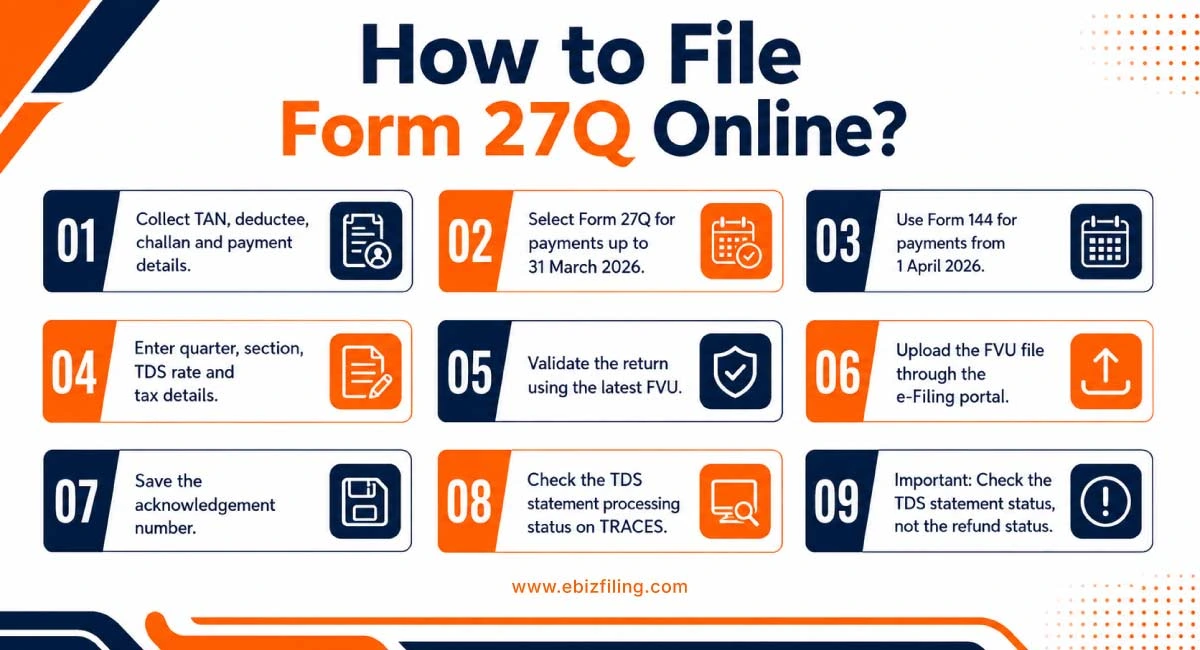
- Collect TAN, deductor, deductee, challan and payment details.
- Select Form 27Q where the earlier of the date of credit or payment falls on or before 31 March 2026 (Select Form 144 where it falls on or after 1 April 2026.)
- Enter the quarter, payment amount, applicable section, TDS rate and tax deposited.
- Validate the statement and correct the errors.
- Generate the FVU file.
- Upload it through the Income Tax e-Filing portal using the deductor’s TAN login or submit it through an authorised filing facility.
- Retain the acknowledgement or return receipt number.
- Check the processing status and file a correction statement if required.
The latest FVU should be used to ensure that the statement does not contain format-level errors. After successful validation, the accepted statement is sent to TRACES for further processing.
The deductor should check the processing status of the TDS statement, not a refund status.
How to Download the Form 27Q or Form 144 Utility
The deductor should download the latest applicable Return Preparation Utility and File Validation Utility from the authorised TDS utility source or use compatible filing software. Older utilities should be avoided.
Form 144 applies where the earlier of the date of credit or payment falls on or after 1 April 2026. Therefore, the reporting period and applicable law should be confirmed before downloading the utility. This distinction is important for anyone researching Form 27Q Filing in 2026.
Interest, Late Fees and Penalties
TDS Deduction
If TDS is not deducted within the prescribed time, interest may apply at 1% for every month or part of a month from the date on which tax was deductible until the date of actual deduction.
If deducted tax is not deposited on time, interest may apply at 1.5% for every month or part of a month until the date of payment. The deductor should deposit the tax and applicable interest before filing or correcting the statement.
Late Filing of Form 27Q
For legacy Form 27Q statements, late filing may attract a fee of ₹200 per day under Section 234E, limited to the amount of TDS. A penalty may also arise under Section 271H for failure to file the statement or for furnishing incorrect information, subject to the applicable conditions.
For Form 144 under the Income-tax Act, 2025, a late filing fee of ₹200 per day applies under Section 427, limited to the amount of tax deductible. Understanding Form 27Q Filing therefore also requires identifying whether Form 27Q or Form 144 applies to the relevant reporting period.
Transaction Review Before Filing Form 27Q
The following classification relates to transaction review in accounting or TDS preparation software. It is not a statutory classification appearing in Form 27Q Filing or Form 144. The exact labels may vary depending on the software being used.
The official Form 144 broadly contains deductor details, tax payment information and deductee-wise details of payments and TDS.
Voucher Statistics
Voucher statistics summarise the transactions recorded during the quarter. They help identify entries that are complete, entries that should be excluded and entries that require further review.
Transactions that are Included
Included transactions contain the required payment and TDS information. They may include:
- Normal TDS deduction entries
- Advance payments subject to TDS
- Lower or nil deduction cases
- TDS adjustment or reversal entries
- Government book adjustments, where applicable
These entries should be reconciled before the statement is generated.
Transactions that are Excluded
Excluded transactions may include:
- Payments not subject to TDS
- Transactions outside the relevant quarter
- Salary payments
- Resident payments reportable in another TDS form
- Non-payment accounting entries
- Optional or incomplete vouchers not affecting TDS
A transaction should not be excluded merely because some information is missing. Such entries should first be reviewed and corrected.
Transactions with Uncertainty
Uncertain transactions contain incomplete or unclear information. Missing residential status, PAN, country, payment nature, applicable section, TDS rate or challan details may prevent correct classification.
Each uncertain transaction should be reviewed before filing. It should then be included, excluded or corrected based on the supporting records and applicable TDS provision.
Specifics of the Deduction
This section may classify deductions at the normal rate, lower rate, nil rate or higher rate. It may also show cases involving a lower-deduction certificate or DTAA benefit.
The deductor should verify the payment amount, applicable rate, tax deducted, tax deposited and reason for lower, nil or higher deduction.
Payment Information
This section contains the relevant TDS payment details, including:
- Challan amount
- Date of deposit
- BSR code
- Challan serial number
- Tax allocated against each deductee
These details should match the tax deposited with the government. Incorrect or unmatched challan details may result in processing defaults and TDS-credit mismatches.
File Your NRI TDS Return with Ebizfiling
Ebizfiling assists businesses and deductors with Form 27Q and Form 144 filing for payments made to non-residents. Our team helps review deductee details, challan information, TDS rates, DTAA documents and the applicable reporting period.
Our services include:
- Form 27Q or Form 144 preparation
- Challan and deductee detail verification
- Regular and correction return filing
- Assistance with DTAA and TRC documents
- Support for late filing and TDS defaults
Get professional assistance with your NRI TDS return filing through Ebizfiling.
Conclusion
Form 27Q was the quarterly TDS statement used to report specified non-salary payments made to non-residents. Form 144 applies where the earlier of the date of credit or payment falls on or after 1 April 2026, while Form 27Q remains relevant for applicable earlier transactions and correction statements. Accurate TAN, deductee, payment, challan, TDS rate and DTAA details are necessary for correct filing. Deductors should confirm the applicable form and reporting period before submission to avoid late fees, processing defaults and TDS-credit mismatches.
Frequently Asked Questions
1. Is Form 27Q Filing still applicable after 1 April 2026?
Form 27Q Filing is used to report TDS deducted from specified non-salary payments made to non-residents. For transactions governed by the Income-tax Act, 2025 from 1 April 2026, Form 144 applies. However, Form 27Q Filing remains applicable for earlier reporting periods and related correction statements.
2. Should rent paid to a non-resident property owner be reported in Form 27Q?
Rent paid to a non-resident may require TDS reporting in the applicable non-resident TDS statement. The deductor should check the nature of payment, relevant tax provision, applicable TDS rate and DTAA benefit before completing the Form 27Q TDS return.
3. Can Form 27Q be filed when the non-resident does not have a PAN?
Yes, filing may still be possible, but the absence of PAN does not automatically provide relief from a higher TDS rate. The deductor must check whether prescribed identification details and supporting documents have been provided by the non-resident.
4. Which quarter should be selected if an invoice and payment fall in different months?
The reporting quarter generally depends on when the amount is credited to the non-resident’s account or paid, whichever occurs earlier. Before starting Form 27Q online filing, the deductor should verify the booking date, payment date and TDS deduction date.
5. Can a DTAA rate be used directly while filing Form 27Q for NRI payments?
A DTAA rate should not be used without checking the relevant treaty article and prescribed documents. The deductor may need a valid Tax Residency Certificate, Form 10F or its applicable replacement, beneficial ownership details and other supporting records.
6. What happens if the challan amount does not match the deductee records?
A challan mismatch may lead to a processing default, short-payment demand or denial of TDS credit to the non-resident. The challan amount, BSR code, deposit date and challan serial number should be reconciled before NRI TDS return filing.
7. Can Form 27Q be revised after it has been accepted?
Yes. A correction statement may be filed to amend deductee details, challan information, payment amounts, TDS rates or other reported particulars. The original acknowledgement or token number and correct supporting records should be available before filing the correction.
8. How can Ebizfiling help with Form 27Q online filing?
Ebizfiling can assist with identifying the correct form, reviewing deductee and challan details, checking the reporting period and preparing regular or correction statements. The team can also support businesses with documentation related to DTAA, TRC and non-resident TDS compliance.
9. How to file Form 27Q online TDS return if multiple payments were made to the same non-resident?
Each reportable payment or credit should be entered with the correct date, amount, section, TDS rate and tax deducted. While learning how to file Form 27Q online TDS return, deductors should avoid combining transactions when the nature, date or applicable rate differs.
10. Can Ebizfiling assist with late Form 27Q filing and TDS defaults?
Yes. Ebizfiling can help review the delay, calculate the applicable interest and late filing fee, reconcile challans and prepare the required statement. Professional support may also help identify whether Form 27Q or Form 144 applies to the relevant reporting period.





TDS Returns Filing
Quickly file error-free TDS Returns with EbizFIling. This ensures seamless credit to the deductee.
About Ebizfiling -



Reviews
Anand Nath Jha
22 Mar 2018Ebizfiling's customer dealing service is International level. Good.
Dhruvi Agarwal
27 Feb 2018They have it all! You tell them your problem and they will have you covered with their services and support. Great going, Ebizfiling.
Nitika Shah
10 Apr 2018We have had a great experience working with you and your company. Looking forward to working with you again.
September 28, 2026 By Srishti M
September 29, 2026 By Srishti M
Income Tax Compliance Calendar October 2026: Filing Guide Introduction The Income Tax Compliance Calendar October 2026 highlights important income tax obligations applicable to taxpayers, businesses and entities covered under audit and transfer pricing provisions. October 2026 includes key compliance […]
September 21, 2026 By Siddhi R
Section 130 of the Income Tax Act: Home Loan Interest Deduction Introduction Buying a residential house property often involves taking a home loan, and the interest paid on such loans can provide tax benefits under certain provisions of the Income […]