


-
August 22, 2026
-
BySteffy A
GST Registration and Process: How to Register for GST Online
Introduction
The GST Registration and Process enables businesses to obtain a Goods and Services Tax Identification Number (GSTIN), collect GST from customers, claim Input Tax Credit (ITC), and comply with GST regulations. Failure to obtain registration when required may result in penalties and compliance issues.
The Goods and Services Tax (GST) has simplified India’s indirect tax system by replacing multiple taxes with a single, unified tax structure. Whether you are a startup founder, MSME owner, professional, freelancer, or e-commerce seller, understanding the GST Registration and Process is essential for running your business legally and efficiently.
One of the biggest advantages of the GST system is that the entire GST Registration and Process is completed online through the GST portal. From application submission to GSTIN allotment, businesses can complete the registration process electronically without visiting any government office.
In this article, we explain the complete GST Registration and Process, including eligibility criteria, required documents, registration steps, approval timelines and post-registration compliance requirements.
What is GST Registration and Why is it Important for Businesses in India?
GST Registration is the process through which a business or individual obtains registration under the Goods and Services Tax law and receives a unique Goods and Services Tax Identification Number (GSTIN).
A GSTIN is a 15-digit alphanumeric identification number assigned to every registered taxpayer. It serves as the primary tax identification number for GST-related transactions, return filing, and tax payments.
Obtaining GST registration is important because it legally authorizes a business to collect GST from customers and claim Input Tax Credit on eligible purchases. It also enhances business credibility and facilitates interstate trade and business expansion.
After successful completion of the GST Registration and Process, the taxpayer receives a GST Registration Certificate in Form GST REG-06. The certificate contains details such as the GSTIN, legal name of the business, principal place of business, and registration date.
Legal Framework Governing GST Registration
The GST Registration and Process in India is governed by the following provisions:
- Section 22 of the CGST Act, 2017: Persons liable for registration based on turnover limits.
- Section 24 of the CGST Act, 2017: Persons required to obtain compulsory registration irrespective of turnover.
- Chapter III of the CGST Rules, 2017: Registration procedures and documentation requirements.
- Notifications and circulars issued by the Government, the GST Council, and the GST authorities from time to time.
Understanding these provisions helps businesses determine whether registration is mandatory and how to complete the registration process correctly.
Who is Required to Obtain GST Registration in India?
The requirement for GST registration is primarily governed by Section 22 and Section 24 of the CGST Act, 2017.
Mandatory GST Registration For:
The following categories of taxpayers are generally required to obtain GST registration:
- Businesses supplying goods whose aggregate turnover exceeds the prescribed threshold limit.
- Service providers crossing the applicable turnover threshold.
- E-commerce sellers and certain suppliers operating through e-commerce platforms.
- Casual taxable persons.
- Non-resident taxable persons.
- Input Service Distributors (ISD).
- Persons liable to pay tax under the Reverse Charge Mechanism (RCM).
- Persons covered under compulsory registration provisions specified under Section 24 of the CGST Act.
Who Can Opt for Voluntary GST Registration?
Businesses that do not fall under mandatory registration criteria may still apply voluntarily.
Voluntary registration offers several benefits, including:
- Eligibility to claim Input Tax Credit.
- Improved business credibility.
- Easier interstate business expansion.
- Better opportunities to work with large organizations.
- Access to e-commerce marketplaces.
Eligibility Criteria for GST Registration
The eligibility for GST registration depends on turnover limits and the nature of business activities.
Turnover Limits for GST Registration
|
Business Type |
Threshold Limit |
|
Suppliers of Goods (Most States) |
₹40 Lakhs |
| Service Providers (Most States) |
₹20 Lakhs |
|
Certain Special Category States |
Lower prescribed limits as notified |
The threshold limits are prescribed under Section 22 of the CGST Act, 2017 and may be amended through government notifications from time to time. The aggregate turnover includes taxable supplies, exempt supplies, exports, and interstate supplies made under the same PAN on an all-India basis.
Apart from turnover limits, GST registration may be required in specific cases such as compulsory registration under Section 24 of the CGST Act.
Documents Required for Online GST Registration
The documents required for online GST registration vary depending on the type of business entity. The table below provides a quick overview of the documents needed for different business structures:
|
Business Type |
Documents Required |
|
PAN Card of the proprietor, Aadhaar Card, passport-size photograph, business address proof, bank account details |
|
|
PAN Card of the firm, Partnership Deed or LLP Agreement, PAN and Aadhaar of partners/designated partners, business address proof, bank account details, authorization letter |
|
|
Certificate of Incorporation, PAN Card of the company, PAN and Aadhaar of directors, Board Resolution, registered office address proof, company bank account details |
GST Registration and Process: Step-by-Step Guide
The GST Registration and Process is carried out online through the GST portal using Form GST REG-01.
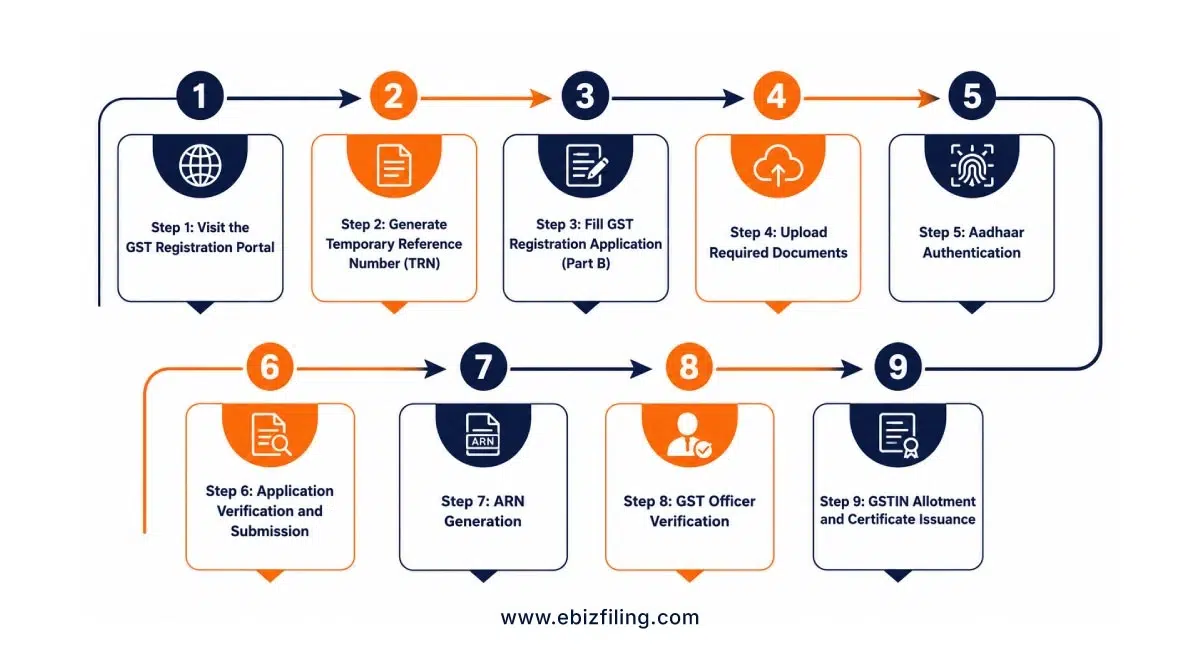
Step 1: Visit the GST Registration Portal
Access the GST portal and select the option for new registration.
Step 2: Generate Temporary Reference Number (TRN)
Complete Part A of the application by providing basic details and generate a Temporary Reference Number (TRN).
Step 3: Fill GST Registration Application (Part B)
Using the TRN, log in and complete Part B of Form GST REG-01 with business information.
Step 4: Upload Required Documents
Upload supporting documents such as PAN, address proof, photographs, and bank details.
Step 5: Aadhaar Authentication
Complete Aadhaar authentication wherever applicable. Successful Aadhaar authentication generally speeds up the registration process.
Step 6: Application Verification and Submission
Verify the application using DSC, EVC, or e-signature and submit it online.
Step 7: ARN Generation
After submission, an Application Reference Number (ARN) is generated for tracking the application status.
Step 8: GST Officer Verification
The GST officer reviews the application and documents. If clarification is required, a notice may be issued in Form GST REG-03, which must be responded to through Form GST REG-04 within the prescribed time.
Step 9: GSTIN Allotment and Certificate Issuance
Upon approval, a GSTIN is allotted and the GST Registration Certificate in Form GST REG-06 is issued.
Registered taxpayers must file applicable GST returns within prescribed due dates. To avoid late fees and penalties, businesses can refer to the GST Compliance Calendar FY 2026-27 for important GST filing and payment deadlines throughout the financial year.
Timeline for GST Registration Approval
The time required for completing the GST Registration and Process depends on the accuracy of the application and verification requirements.
Normal Processing Time: Applications with successful Aadhaar authentication are generally processed within a few working days.
Cases Requiring Physical Verification: Where Aadhaar authentication is not completed or additional verification is required, the registration timeline may increase.
Reasons for Delays
- Incorrect application details
- Incomplete documentation
- Address verification issues
- Delayed response to notices
- Aadhaar authentication failure
How to Download the GST Registration Certificate?
Once registration is approved, taxpayers can download their GST Registration Certificate from the GST portal.
Steps to Download GST REG-06
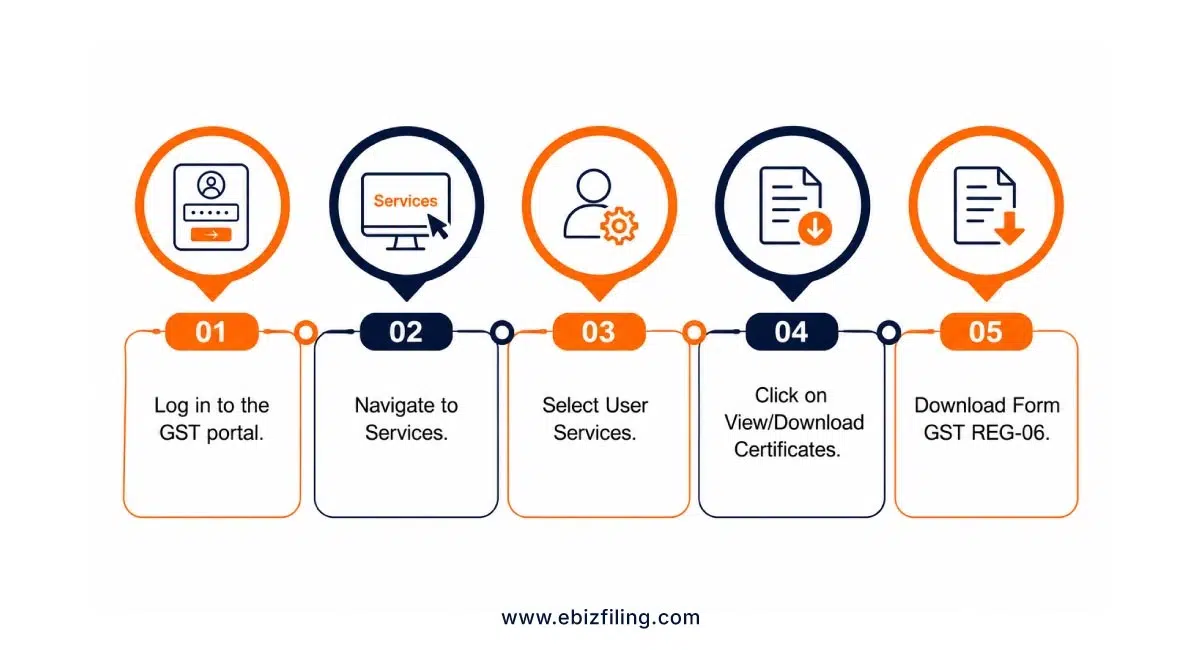
Businesses should keep the certificate updated and readily available for compliance and verification purposes.
Reasons for GST Registration Rejection
Although the GST Registration and Process is straightforward, applications may be rejected due to avoidable mistakes.
- Incorrect PAN application details.
- Address mismatch.
- Invalid or unclear documents.
- Business activity discrepancies.
- Aadhaar authentication failure.
- Incomplete application information.
How to Avoid Rejection
- Verify all information before submission.
- Upload clear and valid documents.
- Ensure consistency across all records.
- Complete Aadhaar authentication promptly.
Post GST Registration Compliance Requirements
Obtaining GST registration is only the beginning. Businesses must continue to comply with GST requirements.
GST Return Filing: Registered taxpayers must file applicable GST returns within prescribed due dates. The return filing requirements are governed primarily under Section 39 of the CGST Act, 2017.
GST Invoice Requirements: Businesses must issue GST-compliant tax invoices containing mandatory particulars.
Record Maintenance: Taxpayers must maintain books of accounts and records as required under GST law.
GST Payment Compliance: Businesses must pay GST liabilities within prescribed timelines and maintain sufficient electronic cash and credit balances.
Annual Return Requirements: Eligible registered taxpayers must file annual returns and reconcile GST records as required under GST regulations.
Businesses must issue GST-compliant tax invoices containing the correct GST rate and HSN/SAC codes. To determine the applicable tax rate for goods and services, businesses can use the GST Rate Finder and HSN Code Tool before raising invoices.
Get Expert Assistance for GST Registration and Process
The GST Registration and Process may seem simple, but errors in documentation or application filing can lead to delays and notices from GST authorities.
Ebizfiling helps businesses complete the GST Registration and Process smoothly through expert guidance, document verification, application filing assistance, and post-registration compliance support. Whether you need a new GST Registration, GST modification, GST return filing, or compliance assistance, our experts ensure a seamless experience from start to finish.
Register Your GST Online with Ebizfiling Today.
Conclusion
Understanding the GST Registration and Process is essential for every business operating in India. From determining eligibility and preparing documents to filing the application and obtaining a GSTIN, each step plays an important role in ensuring compliance with GST regulations.
Timely completion of the GST Registration and Process helps businesses avoid penalties, claim Input Tax Credit, improve credibility, and expand operations confidently. Since registration is conducted entirely online, businesses can complete the process efficiently by submitting accurate information and supporting documents.
If you want to avoid application errors and ensure smooth registration, professional assistance can help simplify the GST Registration and Process and keep your business compliant from day one.
FAQs
1. Is GST registration mandatory for businesses making interstate taxable supplies?
Yes, certain categories of taxpayers making interstate taxable supplies are required to obtain GST registration under the compulsory registration provisions of the CGST Act, regardless of the turnover threshold, subject to applicable exemptions notified by the government.
2. Can a business obtain multiple GST registrations under the same PAN?
Yes, a business can obtain separate GST registrations for different states or Union Territories. Additionally, businesses may opt for separate registrations for multiple places of business within the same state, subject to prescribed conditions.
3. What is the difference between voluntary GST registration and mandatory GST registration?
Mandatory GST registration applies to taxpayers who meet specified turnover limits or fall under compulsory registration categories. Voluntary registration is obtained by businesses that are not legally required to register but wish to avail benefits such as Input Tax Credit and enhanced business credibility.
4. What happens if a GST registration application is not responded to after receiving Form GST REG-03?
If the applicant fails to furnish the required clarification or documents through Form GST REG-04 within the prescribed time, the GST officer may reject the registration application by issuing an order in Form GST REG-05.
5. Can a taxpayer amend details after obtaining GST registration?
Yes, registered taxpayers can amend specific registration details through the GST portal. Certain amendments require approval from the tax authorities, while others are updated automatically upon submission.
6. Is Aadhaar authentication mandatory for GST registration?
Aadhaar authentication is not mandatory in all cases, but completing it generally facilitates faster processing of the registration application. Failure to complete Aadhaar authentication may lead to additional verification procedures, including physical verification of the business premises.
7. Can a business claim Input Tax Credit immediately after obtaining GST registration?
A registered taxpayer can claim Input Tax Credit on eligible inward supplies subject to the conditions prescribed under the CGST Act and GST Rules, including possession of valid tax invoices and compliance by the supplier.
8. How does Ebizfiling assist businesses with the GST Registration and Process?
Ebizfiling provides end-to-end assistance with GST registration, including document verification, application preparation, filing support, follow-up with authorities, and guidance on post-registration GST compliance requirements.
9. Can Ebizfiling help if a GST registration application receives a notice or is marked for clarification?
Yes, Ebizfiling assists businesses in responding to GST notices, preparing clarification documents, and ensuring timely submission of replies to help avoid delays or rejection of the registration application.
10. Does Ebizfiling provide support after GST registration is approved?
Yes, Ebizfiling offers post-registration compliance support, including GST return filing, GST amendments, GST cancellation, GST revocation, and ongoing GST compliance assistance for businesses.





GST Registration
Make your business GST Compliant. Never lose on GST input credit ever. Obtain your GST Registration with Ebizfiling at an affordable price
About Ebizfiling -



Reviews
Addittya Tamhankar
21 Jul 2018EBIZFILING COMPANY IS GOOD. I APPRECIATE THEIR WORK, THEY HAVE BEEN VERY MUCH RESPONSIVE AND RESPONSIBLE, THEIR SERVICE COMES AT AN AFFORDABLE PRICE. TOO GOOD TO BELIEVE. KEEP ROCKING GUYS! GOD BLESS.
Megha Joshi
23 Feb 2018We are really happy with their services and it’s worth the price.
Vatsal Mehta
30 Oct 2017Amazing service, courteous staff and very efficient. I would surely give them 4 stars for their commendable work. Good Going, Ebizfiling.
October 12, 2026 By Srishti M
October 12, 2026 By Srishti M
Company Compliance Calendar November 2026: Key Due Dates & Filings Introduction The Company Compliance Calendar November 2026 highlights important annual return, dematerialisation and income tax compliances that companies may need to complete during the month. November 2026 is particularly […]
October 10, 2026 By Srishti M