


Import Export Code for Business: Complete Guide
Overview
Businesses planning to enter international markets need to obtain an Import Export Code for Business and complete certain regulatory requirements before starting import or export activities. Imagine a business receiving its first overseas order, but the shipment gets delayed because the required trade registration is not available. Such situations can impact delivery timelines, customer relationships, and business operations.
One of the important requirements for eligible businesses involved in international trade is obtaining an Import Export Code for Business.
Import Export Code (IEC) is a 10-digit identification number issued electronically by the Directorate General of Foreign Trade (DGFT) under the Ministry of Commerce and Industry, Government of India.
An IEC acts as an identification number for businesses involved in import and export activities. It helps businesses complete trade-related procedures and comply with applicable foreign trade regulations.
This guide explains the meaning of IEC, who requires it, IEC Code Requirements, documents required for IEC Code, application process, validity, benefits, and other important details businesses should know before starting international trade.
Quick Insights
- Import Export Code (IEC) is a 10-digit identification number issued by DGFT for eligible import and export activities.
- Businesses involved in international trade may require an Import Export Code for Business unless specifically exempted under applicable regulations.
- IEC helps businesses participate in global trade and supports compliance with DGFT requirements.
- Applicants need to provide basic details such as PAN, identity details, address details, and bank information while applying for an IEC.
- IEC generally does not require renewal, but IEC holders must update their details annually on the DGFT portal as applicable.
- Businesses can modify their IEC details through the DGFT portal whenever changes occur.
Understanding Import Export Code (IEC)
Import Export Code (IEC) is a unique 10-digit identification number issued by the Directorate General of Foreign Trade (DGFT) to individuals and business entities involved in eligible import or export activities.
An Import Export Code for Business works as an identity for businesses undertaking international trade transactions. It is generally required for importing goods into India or exporting goods outside India, subject to applicable exemptions.
IEC is issued electronically through the DGFT portal and remains valid unless it is surrendered, cancelled, or deactivated according to applicable DGFT provisions.
To understand the role of IEC in business growth and international trade, explore the advantages of Import Export Code and its importance for businesses involved in import and export activities.
Who Needs Import Export Code?
Import Export Code for Business is generally required by businesses and individuals involved in eligible international trade activities, including:
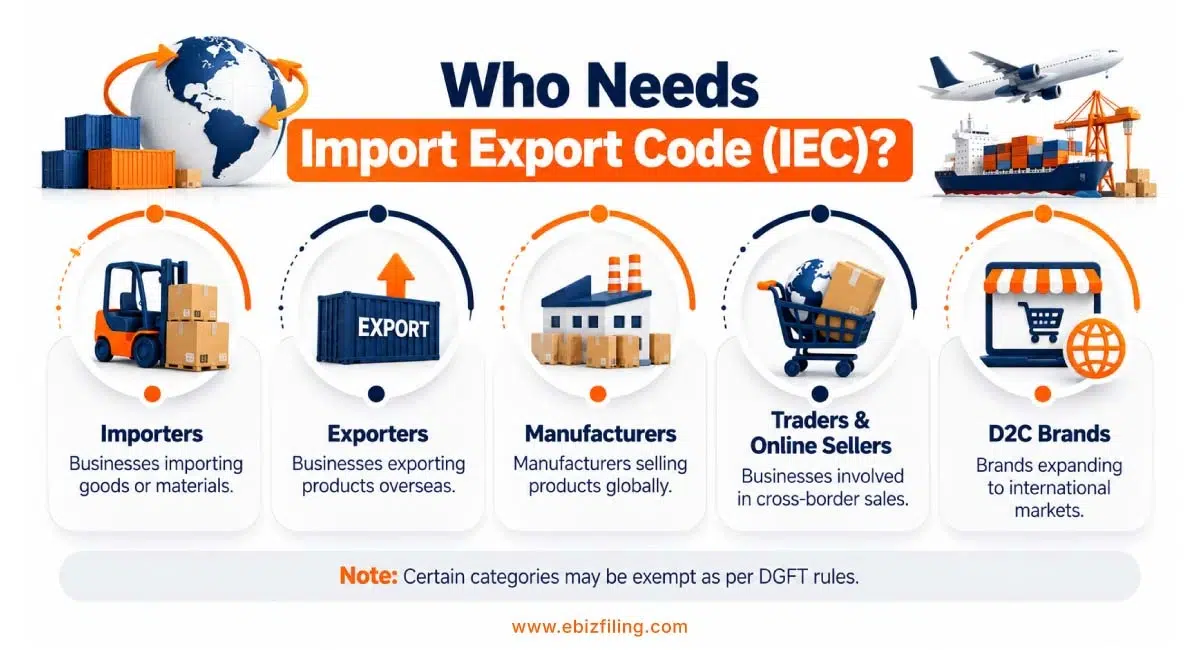
Importers
Businesses importing goods, raw materials, machinery, equipment, or inventory for commercial purposes generally require IEC.
Exporters
Businesses exporting products to customers outside India require IEC for completing export-related procedures.
Manufacturers Exporting Products
Manufacturers selling products in international markets require IEC to undertake export activities.
Traders and Online Sellers
Businesses selling products through international marketplaces or operating cross-border e-commerce activities may require IEC.
D2C Brands Expanding Globally
Direct-to-consumer brands serving customers outside India may require IEC depending on their export activities and applicable regulations.
However, certain categories may be exempt from obtaining IEC as per DGFT provisions.
IEC Exemptions
IEC is generally not required in certain situations, such as:
- Import or export of goods for personal use where the activity is not connected with trade or business.
- Other categories specifically exempted under DGFT provisions.
Persons importing or exporting goods for personal use, where such activities are not connected with trade or manufacture, may be exempt from IEC requirements. Such exemptions are available only for specific categories notified under DGFT provisions.
Businesses should verify the applicable requirements before undertaking import or export activities.








Reviews
Aditi Doshi
29 Mar 2018They manage Accounting and Book-keeping for my company. I must say the team is really doing a good job.
Jitendra Nawrange
09 Aug 2019I am very happy that I am connected to your company. I have liked the service of your company, which provides me the right time for every information. Thank you very much to all your employees. I will always be connected to your company and will tell everyone about your company. thank you ebiz team.
Rahul Shah
10 Nov 2017Highly professional and Corporative. I would strongly recommend your company, Thank you Ebizfiling.
November 14, 2026 By Srishti M
The compliance calendar December 2026 covers important statutory obligations under GST, Income Tax, TDS/TCS, Company Law, LLP regulations, EPF and ESI. It helps businesses identify the filings, tax payments and regulatory requirements applicable during the month. Companies, LLPs, OPCs, employers and registered taxpayers should review the compliance calendar December 2026 based on their entity type, registration status, filing frequency and transaction profile. Timely compliance planning can help avoid late fees, interest, penalties and filing delays.
November 12, 2026 By Srishti M
November 7, 2026 By Srishti M