

Removal of Auditor: Process for Replacement and ROC Compliance
Introduction
When a statutory auditor becomes unresponsive, companies can quickly find themselves stuck with pending audits, unsigned financial statements and delayed ROC filings. The situation may appear straightforward, but the law does not allow a company to simply appoint a new auditor or assume that prolonged silence amounts to resignation.
Under the Companies Act, 2013, Removal of Auditor, resignation and a casual vacancy of auditor are treated as separate legal situations, each with its own procedure, approvals and filing requirements. Choosing the wrong route can create further compliance issues and affect the validity of the auditor replacement process.
For companies already facing delayed annual filings or multiple years of pending compliance, it is important to first regularise the auditor’s position and then proceed with the required audit and ROC filings. This article explains the correct legal process, the role of Forms ADT-2 and ADT-3, the appointment of new auditor, and the steps required to restore ROC compliance.
Summary
- Removal of an auditor before the expiry of tenure is governed by Section 140(1) of the Companies Act, 2013.
- An auditor’s failure to respond does not automatically amount to resignation.
- Form ADT-2 is used to seek approval for the removal of an auditor before the expiry of the auditor’s term.
- Formal resignation can create a casual vacancy of auditor under Section 139(8).
- Valid appointment of a new auditor should precede pending audits and restoration of ROC compliance.
What Should a Company Do When Its Auditor Becomes Unresponsive?
The first step is to determine the legal status of the existing auditor. Failure to respond to calls, emails, or document requests does not by itself terminate the auditor’s statutory appointment. The company should preserve emails, letters, notices and other communication attempts. These records may support the Board’s decision-making, but they do not convert silence into resignation.
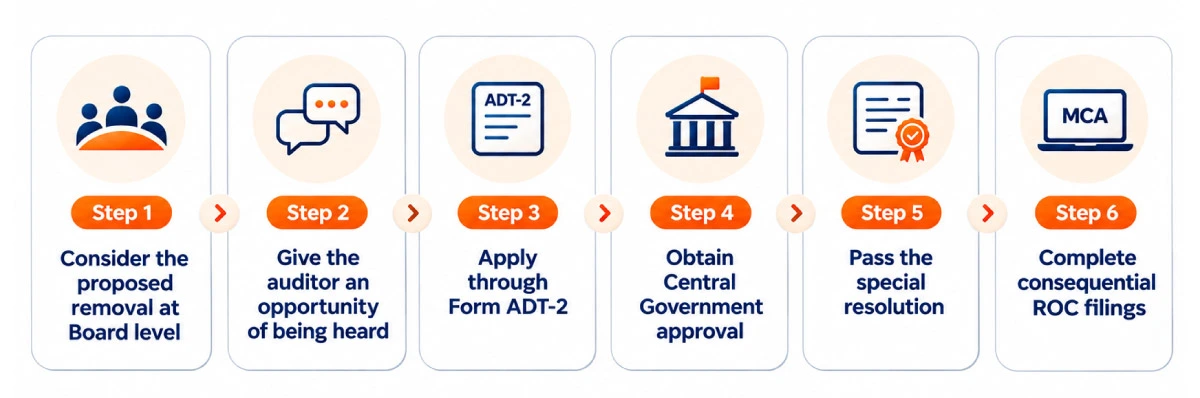
If the auditor remains validly appointed and the company wants to end the appointment before expiry, the statutory Removal of Auditor procedure must be followed.
For a detailed explanation of the separate resignation route, see Ebizfiling’s guide on auditor resignation and appointment under the Companies Act, 2013.
Which legal route applies?
|
Situation |
Applicable legal route |
|
Auditor remains in office but company wants removal before expiry |
Removal of Auditor under Section 140(1) |
|
Auditor formally resigns |
Casual vacancy of auditor under Section 139(8) |
|
Auditor incurs a disqualification under Section 141(3) |
Vacancy treated as a casual vacancy under Section 141(4) |
| Auditor’s term expires normally |
Appointment or reappointment under Section 139 |
Section 141(4) provides that where an auditor incurs a disqualification specified in Section 141(3) after appointment, the auditor must vacate office and the resulting vacancy is treated as a casual vacancy.








November 7, 2026 By Srishti M
November 6, 2026 By Siddhi R
Strike Off Limited Liability Partnership (LLP) in India with Ebizfiling Introduction At Ebizfiling, we assist businesses looking to close their inactive Limited Liability Partnerships (LLPs) through the LLP strike off process. Our services cover accounting assistance, applicable annual compliances, preparation […]
November 6, 2026 By Srishti M