

-
August 14, 2026
-
BySteffy A
Submission of Form 15CA and Form 15CB Under Income tax Act, 1961
Introduction
Form 15CA and Form 15CB were used under the Income tax Act, 1961 to report specified payments made to non-residents or foreign companies. These forms helped the Income Tax Department review the nature of a foreign remittance, its taxability in India and the applicable TDS requirements. Form 15CA was a declaration submitted by the person making the foreign remittance. Form 15CB was a certificate issued by a Chartered Accountant after examining the taxability, applicable TDS rate and DTAA provisions relating to the payment.
These forms applied to eligible foreign remittances made under the Income tax Act, 1961. For applicable remittances made on or after 1 April 2026, Form 15CA and Form 15CB have been replaced by Form 145 and Form 146, respectively, under the Income tax Act, 2025.
Who Is Responsible for Submission?
The person making the foreign payment was responsible for checking whether Form 15CA was required. The remitter had to collect the transaction details, examine the taxability of the payment, select the applicable part and submit the form before making the remittance.
Where Part C applied, the remitter had to assign Form 15CB to a registered Chartered Accountant. The Chartered Accountant reviewed the transaction, applicable TDS provisions, DTAA benefits and supporting documents before filing Form 15CB using a registered Digital Signature Certificate.
Information and Documents Required
Common information and documents required for Form 15CA and Form 15CB submission included:
- PAN and TAN of the remitter
- Address and authorised signatory details
- Name, address, and country of the foreign recipient
- Recipient’s PAN or foreign Tax Identification Number
- Invoice, agreement, contract or purchase order
- Nature, amount, and currency of the payment
- Proposed remittance date
- RBI purpose code
- Authorised dealer bank details
- Applicable TDS provision and tax calculation
- Tax Residency Certificate
- Form 10F, where required for claiming DTAA benefits
- Assessing Officer’s order or certificate for Part B
- Form 15CB certificate for Part C
- TDS challan or payment proof
Additional documents could be required for payments relating to royalty, technical services, interest, commission, software, professional services or the purchase of an asset.
Part-Wise Submission Requirement Under Form 15CA
| Part | Submission requirement |
| Part A | Taxable remittance where the amount or aggregate taxable remittances did not exceed ₹5 lakh during the financial year |
| Part B | Taxable remittance exceeding ₹5 lakh where an order or certificate under Section 195(2), Section 195(3) or Section 197 was obtained from the Assessing Officer |
| Part C | Taxable remittance exceeding ₹5 lakh where Form 15CB was obtained from a Chartered Accountant |
| Part D | Remittance that was not chargeable to tax in India |
The applicable part of Form 15CA depended on the taxability, aggregate value of remittances, and availability of an Assessing Officer’s order or Chartered Accountant’s certificate.
Certain payments were excluded from Form 15CA reporting under Rule 37BB(3). The nature of payment and the RBI purpose code therefore had to be checked before filing.
How to Submit Form 15CA and Form 15CB
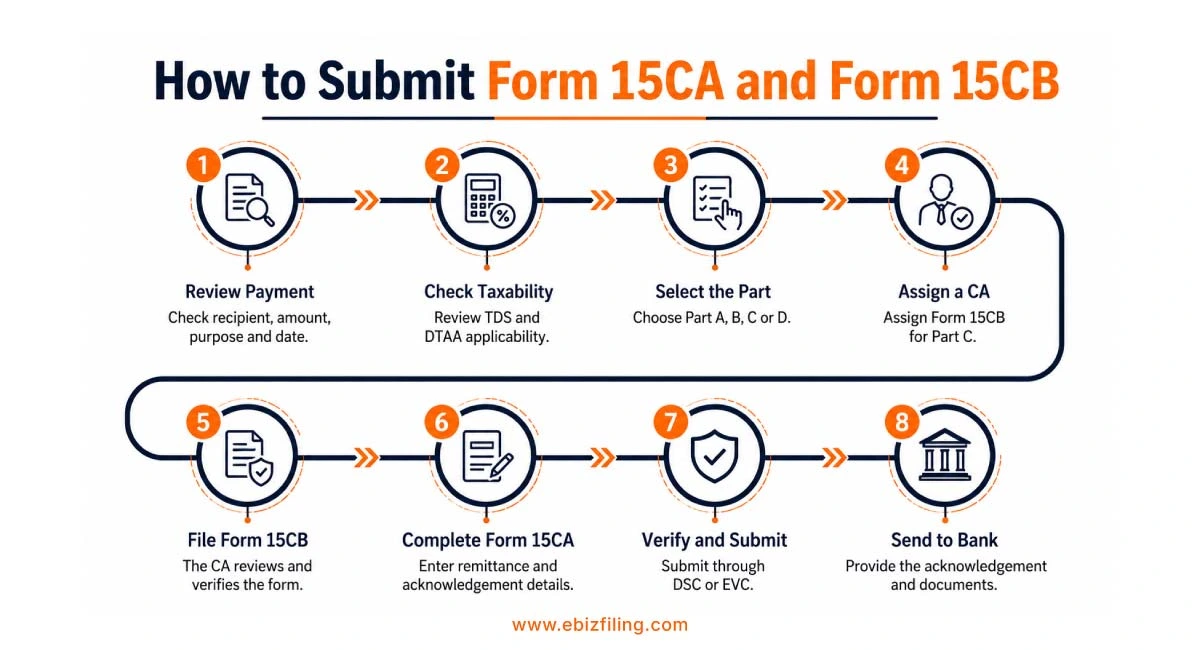
1. Review the Foreign Payment
Identify the foreign recipient, purpose of payment, amount, currency and proposed remittance date.
2. Determine Taxability
Check whether the payment is chargeable to tax in India. Review the applicable provisions of the Income tax Act and the relevant Double Taxation Avoidance Agreement where the foreign recipient is claiming treaty benefits.
3. Select the Correct Part
Choose Part A, Part B, Part C or Part D of Form 15CA based on the taxability, aggregate value of taxable remittances and the available certificate.
4. Assign the Chartered Accountant
Where Part C applies, add a registered Chartered Accountant through the Income Tax e-Filing portal and assign Form 15CB.
5. File Form 15CB
Provide the required documents to the Chartered Accountant. The CA must examine the transaction, determine the applicable TDS and DTAA provisions and complete Form 15CB.
Form 15CB must be verified by the Chartered Accountant using a Digital Signature Certificate registered on the e-Filing portal. The Chartered Accountant could enter the UDIN during submission or choose to update it later through the e-Filing portal.
6. Complete Form 15CA
Use the acknowledgement number of the e-verified Form 15CB to complete Part C of Form 15CA.
For Parts A, B and D, enter the required remitter, recipient, remittance and certificate details directly.
One Form 15CB acknowledgement number could be used only for the corresponding Part C submission of Form 15CA.
7. Verify and Submit Form 15CA
Review the information entered in Form 15CA and complete the applicable e-verification process using a Digital Signature Certificate or Electronic Verification Code.
After successful verification, download the acknowledgement receipt and note the Transaction ID and Acknowledgement Number.
8. Provide the Documents to the Bank
Submit the Form 15CA acknowledgement and the supporting documents requested by the authorised dealer bank before the foreign remittance is processed.
Depending on the transaction and the bank’s internal requirements, the authorised dealer may also request:
- Form 15CB, where applicable
- Invoice or agreement
- TDS payment proof
- Tax Residency Certificate
- Form 10F
- Purpose-code declaration
- Other transaction-related documents
Submission Deadline
Form 15CA and Form 15CB did not have a fixed monthly or annual due date. They were event-based forms that had to be submitted before making the applicable foreign remittance.
Form 15CA was generally filed separately for each remittance. Form 15CB was also required for each remittance satisfying the prescribed conditions.
The remittance amount, recipient details, currency and proposed remittance date had to be checked carefully before submission.
Can Form 15CA Be Corrected After Submission?
Form 15CA could not be edited directly after submission. However, the submitted form could be withdrawn within seven days from the submission date.
After withdrawal, the remitter could file a fresh Form 15CA with the correct recipient, amount, currency, payment purpose or remittance details.
Transition From Form 15CA and Form 15CB
Form 15CA and Form 15CB applied to eligible remittances under the Income tax Act, 1961.
For applicable foreign remittances made on or after 1 April 2026, Form 15CA and Form 15CB have been replaced by Form 145 and Form 146, respectively, under the Income tax Act, 2025.
- Form 145 replaces Form 15CA.
- Form 146 replaces Form 15CB.
- Section 397(3)(d) of the Income tax Act, 2025 contains the corresponding reporting provision.
Where a liability arose before 1 April 2026 but the remittance was made on or after that date, the taxability of the underlying income had to be determined under the law applicable when the income accrued. However, the reporting form was determined according to the law applicable on the remittance date.
Ebizfiling Assistance With Form 15CA and Form 15CB Submission
Ebizfiling can assist businesses and individuals with:
- Reviewing the taxability of the foreign payment
- Checking the applicable TDS provisions
- Reviewing DTAA documents
- Checking the Tax Residency Certificate and Form 10F
- Selecting the correct part of Form 15CA
Need assistance with a foreign remittance? Contact Ebizfiling for Form 15CA and Form 15CB document review, Chartered Accountant coordination and submission support.
Conclusion
Form 15CA and Form 15CB were important reporting documents for specified payments made to non-residents and foreign companies under the Income tax Act, 1961. Before making a foreign payment, the remitter had to review the taxability of the payment, collect the required documents and select the correct part of Form 15CA. Where Part C applied, Form 15CB had to be filed by a registered Chartered Accountant.
Form 15CA then had to be verified, submitted and provided to the authorised dealer bank before the foreign payment was processed. Although Form 15CA and Form 15CB have been replaced for applicable remittances made on or after 1 April 2026, they remain relevant for understanding and reviewing remittances completed under the earlier framework.
FAQs
1. Could Form 15CA be submitted if the proposed remittance date was not final?
The proposed remittance date had to be entered carefully. If the payment date or any material transaction detail changed, the remitter had to check whether the submitted form should be withdrawn and filed again.
2. Could the same Form 15CB be used for more than one foreign remittance?
No. Form 15CB was prepared for a specific remittance. Its acknowledgement details could be used only for the corresponding Part C submission of Form 15CA.
3. What happened if the amount mentioned in Form 15CA differed from the invoice?
A mismatch between Form 15CA, the invoice, and bank documents could delay the remittance. The amount, currency, recipient details, and payment purpose had to be verified before submission.
4. Was an invoice sufficient for submitting Form 15CA and Form 15CB?
No. Depending on the transaction, the remitter could also require an agreement, Tax Residency Certificate, Form 10F, DTAA working, TDS calculation, RBI purpose code and bank documents.
5. What could be done if the bank rejected the Form 15CA acknowledgement?
The remitter had to check whether the acknowledgement number, payment amount, recipient details and purpose code matched the supporting documents. A fresh submission could be required if the filed form contained incorrect information.
6. Could Part C of Form 15CA be filed before the Chartered Accountant completed Form 15CB?
No. The Chartered Accountant had to first file and verify Form 15CB. Its acknowledgement number was then used to complete Part C of Form 15CA.
7. Was a separate Form 15CA required for each foreign payment?
Form 15CA was generally linked to a specific remittance. Each payment had to be assessed separately while also considering the aggregate taxable remittances for applying the ₹5 lakh threshold.
8. Did submitting Form 15CA and Form 15CB complete the foreign remittance process?
No. Filing Form 15CA and Form 15CB was only one part of the process. The authorised dealer bank could also require invoices, agreements, TDS payment proof, declarations and other transaction documents.
9. Can Ebizfiling review the documents related to Form 15CA?
Yes. Ebizfiling can review the remitter details, recipient information, invoice, agreement, tax documents and RBI purpose code to identify mismatches that may affect the remittance.
10. Can Ebizfiling coordinate Form 15CB certification with a Chartered Accountant?
Yes. Ebizfiling can assist with document collection, taxability review, DTAA documentation and coordination with a Chartered Accountant for Form 15CB. It can also support the related Form 15CA and bank-document review.





15 CA online
File Form 15 CA for any payment made outside India with Ebizfiling at an affordable prices
About Ebizfiling -



Reviews
DEEPAK BAGRA
08 Sep 2018I find the service, working approach and commitments very professional. Their progress updates are commendable. I really liked working with them.
Kavita Pawar
21 Jun 2018I would surely give them 5 stars for their Services, Staff, and Pricing!
Harshit Gamit
19 Apr 2018My GST process was made easier with Ebizfiling. I really appreciate the hard work by your team. Keep up the same in the future. Good Luck!
September 7, 2026 By Steffy A
Health Insurance Deduction Under Section 126: Rules & Limits Introduction Health insurance protects families from rising medical costs and can also provide a tax benefit when the legal conditions are satisfied. Section 126 of the Income Tax Act, 2025 provides […]
August 29, 2026 By Steffy A
OPC Compliance Calendar September 2026: Key Due Dates Introduction The OPC Compliance Calendar September 2026 lists the major tax, GST, labour law, and ROC obligations that One Person Companies may need to complete during the month. September includes important compliances […]
August 29, 2026 By Steffy A
TDS and TCS Compliance Calendar September 2026: Key Deadlines Introduction The TDS and TCS Compliance Calendar September 2026 helps deductors, collectors, government offices, property buyers and eligible individuals or HUFs identify the forms applicable to them. Reviewing these requirements in […]