


-
July 21, 2026
-
BySteffy A
Section 115BAB of the Income Tax Act: Tax Rate and Eligibility
Introduction
The Government introduced Section 115BAB of the Income Tax Act to provide a concessional corporate tax regime for eligible new domestic manufacturing companies. The provision was introduced to encourage investment, manufacturing activity and business growth in India by offering a lower corporate tax rate to companies satisfying the prescribed conditions.
This article provides information about Section 115BAB of the Income Tax Act, the eligibility criteria under Section 115BAB, the tax rate for domestic manufacturing companies, and the transfer pricing provisions under Section 115BAB.
Section 115BAB of the Income Tax Act
Section 115BAB of the Income Tax Act was introduced to give eligible domestic manufacturing companies the option to pay tax at the rate of 15%, excluding surcharge and cess.
Companies opting for the lower tax rate will not be eligible to claim certain specified deductions, exemptions, or incentives. Eligible companies can choose whether to pay tax under the concessional tax regime provided under Section 115BAB.
Under the Income-tax Act, 2025, Section 115BAB has been renumbered as Section 201. The concessional tax provisions for eligible domestic manufacturing companies continue under the new section.
The introduction of Section 115BAB supports the growth of economic activity and employment opportunities. It also encourages liquidity, investment, and production. As a result, the profits and disposable income of stakeholders may increase, leading to higher demand and consumption.
Tax Rates Applicable Under Section 115BAB of the Income Tax Act
|
Nature of income |
Basic tax rate |
Effective rate |
|
Eligible manufacturing or production income and income incidental to such business, other than income covered below |
15% | 17.16% |
| Income neither derived from nor incidental to manufacturing or production, where no separate tax rate applies | 22% |
25.168% |
|
Short-term capital gains from a capital asset on which depreciation is not allowable |
22% | 25.168% |
| Excess profits deemed as income under Section 115BAB(6) | 30% |
34.32% |
|
Capital gains or other income taxable at a separately prescribed rate |
Applicable special rate |
Depends on the relevant provision |
The effective rates include a 10% surcharge and 4% health and education cess.
Eligibility Criteria for Section 115BAB of the Income Tax Act
Section 115BAB of the Income Tax Act is an optional tax regime available to eligible new domestic manufacturing companies from Assessment Year 2020-21, subject to fulfilment of the prescribed incorporation, commencement, business and income-computation conditions.
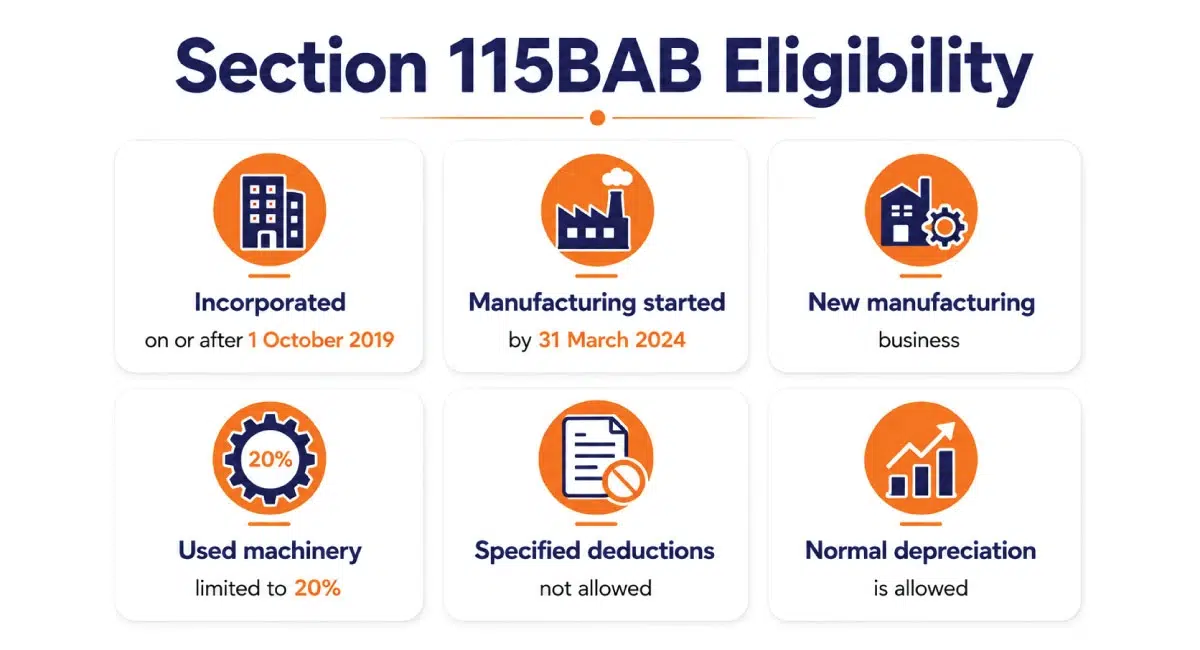
The company must be incorporated and registered on or after October 1, 2019, and manufacturing or production must commence on or before March 31, 2024. Such a company should satisfy the following conditions:
- Except where a business is re-established under Section 33B, the company should not be formed by splitting up or reconstructing an existing business.
- The company should generally not use previously used plant or machinery. However, machinery previously used outside India may be permitted if it was not used in India before its installation, is imported into India, and no depreciation was allowed or allowable in India before its installation. Previously used plant or machinery may also be permitted where its value does not exceed 20% of the total value of the plant and machinery used by the company.
- The company should not use a building that was previously used as a hotel or convention centre where a deduction under Section 80-ID had been claimed and allowed.
- The company should be engaged in the business of manufacturing or producing an article or thing. It may also conduct research relating to the article or thing manufactured by it. The company may also distribute the article or thing manufactured or produced by it.
The total income of the company should be calculated without claiming the following specified deductions and incentives:
- Deduction available to units in a Special Economic Zone under Section 10AA.
- Investment allowance under Section 32AD for eligible new plant and machinery installed in specified notified backward areas.
- Deduction under Section 33AB available to tea, coffee, and rubber manufacturers.
- Deduction under Section 33ABA for deposits made to the site restoration fund by companies engaged in the extraction or production of petroleum, natural gas, or both in India.
- Specified deductions for expenditure on scientific research under Section 35.
- Deduction for capital expenditure incurred by a specified business under Section 35AD.
- Deduction for expenditure incurred on an agricultural extension project under Section 35CCC or a skill development project under Section 35CCD.
- Deductions under Chapter VI-A relating to specified incomes are generally not available, except eligible deductions under Sections 80JJAA and 80M.
- Set-off of losses carried forward from previous years if such losses relate to the deductions mentioned above.
- Additional depreciation under Section 32(1)(iia) cannot be claimed. However, normal depreciation under Section 32 remains available at the prescribed rates. Where the depreciation rate for a block of assets exceeds 40%, it is restricted to 40%.
How to Opt for Section 115BAB of the Income Tax Act
An eligible domestic manufacturing company must exercise the option under Section 115BAB of the Income Tax Act by filing Form 10-ID electronically on or before the due date prescribed for filing its income tax return for the year in which the benefit is first claimed.
Once the option is exercised:
- It applies to subsequent assessment years.
- It cannot be withdrawn once exercised.
- Failure to satisfy the prescribed conditions will render the option invalid for that year and subsequent years.
For tax years governed by the Income-tax Act, 2025, the corresponding provisions of Section 201 and the prescribed form and procedure should be followed.
Section 115BAB Transfer Pricing Provision
Where the course of business between an eligible company and another person is arranged, because of a close connection or for any other reason, in a manner that produces more than the ordinary profits expected from such business, the Assessing Officer may examine the arrangement and compute the profits at the amount reasonably deemed to have been derived from the business.
Where the arrangement involves a specified domestic transaction under Section 92BA, the profits must be determined having regard to the arm’s length price under the applicable transfer-pricing provisions.
Any profit exceeding the amount determined by the Assessing Officer is deemed to be the company’s income and is taxable at a basic rate of 30%, along with the applicable surcharge and cess.
Company Income Tax Filing Support
Companies opting for the concessional tax regime under Section 115BAB of the Income Tax Act must calculate their tax liability correctly and file the applicable income tax return within the prescribed time.
Ebizfiling can assist with:
- Checking eligibility under Section 115BAB
- Calculating the applicable tax liability
- Reviewing deductions and exemptions
- Preparing and filing the company income tax return
- Ensuring compliance with applicable tax provisions
Get professional assistance through Ebizfiling’s Company IT Filing Online service.
Conclusion
Section 115BAB of the Income Tax Act provides eligible domestic manufacturing companies with the option to pay tax at a concessional basic rate of 15% on eligible manufacturing income, subject to the prescribed conditions. After adding the 10% surcharge and 4% health and education cess, the effective rate on such income is 17.16%.
However, non-manufacturing income, certain short-term capital gains, excess profits and income taxable at a special rate may be taxed differently. Under the Income-tax Act, 2025, the corresponding provisions are contained in Section 201. Eligible companies should examine their income, deductions, losses and compliance requirements before exercising the option.
Frequently Asked Questions
1. What is the effective tax rate under Section 115BAB for eligible manufacturing income?
Eligible manufacturing income is taxed at a basic rate of 15%. After adding the 10% surcharge and 4% health and education cess, the effective tax rate is 17.16%. However, non-manufacturing income, certain short-term capital gains, excess profits, and special-rate income may be taxed at different rates.
2. What are the timelines for establishing Section 115BAB eligibility?
Section 115BAB of the Income Tax Act eligibility is available to a domestic company set up and registered on or after October 1, 2019, provided it commenced manufacturing or production on or before March 31, 2024. Ebizfiling can help companies review their incorporation, commencement and tax records before exercising the option.
3. Can an existing business restructure itself to qualify for Section 115BAB for domestic manufacturing companies?
A company formed by splitting up or reconstructing an existing business cannot claim the benefit under Section 115BAB. However, an exception applies where a business is re-established, reconstructed or revived in the circumstances covered under Section 33B.
4. What are the key Section 115BAB exemptions and deductions that a company must give up?
To claim this lower corporate tax rate, businesses must give up several major incentives. Under the statutory Section 115BAB exemptions, a company cannot claim deductions for units in Special Economic Zones (SEZs) under Section 10AA, additional depreciation on new machinery, or special deductions for scientific research expenditures.
5. Does Section 115BAB applicability extend to companies using second-hand machinery?
Generally, previously used machinery is not permitted. However, machinery previously used outside India may qualify if it was not used in India before installation, is imported into India, and no depreciation was previously allowed or allowable in India. Used machinery may also be permitted where its value does not exceed 20% of the company’s total plant and machinery.
6. How do the Section 115BAB transfer pricing provisions work for closely connected businesses?
Where transactions with a closely connected person are arranged to produce more than ordinary profits, the Assessing Officer may determine the reasonable profits that should have arisen from the business. If the arrangement involves a specified domestic transaction, the profits must be determined having regard to the arm’s length price. Any excess profit is deemed to be income and taxed at a basic rate of 30%.
7. Are companies that opt for Section 115BAB required to pay the Minimum Alternate Tax?
No. The Minimum Alternate Tax provisions under Section 115JB do not apply to a company that opts for taxation under Section 115BAB. Further, any unused or brought-forward MAT credit cannot be carried forward or set off after the company opts for this concessional tax regime.
8. What types of businesses are excluded from the definition of a manufacturing company under this section?
The excluded activities include the development of computer software, mining, conversion of marble blocks or similar items into slabs, bottling of gas into cylinders, printing of books, production of cinematograph films and any other business notified by the Central Government. Generation of electricity is treated as manufacturing for this purpose.
9. Can a company claim normal depreciation under the Section 115BAB tax rate regime?
Yes. A company can claim normal depreciation at the prescribed rates, although additional depreciation under Section 32(1)(iia) is not available under the Section 115BAB of the Income Tax Act regime.
10. What is the corresponding provision for Section 115BAB of the Income Tax Act, 2025?
Under the Income-tax Act, 2025, the provisions corresponding to Section 115BAB are contained in Section 201. The concessional basic rate of 15% continues for eligible manufacturing income. However, non-manufacturing income, certain short-term capital gains, excess profits, and special-rate income may be taxed at different rates under Section 201.





Income Tax Return
Filing of Income Tax return is necessary if you have earned any income. File your ITR with EbizFiling at an Affordable Price.
About Ebizfiling -



Reviews
Dipak Giri
23 Apr 2022I wanted to say Thank you & Sincere Gratitude to all team member of EBizfilling India Private Limited. Ebizfilling is an excellent organization. I love that you all are so committed to cross-departmental Collaboration with time frame. It was great experience to have this kind of co-operation while staying far away to get all kind of services like Business registration, All compliance service, Recruitment, Accounting Marketing, Technical service for Kitchen etc in one place , Specially Mansi, Anuja, Pulkit, Aron team member of Ebizfilling did a excellent job on their part to make successful our project. Still we are with them for more services which they are always committed to do on time. Thanks Once Again to Team of Ebizfilling & looking forward for future service in best possible way. Anyone, Any industry can have touch with them for better progress in your Organization. From, DAJ Pizzeria House Private Limited
Kalla swathi
09 Apr 2022Excellent service indeed.. I appreciate the entire team for incorporating my company very well
Akshay Sharma
18 Apr 2022I took a TM service for my Tea Brand, wonderful service with humble staff, and provided solutions on time. Recommended for all
October 21, 2026 By Srishti M
Tax Planning for NRI Returning to India Before Becoming ROR Introduction Tax planning for NRI returning to India should start before the person becomes Resident and Ordinarily Resident, also known as ROR. Under the Income-tax Act, 2025, residential status decides […]
September 30, 2026 By Srishti M
September 29, 2026 By Srishti M
Income Tax Compliance Calendar October 2026: Filing Guide Introduction The Income Tax Compliance Calendar October 2026 highlights important income tax obligations applicable to taxpayers, businesses and entities covered under audit and transfer pricing provisions. October 2026 includes key compliance […]