


-
July 28, 2026
-
BySteffy A
Startup Registration in India: Licenses and Registrations
Overview
Startup Registration in India is the first step to starting a legal and reliable business. Founders must understand the registrations required for startup, such as company registration, GST, Udyam Registration, Startup India registration, trademark, and other licenses required for startup in India. In this blog, we will discuss the different types of registrations and licenses required for startups.
Requirements for Startup Registration in India
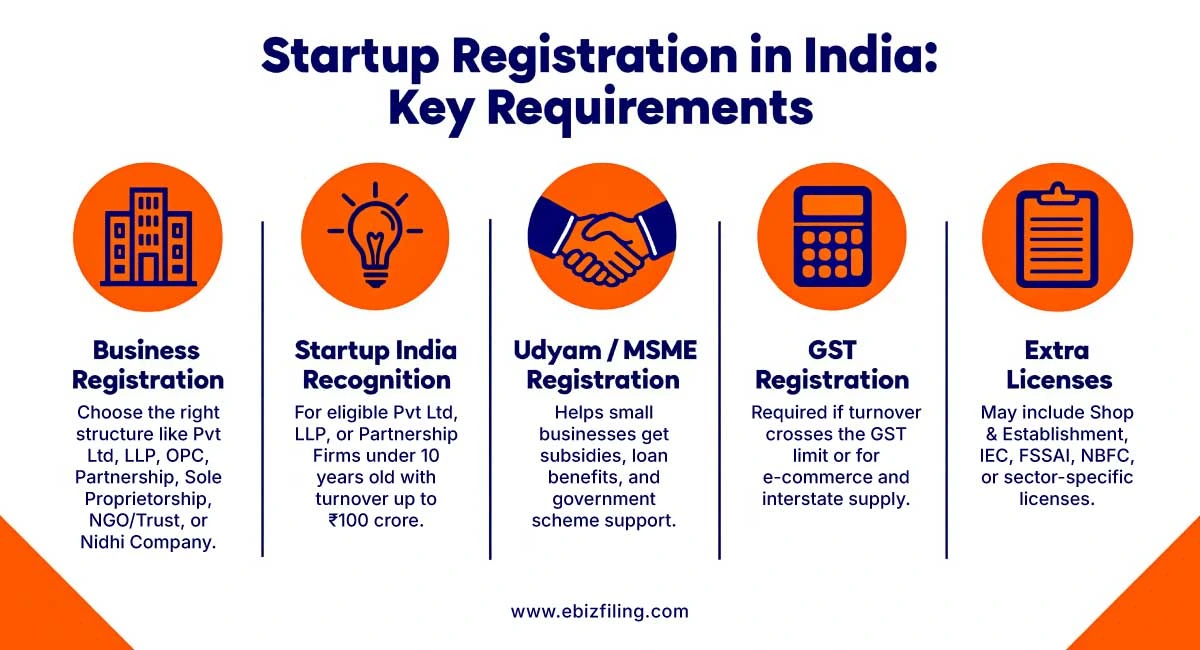
Business Structure for Registration
Many founders get confused about what is mandatory and what is optional. Add a quick decision table:
|
Business Activity |
Registration Required |
|
Starting any company |
Company Registration |
| Selling taxable goods/services |
GST Registration |
|
MSME benefits |
Udyam Registration |
| Brand protection |
Trademark Registration |
|
Food business |
FSSAI Registration |
| Import/Export |
IEC Registration |
Startup India Registration
When the business falls under the Startup India eligibility criteria, it can apply for DPIIT recognition through the Startup India portal. A business registered as a Private Limited Company, LLP and Partnership Firm can apply if it meets the required conditions.
The entity should not be more than 10 years old from the date of incorporation or registration. For eligible Deep Tech startups, this period is 20 years. Its turnover should be less than ₹200 crore in any previous financial year, and for eligible Deep Tech startups, the limit is ₹300 crore. The business should work towards innovation, development, or improvement of products, processes, or services, or have a scalable business model with high potential for employment generation or wealth creation. The entity should also not be formed by splitting up or reconstructing an existing business.
Recommended Read by Ebizfiling: Startup India Recognition and Its Benefits
GST Registration
GST Registration is required only when a startup meets the prescribed GST Registration criteria. This may include crossing the turnover threshold, making interstate taxable supplies in specified cases, selling through e-commerce platforms, or falling under any mandatory registration category under GST law.
In most states, the threshold is ₹40 lakh for goods and ₹20 lakh for services, while lower limits may apply in special category states. Failure to obtain GST Registration when required may attract penalties.
Udyam Registration
Udyam Registration is the official MSME Registration system introduced by the Government of India. Udyam Registration replaced the earlier Udyog Aadhaar Registration system and serves as the official MSME Registration mechanism in India. Once the registration is obtained, eligible businesses can access various government schemes, subsidies, financial assistance, and other MSME benefits provided by the Government for small businesses in India.
For a detailed explanation of the process, benefits, and eligibility, read our complete guide on Udyam Registration. It is done through the official government portal. Ebizfiling can assist startups with guidance, document support, and the registration process.
Trademark Registration
Trademark Registration helps protect a startup’s brand name, logo, tagline, or product name from unauthorized use. It strengthens brand identity and provides legal protection against infringement.
FSSAI Registration
Any startup involved in manufacturing, processing, storage, distribution, or sale of food products must obtain the appropriate FSSAI Registration or FSSAI license before commencing operations.
Essential Registrations Required for Startups in India
|
Registration |
Mandatory/Optional |
Purpose |
|
Company Registration |
Mandatory | Legal business formation |
|
GST Registration |
Conditional |
Tax compliance |
| Udyam Registration | Optional |
MSME benefits |
|
Trademark Registration |
Optional | Brand protection |
| FSSAI Registration | Industry-specific |
Food business compliance |
|
IEC Registration |
Required for Import/Export Businesses |
International trade |
Licenses Required for Startup Registration in India
Apart from the above registrations, there are certain licenses required to be obtained for specific kinds of startups such as shops & establishments, food business, Import Export business, Financial institutions, etc. which are as follows:
Shop and Establishment License for Startup Registration in India
Every state has its own Shop and Establishment Act, which provides for the rules to be followed by every shop and establishment running its business in the state. The Act also provides for shop and establishment licenses or trade licenses. A business that comes under the definition of shop and establishment must obtain the Shop and Establishment Certificate without fail to avoid penalty and fine.
Import Export Code Registration
Businesses that wish to import or export goods or services from India need to have a valid IE Code. IE Code must be mentioned in all relevant customs documents. Bankers would require you to have valid IEC registration for making payments abroad. To obtain the Import Export Code, it is mandatory to have a PAN and a current account in a bank.
Apart from this, certain businesses such as non-banking financial institutions or fintech companies may require NBFC registration, while multimedia broadcasting platforms may require broadcasting licenses.
How a Startup Became Legally Ready with Ebizfiling
A founder planned to start a small packaged food company and market its products online. The founder wanted to know which registrations were necessary before taking paid orders, even though the product samples were available.
Ebizfiling analyzed the business activities and recommended the initial registration requirements. The founder received guidance on registering a Private Limited Company, followed by GST registration, Udyam Registration, FSSAI Registration, and trademark protection.
The startup was able to open a current account, list products online, issue appropriate invoices, and begin selling with more legal clarity after completing the necessary registrations.
Conclusion
Startup Registration in India is an important step in building a legally compliant and reliable business. Each registration, whether company registration, GST, Udyam, trademark, IEC, FSSAI, or any other applicable license, plays a specific role in helping a startup operate smoothly. With the right registrations, startups can avoid penalties, open business bank accounts, issue proper invoices, apply for funding, build credibility, and grow with more confidence.
FAQs
1. What is the eligibility for Startup India Registration?
For Startup Registration in India, the business must be registered as a Private Limited Company, Partnership Firm, Limited Liability Partnership, or Cooperative Society. It should not be more than 10 years old, or 20 years old in case of eligible Deep Tech startups. Its turnover should be less than ₹200 crore in any previous financial year, or ₹300 crore for eligible Deep Tech startups. It should also work towards innovation, product or service improvement, or a scalable business model.
2. What is the most appropriate business structure for a startup?
The most common business structures for startup registration in India are Private Limited Company and Limited Liability Partnership. Startups typically prefer a Private Limited Company that offers them greater credibility, limited liability, and future funding opportunities. LLP is applicable to founders seeking flexibility, limited liability, and relatively easier compliance.
3. What happens if the DPIIT application is rejected?
The applicant may reapply with a revised and more detailed innovation description and complete documentation. There is no penalty for reapplication and no government fee involved.
4. Is it mandatory to have GST Registration at the outset?
No, not every startup needs GST Registration at the time of incorporation. GST Registration becomes applicable when the startup crosses the prescribed turnover threshold or falls under mandatory GST Registration criteria. For example, startups involved in e-commerce sales, certain interstate taxable supplies, or other specified taxable activities may need GST Registration at an early stage.
5. What is MSME Registration and why is it beneficial to startups?
Udyam Registration, also known as MSME Registration, provides eligible startups with recognition as Micro, Small, or Medium Enterprises. It can help startups access government schemes, easier loans, subsidy benefits, tender-related benefits, and protection against delayed payments by buyers.
6. Does a startup need trademark Registration?
Not all startups require trademark Registration, but it is useful for protecting the brand. It helps protect the startup’s name, logo, tagline, or product name from being copied or misused by others. Companies that are looking to create a distinctive brand name need to consider registration of trademarks at an early stage.
7. Can a foreign national register for a startup in India?
Yes, a foreign national can register a startup in India. A Private Limited Company or LLP with foreign nationals as shareholders must comply with applicable FEMA, RBI, and incorporation-related documentation requirements.
8. How much time does Startup Registration in India take?
The timeline depends on the type of registration and the readiness of the required documents. Company registration can generally be completed within a few working days if the documents are ready and the proposed name is approved.
9. Is a business bank account required after startup registration in India?
Yes, a business bank account is important after startup registration. It assists the startup in getting paid, covering business operating expenses, keeping accurate accounting records, and separating personal and business transactions. Banks usually require registration documents, PAN, address proof, and other business information.
10. Is DSC required for Startup Registration in India?
A DSC is generally not required for Startup India recognition, but it may be needed for company incorporation, LLP registration, MCA filings, GST-related filings, and other government portal submissions. Ebizfiling helps founders understand where DSC is required and supports them with the right registration process.





Indian Startup Recognition online
Get your company registered under Government's Startup India Initiative and get various benefits for your company.
About Ebizfiling -


Follow Author
Leave a Reply
Reviews
-

Rajesh Moza
16 Jul 2020For starting a new a company or applying to become a Director of a company, to procure Digital signature/Trademark & other IPRs etc Ebizfiling India Pvt Ltd is there to do all these jobs through single window service. Ebizfiling is a complete online service platform and people working here are young professionals. They have been very honest with me, whatever they promised initially, they did it. I feel rates quoted by this company were lowest in comparison to others and they cleared all my doubts, wherever needed.

-
-
October 15, 2026 By Srishti M
TDS and TCS Compliance Calendar November 2026TDS and TCS Compliance Calendar November 2026: Compliance Guide Introduction The TDS and TCS Compliance Calendar November 2026 covers important tax deduction, collection, payment, certificate and reporting requirements applicable during the month. It helps businesses, government offices and other responsible […]
-
-
-
October 14, 2026 By Srishti M
GST compliance calendar November 2026GST Compliance Calendar November 2026: Key Due Dates & Filings Introduction The GST Compliance Calendar November 2026 highlights the major GST return filing, tax payment, invoice reporting and year-end adjustment deadlines applicable during the month. It covers regular taxpayers, QRMP […]
-
-




Hello ma’am
Please write us your detailed query at info@ebizfiling.com/ contact us at +919643203209, if you need any additional information or assistance.
Thanks for connecting.
Hi Dhruv,
Thank you for your inquiry.
The team will get in touch with you soon, Meanwhile you can get in touch with Ebizfiling on +919643203209 / info@ebizfiling.com
do i need a License for an Immigration Consultancy?
Hi Iqra,
Thanks for writing to us. Please share your detailed query on info@ebizfiling.com. Team will get in touch with you soon.
Hi Kshitij,
For the Incorporation of an LLP there is no requirement of any separate license.
However, for further assistance or In case of any further query, you may write to us at info@ebizfiling.com or may call us on +919643203209.