


-
October 13, 2026
ITR Filing Online for FY 2020-21: Process, Forms and Latest Updates
Introduction
ITR filing online for FY 2020-21 relates to income earned from 1 April 2020 to 31 March 2021 and reported for Assessment Year 2021-22. Taxpayers had to choose the correct Income Tax Return form according to their income and eligibility. Although the regular filing period has ended, information about this year remains relevant for old compliance, refund claims, notices and missed returns. The official AY 2021-22 ITR instructions confirm that these returns related to FY 2020-21 and were governed by the Income-tax Act, 1961.
This guide keeps ITR filing online for FY 2020-21 as the main focus while also explaining the current AY 2026-27 filing position and the transition to the Income-tax Act, 2025.
Quick Insights
- FY 2020-21 corresponds to AY 2021-22 and was governed by the Income-tax Act, 1961.
- The normal and updated return windows for ITR filing online for FY 2020-21 have expired.
- AY 2026-27 returns for FY 2025-26 continue to be filed under the Income-tax Act, 1961.
- The Income-tax Act, 2025 applies from Tax Year 2026-27, beginning 1 April 2026.
- Current taxpayers should follow the latest ITR form, utility and due date applicable to their filing category.
What is ITR Filing Online for FY 2020-21?
ITR filing online for FY 2020-21 means electronically filing a return for income earned during FY 2020-21. The corresponding assessment year is AY 2021-22. The official ITR-1 instructions for AY 2021-22 specifically state that the form relates to income earned during FY 2020-21.
The applicable ITR depended on the taxpayer’s income sources and status. For a broader understanding of electronic return filing, you can also read Ebizfiling’s guide on e-filing an Income Tax Return.
Who Was Required to File ITR for FY 2020-21?
ITR filing online for FY 2020-21 applied where taxpayers met the return filing conditions for AY 2021-22. This generally included individuals whose total income crossed the applicable basic exemption limit.
Mandatory filing could also arise from specified transactions even when income was below the normal threshold. For AY 2021-22, triggers included deposits above Rs. 1 crore in one or more current accounts, expenditure above Rs. 2 lakh on foreign travel or electricity expenditure above Rs. 1 lakh, subject to the provisions applicable for the year.
Which ITR Forms Were Applicable for FY 2020-21 and What Applies Now?
ITR eligibility has changed over time. This comparison separates ITR filing online for FY 2020-21 from the current AY 2026-27 filing requirements.
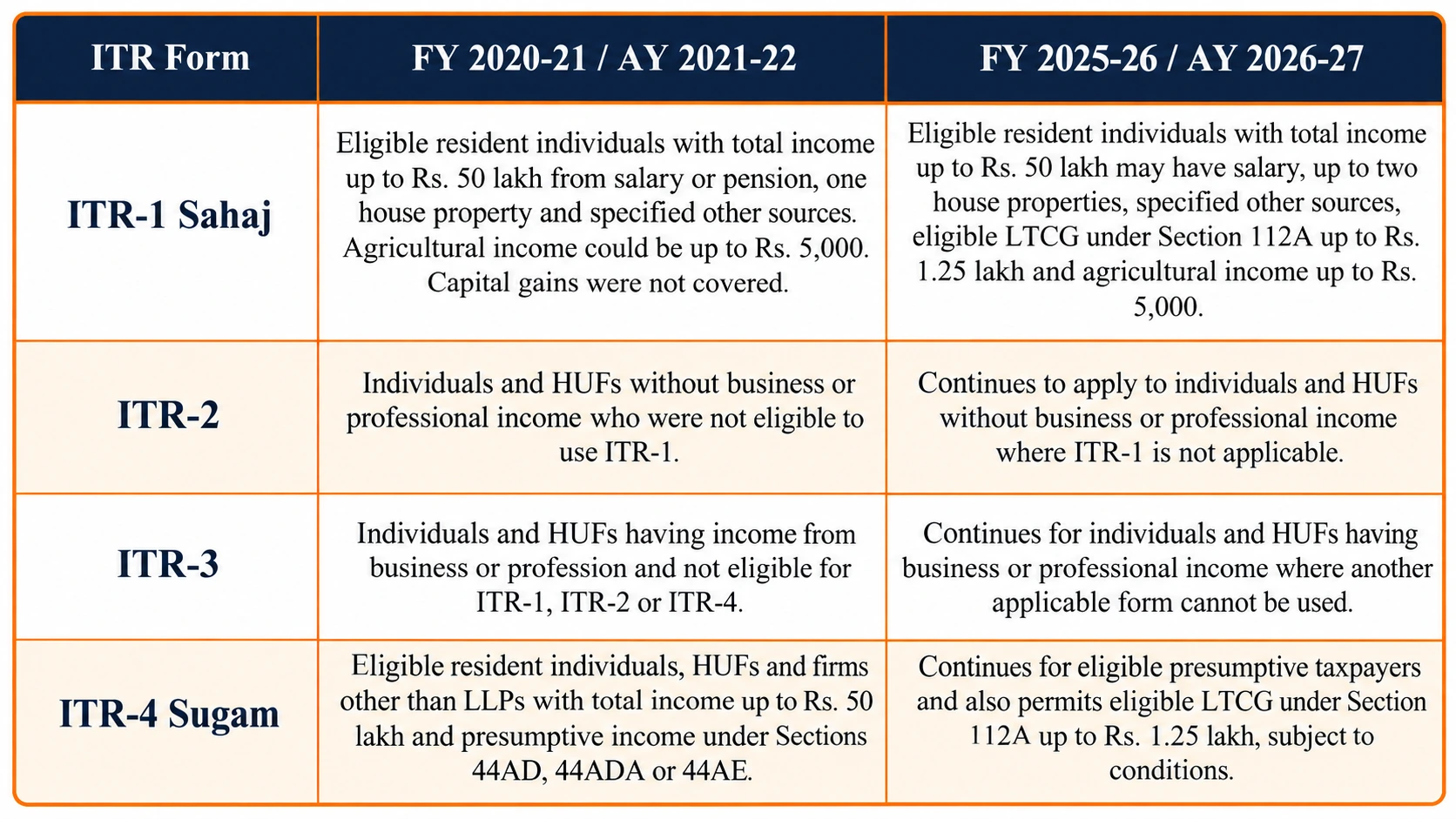
The old form eligibility is confirmed by the official AY 2021-22 instructions for ITR-1, ITR-2, ITR-3 and ITR-4.
For AY 2026-27, CBDT Notification No. 45/2026 expressly expanded ITR-1 from one to two house properties and provides for eligible Section 112A LTCG up to Rs. 1.25 lakh in ITR-1 and ITR-4. Taxpayers can also refer to our ITR Forms Guide for AY 2026-27.
Documents Required for ITR Filing Online for FY 2020-21
For ITR filing online for FY 2020-21, common records included PAN, Aadhaar details, Form 16, Form 26AS, bank account information, interest certificates and documents supporting eligible deductions. Taxpayers with capital gains, house property, business or professional income also needed supporting records relevant to those sources.
For a detailed checklist, see our guide on documents required for ITR filing.
How to Complete ITR Filing Online for FY 2020-21?
The historical process for ITR filing online for FY 2020-21 involved these steps:
- Log In: Access the Income Tax e-Filing portal using the taxpayer’s credentials.
- Select AY: Choose AY 2021-22 for income earned during FY 2020-21.
- Choose ITR: Select the applicable return form based on income and eligibility.
- Report Income: Enter income under all applicable heads.
- Claim Deductions: Add eligible deductions applicable for the relevant year.
- Check Taxes: Match TDS and tax payments with the available tax records.
- Submit Return: Review the computation and submit the ITR.
- Verify ITR: Complete verification using an accepted method.
The official AY 2021-22 instructions provided for electronic filing and verification through methods such as EVC, Aadhaar OTP or ITR-V, depending on the filing situation. These historical steps do not mean that the regular filing window remains open today.
Latest ITR Filing Update for FY 2025-26 and AY 2026-27
Taxpayers filing income earned during FY 2025-26 are currently dealing with AY 2026-27. CBDT Notification No. 45/2026 notified revised ITR-1 and ITR-4 forms for AY 2026-27 under Section 139 read with Section 295 of the Income-tax Act, 1961.
For AY 2026-27, ITR-1 can cover up to two house properties and eligible LTCG under Section 112A up to Rs. 1.25 lakh. ITR-4 also permits eligible Section 112A LTCG up to Rs. 1.25 lakh, subject to its eligibility conditions. The Income Tax Department has released current AY 2026-27 utilities on its official ITR downloads page.
As of August 2026, the 31 July 2026 due date has passed for taxpayers to whom that deadline applied. The department’s current tax calendar lists 31 August 2026 for specified non-corporate taxpayers having non-audit business or professional income and certain related partners or spouses. Taxpayers should check their category instead of assuming that the same deadline applies to everyone.
What Changes Under the Income-tax Act, 2025?
The Income-tax Act, 2025 came into force on 1 April 2026. However, it does not retrospectively govern ITR filing online for FY 2020-21. It also does not replace the 1961 Act for the AY 2026-27 return relating to FY 2025-26. The AY 2026-27 ITR notification itself was issued under the Income-tax Act, 1961.
The Income Tax Department clarifies that payments and compliance relating to AY 2026-27 and earlier periods continue under the Income-tax Act, 1961, while the Income-tax Act, 2025 applies from Tax Year 2026-27 onwards. The new law uses the concept of a “Tax Year” for income earned from 1 April 2026 onward instead of the earlier Previous Year and Assessment Year framework.
Therefore, ITR filing online for FY 2020-21 must still be understood according to the Income-tax Act, 1961 and the rules applicable to AY 2021-22.
Can You Still File ITR for FY 2020-21?
A taxpayer searching for ITR filing online for FY 2020-21 today may actually be trying to submit a missed return. The original, belated and revised return periods for AY 2021-22 have already expired.
The updated return framework under Section 139(8A) allows eligible taxpayers to use ITR-U within a maximum period of 48 months from the end of the relevant assessment year. The ITR-U notified by CBDT in March 2026 expressly provides filing periods extending from 12 months up to 48 months.
For AY 2021-22, the 48-month period ended on 31 March 2026. Therefore, the ordinary ITR-U route for ITR filing online for FY 2020-21 is no longer within the permitted window as of August 2026.
However, a separate remedy may exist in limited cases. CBDT Circular No. 11/2024 provides a condonation framework under Section 119(2)(b) for delayed returns involving refund claims or carry forward and set-off of losses, subject to reasonable cause, genuine hardship, prescribed conditions and approval. The circular generally does not permit such applications beyond five years from the end of the relevant assessment year. The Income Tax Department also provides an official condonation of delay filing guide.
For more background on updated returns, read Ebizfiling’s guide on Section 139(8A) and ITR-U.
What Happens If You Missed ITR Filing for FY 2020-21?
Missing ITR filing online for FY 2020-21 may result in interest, outstanding tax, restrictions on carrying forward certain losses, refund complications or further tax proceedings, depending on the taxpayer’s facts and applicable provisions. The condonation mechanism itself distinguishes delayed refund and loss claims from the ordinary return process.
A refund claim, loss claim, notice or unpaid tax issue may require a different route, so an old return should not automatically be treated as an ordinary late return.
Mistakes to Avoid During ITR Filing
Common mistakes in ITR filing online for FY 2020-21 include selecting the wrong assessment year, choosing an incorrect ITR form, omitting income, claiming ineligible deductions and ignoring mismatches in tax records.
Another mistake is applying AY 2026-27 rules to ITR filing online for FY 2020-21. For example, the current ITR-1 provisions allowing up to two house properties and eligible Section 112A LTCG were not the ITR-1 rules applicable to AY 2021-22.
Why Choose Ebizfiling for ITR Filing?
Old ITR matters need more than just form selection. For ITR filing online for FY 2020-21, Ebizfiling helps review your past filing status, Form 16, Form 26AS, tax payments, deductions, refund position, and any pending notice or compliance issue. If the regular filing window has closed, the team can help identify whether any valid alternative route may apply based on your case.
For current returns, Ebizfiling also supports ITR form selection, tax computation, return preparation, filing, and verification.
Need help with your ITR filing? Connect with Ebizfiling today for professional assistance.
Conclusion
ITR filing online for FY 2020-21 relates to AY 2021-22 and continues to be understood under the Income-tax Act, 1961. The forms and eligibility applicable to that year should not be confused with current AY 2026-27 requirements or provisions applying under the Income-tax Act, 2025.
For current filing, taxpayers should follow the forms, utilities and deadlines applicable to AY 2026-27. For income arising from Tax Year 2026-27 onwards, the Income-tax Act, 2025 becomes the relevant framework. Anyone dealing with ITR filing online for FY 2020-21 after missing the original filing period should first determine whether any specific statutory remedy remains available.
Frequently Asked Questions
1. Can an error in a processed ITR for AY 2021-22 be corrected after the revised return deadline?
Yes. If there is a mistake apparent from the record in an intimation under Section 143(1) or another eligible order, a rectification request under Section 154 may be considered. The Income Tax Department states that rectification is different from filing a revised return and is available only for eligible errors in a processed return or order.
2. Can I claim a new deduction through a Section 154 rectification request?
No. A rectification request cannot normally be used to introduce a new exemption or deduction that was not claimed in the original return. Section 154 is intended to correct mistakes apparent from the record and is not a substitute for a revised return.
3. What happens if a Section 139(9) defective return notice is received for AY 2021-22 after the normal filing period has expired?
The taxpayer should respond to the defective return notice within the period specified in the notice. The Income Tax Department generally provides 15 days to correct the defect, although an extension may be requested. Once the normal filing period for the assessment year has expired, the taxpayer cannot simply file a fresh or revised return instead of responding to the notice.
4. What if an ITR for FY 2020-21 was filed but was not verified within the prescribed time?
A taxpayer may be able to submit a condonation request for delay in ITR verification through the e-Filing portal. For returns filed on or before 31 July 2022, the earlier verification period of 120 days applies. Acceptance of the condonation request is required for the delayed verification to be considered.
5. Can a failed refund for AY 2021-22 still be reissued?
Yes, where a refund was already determined but failed, a taxpayer can use the Refund Reissue service on the e-Filing portal. A valid and validated bank account is required before submitting the request.
6. What should I do if an AY 2021-22 tax demand still appears even though I have already paid it?
The taxpayer can respond through Pending Actions > Response to Outstanding Demand on the e-Filing portal. Where the demand has already been paid, challan details such as the BSR code, payment date, serial number and amount can be provided. A tax credit mismatch rectification may also be relevant in appropriate cases.
7. How is an ITR filed after a condonation request under Section 119(2)(b) is approved?
After approval of the condonation request, the return is filed under Section 139(9A) for the relevant assessment year. According to the Income Tax Department’s current user manual, this filing is completed using the offline utility, after which the generated JSON file is uploaded to the e-Filing portal. The condonation must be approved before this filing can be made.
8. Can Form ITR-U be used to claim a higher refund or reduce an existing tax liability?
No. An updated return cannot be used if it results in a higher refund, decreases the total tax liability, or increases the reported loss. ITR-U is primarily intended to disclose additional income or correct specified omissions subject to the applicable conditions. For AY 2021-22, the 48-month ITR-U filing window has also already expired.
9. Can Ebizfiling help if a Section 143(1) intimation shows an unexpected tax demand or lower refund?
Yes. Ebizfiling can review the Section 143(1) intimation, compare it with the filed return and supporting tax records, identify the reason for the adjustment, and assist with the appropriate response or rectification where applicable. Explore Ebizfiling’s Section 143(1) notice assistance.
10. Can Ebizfiling assist with a defective return notice under Section 139(9)?
Yes. Ebizfiling can review the defect mentioned in the notice, check the return and supporting documents, prepare the required corrections, and assist with submitting the response through the Income Tax e-Filing portal within the applicable period. Learn about Ebizfiling’s Section 139(9) notice service.





Income Tax Return
Get reliable support for Income Tax Returns and navigate tax audit-related filing requirements and applicable deadlines with ease.
About Ebizfiling -



Reviews
Nayanshree Barsaiyan
08 Jul 2019My requirement was fulfilled on time. the customer care response is very prompt.
Mansi Mehra
14 Jul 2018I really appreciate the selfless support shown by your team. Cheers!
Gautam Chhabria
01 Oct 2019These guys deliver on their promise..
October 15, 2026 By Srishti M
TDS and TCS Compliance Calendar November 2026: Compliance Guide Introduction The TDS and TCS Compliance Calendar November 2026 covers important tax deduction, collection, payment, certificate and reporting requirements applicable during the month. It helps businesses, government offices and other responsible […]
October 14, 2026 By Srishti M
GST Compliance Calendar November 2026: Key Due Dates & Filings Introduction The GST Compliance Calendar November 2026 highlights the major GST return filing, tax payment, invoice reporting and year-end adjustment deadlines applicable during the month. It covers regular taxpayers, QRMP […]
October 13, 2026 By Srishti M