

Impact of TCS on SMEs: Challenges and Business Impact
Introduction
Impact of TCS on SMEs goes beyond basic tax compliance. For small businesses, the impact is on cash flow, vendor payments, pricing, accounting, and daily business decisions. Compared to large companies with internal tax teams, many SMEs work with limited finance support, which makes TCS compliance difficult for them to manage. This blog explains how TCS affects SMEs, the risks they should be aware of in 2025, and the practical steps they can take to stay compliant.
TCS Rules Impact on SMEs
Tax Collected at Source (TCS) was a tax collection mechanism under Section 206C of the Income-tax Act, 1961. As per the latest update, TCS on sale of goods under Section 206C(1H) is no longer applicable from 1 April 2025. This means sellers are no longer required to collect TCS on the sale of goods under this section. This change reduces the compliance burden for many SMEs.e of goods, has been omitted with effect from 1 April 2025. for many SMEs. Under TCS, a seller collects tax from the buyer on specified transactions and deposits it with the Central Government. However, TCS still applies to certain notified transactions, so SMEs should check applicability based on their business activity.
To understand related updates, you can also read our detailed guide on TDS and TCS new changes.
How Does TCS Impact SMEs?
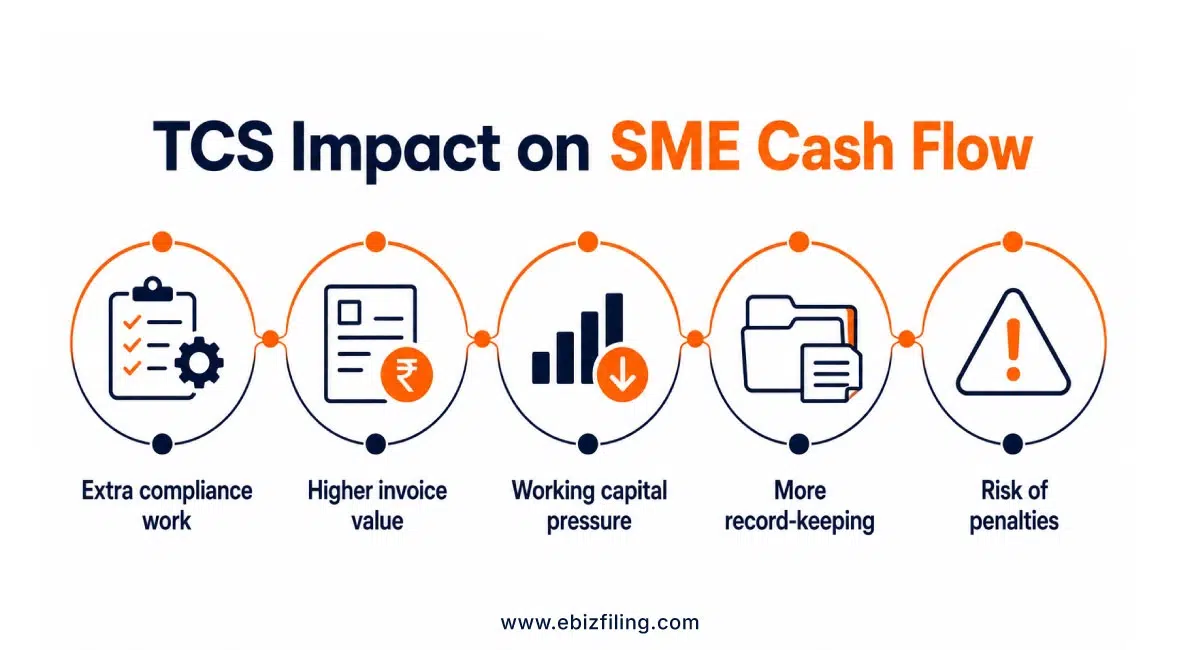
The impact of TCS on SMEs can be seen in their cash flow, compliance work, record-keeping, and overall business planning wherever TCS is applicable.
1. Compliance Burden
TCS provisions can increase the compliance burden on SMEs where they are applicable. SMEs need to check whether TCS applies to their transactions, collect the correct amount, deposit it on time, and maintain proper records. This increases compliance responsibility and may also raise operational costs for SMEs. Businesses that handle multiple tax filings can also explore Business Income Tax Return Filing service for better tax compliance support.
2. Cash Flow Issues
SMEs may face cash flow issues due to TCS provisions. The collected TCS amount must be deposited with the government within the prescribed timeline. Delays in depositing the collected TCS amount or errors in reconciliation may affect liquidity and working capital. and affect their working capital.
3. Administrative Burden
SMEs may have to spend additional time and resources to comply with TCS requirements. This can be challenging because many small businesses work with limited staff or depend on external accountants. The extra documentation and filing work can affect their productivity.
4. Reduced Competitiveness
Where TCS is applicable, it can increase the invoice value for buyers. This may affect pricing discussions, especially for SMEs dealing with price-sensitive customers. In some cases, SMEs may find it difficult to absorb the additional compliance cost, which can affect profitability.
5. Risk of Errors and Penalties
TCS rules involve specific rates, timelines, and transaction categories. If SMEs apply TCS incorrectly, miss a deadline, or file incorrect returns, they may face interest, penalties, or notices from the tax department. Businesses that need correction support for tax deduction filings can check TDS Return Revision service.
TCS Compliance Checklist for SMEs
TCS compliance becomes easier when SMEs treat it as a monthly tracking activity, not a last-minute filing task. Since TCS applies only to specified transactions, the first step is to check whether the transaction actually falls under Section 206C.
1. Check Applicability
Before raising an invoice, SMEs should confirm whether TCS applies to that transaction. This avoids unnecessary collection from buyers and also prevents missed compliance where TCS is required.
2. Maintain Buyer Details
Keep proper records of buyer information, invoice value, PAN details, TCS amount collected, and payment status. These details are useful while filing returns and matching tax records.
3. Track Deposit Dates
TCS collected must be deposited within the prescribed timeline. SMEs should maintain a simple compliance calendar so deadlines are not missed.
4. Match Records with Form 26AS and AIS
TCS entries should match with tax statements. Any mismatch can create confusion for both the business and the buyer, especially during tax credit checks.
5. File Returns Correctly
SMEs should make sure TCS return details are accurate before filing. Wrong buyer details, incorrect amounts, or missed entries can lead to notices and corrections later. For businesses also managing GST filings, GST Return Filing can help maintain timely compliance.
Manage TCS Compliance with Ebizfiling Support
TCS compliance can become confusing when a business has different types of transactions, high-value invoices, or limited accounting support. Ebizfiling helps SMEs manage this process in a practical way.
How Ebizfiling can help:
- Check whether TCS applies to your transactions
- Guide you on proper documentation and records
- Help with timely filing of TCS returns.
- Reduce chances of errors, notices, and penalties
- Support your business with ongoing tax compliance
With expert support from Ebizfiling, SMEs can handle TCS requirements more confidently and focus on daily business operations.
You can also read new TDS and TCS forms under the Income Tax Act for related compliance updates.
Conclusion
The impact of TCS on SMEs depends on where TCS is applicable. It can affect cash flow, records, pricing, and compliance work. While the April 2025 update has reduced the burden for many businesses, SMEs should still stay careful with TCS rules. Proper records, timely filing, and expert guidance can help them avoid errors, notices, and penalties.
Common Questions on TCS on SMEs
1. How does the impact of TCS on SMEs affect cash flow?
The impact of TCS on SMEs becomes visible when collected tax has to be deposited on time, even if internal payment tracking is weak. Delays or mismatches can disturb working capital and create extra pressure on the finance team.
2. Can incorrect TCS reporting affect buyer relationships?
Yes, If TCS entries does not appear correctly in Form 26AS or AIS, buyers may face issues at the time of claiming tax credit. This often leads to follow-up calls, delayed payments, and pressure on SMEs to correct filings as soon as possible.
3. How can SMEs reduce the impact of TCS on SMEs in 2026?
To reduce the impact of TCS on SMEs in 2026, small businesses first need to check whether TCS applies before raising an invoice. They should also keep the details updated, Track TCS collection and deposit details., check dates, and match their records with Form 26AS and AIS on time.
4. How does Ebizfiling help SMEs manage tax compliance better?
Professionals at Ebizfiling help SMEs stay compliant with tax laws without feeling overwhelmed.. From understanding which rules apply to your business to filing returns on time, checking due dates, and keeping records in order, we support small business owners at every step.
5. What are the practical solutions SME's can take to control TCS-related cash flow and filing pressure?
SMEs can control TCS pressure by checking TCS before invoicing, keeping buyer PAN details ready, tracking deposit dates, and matching entries with Form 26AS and AIS every month. This helps avoid payment delays, mismatches, and penalties.
6. Why is it important to link PAN-Aadhar documents for small businesses?
PAN-Aadhaar linking is important because non-linking can lead to higher TDS or TCS. For MSMEs, this may result in extra follow-ups, payment delays, and mismatch issues in tax records.
7. What basic TDS and TCS responsibilities MSMEs should not miss?
MSMEs must obtain TAN, deduct or collect tax at the correct rate, deposit it on time, issue the TDS certificates, file quarterly returns on time, and match records with Form 26AS and AIS.
8. How can Ebizfiling help SMEs benefit from tax relief while staying compliant?
Ebizfiling helps SMEs understand applicable tax benefits, manage filings on time, maintain proper records, and avoid compliance gaps. This allows small businesses to use available tax relief without facing unnecessary notices, penalties, or filing stress.
9. How can new TDS sections in 2026 impact of TCS on SMEs?
New TDS sections in 2026 may increase compliance work for SMEs because businesses will need to be updates with new rules, track more deduction rules, filing requirements, and reporting details along with existing TCS responsibilities.
10. Is Section 206C(1H) still applicable to SMEs after recent changes ?
No, As TCS on sale of goods under Section 206C(1H) is no longer applicable from 1 April 2025. SMEs do not need to collect TCS on general sale of goods now, but they should still check if TCS applies to other specified transactions under Section 206C.





File TDS Returns
Quickly file error-free TDS Returns with EbizFiling. This ensures seamless credit to the deductee. Prices Starting INR 999/-.
About Ebizfiling -



Reviews
Akshay shinde
23 Apr 2019Excellent service…
Ashish Paliwal
29 Sep 2018Let me be honest and tell you that I did not choose eBiz filing after my initial LLP company registration did to pricing. A lot of companies contact me with better rates so I generally choose them. However, I will still rate eBiz filing 10/10 on work ethics. You guys are professionals in true sense.
Devangi Patnayak
11 Mar 2018I am very happy with the way they serve their clients. They are focused on providing the best help that they can and are result oriented.
October 12, 2026 By Srishti M
October 12, 2026 By Srishti M
Company Compliance Calendar November 2026: Key Due Dates & Filings Introduction The Company Compliance Calendar November 2026 highlights important annual return, dematerialisation and income tax compliances that companies may need to complete during the month. November 2026 is particularly […]
October 10, 2026 By Srishti M