

-
September 16, 2026
How to Start a Food Items Trading Business in India?
Introduction
A food items trading business buys food from manufacturers, farmers, processors, importers, or distributors and resells it to retailers, restaurants, institutions, customers, or other businesses. Products may include packaged foods, grains, spices, beverages, dairy, frozen goods, fruits, and vegetables.
The Food Safety and Standards Act, 2006 regulates the manufacture, storage, distribution, sale, and import of food. Under Section 31, every Food Business Operator must obtain the registration or licence applicable to it through FoSCoS.
This guide explains how to start a food trading business in India under current FSSAI, GST, import-export, storage, and labelling requirements.
Quick Insights
- Every food items trading business must obtain the applicable FSSAI registration or licence before beginning operations.
- From 1 April 2026, ordinary traders with turnover up to Rs. 1.5 crore generally fall under FSSAI registration.
- Importers, e-commerce food businesses, and trader or merchant exporters require a Central FSSAI licence irrespective of turnover.
- GST registration depends on turnover, products, location, exemptions, and compulsory registration provisions.
- Pre-packaged food must follow applicable FSSAI labelling and Legal Metrology requirements.
What Is a Food Items Trading Business?
A food items trading business buys and resells food without materially changing its composition. It may operate through wholesale, retail, distribution, e-commerce, import, or export channels.
FoSCoS treats wholesalers, distributors, retailers, importers, e-commerce operators, and trader or merchant exporters as separate Kinds of Business. A wholesaler sells food in bulk to resellers or retailers, while a retailer sells it to the final consumer.
Simple trading is different from manufacturing, processing, repacking, or relabelling. Opening bulk packs and placing food into smaller labelled packs may amount to repacking. Every applicable activity must be selected while applying for the food business licence.
Best Food Trading Business Models in India
A wholesale food business buys in bulk and supplies retailers, restaurants, institutions, and resellers. It needs working capital, storage, transport planning, and expiry control.
A retailer sells to consumers, while a distributor moves products from manufacturers to sellers. An online food items trading business may sell through a website, application, or marketplace. From 1 April 2026, e-commerce requires a Central FSSAI licence without a turnover threshold.
Food importers bring products into India, while trader or merchant exporters source food for overseas sale. Both require a Central FSSAI licence irrespective of turnover.
Best Business Structure for Food Trading
A food items trading business may operate as a proprietorship, partnership firm, LLP, One Person Company, or Private Limited Company. The choice depends on ownership, liability, taxation, and scale.
A proprietorship may suit a small operation. An LLP or company may suit multiple founders or expansion plans. Online business registration does not replace food trading business registration. FSSAI, GST, IEC, and local permissions must be considered separately.
FSSAI Registration for Food Traders
FSSAI registration is a primary legal requirement. The applicant must select the correct Kind of Business, food categories, premises, turnover, and operating model.
For ordinary wholesalers, distributors, retailers, storage operators, and specialised food transporters, the criteria effective from 1 April 2026 generally provide:
- Turnover up to Rs. 1.5 crore: FSSAI registration
- Turnover above Rs. 1.5 crore and up to Rs. 50 crore: State FSSAI licence
- Turnover above Rs. 50 crore: Central FSSAI licence
These thresholds do not apply to every activity. Importers, e-commerce food businesses, and trader or merchant exporters require a Central licence without a turnover limit.
A food items trading business should ensure that every relevant premise and activity is covered. Adding a warehouse, online sales, import activity, repacking, relabelling, or another location may require a new application or modification. FSSAI registration for traders should reflect the actual operating model.
GST Registration Rules for Food Traders
GST registration is not automatically compulsory for every food items trading business. For suppliers engaged exclusively in goods, the general threshold is Rs. 40 lakh in most states and Rs. 20 lakh in specified states. Voluntary and mandatory registration provisions, interstate supplies, e-commerce arrangements, location, and exemptions may change the position.
Some food products are exempt, while others are taxable at different rates. A person dealing exclusively in exempt supplies is generally not required to register merely because turnover exceeds the normal threshold. Traders should review product classification, aggregate turnover, and place of supply before applying.
IEC Registration for Food Import and Export
A food items trading business importing or exporting goods generally needs an Importer Exporter Code unless specifically exempted. DGFT identifies IEC as a key business identification number for imports and exports. It is PAN-linked, but the IEC application documents must still be submitted to DGFT.
IEC does not replace the Central FSSAI licence required for food imports or trader-exporter activities.
Other Registrations for Food Traders
An eligible MSME may obtain Udyam or MSME Registration. The official portal states that it is free, paperless, online, and based on self-declaration. It does not replace FSSAI, GST, or IEC requirements.
Depending on location and products, a food items trading business may also need Shops and Establishments registration, a trade licence, or agricultural market permissions.
Documents Required for Food Traders
Documents depend on the legal structure, premises, and FSSAI category. Common records include:
- PAN and identity proof of the proprietor, partners, or directors
- Business constitution documents
- Proof of possession of the shop, office, or warehouse
- Rent agreement and owner consent, where applicable
- Food category and activity details
- Authorisation letter or board resolution, where applicable
- Warehouse information and IEC details, where relevant
- Category-specific or state-specific documents
FoSCoS publishes separate document lists for registration, State licences, Central licences, and specialised Kinds of Business. Applicants should check the latest list.
How to Start a Food Items Trading Business Step by Step
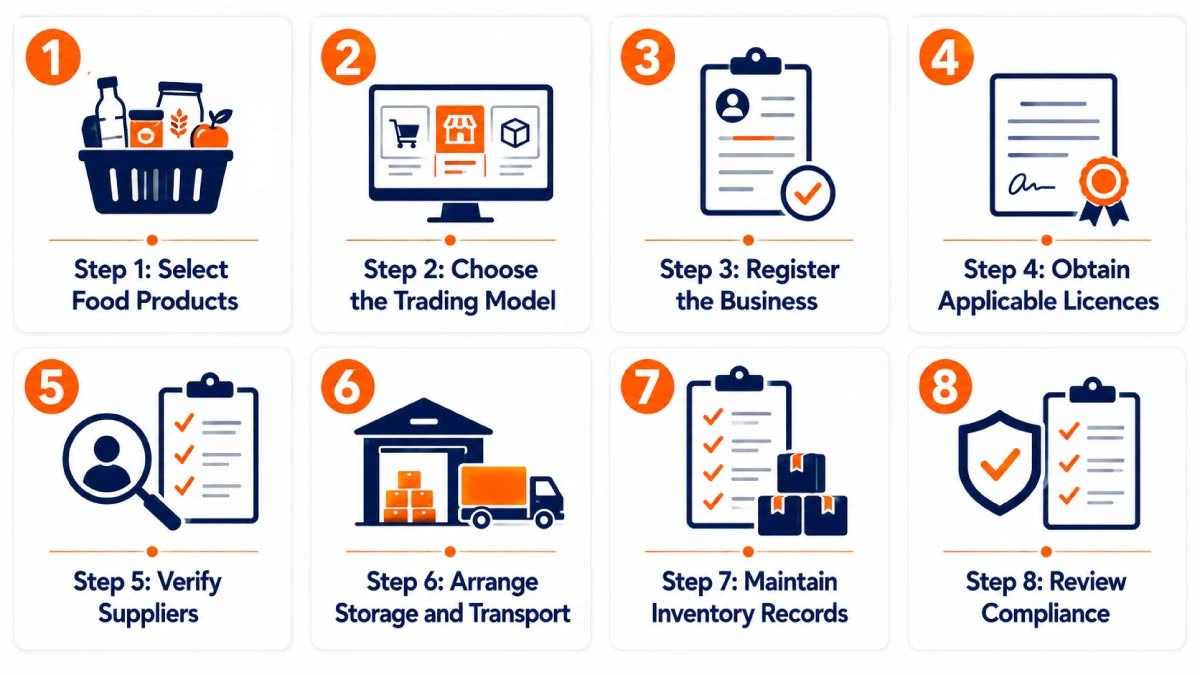
Step 1: Select Food Products
Choose products after reviewing demand, shelf life, storage needs, transport, margins, and restrictions.
Step 2: Choose the Trading Model
Decide whether the food items trading business will operate as a wholesaler, distributor, retailer, online seller, importer, exporter, or a combination.
Step 3: Register the Business
Select the legal structure, complete registration, and use consistent legal details.
Step 4: Obtain Applicable Licences
Apply for the correct FSSAI registration or licence. Complete GST, IEC, Udyam, and local registrations wherever applicable.
Step 5: Verify Suppliers
Check supplier invoices, FSSAI numbers, labels, batches, date markings, and storage instructions. These records support traceability.
Step 6: Arrange Storage and Transport
A food items trading business must store products according to their nature. Protect dry goods from moisture and pests, maintain suitable temperatures for chilled or frozen goods, and keep warehouses and vehicles clean.
Step 7: Maintain Inventory Records
For better inventory control and traceability, traders may maintain batch, expiry, damaged-stock, return, and supplier records. Using FEFO can also help reduce expiry-related losses.
Step 8: Review Compliance
Track turnover, licence validity, tax filings, complaints, and changes in activities or premises. Review approvals before adding online sales, imports, repacking, relabelling, or locations.
Food Packaging and Labelling Rules for Traders
Pre-packaged food sold by a food items trading business must comply with the Food Safety and Standards (Labelling and Display) Regulations, 2020, as amended. Depending on the product, labels may require the food name, ingredients, nutrition information, allergens, vegetarian or non-vegetarian symbol, responsible business details, FSSAI number, batch identification, date marking, and storage instructions. FSSAI lists five amendments to these regulations, including an amendment dated 24 March 2026.
The Food Safety and Standards (Packaging) Regulations, 2018 apply to food-contact packaging. Packaging should suit the product and should not contaminate it.
Legal Metrology rules may additionally require the common or generic name, net quantity, maximum retail price, manufacturer, packer or importer details, country of origin for imported goods, and consumer care information. E-commerce entities must display applicable declarations online.
A food items trading business that repacks or relabels products assumes additional responsibilities and should confirm its FoSCoS category before sale.
Food Storage and Transportation Requirements
Food storage compliance is important for a wholesale food business and every other model. Warehouses need cleaning, pest control, stock segregation, ventilation, and temperature management. Food should be kept away from chemicals, waste, and damaged stock.
The food items trading business should follow storage instructions and maintain the cold chain where required. Vehicles and containers must suit the food carried. FoSCoS separately recognises ordinary storage, cold or refrigerated storage, controlled-atmosphere storage, and specialised transportation as food business activities.
Cost and Profitability of a Food Items Trading Business
The cost of starting a food items trading business depends on location, products, scale, and sales model. Expenses may include registration, licences, rent, stock, warehouse equipment, refrigeration, transport, employees, software, insurance, and marketing.
A wholesale model generally needs more working capital. Profitability depends on purchase prices, inventory turnover, storage costs, delivery expenses, credit periods, damage, and expiry losses.
Food Trading Challenges and Solutions
Challenges include expired stock, damaged packaging, price fluctuations, seasonal demand, supplier delays, storage failures, incorrect labels, missing invoices, and low margins. Problems may arise if the wrong FSSAI category is selected or a new activity starts without approval.
A food items trading business can reduce risks by using verified suppliers, checking labels before accepting stock, maintaining digital records, monitoring expiry dates, and reviewing licences regularly.
Why Choose Ebizfiling for Food Business Registration?
Ebizfiling helps food traders identify the correct FSSAI category based on their turnover, products, premises, and business model. Its team can assist with document preparation, FoSCoS filing, application corrections, and related registrations such as GST, Udyam, IEC, and business registration.
The applicant must provide complete and accurate details, while final approval remains subject to verification by the concerned authority.
Start your food business registration with Ebizfiling today.
Conclusion
Starting a food items trading business requires the right products, dependable suppliers, suitable FSSAI approval, safe storage, compliant labels, and accurate records. GST, IEC, Udyam, and local requirements should be assessed according to the actual business model.
The revised FoSCoS criteria effective from 1 April 2026 changed the turnover thresholds for ordinary traders. Before launching or expanding a food items trading business, review its turnover, premises, sales channels, and activities such as e-commerce, importing, exporting, warehousing, repacking, or relabelling. Correct registration creates a stronger legal foundation for responsible growth.
Frequently Asked Questions
1. Can one FSSAI licence include wholesale, distribution, and retail activities?
Yes. An applicant can select more than one Kind of Business when the activities are carried out by the same Food Business Operator from the same premises. Every activity must be correctly declared and endorsed on the FSSAI licence.
2. Does every warehouse or branch need a separate FSSAI approval?
A separate FSSAI registration or licence is generally required for each distinct business unit or premises, depending on its activity, turnover, or capacity. A business operating in multiple states may also require a Central licence for its head office or registered office, along with the applicable approval for each unit.
3. Can the same FSSAI number be retained after changing the business address?
Yes. A Food Business Operator may apply for modification of the existing registration or licence when the business premises change. FoSCoS allows the operator to retain the existing FSSAI number after the address modification is approved.
4. Is mentioning the FSSAI number on invoices mandatory?
Yes. Food businesses must mention their 14-digit FSSAI registration or licence number on receipts, invoices, cash memos, bills, and similar documents issued for the sale of food products.
5. Do ordinary food wholesalers and retailers need to file Form D-1?
Ordinary wholesalers, distributors, and retailers are generally not required to file Form D-1 only because they trade food. The annual return requirement applies mainly to licensed manufacturers and importers. However, it may apply if the trader is also licensed as a manufacturer, repacker, relabeller, or importer.
6. What must a trader do after discovering unsafe food in the supply chain?
A trader who has distributed food that may not comply with food safety law must initiate steps to withdraw it from the market. The trader should inform the competent authority, identify the affected batches, contact buyers, and maintain records of the recall action.
7. Does perpetual FSSAI validity remove all ongoing compliance duties?
No. The 2026 framework introduced perpetual validity for FSSAI registrations and licences, removing the need for repeated periodic renewals. Food businesses must still maintain hygiene, update changes in activities or premises, comply with inspection requirements, file applicable returns, and surrender the approval after closure.
8. What should a food trader do after permanently closing the business?
The Food Business Operator must inform the concerned Licensing or Registering Authority within 30 days of closure. The FSSAI registration certificate or licence must also be surrendered through the prescribed process.
9. Can Ebizfiling help respond to a clarification raised on an FSSAI application?
Yes. Ebizfiling can assist in reviewing the clarification, identifying the missing or inconsistent information, preparing the required response, and uploading supporting documents through the application process. The applicant must provide accurate records within the time allowed by the authority.
10. Can Ebizfiling determine whether a modification or fresh FSSAI application is required?
Ebizfiling can review changes involving the business address, legal entity, turnover, Kind of Business, warehouse, product category, import activity, or online sales channel. Based on the applicable FoSCoS requirements, its professionals can help identify whether the existing approval should be modified or a fresh application should be filed.





FSSAI Registration
Do you wish to start a Business that Involves food product in any manner? Food license / FSSAI license is necessary to start a food business. Get yours with Ebizfiling.
About Ebizfiling -



Reviews
ALEIXO ANTONIO DA COSTA
30 Sep 2021Was a great experience and value for money service, recently did a company incorporation with ebizfiling.
Jobin Mathew
19 Nov 2021I reached ebizfiling for DSC renewal , Ms anitha KV assisted in renewal it was done on timely and hassle free.
P V GIRI
19 Nov 2021Pvt Ltd incorporated by Ebizfiling services are very good in the terms of service as well as good response thank you Ebizfiling
July 9, 2026 By Steffy A
AML obligations for Practicing CS under FIU-IND Framework Introduction AML obligations for Practicing CS are becoming increasingly important in today’s evolving regulatory environment, where the role of Practicing Company Secretaries has expanded beyond traditional compliance functions into areas involving corporate […]
June 26, 2026 By Steffy A
Why Online Legal Services Are Growing in India? Introduction The legal industry is evolving rapidly as technology reshapes how legal assistance is delivered. In India, online legal services are growing because they address historical challenges such as court backlogs, complex […]
June 26, 2026 By Steffy A
Why More Businesses Are Choosing Outsourcing Legal Work? Introduction Businesses are increasingly turning to outsourcing legal work to manage compliance, contracts, and regulatory responsibilities more efficiently. Through Legal Process Outsourcing, companies can reduce operational costs while gaining access to experienced […]